Listen, we need to have a serious talk about what is happening in your skillet. I don’t care if you just dropped thirty dollars on a pristine, wild-caught, center-cut halibut fillet from the fancy artisanal fishmonger downtown. If you are approaching that gorgeous, delicate piece of seafood with a chunky, melted, blunt-edged plastic spatula that you bought at a grocery store checkout aisle in 2014, you are committing a culinary crime. You are going to end up with an overpriced, mangled pile of seafood hash, and you are going to blame the fish.
But it isn’t the fish’s fault, and it isn’t your lack of a culinary degree, either. It is your equipment.
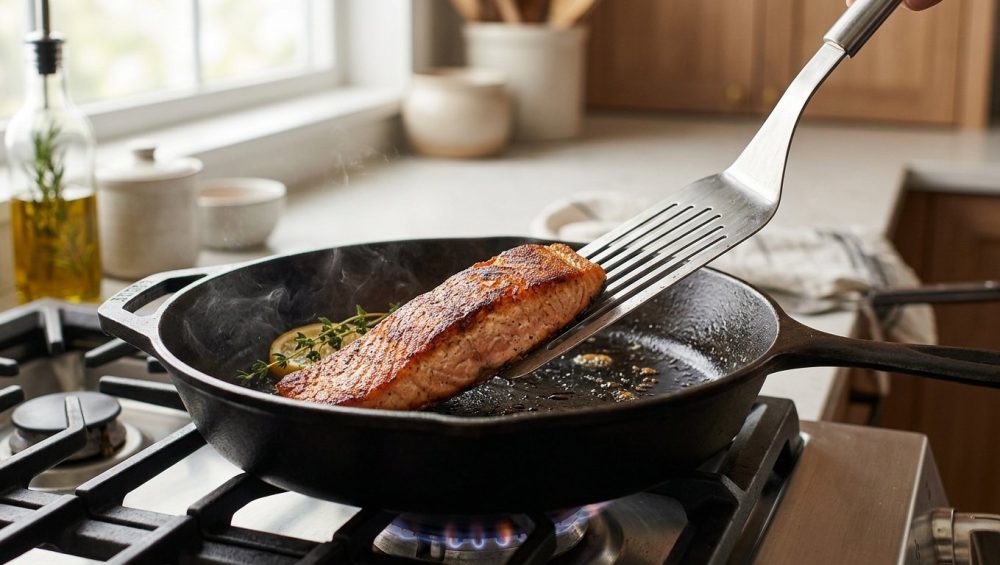
If you want to cook like a professional in your own home kitchen, you have to stop sabotaging yourself with tools designed for mediocrity. The secret to executing a flawless, restaurant-quality sear on a piece of delicate protein without it crumbling into a million tragic pieces isn’t magic. It is simple mechanics, and it comes in the form of a flexible stainless steel fish spatula. Also known as a pelican turner or a slotted fish turner, this strangely shaped, angled piece of metal is arguably the most brilliant, versatile, and misunderstood hand tool in the modern kitchen.
Today, we are going to completely deconstruct the science of the sear, the anatomy of fish muscle, and the undeniable mechanical advantages of the fish spatula. Grab a glass of wine, pull up a stool, and get ready to throw your plastic flippers directly into the recycling bin.
The Physics of the Flop: Why Your Fish Breaks in the First Place
To understand why a fish spatula is a non-negotiable requirement for your kitchen tool crock, you first have to understand why fish is so obnoxiously fragile. We have to talk about the actual biological structure of the meat you are trying to cook.
The Myotome and Myosepta Dilemma
Unlike cows, pigs, or chickens—which have to support their own heavy body weight against the crushing force of gravity—fish live in a buoyant, zero-gravity aquatic environment. Because they basically float their entire lives, fish do not need dense, thick, weight-bearing connective tissue.
If you look closely at a raw salmon fillet, you will notice that the meat is divided into distinct, W-shaped blocks or distinct flakes. These individual muscle blocks are called myotomes (or myomeres). The thin, white, web-like lines separating these blocks are the connective tissue, known as the myosepta.
Here is where the physics of cooking comes into play. The myosepta is made of collagen. In land animals, collagen is incredibly tough and requires hours of low-and-slow braising to break down into tender gelatin (think of a tough chuck roast turning into melt-in-your-mouth pot roast). But because a fish’s collagen is biologically designed for a cold, buoyant environment, it is incredibly weak. When exposed to the heat of a frying pan, the collagen in the myosepta denatures and melts into gelatin almost instantly—usually between 120°F and 130°F.
Once that connective tissue melts, there is literally nothing holding those muscle blocks together except gravity and a little bit of residual moisture. The structural integrity of the fillet drops to zero.
The Pan Adhesion Problem
Now, combine this extreme biological fragility with the intense heat of a frying pan. When cold protein hits hot metal, the proteins immediately denature and form temporary chemical bonds with the microscopic pores of the pan. If your food constantly sticks to your stainless steel skillet, it is usually because you haven’t managed this thermal reaction correctly.
To prevent this, you should always perform the water drop test to ensure your skillet has reached the precise temperature needed for the Leidenfrost effect before you even think about adding your cooking fat. But even with perfect heat management, the bottom of the fish is going to develop a crispy, browned crust (thanks to the Maillard reaction) that is somewhat adhered to the pan.
So, you have a piece of fish whose internal structure has completely liquefied, and whose bottom crust is temporarily glued to the skillet. If you take a thick, blunt plastic spatula and try to shove it under that fillet, you are essentially driving a wedge directly into the weakest part of the fish. The blunt edge of the plastic will hit the crust, fail to slide underneath it, and instead push the meat upwards. The fragile myotomes will separate, the fillet will buckle, and your beautiful dinner will instantly tear in half.
The Anatomy of a Kitchen Hero: Breaking Down the Fish Spatula
The flexible stainless steel fish spatula was engineered specifically to solve the myotome dilemma. It is not just a flat piece of metal on a stick; it is a highly calculated instrument of culinary mechanics. Let’s break down the exact design features that make it a masterpiece.
The Razor-Thin Micro-Bevel
Look at the front edge of a standard nylon or silicone spatula. It is thick—usually two to three millimeters thick. In the microscopic landscape of a frying pan, a three-millimeter edge is a blunt-force bulldozer.
A high-quality fish spatula, on the other hand, is stamped from a thin sheet of high-carbon stainless steel, and the very front edge is ground down to a razor-thin micro-bevel. This edge is often less than a millimeter thick. Instead of acting like a wedge that forces food up and apart, the beveled edge acts like a scalpel. It is thin enough to slide seamlessly into the microscopic gap between the pan’s surface and the browned crust of the fish, severing the bond without disturbing the fragile meat above it.
The Strategic Slots and Fluid Dynamics
A fish spatula features long, wide slots that run almost the entire length of the blade. The average home cook assumes these slots are just there to let excess cooking oil drain away when you lift the food. While drainage is certainly a benefit, the true mechanical purpose of the slots is entirely about fluid dynamics and friction reduction.
When you press a solid, un-slotted spatula down into a hot pan coated in oil, you create a hydraulic seal. The steam escaping from the food and the hot oil in the pan get trapped under the solid blade, creating a pocket of pressure that physically pushes the food away from the spatula. You end up chasing your food around the perimeter of the skillet.
The slots on a fish spatula relieve this hydraulic pressure. Steam and oil pass right through the gaps, allowing the blade to slide effortlessly under the food without pushing it away. Furthermore, the slots drastically reduce the surface area of the metal, which means there is less surface area for the delicate fish to stick to once it is lifted out of the pan.
The Perfect Offset Angle
If you lay a fish spatula flat on the counter, you will notice that the blade is not perfectly straight in relation to the handle. It typically features a 15-to-20-degree upward offset angle.
This angle provides a massive ergonomic and mechanical advantage. When you are cooking in a skillet with high, sloped sides, a straight spatula forces you to hold your wrist at an awkward, steep angle to get the blade flat against the bottom of the pan. The offset angle of the fish spatula naturally compensates for the lip of the pan, allowing you to keep your wrist in a relaxed, neutral position while the blade rests perfectly flush against the cooking surface.
The Asymmetrical Curve
You will also notice that the front edge of the fish spatula is not cut straight across; it is cut on a diagonal, asymmetrical curve. Frying pans are round. If you try to scoop up a piece of food resting near the curved edge of a skillet using a square-edged spatula, the corners of the spatula will hit the sides of the pan, preventing you from getting under the food.
The curved, asymmetrical edge of the fish spatula is designed to perfectly mimic the sweeping, circular contour of a standard skillet. It allows you to swoop in from the side, hugging the curve of the pan, and cleanly lift the food without bumping into the cookware’s walls.
The Flexible Spring
Perhaps the most crucial element of the fish spatula is its flexibility. Made from tempered, high-carbon stainless steel, the blade is springy and resilient. When you press the handle down, the thin blade flexes, allowing the front half of the spatula to press completely flat against the bottom of the pan. This maximizes your contact area, ensuring that you can scrape up every single bit of the flavorful, caramelized crust without leaving half of your dinner glued to the stainless steel. Once you lift the food, the steel instantly snaps back into its supportive, angled shape.
The Toxic Truth About Your Chunky Plastic Flipper
Now that you understand the sheer brilliance of the fish spatula, we need to have a very blunt conversation about the plastic flipper sitting in your utensil drawer. I have absolutely zero patience for cheap, toxic kitchenware, and neither should you.
The Melting Point Hazard
The vast majority of cheap plastic spatulas are made from nylon (polyamide). While manufacturers love to slap “heat resistant” labels on these tools, the science tells a much darker story. The melting point of standard culinary nylon is typically between 430°F and 500°F (220°C to 260°C).
That might sound high, but it really isn’t. An empty skillet preheating on a medium-high burner can easily blast past 500°F in less than three minutes. When you are hard-searing a steak, blistering peppers, or trying to get a crispy skin on a salmon fillet, the surface of your pan is hovering right around the melting point of your spatula.
When you press a nylon spatula against a 450°F pan, the micro-edge of the plastic instantly degrades, frays, and melts. You might not see a puddle of liquid plastic, but the edge of the spatula is slowly shedding microscopic synthetic polymers directly into your food. If the edge of your plastic spatula looks fuzzy, frayed, or melted, you have been feeding your family microplastics for years.
The Chemical Leaching Crisis
It gets worse. In recent years, independent laboratory testing has revealed horrifying truths about the black plastic utensils ubiquitous in home kitchens. A groundbreaking 2024 study discovered that a massive percentage of black plastic kitchenware is manufactured using recycled electronic waste.
When electronics recyclers break down old computer monitors, television casings, and obsolete keyboards, that black plastic is often melted down and repurposed into cheap consumer goods—including kitchen spatulas and slotted spoons. The problem? That electronic plastic is heavily treated with highly toxic flame retardants, specifically decabromodiphenyl ether (decaBDE) and other dangerous chemical compounds.
When you expose these black plastic spatulas to the high heat of cooking oil, those flame retardants and heavy metals can leach directly into your meal. Exposure to these endocrine-disrupting chemicals has been linked to thyroid disease, reproductive issues, and neurological damage. You are literally stirring electronic waste chemicals into your weeknight stir-fry.
The Non-Stick Irony
Many home cooks stubbornly cling to their plastic spatulas because they are terrified of scratching their non-stick Teflon pans. But this is a paradox of bad habits. First of all, you shouldn’t be hard-searing fish in a delicate non-stick pan anyway; non-stick coatings cannot handle the high heat required for a proper crust without degrading and releasing toxic PFAS fumes.
Second, the way you treat your pans matters more than the spatula. Just as aerosol cooking spray slowly ruins nonstick pans by baking an impenetrable layer of sticky, polymerized soy lecithin onto the surface, using melting plastic utensils leaves microscopic residues that degrade the pan’s performance over time.
If you are worried about scratching your pans, the solution is not to use toxic melting plastic. The solution is to upgrade to a high-quality stainless steel, carbon steel, or cast-iron skillet that can easily withstand a metal fish spatula. While it’s true that some cheap silicone spatulas taste soapy because they absorb dishwasher detergents, a solid, high-heat silicone turner is a much safer alternative for non-stick pans than hard nylon. But for pure performance on heavy-duty cookware, nothing beats the stainless steel fish spatula.
Beyond the Catch: Why It’s the Only Spatula You Actually Need
The culinary industry did this tool a massive disservice by naming it a “fish spatula.” The hyper-specific name implies that it is a one-trick pony, destined to gather dust in the back of your drawer until the one Tuesday a month you decide to cook tilapia.
In reality, the fish spatula is the ultimate all-purpose kitchen lifter. Because of its thin edge, wide base, and flexible spring, it outperforms standard turners in almost every single stovetop and oven application.
The Ultimate Breakfast Tool
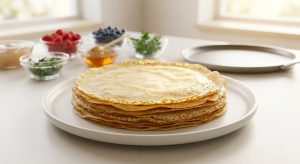
If you want flawless pancakes, throw away your square plastic turner. The elongated blade of a fish spatula is large enough to support the entire diameter of a large pancake or crepe, preventing the wet batter from dripping off the edges during the flip.
Furthermore, a flexible fish spatula is an absolute game-changer for frying eggs. The razor-thin bevel slides effortlessly under the delicate, lacy edges of a fried egg white without snagging, tearing, or accidentally puncturing the yolk. It gives you the surgical precision needed for the perfect over-easy flip.
The Sheet Pan Scraper
When you roast vegetables, potatoes, or meatballs on a bare aluminum baking sheet, they develop a beautiful, caramelized crust where the food meets the hot metal. If you try to remove them with tongs or a blunt wooden spoon, you will tear the food in half, leaving all the crispy, flavorful bits permanently stuck to the pan.
The fish spatula is the perfect sheet pan companion. You can press the flexible blade flat against the baking sheet and sheer right through the roasted fond, lifting the potatoes perfectly intact. You wouldn’t prep a delicate piece of fish on cheap bamboo cutting boards that destroy your knife edges, so why would you use a blunt tool that destroys your hard-earned roasted crust?
Smashed Burgers and Searing Meats
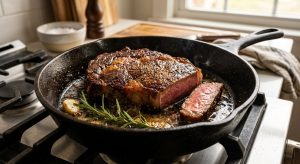
While some burger purists prefer a completely rigid, heavy-duty scraper for making ultra-thin smash burgers, the fish spatula is more than capable of handling heavy proteins. The sharp edge is fantastic for scraping the flavorful fond out of a cast-iron skillet when searing steaks, pork chops, or chicken thighs. The slots also allow you to lift the resting meat out of a pool of hot grease, draining the fat away before you transfer the protein to a cutting board.
How to Choose the Ultimate Fish Spatula (And Ditch the Junk)
Not all fish spatulas are created equal. Since this tool relies entirely on its mechanical geometry and material science, buying a cheap knockoff will leave you frustrated. Here is exactly what you need to look for when upgrading your utensil crock.
The Blade Material
You must buy a spatula made from high-carbon, tempered stainless steel. If the steel is too cheap, it will bend and permanently deform the first time you press down on it. It needs to have a high structural memory, meaning it can flex deeply and instantly snap back into its original angled shape. Look for blades that are explicitly advertised as flexible spring steel.
The Handle Construction
A good fish spatula should feature a full-tang construction, meaning the metal of the blade extends all the way down through the entire length of the handle, secured by heavy-duty rivets. If the metal only goes an inch into a plastic handle, the spatula will eventually snap in half under pressure.
For the handle material itself, you have two choices: wood or synthetic. Hardwood handles (like walnut or rosewood) offer a beautiful, classic aesthetic and a comfortable, warm grip. However, wooden handles cannot go in the dishwasher, as the heat and water will cause the wood to swell, crack, and rot. If you are a pragmatist who demands dishwasher-safe convenience, opt for a handle made from POM (polyoxymethylene) or high-density fiberglass-reinforced plastic.
The Size Factor
Fish spatulas generally come in two sizes: standard (around 11 inches in total length, with a 6.5-inch blade) and large (12.5 inches in total length). For 90% of home cooks using standard 10-inch or 12-inch skillets, the 11-inch standard size is absolutely perfect. The larger size can feel unwieldy and difficult to maneuver in a crowded pan unless you are routinely cooking on a massive outdoor flat-top griddle.
The Left-Handed Conundrum
Because the front edge of a fish spatula is cut on an asymmetrical curve, it is inherently a handed tool. Standard fish spatulas are designed for right-handed cooks; the curve is optimized for sweeping into the pan from the right side.
If you are a southpaw, using a right-handed fish spatula will feel incredibly awkward, as the sharpest point of the bevel will be facing the wrong direction. Thankfully, reputable culinary manufacturers (like Lamson and Wusthof) manufacture dedicated left-handed fish spatulas where the bevel and the curve are completely reversed. If you are left-handed, you must seek out a specifically left-handed model.
Masterclass Technique: Executing the Flawless Flip
Owning a professional-grade tool is only half the battle; you still have to know how to drive it. If your fish fillets always fall apart the second you try to turn them, you are likely rushing the process and fighting the pan. Here is the step-by-step masterclass on how to execute a flawless, restaurant-quality flip.
Step 1: Master Your Impatience
The number one reason fish breaks in the pan has nothing to do with the spatula; it has to do with your anxiety. When you place a piece of fish into a hot skillet, the proteins immediately bond to the metal. As the Maillard reaction occurs, the moisture is driven out of the surface, creating a crispy, browned crust.
Once that crust fully forms, the proteins will naturally release their chemical bond from the metal. If you try to flip the fish before this natural release happens, you will tear the meat. Flipping too early is one of those classic beginner cooking mistakes that will instantly ruin your dinner. Do not touch the fish. Let it sear. You will know it is ready to flip when you give the pan a gentle shake and the fillet slides freely on its own.
Step 2: The Angled Approach
When the fish has released, do not attack it head-on like you are shoveling snow. Approach the fillet from the side at a slight 45-degree angle. Hold the handle of the fish spatula low, allowing the offset angle to do the work of keeping the blade flush against the bottom of the pan.
Step 3: The Shimmy and Flex
Apply gentle downward pressure on the handle so the flexible steel blade bends and sits perfectly flat against the skillet. Slide the razor-thin bevel right under the edge of the fish. Do not shove it in one violent motion. Instead, use a gentle, side-to-side shimmying motion to glide the blade completely under the fillet. The slots will allow the hot oil to pass through, preventing the fish from being pushed away.
Step 4: The Confident Roll
Once the fillet is fully supported by the long metal blade, lift it smoothly out of the pan. Do not hesitate. Hesitation leads to the fish sliding off the edge and splashing back into the hot oil. Lift the fish, rotate your wrist, and gently roll the fish back into the pan, laying it down away from your body so that any splashing oil is directed toward the back of the stove, not onto your shirt.
The Final Word
Cooking beautiful, delicate food at home does not require a culinary degree, but it does require you to respect the physics of the kitchen. You cannot expect professional results if you are using melted, toxic, blunt-force plastic tools that fight against the very nature of the ingredients you are trying to prepare.
Upgrading your toolkit is the fastest way to eliminate kitchen chaos for good. Throw away the plastic bulldozer. Stop eating microplastics and flame retardants. Stop tearing your expensive seafood into shreds. Do yourself a massive favor and invest twenty dollars in a high-quality flexible slotted spatula. It will outlast your current cookware, it will protect your health, and it will completely transform the way you maneuver around a hot stove. Now go buy some salmon, get your skillet smoking hot, and execute the perfect flip.