Listen up, weekend warriors. We need to have a serious chat about what you are spraying onto your expensive cookware. I know you’re busy. I know that when it’s 6:30 PM on a Tuesday and you’re trying to get a weeknight dinner on the table before your family stages a mutiny, the absolute easiest thing to do is grab that aerosol can of cooking spray and hose down your skillet. It takes two seconds, it promises zero calories, and it claims to make cleanup a breeze.
But I am here to tell you, with brutal honesty and zero culinary sugar-coating, that your beloved cooking spray is actively destroying your kitchen investments.
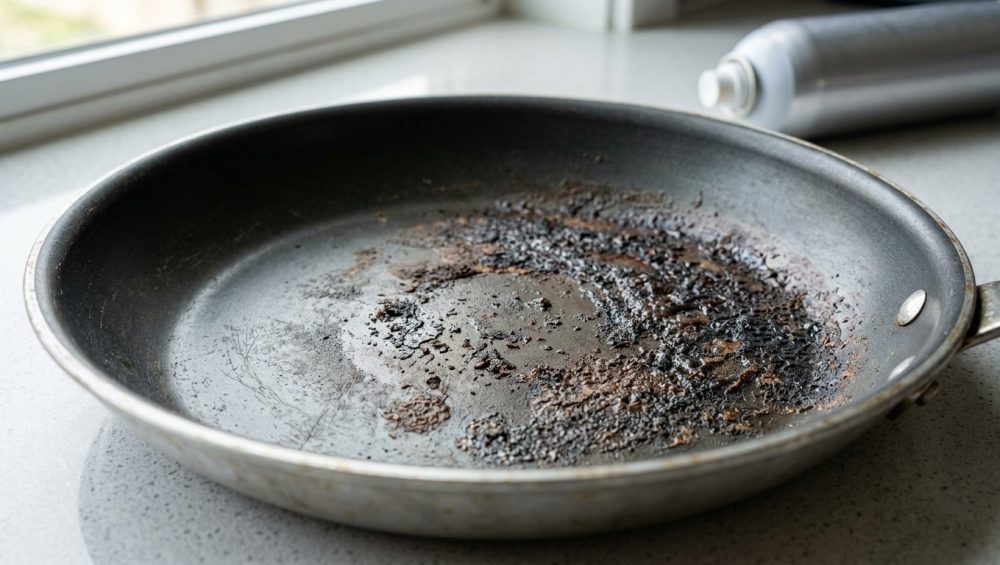
You know exactly what I am talking about. You buy a brand-new, top-of-the-line nonstick skillet. For the first three weeks, it is a glorious, frictionless miracle. Eggs slide around like they are on an ice rink. Pancakes flip with the grace of an Olympic gymnast. But then, right around month two, things start to get sticky. A weird, yellowish-brown gummy residue starts forming around the edges of the pan. Suddenly, your over-easy eggs are tearing, your fish fillets are leaving half their crust behind, and you are left scrubbing at the sink, wondering why your pans keep losing their slip.
The culprit isn’t the pan. The culprit is that innocent-looking can of spray oil sitting in your pantry.
Today, we are taking an incredibly comprehensive, deep dive into the kitchenware chemistry of cooking sprays. I am going to explain exactly how the hidden ingredients in these aerosols undergo a chemical transformation under heat, why they aggressively degrade both traditional PTFE and modern ceramic coatings, and what you need to do to stop the madness. You don’t need a culinary degree to understand the science of your kitchen, but you do need to stop sabotaging your own tools. Put down the aerosol can, pour yourself a glass of wine, and let’s get into it.
The Crime Scene: Why Your Nonstick Pan Suddenly Hates You
To understand why your pan is failing, we first have to understand what makes it nonstick in the first place. Whether you are using a traditional PTFE (Teflon) skillet or a trendy new ceramic-coated pan, the mechanism is relatively similar: a highly specialized synthetic coating is bonded to a metal base (usually aluminum or stainless steel) to create a surface with an incredibly low coefficient of friction.
When you heat a dry pan, the metal expands on a microscopic level. If you drop a piece of protein—like a chicken breast or a cracked egg—directly onto that dry, hot, expanding metal, the proteins will instantly form strong chemical bonds with the surface. This is why food sticks. The nonstick coating acts as a physical and chemical barrier, preventing those protein bonds from forming.
So why do we even need oil or fat in a nonstick pan? Two reasons. First, fat conducts heat better than air, allowing your food to cook evenly and achieve a beautiful golden-brown sear. Second, even the best nonstick coatings have microscopic imperfections, and a tiny amount of fat fills in those gaps, creating an impenetrable layer of lubrication.
The problem arises when we introduce commercial cooking sprays into this delicate ecosystem. Aerosol cooking sprays are not just pure oil. If they were, they wouldn’t spray out in that perfectly fine, uniform mist. They are highly engineered chemical cocktails designed for convenience, not for the longevity of your cookware. When you spray these concoctions onto a hot surface, the non-oil ingredients undergo a radical transformation, bonding to the pan in a way that the manufacturer never intended. This is one of the most common rookie kitchen mistakes that home cooks make, and it costs them hundreds of dollars in ruined equipment every year.
The Chemical Culprit: Unmasking Soy Lecithin
If you turn your can of cooking spray around and actually read the ingredient list, you will see a few things that don’t sound like food. The most prominent offender, and the primary villain in our story, is an ingredient called soy lecithin.
What is Soy Lecithin Anyway?
Soy lecithin is an emulsifier. In the food industry, emulsifiers are used to force two unmixable substances—like oil and water, or in this case, oil and chemical propellants—to play nicely together. It is a naturally occurring fatty substance found in the tissues of plants and animals, but the commercial version used in your cooking spray is typically a highly processed byproduct of refining soybean oil.
In the context of an aerosol can, soy lecithin is a mechanical necessity. It prevents the oil from clumping, stops the ingredients from separating while sitting on the shelf, and ensures that when you press the nozzle, you get a continuous, even mist rather than a sputtering, messy stream of pure fat. From a manufacturing standpoint, it is a brilliant additive. From a culinary and equipment-maintenance standpoint, it is an absolute disaster.
The Polymerization Problem: When Good Additives Go Bad
Here is where the chemistry lesson comes in. When soy lecithin is exposed to the high temperatures of your stovetop, it undergoes a process called polymerization.
Polymerization is a chemical reaction in which relatively small molecules combine chemically to produce a very large, chainlike or network molecule, called a polymer. If you own cast iron cookware, you are actually already familiar with this process. When you rub oil onto a cast iron skillet and bake it at a high temperature, the oil polymerizes, transforming from a liquid fat into a hard, slick, protective plastic-like shell. This is what gives cast iron its coveted seasoning. (And if you do this wrong, it’s exactly why your cast iron leaves black specks in your food).
But here is the critical difference: you want oil to polymerize on bare cast iron or carbon steel. You absolutely do not want it to polymerize on top of a nonstick coating.
Because soy lecithin polymerizes at a much lower temperature than most cooking oils, it begins to form this hard, sticky, thermoset polymer matrix almost immediately upon hitting a hot pan. A thermoset polymer is a type of plastic that, once formed and cured by heat, cannot be melted or reshaped. It is permanently set.
When you spray your nonstick skillet, the lecithin polymerizes and bonds fiercely to the microscopic texture of the nonstick coating. Over time, and with repeated use, these microscopic layers of polymerized lecithin build up. This is that yellowish, brownish, sticky residue you feel on the sides and cooking surface of your pan. It acts like glue. Instead of a frictionless surface, you now have a microscopic layer of sticky plastic permanently fused to your expensive Teflon or ceramic pan. You have effectively paved over your nonstick coating with a layer of chemical superglue.
Aerosol Anatomy: What Else is Hiding in That Can?
Soy lecithin isn’t the only questionable ingredient lurking in that convenient little can. Remember my strict rule against toxic, cheap kitchenware? That philosophy extends to the chemicals we casually spray onto our food. Let’s break down the rest of the aerosol anatomy.
Propellants: Butane, Propane, and Isobutane
How does the liquid oil actually get out of the can and onto your pan? It requires a propellant—a gas under pressure that forces the liquid through the nozzle. If you read the fine print on a standard commercial cooking spray, you will likely see ingredients like butane, isobutane, and propane.
Yes, you read that correctly. The exact same highly flammable hydrocarbon gases that you use to fuel your backyard grill, power your camping stove, and fill your disposable lighters are being used to mist canola oil onto your morning eggs. The FDA classifies these propellants as “Generally Recognized As Safe” (GRAS) for food use, arguing that the amount of gas that actually makes it onto your food is negligible, as most of it dissipates into the air the moment it leaves the pressurized can.
However, from the perspective of a home cook who cares about what goes into their body, the idea of aerosolizing petroleum-derived gases in a poorly ventilated kitchen every single morning is less than appetizing. If we are banishing toxic kitchen gear, we should probably banish the butane-laced egg lubricants, too. Furthermore, these propellants burn at different temperatures than the oil, contributing to the scorching and carbonization that ruins the finish of your pans.
Dimethyl Silicone: The Anti-Foaming Agent
Another common ingredient in commercial sprays is dimethyl silicone (also known as polydimethylsiloxane). This is an anti-foaming agent. When you spray oil out of a pressurized nozzle at high velocity, it naturally wants to foam up. Manufacturers add dimethyl silicone to prevent this, ensuring the spray remains a clear, flat liquid when it hits the pan.
Dimethyl silicone is a synthetic polymer. It is completely inert and generally considered safe to ingest in small quantities, which is why it is also found in fast-food fryer oils, cosmetics, and even Silly Putty. However, just because it won’t kill you doesn’t mean it belongs in your skillet. Like soy lecithin, silicone additives can leave behind a stubborn, invisible residue that interferes with the nonstick properties of your cookware over time.
The “Zero Calorie” Illusion
Before we move on to the physical destruction of your pans, we need to address the most insidious marketing lie associated with cooking sprays: the “Zero Calorie” claim.
Take a look at the nutrition label on a can of cooking spray. It proudly declares 0 calories and 0 grams of fat per serving. How is this physically possible when the primary ingredient is literally pure fat (canola, olive, or vegetable oil)?
It’s a loophole in the FDA labeling regulations. The FDA allows manufacturers to round down to zero if a serving contains fewer than 5 calories or less than 0.5 grams of fat. To exploit this, the manufacturers set the “serving size” to a hilariously unrealistic fraction of a second—usually a 1/4 second spray.
Let’s be brutally honest: no human being on earth sprays a pan for one-quarter of a second. When you hold down that nozzle to coat a 10-inch skillet, you are spraying for at least two to three seconds. You are easily dispensing 20 to 30 calories of pure fat, plus a healthy dose of lecithin and butane. You are not saving calories; you are just ruining your pan with extra chemicals.
How Cooking Sprays Destroy Different Types of Nonstick Pans
We know the chemistry, but how does this actually play out in your kitchen? The damage manifests differently depending on the exact type of nonstick coating you are using. Let’s examine the casualties.
The Death of Traditional PTFE (Teflon)
Traditional nonstick pans use a coating made of polytetrafluoroethylene (PTFE), most commonly known by the brand name Teflon. PTFE is incredibly slick, but it is also notoriously fragile. It scratches easily, and it degrades rapidly if exposed to high heat (anything over 500°F).
When you use cooking spray on a PTFE pan, the damage usually starts on the sloping sides of the skillet. Think about how you cook: you place a chicken breast in the center of the pan. The food in the center absorbs the heat from the burner, keeping the temperature of the cooking surface relatively regulated. But the sides of the pan remain empty. They get hotter and hotter.
The overspray from your aerosol can clings to these hot, empty sides. Without any food to absorb the thermal energy, the soy lecithin on the sides of the pan instantly polymerizes, baking into the PTFE. This creates a hard, brown, sticky ring around the perimeter of your skillet. When you try to scrub this polymerized ring off with a sponge, you inadvertently scrub away the fragile PTFE coating underneath it. You are caught in a lose-lose situation: leave the sticky residue and ruin the nonstick properties, or scrub the residue and physically destroy the coating. This is why I constantly tell my readers they need to stop ruining your nonstick pans with these aggressive aerosol cans.
The Ceramic Pan Massacre
In recent years, ceramic nonstick pans have surged in popularity, marketed as a greener, safer alternative to PTFE. These pans don’t actually contain traditional ceramic pottery; instead, they use a “sol-gel” (solution-gel) coating, which is a silicone-based derivative of sand.
Ceramic pans are highly susceptible to lecithin buildup. While they can generally withstand higher temperatures than PTFE without releasing toxic fumes, their nonstick properties are actually much more delicate. The sol-gel coating releases microscopic amounts of silicone oil every time you cook, which provides the slippery surface.
When polymerized soy lecithin bonds to a ceramic coating, it completely blocks the release of this silicone oil. The pan doesn’t just become a little sticky; it becomes practically unusable. Eggs will fuse to the surface like they are welded on. Because ceramic coatings are inherently brittle, trying to aggressively scrub off the polymerized spray will cause the sol-gel layer to micro-fracture and flake off entirely. If you have ever wondered why your expensive ceramic pan lost its non-stick magic after just two months, aerosol cooking spray is almost certainly the culprit.
The Economics of Ruined Cookware: A Cost Analysis
Let’s talk about money, because time is money, and replacing your kitchen gear every six months is a massive waste of both.
A high-quality nonstick skillet from a reputable brand will cost you anywhere from $60 to $150. If cared for properly—meaning hand-washed, never overheated, and never subjected to aerosol sprays—a good PTFE pan should last you three to five years. A ceramic pan might last one to three years.
When you use cooking spray daily, you accelerate the degradation process exponentially. That polymerized lecithin buildup usually renders a pan frustratingly sticky within three to six months. If you are replacing an $80 skillet twice a year because everything sticks to it, you are spending $160 annually just to maintain a functional breakfast station. Over five years, that is $800 poured down the drain, all because you wanted to save three seconds greasing the pan.
The sheer economics of this habit should be enough to make you stop. You are paying a premium for a nonstick surface, and then you are paying $4 for a can of spray that instantly destroys that premium surface. It is culinary self-sabotage.
The Intervention: How to Stop the Madness (and Grease Your Pans Properly)
Alright, the tough love portion of this masterclass is over. You know what you are doing wrong. Now, as your sassy but fiercely supportive sous-chef, I am going to tell you exactly how to fix it. We are going to prioritize efficiency without sacrificing our expensive gear. Here are the approved, safe, and highly effective ways to grease your nonstick pans.
The Oil Spritzer Revolution
If you absolutely love the convenience of a spray mist and refuse to give it up, you need to invest in a reusable glass oil spritzer. These devices are brilliant. You fill the glass reservoir with your own high-quality cooking oil—avocado oil, light olive oil, or grapeseed oil. The cap contains a manual pump mechanism. You pump the cap a few times to build up air pressure inside the bottle, and when you press the nozzle, it releases a fine, continuous mist of pure oil.
There are no propellants. There is no butane. There is no dimethyl silicone. And most importantly, there is absolutely no soy lecithin to polymerize on your pans. You get the exact same convenience as a commercial aerosol can, but with 100% pure, unadulterated fat. It takes five seconds to pump the cap, and it will save your $100 skillet. Buy one immediately.
The Good Old-Fashioned Butter and Paper Towel Method
If you don’t want to buy another gadget, rely on the method that professional chefs and grandmothers have used for centuries. Pour a dime-sized amount of high-heat cooking oil into the center of your cold pan. Take a folded paper towel and quickly wipe the oil across the entire surface, including the sides.
This leaves a microscopic, perfectly even layer of pure fat across the pan. It uses less oil than pouring directly from the bottle, it ensures total coverage, and it creates zero chemical residue. If you are cooking eggs, do the exact same thing with a small pat of butter. Let the butter melt, swirl it around to coat the bottom, and you are ready to cook. It is foolproof, cheap, and safe for all coatings.
Silicone Basting Brushes
For baking sheets, muffin tins, and large skillets, a high-quality silicone basting brush is your best friend. Drop a small amount of oil onto the surface and use the brush to paint the fat into every corner and crevice.
A quick warning on silicone kitchenware: always ensure you are buying 100% pure, platinum-grade silicone. Cheap silicone products often contain plastic fillers that degrade under heat and absorb dishwasher detergents. If you have ever wondered why your silicone spatulas taste like soap, it is because you bought cheap filler-laced gear. Invest in pure silicone brushes, and they will last a lifetime while keeping your pans perfectly greased.
Can You Save a Pan That’s Already Ruined? (The Rehabilitation Process)
I can hear you panicking through the screen. “But Chef, I sprayed my favorite $120 ceramic pan this morning! Is it destined for the trash?”
Take a deep breath. Depending on how severe the polymerization is, you might be able to rehabilitate the pan. But you have to do it carefully.
Why Dish Soap and Elbow Grease Won’t Work
As we discussed, polymerized soy lecithin is a thermoset polymer. It is structurally similar to plastic. Standard dish soap is designed to break down liquid fats and fresh grease; it does absolutely nothing to a cured polymer matrix.
If you grab a heavy-duty scouring pad and scrub with all your might, you will remove the sticky brown residue. But you will also remove the PTFE or ceramic coating directly underneath it, permanently destroying the pan. Abrasive scrubbing is strictly forbidden.
The Baking Soda Simmer (For Mild Damage)
To break down polymerized oil without scratching the surface, we need to alter the pH. Polymerized fats are resistant to acids (like vinegar), but they can be weakened by alkaline solutions (high pH).
Here is the rehabilitation protocol: Add two to three heaping tablespoons of baking soda to your sticky nonstick pan. Add about an inch and a half of water. Place the pan on the stove over medium heat and bring it to a gentle simmer. Do not let it reach a rapid, rolling boil. Let the baking soda solution simmer for about 10 to 15 minutes.
The heat combined with the highly alkaline baking soda will slowly begin to saponify and break down the chemical bonds of the polymerized lecithin. Turn off the heat and let the water cool until it is safe to touch. Take a soft, non-abrasive microfiber cloth or a gentle sponge and wipe the affected areas. If the damage is mild, the brown gunk should lift away. If it doesn’t work the first time, repeat the process.
This method is also incredibly effective if your baking sheets warp and accumulate sticky brown overspray from roasting vegetables.
The Water Drop Test for Stainless Steel
If you try the baking soda simmer and your nonstick pan is still a sticky, ruined mess, it might be time to accept defeat. And honestly? This might be the perfect opportunity to graduate to stainless steel cookware.
Stainless steel has no chemical coatings to ruin. It will last longer than you will. But I know what you are thinking: “Chef, I hate stainless steel because everything sticks to it!”
Listen to me: food only sticks to your stainless steel because you are not heating it correctly. If you learn the thermodynamics of your cookware, you can make a bare metal pan act completely nonstick. The secret is the Leidenfrost Effect, which you can easily master by performing the water drop test before you add your oil. Heat the dry pan, flick a drop of water into it, and if the water forms a perfect bead that dances across the surface like mercury, the pan is perfectly preheated. Add your oil, add your food, and marvel as it glides around without a single chemical coating in sight.
Knowing When to Say Goodbye (The Toxic Flaking Point)
There is a hard line between a pan that is slightly sticky and a pan that is actively dangerous. If you have scrubbed your PTFE pan so hard that you can see visible scratches, or if the dark Teflon coating is beginning to peel, flake, or chip off into your food, you must throw it away immediately.
Ingesting microscopic flakes of PTFE is generally considered inert, but a flaking pan means the underlying metal (often reactive aluminum) is exposed to your acidic foods. Furthermore, a deeply scratched Teflon pan has lost its structural integrity and can release toxic polymer fumes at lower temperatures. Do not serve your family eggs with a side of microplastics. Throw the ruined pan in the trash, buy a new one, and swear a blood oath that you will never let an aerosol can near it again.
The Sassy Sous-Chef’s Final Verdict
Cooking should be an empowering, enjoyable experience. It should be a time to pour a glass of wine, put on some good music, and transform raw ingredients into something spectacular. It should not be a stressful battle against sticky pans, ruined omelets, and a sink full of un-washable, gummy skillets.
You do not need a professional kitchen to cook like a master, but you do need to treat your equipment with the respect it deserves. Commercial cooking sprays are a shortcut that ultimately leads to a dead end. The soy lecithin, the butane propellants, and the dimethyl silicone are actively sabotaging the expensive nonstick coatings you rely on to make your weeknight dinners manageable.
Take the extra five seconds to pump a reusable oil spritzer, or grab a paper towel and wipe a thin layer of pure, unadulterated fat across your skillet. Your food will taste better, you won’t be inhaling lighter fluid, and your $100 nonstick pans will actually survive to see their third birthday.
Now, get out of here, throw that aerosol can in the garbage, and go cook something amazing. Your pans—and your sanity—will thank you.