Picture this: It is 8:30 PM on a Friday. You have survived a grueling workweek, you have successfully navigated the chaos of the grocery store, and you have finally collapsed onto your couch. You are exhausted, but you are also craving a reward. You march into the kitchen, open the freezer, and retrieve a premium pint of double-fudge brownie ice cream. You grab your favorite stainless steel spoon from the drawer, plunge it into the pint, and press down with the might of a weekend culinary warrior.
And then, tragedy strikes.
Instead of yielding a perfect, creamy orb of frozen delight, the ice cream fights back. Your spoon bends backward at a horrifying ninety-degree angle, permanently disfigured by the sheer, unyielding density of frozen dairy. You are left holding a mangled piece of flatware, staring into a pint that remains entirely intact.
Listen to me closely, my fellow home cooks: you do not have to live like this. You do not have to rely on brute force, and you certainly do not have to sacrifice your good silverware to the dessert gods. If your ice cream turns icy, that is a recipe issue, but if it is simply frozen solid, that is an equipment issue. The solution is not lifting weights to increase your arm strength; the solution is science. Specifically, the science of a highly conductive, liquid-filled aluminum ice cream scoop.
Today, we are diving deep into the thermodynamics of frozen desserts. We are going to explore exactly why standard cutlery fails you, how a brilliant 1930s invention uses your own body heat to glide through solid pints, and why upgrading your kitchen gear is the ultimate form of self-care.
The Physics of Frozen Dairy: Why Your Pint is a Brick
To understand why we need a specialized tool, we first have to understand the enemy. Why is the ice cream in your home freezer as hard as a diamond, while the ice cream at your local parlor is soft, lush, and effortlessly scoopable?
It all comes down to the complex molecular structure of the dessert and the brutal reality of home appliances. Ice cream is not merely a solid block of frozen milk. It is a highly intricate, microscopic emulsion consisting of four main components: ice crystals, liquid sugar syrup, fat globules, and air bubbles. The delicate balance of these four elements determines the texture of your dessert.
The primary scientific principle at play here is called “freezing point depression”. Pure water freezes at exactly 32°F (0°C). However, when you dissolve sugars, fats, and sometimes alcohols into that water, the freezing point drops significantly. Because of this, ice cream is never actually 100% frozen solid; it is essentially a suspension of microscopic ice crystals floating in an unfrozen, highly concentrated sugar syrup.
Here is where the problem starts: commercial ice cream parlors store their tubs in specialized dipping cabinets that are precisely calibrated to sit between 6°F and 12°F. At this temperature, the ratio of liquid syrup to solid ice crystals is perfectly balanced, rendering the dessert firm but easily scoopable.
Your home freezer, on the other hand, is a completely different beast. To keep your meats, frozen vegetables, and leftovers safe from bacterial growth, a standard home freezer is set to 0°F (-18°C) or even colder. At 0°F, a much larger percentage of that liquid sugar syrup is forced to freeze into solid ice. Wrestling with rock hard ice cream is a universal struggle simply because your appliance is doing exactly what it was designed to do: deep-freeze your food.
Furthermore, modern frost-free home freezers go through automatic defrost cycles. They periodically raise their internal temperature slightly to melt frost off the evaporator coils, and then rapidly cool back down. This constant temperature fluctuation causes the microscopic ice crystals in your pint to melt slightly and refreeze into larger, harder, crunchier ice crystals. Much like chilling your dough before baking, temperature control is everything in the kitchen. Just as you might rely on a simple oven thermometer to check your baking temps, you must respect the harsh thermal reality of your freezer.
The Graveyard of Bent Cutlery: Why Standard Spoons Fail
So, your ice cream is sitting at a hostile 0°F. You grab a standard dinner spoon. Why does it bend?
Most decent kitchen flatware is made from austenitic stainless steel, typically graded as 18/10 or 18/8. This means the steel contains 18% chromium (for rust resistance) and 8% to 10% nickel (for shine and structural strength). Stainless steel is a remarkably tough material, boasting a tensile strength of around 510 to 620 MPa.
However, a spoon is essentially a lever, and the narrow neck of the spoon (where the handle meets the bowl) acts as the fulcrum point. When you stab a spoon into a rock-hard pint of premium ice cream—which is incredibly dense due to high butterfat and low air content (overrun)—the frozen dairy offers massive physical resistance. As you push down on the handle, you are applying intense mechanical torque directly to the weakest point of the steel. The resistance of the frozen fat and ice crystals exceeds the yield strength of the spoon’s neck, and the metal warps. It is the exact same mechanical failure that explains why your wooden spoons keep cracking under pressure when stirring incredibly thick batters.
Desperate home cooks will often try to bypass this by running their spoon under hot tap water. While this briefly melts the top layer of the ice cream, the cold mass immediately absorbs the heat, instantly refreezing the melted edges into an impenetrable, icy crust. Others will resort to highly dangerous tactics, like hacking at the pint with a butter knife or, heaven forbid, a sharp chef’s knife.
Put the knives down. Step away from the sink. There is a much, much better way.
Enter the Conductive Ice Cream Scoop
To find our culinary savior, we have to travel back to the year 1932. A man named Sherman Kelly was vacationing in West Palm Beach, Florida. While visiting a local ice cream parlor, he noticed a young woman struggling to dip portions from a frozen tub. Kelly observed that the constant, repetitive strain of forcing a mechanical, spring-loaded disher into the hard dessert had left the young woman’s hands covered in painful blisters.
Kelly, possessing the mind of an inventor, decided that there absolutely had to be a better way to serve this beloved treat. In 1933, he developed and patented a completely new type of tool: a non-mechanical, one-piece scoop made entirely of cast aluminum, featuring a hollow handle filled with a mysterious fluid. By 1935, the Zeroll Company was born in his garage in Toledo, Ohio, and the world of frozen desserts was changed forever.
The genius of Kelly’s invention lies entirely in the metallurgical properties of aluminum. While standard cutlery is made of stainless steel, Kelly specifically chose aluminum for its extraordinary thermal conductivity.
In the world of thermodynamics, thermal conductivity (measured in Watts per meter-Kelvin, or W/mK) dictates how fast a material can transfer heat. Stainless steel is an incredibly poor conductor of heat, clocking in at a sluggish 15 to 16 W/mK. This is actually why stainless steel is great for travel mugs—it traps heat inside. Aluminum, on the other hand, has a thermal conductivity of roughly 205 W/mK.
Let that sink in: aluminum transfers heat nearly thirteen times faster than stainless steel. When you touch a piece of aluminum, it feels cold to the touch not because the metal itself is cold, but because it is rapidly sucking the heat out of your fingertips. Kelly realized that if he could harness the natural, 98.6°F warmth of the human hand and rapidly funnel it into the bowl of the scoop, the metal would effortlessly melt its way through the frozen dairy.
The Secret Weapon: The Encapsulated Liquid Core
While the aluminum construction is brilliant on its own, the true magic of the classic conductive scoop lies hidden inside the handle.
If you pick up a high-quality conductive scoop and shake it, you will hear and feel a liquid sloshing around inside. Nobody wants a situation where ice cream melts too fast, but we do want the scoop itself to act as a highly efficient heat-delivery system. The hollow handle of the scoop is vacuum-sealed and partially filled with a non-toxic, heat-conducting fluid. Depending on the manufacturer, this liquid is typically a food-grade mineral oil or a bio-safe, non-toxic antifreeze solution.
This liquid core acts as a thermal highway. When you grip the handle, the warmth from your palm immediately begins heating the aluminum. The liquid inside absorbs this heat, rapidly circulating it down the neck of the scoop and directly into the thin, curved edges of the bowl.
As you press the edge of the scoop against the surface of the hard ice cream, the localized heat instantly melts a microscopic layer of the frozen fat and sugar on contact. This tiny layer of melted ice cream acts as a liquid lubricant, completely eliminating the friction and physical resistance that causes standard spoons to bend. You are no longer using mechanical force to break the ice cream; you are using thermodynamics to slice through it like a hot knife through butter.
Because the liquid is encapsulated, the heat transfer is continuous. As long as you are holding the handle, your body acts as a limitless thermal battery, powering the scoop’s defrosting capabilities.
The “No-Go” Rule: Toxic Gear and Gimmicks to Avoid
If you have read my articles before, you know that I am absolutely militant about banishing toxic kitchen gear from my home. The kitchenware industry is flooded with cheap, gimmicky garbage designed to separate you from your hard-earned money, and ice cream scoops are no exception.
When shopping for a conductive scoop, you must strictly adhere to the “No-Go” rule.
First, absolutely avoid any scoop that features a painted or non-stick Teflon coating. I cannot stress this enough. Manufacturers often apply these cheap coatings to make the scoop look aesthetically pleasing (like matte black or pastel pink), but the intense temperature fluctuations and the mechanical scraping against frozen ice cream will inevitably cause these toxic coatings to chip, flake, and peel. You do not want microscopic shards of forever-chemicals mixed into your mint chocolate chip.
Second, avoid scoops with cheap plastic handles glued to metal bowls. The plastic acts as a thermal insulator, completely defeating the purpose of a conductive scoop by blocking your hand’s heat from reaching the metal. Furthermore, the joint where the plastic meets the metal is a massive structural weak point that will inevitably snap under pressure.
Third, beware of mystery metals. You want a scoop made of a single, continuous piece of high-grade, food-safe cast aluminum alloy. Do not settle for hollow, lightweight zinc knock-offs that warp and bend. Invest in a legacy brand (like the original Zeroll) that uses heavy-duty, one-piece aluminum construction. This is a tool that, if cared for properly, will literally outlive you and can be passed down to your grandchildren.
The Dishwasher Death Sentence
Speaking of caring for your tools properly, we need to have a very serious conversation about cleaning.
If you take away absolutely nothing else from this masterclass, remember this single, unbreakable rule: Never, under any circumstances, put an aluminum conductive ice cream scoop in the dishwasher.
Just like when your cheap plastic containers stain orange from leftover spaghetti sauce, your kitchen tools react aggressively to their environment. Aluminum is a highly reactive metal. In its natural state, it protects itself by forming a microscopic, invisible layer of aluminum oxide on its surface.
Modern dishwasher detergents are incredibly harsh and highly alkaline (they have a very high pH). When you subject an aluminum scoop to the blistering hot water and the caustic, alkaline chemicals of a dishwasher cycle, the detergent violently strips away that protective oxide layer. The bare aluminum then rapidly oxidizes, turning the entire surface of the scoop into a dark, chalky, powdery gray mess.
If you’ve ever wondered why your ice cream scoop turned gray after a cycle, this is exactly what happened. The oxidation will rub off on your hands, turning your skin black, and worse, it will leave a metallic gray streak across your pristine vanilla bean ice cream. It’s a kitchen sin right up there with ruining your cast iron by soaking it in soapy water overnight.
Furthermore, the extreme heat of the dishwasher’s drying cycle can actually cause the heat-conductive liquid inside the handle to expand rapidly. In some extreme cases, this pressure buildup can cause the base cap of the handle to blow off entirely, ruining the tool and posing a safety hazard.
To care for your conductive scoop, simply wash it by hand in warm, mildly soapy water immediately after use, and dry it thoroughly with a soft towel. It takes less than thirty seconds, and it preserves the integrity of the tool for decades.
A Masterclass in Scooping Technique
Having the right tool is only half the battle; knowing how to wield it is what separates the amateurs from the weekend culinary artists.
Most people approach a pint of ice cream like they are digging a trench. They stab the spoon straight down into the center, pry upward, and aggressively hack away at the frozen block. This “dig and pry” method is horribly inefficient, destroys the texture of the ice cream, and compresses all the lovely, airy lightness right out of the dessert.
When using a conductive scoop, you must change your approach. You want to utilize the “S-Curve” method.
- Grip and Warm: Hold the scoop firmly in the palm of your hand for about ten to fifteen seconds before you even touch the ice cream. Let your body heat activate the conductive fluid inside the handle.
- The Shallow Skim: Instead of stabbing downward, place the edge of the scoop at the outer perimeter of the pint, right where the ice cream meets the cardboard edge.
- The Roll: Apply gentle, even pressure and drag the scoop across the surface of the ice cream in a shallow, curving motion (like drawing an ‘S’ or a ‘C’).
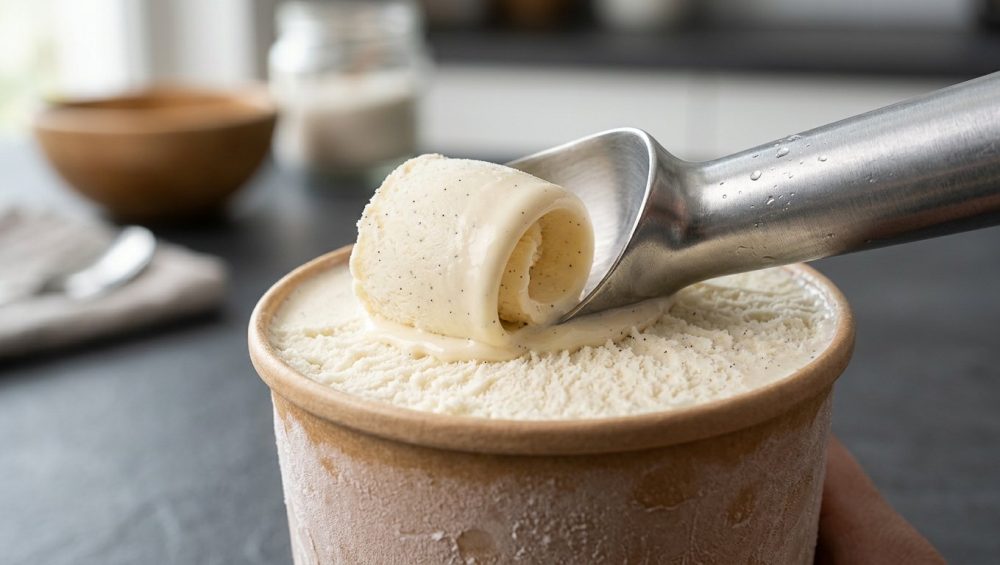
- Let the Tool Work: Do not force it. Allow the heated edge of the aluminum to melt its way through the top layer. Because of the scoop’s perfectly engineered curved bowl, the ice cream will naturally curl back on itself, rolling into a flawless, photogenic sphere.
This rolling technique is not just about aesthetics; it is about economics and mouthfeel. During the Great Depression, when Sherman Kelly first introduced the Zeroll scoop to parlor owners, his major selling point was that this rolling action prevented the ice cream from being compressed. By shaving the ice cream rather than packing it down, the scoop preserved the “overrun” (the air whipped into the ice cream during churning). This allowed parlor owners to yield 10% to 20% more individual scoops out of a single gallon of ice cream, saving them massive amounts of money.
For the home cook, preserving that overrun means your dessert stays light, fluffy, and melts beautifully on the palate, rather than turning into a dense, gummy paste.
The Sassy Sous-Chef’s Final Verdict
Weekdays are for survival. When you are rushing to get dinner on the table by 7:00 PM on a Tuesday, you rely on sheet-pan meals, pre-chopped vegetables, and every time-saving shortcut in the book. But the weekend? The weekend is when we slow down. It is when we demand perfection, beauty, and a touch of culinary magic in our own kitchens.
You do not need a culinary degree to serve a flawless, perfectly spherical scoop of premium ice cream that looks like it belongs in a high-end gelateria. You just need to stop fighting the laws of thermodynamics.
Throw away the bent spoons. Stop hacking at your pints with butter knives. Invest in a high-quality, solid aluminum, liquid-filled conductive ice cream scoop. Respect the tool, wash it by hand, and let your own body heat do the heavy lifting. Your hands will thank you, your silverware drawer will thank you, and your Friday night dessert experience will finally be the effortless, luxurious reward you actually deserve. Now go forth, scoop with confidence, and leave the bent cutlery in the past where it belongs.