Listen, we need to have a serious talk about the absolute massacre happening on your stovetop every Tuesday night. I know exactly what you are doing. You buy a beautiful, expensive piece of pasture-raised chicken or a perfectly marbled steak. You drop it into a shiny stainless steel skillet, hear a satisfying sizzle, and then, three minutes later, tragedy strikes. You try to flip it, but the protein has chemically welded itself to the metal. Panic sets in. You scrape, you pry, you curse, and eventually, you are left serving a mangled, shredded pile of meat while spending the next twenty minutes aggressively scrubbing the pan in the sink.
I have been there. We have all been there. It is one of the most frustrating rookie kitchen mistakes that drives perfectly capable home cooks back into the welcoming, yet highly toxic, arms of cheap non-stick cookware.
But as your resident culinary realist and sassy sous-chef, I am here to tell you that you do not need a culinary degree to cook like a professional, and you certainly do not need to rely on chemical coatings that peel off into your scrambled eggs. What you need is a basic, working understanding of thermodynamics. Specifically, you need to master heat control and the Leidenfrost effect. By understanding the precise temperature thresholds required to create a microscopic vapor barrier, you can transform an uncoated piece of metal into a naturally slick workhorse. This is the definitive, exhaustive masterclass on exactly why your food is fusing to your cookware, and how to stop it once and for all.
The Toxic Reality of “Easy” Cookware (Why You Must Switch)
Let us address the elephant in the room. Why are we even bothering to learn the science of stainless steel? Why not just buy a pan where your food slides around like an ice skater? Because the “easy” kitchen is a heavily marketed lie, and it is making us sick.
For decades, the cookware industry has convinced home cooks that they are incapable of frying an egg without a layer of polytetrafluoroethylene (PTFE). But the regulatory landscape is shifting beneath our feet. As of 2026, the data surrounding PFAS—the “forever chemicals” used to manufacture traditional non-stick coatings—is impossible to ignore. France has already implemented bans on PFAS in various consumer goods, and states like California and New York have passed aggressive legislation targeting these chemicals. Even more significantly, the European Union is currently tracking toward a massive restriction covering over 10,000 PFAS compounds by 2027.
Every time you buy a cheap Teflon pan, you are purchasing a disposable product with a built-in expiration date. The moment you notice your pans losing their non-stick coating, you are already ingesting it. The coating micro-scratches, degrades under high heat, and flakes directly into your dinner.
And do not think you are safe just because you bought into the trendy, pastel-colored ceramic cookware marketed all over your social media feeds. Those pans rely on a sol-gel sand derivative that is notoriously fragile. Within a year of standard weeknight cooking, those aesthetically pleasing ceramic pans lose their slip, becoming just as sticky as uncoated metal, but without any of the rugged durability.
Stainless steel, on the other hand, is a lifetime investment. It contains zero synthetic coatings, it will not off-gas toxic fumes if you accidentally overheat it, and it can survive being dropped, scrubbed, and thrown into a 500-degree oven. It is an industrial engine. But like any high-performance engine, you need to know how to drive it.
The Anatomy and Metallurgy of a Stainless Steel Pan
To understand why food sticks, you first have to understand the tool you are working with. Not all stainless steel is created equal, and if you are cooking on a flimsy, ten-dollar pan from a discount bin, you are setting yourself up for failure before you even turn on the stove.
The 18/10 Rule
When you look at the bottom of a high-quality stainless steel skillet, you will usually see the numbers “18/10” stamped into the metal. This refers to the metallurgical composition of the steel: 18 percent chromium and 10 percent nickel. The chromium is what makes the steel “stainless” by reacting with oxygen to form a microscopic, self-healing passivation layer that prevents rust. The nickel provides a polished, mirror-like finish and adds structural durability. This combination creates a cooking surface that is incredibly resilient and completely non-reactive to highly acidic foods like tomatoes and vinegar.
The Magic of Cladding
Here is the catch: stainless steel is actually a terrible conductor of heat. If you were to cook on a pan made entirely of pure stainless steel, it would develop massive hot spots right over the burner flames, while the edges remained ice cold. Hot spots are the enemy of non-stick cooking because they cause food to cook unevenly and bond to the metal in unpredictable patches.
To solve this, reputable cookware manufacturers use a process called “cladding.” They take a highly conductive metal—usually aluminum or copper—and sandwich it between layers of stainless steel. A “tri-ply” pan has an aluminum core wrapped in steel, while a “5-ply” pan might alternate layers of steel and aluminum for even greater thermal mass. This conductive core pulls the heat from your stove and distributes it perfectly evenly across the entire cooking surface, right up to the rim. When the heat is perfectly uniform, you have complete control over the cooking environment.
The Microscopic Truth: The Chemistry of Why Food Sticks
Now that we have a quality pan, we need to look at the physics of the kitchen. Why does a chicken breast fuse to a pan that feels perfectly smooth to the touch?
The Jagged Landscape
When you run your hand over a premium skillet, it feels like glass. But if you were to put that same pan under an electron microscope, you would see a terrifying, jagged landscape of microscopic hills, valleys, and crevices. It looks like a metallic mountain range.
There is a persistent myth in culinary circles that metal has “pores” that open and close like human skin. Let me be perfectly clear: steel does not have biological pores. It is a solid crystalline structure. However, metal does expand when exposed to heat. As your pan heats up, those microscopic jagged hills and valleys stretch, shift, and expand.
The Protein Bond
When you drop a piece of cold, raw, protein-rich food into a pan that is not properly heated, the proteins seep directly into those microscopic valleys. Then, the chemistry happens. As the pan heats up, the proteins in your food denature and unfold, exposing highly reactive amino acids. These amino acids come into direct contact with the iron atoms in the steel.
Because the pan was not hot enough to instantly sear the exterior of the food, the proteins form actual chemical bonds with the metal—specifically, Van der Waals forces and incredibly strong covalent bonds. Your food is not just “stuck” to the pan. It has fundamentally, chemically bonded with the metal. It has become one with the skillet. This is why no amount of scraping will save your dinner; you are literally trying to break a molecular bond with a spatula. Mastering the art of preventing protein adhesion is the only way to win this battle.
The Physics of the Leidenfrost Effect
So, how do we stop this chemical bonding from happening? We create a forcefield.
Enter the Leidenfrost effect, named after the 18th-century German physician Johann Gottlob Leidenfrost, who first described the phenomenon in 1756. This is the undisputed holy grail of cooking with stainless steel, and understanding it will completely change your relationship with your kitchen.
The Leidenfrost effect occurs when a liquid comes into near contact with a surface that is significantly hotter than the liquid’s boiling point. For water, the boiling point is 100°C (212°F). But when your stainless steel pan reaches approximately 220°C to 225°C (about 430°F to 440°F), something magical happens.
When moisture from your food hits a pan at this precise temperature threshold, the very bottom layer of that moisture vaporizes instantaneously. This rapid, explosive vaporization creates a microscopic cushion of steam. This steam barrier physically lifts the food, suspending it fractions of a millimeter above the metal.
Because the food is hovering on a cloud of its own vapor, it never actually touches the iron atoms in the steel. No physical contact means no chemical bonds. No chemical bonds means stick-free searing. The food simply glides across the pan like a puck on an air hockey table.
The Mercury Ball Water-Drop Test: A Masterclass in Heat Control
You do not need an expensive infrared laser thermometer to find this magical 225°C threshold. You just need tap water. This technique is non-negotiable. If you want to stop scrubbing stainless steel every night, you must memorize this exact process.
Step 1: The Dry Preheat
Place your perfectly clean, completely dry stainless steel skillet on the stove over medium heat. Do not add oil yet. This is a massive rookie mistake. If you heat oil from the very beginning, the oil will slowly rise in temperature alongside the pan. By the time the thick metal reaches the Leidenfrost threshold, your oil will have degraded, smoked, and polymerized into a sticky, gummy resin that is impossible to clean. Always preheat the pan dry.
Step 2: The Wait
Walk away. Prep your vegetables. Pour a glass of wine. Give the pan 2 to 3 minutes to undergo thermal expansion and reach its target temperature. The exact time will depend on whether you are using a gas, electric, or induction cooktop, as well as the thickness of your pan’s cladding. Induction is lightning fast, while older electric coils require patience.
Step 3: The Drop Test
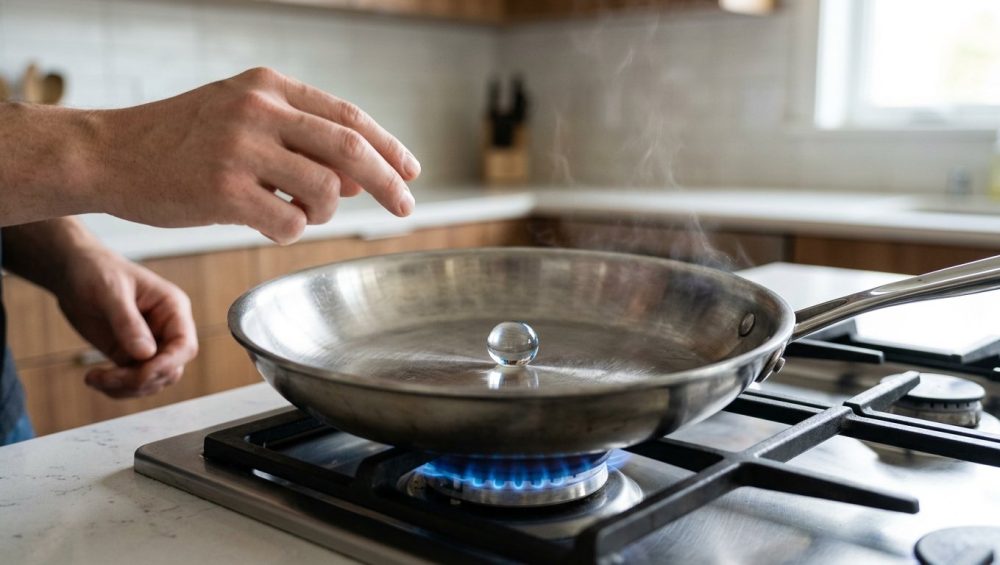
Flick a few drops of water from your fingers directly into the center of the pan. Watch exactly how the water reacts.
- The Sizzle (Too Cold): If the water instantly sizzles, bubbles aggressively, and evaporates into thin air within a second, the pan is too cold. The Leidenfrost threshold has not been breached. If you add food now, it will sink into the microscopic valleys and bond to the metal. Wait another 30 to 60 seconds and test again.
- The Splatter (Too Hot): If the water violently explodes into dozens of tiny, angry droplets that shoot across the kitchen like shrapnel, your pan is way too hot. Turn the heat down and let it cool for a minute, or you will instantly burn your cooking fat the moment it touches the steel.
- The Mercury Ball (Just Right): If the water forms a single, cohesive bead that dances, glides, and skates effortlessly across the surface of the metal like a bead of liquid mercury, congratulations. You have achieved the Leidenfrost effect. The pan is ready.
The Thermodynamics of Cooking Fat
Once you have your dancing mercury ball, take a dry towel and carefully wipe the water out of the pan. Do not leave the water in there, or your oil will violently splatter and burn you. Now, it is time to add your cooking fat.
Wait, if the steam barrier is doing the heavy lifting to prevent sticking, why do we even need oil? Because oil is your secondary defense system and the primary conductor of heat to the uneven surface of your food.
Viscosity and the “Hot Pan, Cold Oil” Rule
When you add room-temperature oil to a thoroughly preheated pan, the intense heat immediately drops the viscosity of the oil. It goes from being thick and sludgy to becoming thin, watery, and incredibly slick. This super-heated, low-viscosity oil instantly rushes into the microscopic valleys of the expanded steel, filling them in and creating a perfectly flat, lubricated surface.
This is the golden rule of professional kitchens: Hot pan, cold oil, food won’t stick.
Choosing the Right Fat
You must choose an oil with a smoke point that can survive the Leidenfrost threshold. Extra virgin olive oil and unclarified butter will instantly burn and turn bitter at 225°C. You need high-heat fats. Avocado oil, grapeseed oil, clarified butter (ghee), or refined sunflower oil are your best friends here.
Add your oil, swirl it around to completely coat the bottom of the pan, and wait just a few seconds until you see it shimmer. The surface of the oil will look like a slightly rippling pond. If it starts to smoke aggressively, you have waited too long, and your oil is breaking down. The precise moment it shimmers, drop your food in.
The Protein Problem: Temperature Shock and Surface Moisture
You have the perfect, heavily-clad pan. You nailed the water drop test. You used the right high-heat oil. You drop your chicken in, and it still sticks. Why? Because you committed the cardinal sin of temperature shock.
The Thermodynamics of Thermal Mass
If you take a dense, one-pound piece of meat directly out of a 3°C (38°F) refrigerator and throw it into a 225°C (437°F) pan, the massive temperature differential will instantly crash the surface temperature of the metal. The pan’s thermal mass is overwhelmed by the freezing cold protein. The pan drops below the Leidenfrost threshold, the steam barrier immediately collapses, and the proteins instantly bond to the steel.
You must let your proteins sit at room temperature for 15 to 30 minutes before cooking. This takes the chill off the meat, allowing the pan to maintain its critical temperature when the food hits the oil.
The Phase Change of Water
Furthermore, surface moisture is the absolute enemy of a good sear. While we rely on a microscopic amount of internal moisture to create the vapor barrier, excess water on the outside of your food will ruin everything. Water requires a massive amount of thermal energy to undergo a phase change from liquid to gas. If your steak is wet, the heat of the pan will be entirely consumed by boiling that surface water, steaming your meat instead of searing it, and plummeting the pan’s temperature in the process.
You absolutely must pat your meat completely dry with paper towels before it ever touches the heat. Dry meat sears. Wet meat sticks.
The Maillard Reaction and the “Patience is a Virtue” Rule
Once your dry, room-temperature protein hits the shimmering oil in your perfectly preheated pan, you need to do the hardest thing in the culinary world: absolutely nothing.
Put down the tongs. Step away from the stove. Stop prodding your dinner.
When the food first makes contact, it will stick slightly as the initial moisture cooks off and the surface begins to sear. This is completely normal. Do not panic, and whatever you do, do not try to force a flexible fish spatula under it yet. You will just tear the meat and leave the best part glued to the steel.
As the meat cooks, it undergoes the Maillard reaction. Named after French chemist Louis-Camille Maillard, who described it in 1912, this is a complex chemical process where amino acids and reducing sugars react under high heat to create hundreds of new flavor compounds and a deeply browned crust.
As this glorious crust forms, the chemical structure of the food’s surface physically changes. It hardens, contracts, and naturally severs its own bonds with the metal. The food is literally programmed to release itself when it is ready. If you gently nudge the chicken and it resists, it is not done searing. Give it another 60 seconds. The pan will tell you when it is time to flip. Patience is not just a virtue; it is a culinary requirement.
Advanced Troubleshooting for Delicate Ingredients
Not all foods are created equal. The aggressive heat required to sear a thick pork chop will absolutely obliterate delicate ingredients. You have to adjust your strategy based on what is going into the skillet.
Delicate Seafood
Fish skin is notoriously fragile and packed with proteins that love to glue themselves to metal. The tragedy of fish fillets falling apart is entirely preventable. For fish, you still need to achieve the Leidenfrost effect to expand the metal, but you must lower the heat immediately after adding your oil. Fish cooks very quickly, and maintaining a roaring medium-high heat will scorch the exterior before the center is even warm. Score the skin with a sharp knife to prevent it from curling, press the fillet down firmly with your spatula for the first ten seconds to ensure even contact, and let the pan do the work.
The Egg Conundrum
Eggs are the ultimate test of a home cook’s prowess. They are essentially pure liquid protein, making them the most likely candidate to fuse to your skillet. This is why so many people end up with rubbery, watery scrambled eggs that require an hour of soaking to clean up.
The trick with eggs is temperature manipulation. Heat your pan until it passes the water drop test. This ensures the microscopic valleys have expanded. Then, turn the burner down to medium-low. Add a generous knob of butter. Butter contains milk solids and water, which provide an excellent thermal buffer. Let the butter melt and foam. The moment the foaming subsides, pour in your beaten eggs. The initial high heat of the pan sealed the pores, while the lowered burner prevents the delicate egg proteins from instantly turning into rubber. Keep them moving, and pull them off the heat before they look completely done, as carryover cooking will finish the job.
Tofu and Starchy Vegetables
Tofu and starchy vegetables like potatoes are notorious stickers. Tofu acts like a sponge, soaking up your cooking fat and leaving the pan completely dry, which leads to immediate sticking. Always press your tofu for at least twenty minutes to remove excess water. Then, toss it in a light coating of cornstarch to create a dry, protective barrier. Ensure you are using slightly more oil than you would for a fatty piece of meat, as the tofu will absorb some of it. For potatoes, soaking them in cold water to remove excess surface starch, and then thoroughly drying them, will prevent them from turning into a gummy mess in the skillet.
Maintenance, Cleaning, and Deglazing
Even with absolutely perfect technique, you will occasionally end up with some browned bits stuck to the bottom of the pan after searing a piece of meat. Do not panic. These caramelized bits are called “fond,” and they are not a mistake—they are culinary gold.
The Art of Deglazing
Never take a blazing hot stainless steel pan and plunge it directly into cold sink water. This causes massive thermal shock, which can permanently warp the metal, turning your perfectly flat skillet into a wobbly spinner that will never heat evenly again.
Instead, while the pan is still hot, remove the meat and pour in a splash of dry white wine, chicken broth, or even just tap water. The liquid will aggressively boil, instantly lifting the fond right off the metal. Scrape it up with a flat-edged wooden spoon, let the liquid reduce, swirl in a tablespoon of cold butter, and you have just created an incredible, restaurant-quality pan sauce in under two minutes. Your pan is now practically clean, and your dinner is elevated.
Routine Cleaning
For routine cleaning, hot soapy water and a non-abrasive sponge are usually all you need. However, over time, your stainless steel may develop a cloudy rainbow-colored heat tint, or you might get stubborn polymerized oil stains baked onto the sides.
Do not waste your time with highly abrasive steel wool, which will scratch the polished finish and is really only reserved for ruining your cast iron if used improperly. Instead, reach for the ultimate secret weapon: Bar Keepers Friend. This inexpensive powder contains oxalic acid, which breaks down polymerized grease and removes heat tints on a molecular level without scratching the steel. Make a paste with the powder and a little water, let it sit on the stains for sixty seconds, give it a gentle scrub, and your pan will look like it just came out of the factory box.
Master Your Kitchen
Cooking with stainless steel does not require a Michelin star, a degree in metallurgy, or a trust fund. It simply requires a little bit of patience, a healthy respect for heat control, and the willingness to break bad habits.
Stop fearing your cookware. Stop relying on toxic, disposable crutches that promise an easy way out but deliver nothing but microplastics and frustration. Master the water drop test, respect the vapor barrier, and let the Maillard reaction do its job. Once you understand the basic rules of thermal dynamics, you will unlock a lifetime of flawless, stress-free cooking. Now get back in the kitchen, heat up that skillet, and show that Tuesday night chicken breast who is boss.