Listen up, weekend culinary warriors. We need to have a serious, sit-down conversation about the sad, limp, watery tragedy you have been calling “roasted vegetables.” You know exactly what I am talking about. It is a busy Tuesday night, you are exhausted, and you just want a healthy side dish to go with your chicken. You chop up some broccoli, toss it in a glug of olive oil, scatter it onto a room-temperature baking sheet, and shove it into a 400-degree oven. Twenty-five minutes later, you pull out a tray of gray, spongy, steamed mush that tastes like absolute despair. You chew it out of obligation, wondering why the roasted vegetables at your favorite neighborhood bistro taste like caramelized, crispy, flavor-packed magic, while yours taste like they were boiled in a hospital cafeteria.
Let me save you from a lifetime of mediocre side dishes: you do not need a culinary degree, you do not need a commercial convection oven, and you certainly do not need to spend hours hovering over a stove. The difference between restaurant-quality caramelization and your soggy weeknight disaster comes down to one shockingly simple, zero-effort trick. You need to stop putting your vegetables on a cold piece of metal.
That is it. That is the big secret. Preheating your baking sheet before your food ever touches it is the single most transformative technique you can deploy in your home kitchen. It requires absolutely zero extra time, zero extra ingredients, and zero advanced knife skills. Today, we are going to dive deep into the unapologetic food science of why this works, how to execute it flawlessly, and why you need to immediately throw away that peeling, toxic non-stick pan you bought at a discount store five years ago. Grab a glass of wine, pull up a stool, and let us fix your dinners once and for all.
The Anatomy of a Roasted Vegetable Disaster
To understand how to fix the problem, we first have to understand why the problem exists. Cooking is just applied physics and chemistry, and when you put a cold pan into a hot oven, you are setting yourself up for scientific failure.
The Cold Pan Trap
When you preheat your oven to 425°F, the air inside the oven reaches that temperature. However, air is a remarkably terrible conductor of heat. If you stick your hand into a 425°F oven, you will not instantly burn yourself (though I highly suggest you do not linger). But if you touch a 425°F piece of metal, you are taking a trip to the emergency room. Metal is dense, and it absorbs and transfers thermal energy rapidly.
When you place a room-temperature baking sheet loaded with room-temperature vegetables into a hot oven, that metal pan does not instantly become 425°F. It takes a significant amount of time—often 10 to 15 minutes—for the thermal energy in the oven air to transfer into the metal and bring it up to roasting temperature. During this agonizing ramp-up time, your vegetables are not roasting. They are just sitting there, gently warming up, which triggers a catastrophic chain reaction. Understanding this thermal lag is one of the most critical steps to avoiding common rookie kitchen mistakes that plague everyday home cooks.
The Steaming Effect (Why Mush Happens)
Vegetables are essentially delicious little water balloons. Depending on the variety, a vegetable is composed of anywhere from 80% to 95% water. As the ambient heat of the oven slowly warms up your cold baking sheet, the cellular walls of your broccoli, zucchini, or bell peppers begin to break down and release their internal moisture.
Because the pan is not hot enough to instantly evaporate this escaping water, the liquid simply pools on the surface of the baking sheet. Now, your vegetables are sitting in a shallow puddle of their own juices. Here is where the laws of thermodynamics ruin your dinner: water boils at 212°F (100°C). As long as there is liquid water touching your food, the surface temperature of that food absolutely cannot exceed 212°F. All the thermal energy from the oven goes into boiling the water, not browning the vegetable. Instead of roasting in dry heat, your vegetables are actively boiling and steaming in a shallow bath. By the time all that pooled water finally evaporates, your vegetables are already overcooked, structurally compromised, and turned to mush.
The Food Science of the Sizzle: Why Preheating Changes Everything
Now, let us look at the alternative. When you place an empty baking sheet into the oven while it preheats, you are allowing that metal to absorb massive amounts of thermal energy. By the time you are ready to cook, that pan is a blazing hot, 425°F weapon of culinary perfection.
Evaporation on Contact: Winning the Moisture War
When you drop your oil-coated vegetables onto a preheated pan, you will immediately hear a loud, aggressive sizzle. That sound is the auditory confirmation of victory. It is the sound of surface moisture evaporating on contact. Because the metal is already screaming hot, the water that naturally leaks out of the vegetables is instantly converted into steam and pushed away from the food. The moisture never has a chance to pool. You have successfully bypassed the 212°F boiling trap, allowing the surface temperature of the vegetable to skyrocket immediately.
The Maillard Reaction: The Holy Grail of Flavor
This rapid spike in surface temperature is the entire goal of roasting, because it is the only way to unlock the holy grail of culinary flavor: the Maillard reaction. If you are serious about mastering the Maillard reaction, you have to respect its strict thermal requirements.
The Maillard reaction is a complex chemical cascade that occurs between amino acids (the building blocks of proteins) and reducing sugars when exposed to high heat. It is responsible for the browned, savory, deeply complex flavors in everything from seared steak and toasted bread to roasted coffee and, yes, perfectly charred broccoli.
However, the Maillard reaction is incredibly picky about temperature. It only begins to occur at around 285°F (140°C), and it really hits its stride between 310°F and 325°F. Remember our steaming effect from earlier? If your vegetables are trapped in a puddle of 212°F water, the Maillard reaction is chemically impossible. By preheating the pan, you evaporate the water instantly, allowing the vegetable’s surface to quickly breach that 285°F threshold. The amino acids and sugars rapidly combine to form hundreds of brand-new, highly craveable flavor compounds. This instant browning is the absolute secret to perfect crunch and restaurant-level depth of flavor.
Caramelization vs. Maillard (Yes, There is a Difference)
People often use the terms “caramelization” and “the Maillard reaction” interchangeably, but since we are running a zero-fluff masterclass here, let us get our facts straight. Caramelization is a completely different chemical process. It is a form of non-enzymatic browning that involves the pyrolysis (thermal decomposition) of sugars, completely independent of amino acids. Caramelization generally requires even higher temperatures than the Maillard reaction—sucrose, for example, does not caramelize until it hits about 320°F (160°C).
When you roast vegetables like carrots or sweet potatoes, which have high natural sugar contents, you are actually triggering both the Maillard reaction and caramelization simultaneously. But neither of these glorious reactions will happen if your pan is cold and your food is wet.
The “No-Go” Rule: Why Your Baking Sheet Material Matters
I am going to be brutally honest with you: technique is only half the battle. If you are using cheap, poorly manufactured equipment, you are sabotaging yourself before you even turn on the oven. I have zero patience for toxic, flimsy kitchenware, and neither should you.
The Toxic Trap of Cheap Non-Stick
If you are currently roasting vegetables on a dark, lightweight baking sheet coated in a non-stick material (like Teflon or PTFE), I need you to stop immediately. Those pans are a toxic trap. Traditional non-stick coatings are simply not designed to withstand the aggressive, 400°F to 450°F temperatures required for proper roasting. When exposed to high heat, these coatings begin to degrade, releasing invisible, noxious fumes that can literally kill pet birds and cause “polymer fume fever” in humans. Over time, the coating will blister, flake, and peel directly into your food.
We do not serve forever chemicals (PFAS) at our dinner parties. It is time to start taking your health seriously by banishing toxic kitchen gear from your cabinets for good.
The Warping Problem (And How to Avoid It)
Have you ever been baking something, only to hear a loud BANG from inside the oven, as if someone just fired a starting pistol? That is the sound of a cheap, thin baking sheet warping under thermal stress. When metal heats up, it expands. If a pan is too thin, the expansion happens unevenly, causing the metal to violently buckle and twist. This is not just annoying; it is a massive cooking flaw. A warped pan means your oil pools in one corner, leaving half your vegetables dry and burning while the other half boils in a deep puddle of fat. Understanding why your baking sheets keep warping is the first step to buying equipment that actually works. You need thick, heavy-gauge metal that can handle intense thermal shock without flinching.
The Holy Trinity of Safe Roasting Gear
If you want professional results, you need to use what the professionals use. You have three primary options for high-heat, preheated roasting:
1. Bare Aluminum (Commercial Grade):
In the professional restaurant industry, heavy-duty bare aluminum half-sheet pans are the undisputed kings of the kitchen. Aluminum is an extraordinary conductor of heat. Its thermal conductivity is approximately 237 W/m-K, which means it transfers heat about 15 times faster than standard stainless steel. When your vegetables hit a preheated aluminum pan, the heat transfer is violently fast, ensuring an instant sear. However, you must buy heavy-gauge (10-gauge or 13-gauge) commercial aluminum to prevent warping. Also, be aware of recent 2025 FDA alerts regarding lead contamination in ultra-cheap, unbranded imported aluminum. Always buy from reputable restaurant supply brands.
2. Multi-Ply Stainless Steel:
If you want to avoid aluminum contact entirely, multi-ply clad stainless steel is your best bet. Stainless steel on its own is a terrible conductor of heat (around 16.5 W/m-K), but it has fantastic thermal mass, meaning it holds onto heat very well once it finally gets hot. Premium pans solve the conductivity issue by sandwiching a thick core of highly conductive aluminum completely inside layers of safe, non-reactive stainless steel. These pans are practically indestructible, they will never warp, and they sear beautifully.
3. Carbon Steel:
Carbon steel is the unsung hero of the roasting world. It shares the durability and heat retention of cast iron but is significantly lighter and more responsive. A carbon steel baking steel or roasting pan, once properly seasoned, becomes naturally non-stick without any synthetic chemicals. When you preheat carbon steel, it acts like a thermal battery, holding a massive reservoir of energy that blasts your vegetables with heat the second they touch the surface.
The Zero-Effort Masterclass: How to Roast Like a Pro
Now that we have covered the thermodynamics and banished the toxic gear, it is time to execute. This is exactly how you are going to achieve flawless, crispy, caramelized vegetables every single time. It is so simple that realizing preheating the pan changes everything will make you angry you didn’t start doing it years ago.
Step 1: Prep and Dry (Water is the Enemy)
Wash your vegetables, but then you must dry them ruthlessly. Remember, water is the enemy of the Maillard reaction. If you take wet broccoli florets straight from the colander and throw them in the oven, you are just adding unnecessary moisture to the equation. Use a clean kitchen towel to pat your root vegetables dry. For broccoli and cauliflower, do not be afraid to throw them directly into a salad spinner to whip the moisture out of all those tiny crevices.
Step 2: The Oil Coating (Fat Equals Flavor and Conduction)
Place your dry vegetables into a large mixing bowl. Do not try to oil and season them directly on the baking sheet—you will end up with uneven coverage and a massive mess. Drizzle them with a high-quality cooking fat. You need to use enough oil to lightly and evenly coat every single piece.
Oil does two things here. First, it adds flavor and helps the seasonings adhere. Second, and more importantly from a scientific perspective, oil acts as a thermal bridge. The surface of a vegetable is uneven, and the surface of a metal pan is microscopically jagged. Without oil, there are tiny pockets of insulating air between the food and the metal. Oil fills those gaps, drastically increasing the surface area contact and allowing thermal energy to transfer efficiently from the pan into the vegetable. This simple step turns a stressful chore into kitchen artistry.
Step 3: The Preheat Protocol
Before you even start chopping your vegetables, place your clean, empty, heavy-duty baking sheet onto the middle rack of your oven. Set the oven to 425°F (or 450°F depending on the vegetable).
Here is the crucial part: when your oven beeps to tell you it has reached the target temperature, do not immediately take the pan out. The air is 425°F, but the dense metal pan might still be catching up. Let the empty pan sit in the hot oven for an additional 10 minutes to ensure it is fully saturated with thermal energy.
Step 4: The Sizzle and Spacing
Carefully remove the blazing hot pan from the oven using thick oven mitts (do not forget it is hot and grab it bare-handed; we have all done it, and it ruins the evening). Immediately dump your oiled, seasoned vegetables onto the metal.
Listen closely. You should hear a loud, aggressive sizzle the absolute millisecond the food hits the pan. If it is silent, your pan was not hot enough.
Using a pair of tongs or a spatula, quickly spread the vegetables out into a single, even layer. They need personal space. If they are piled on top of each other, the moisture escaping from the bottom layer will rise up and steam the top layer. Give them room to breathe so the evaporating water can escape into the oven air. Then, get the pan back into the oven as quickly as possible so you do not lose your heat.
Advanced Roasting Dynamics: Vegetables Are Not Created Equal
You cannot treat a delicate zucchini the same way you treat a dense potato. Once you understand the baseline technique, you have to adapt your strategy based on the cellular structure and water content of the specific vegetable you are cooking. Transforming a chaotic cooking routine into a seamless process means knowing your ingredients intimately.
High-Water Vegetables (Zucchini, Bell Peppers, Mushrooms)
These vegetables are notorious for turning into mush because their water content is astronomically high. For these, the preheated pan is absolutely non-negotiable. You need to hit them with maximum thermal shock right out of the gate.
Cut them into larger, uniform pieces so they do not instantly disintegrate. Do not overcrowd the pan—give them even more space than you think they need. Roast them at a blistering 450°F. The goal is to aggressively sear the exterior and evaporate the surface moisture before the internal structure totally collapses.
Dense Root Vegetables (Potatoes, Carrots, Beets, Parsnips)
Root vegetables are dense, starchy, and take a long time to cook through to the center. The challenge here is ensuring the inside becomes tender and fluffy before the outside burns to a crisp.
The preheated pan works wonders here. By starting them on a screaming hot surface, you immediately establish a thick, crispy crust on the bottom. Cut them into uniform, bite-sized cubes so the heat penetrates evenly. For potatoes, if you really want to achieve absolute perfection, you can par-boil them in alkaline water (water with a pinch of baking soda) for five minutes before tossing them in oil and hitting the hot pan. The alkaline water breaks down the exterior starches, creating a mashed-potato-like slurry on the outside that fries up into an insanely crunchy shell on the preheated metal.
Cruciferous Wonders (Broccoli, Cauliflower, Brussels Sprouts)
These are the crown jewels of roasted vegetables. Their complex, branching structures are practically begging to be charred.
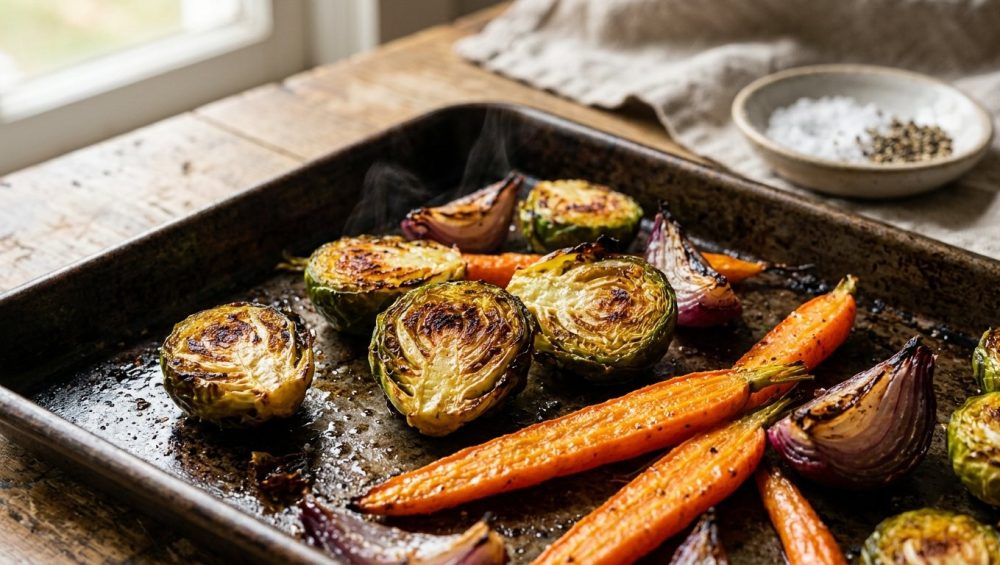
To maximize the Maillard reaction with cruciferous vegetables, utilize the “flat-side-down” rule. When you halve Brussels sprouts or cut broccoli florets, you create a perfectly flat surface. When you place them onto the hot pan, take an extra thirty seconds with your tongs to ensure every single piece is lying flat-side down against the metal. This maximizes the direct physical contact between the vegetable and the conductive heat source, resulting in a deeply caramelized, nearly blackened crust that tastes like absolute heaven.
Troubleshooting: When Good Veggies Go Bad
Even with a preheated pan, things can occasionally go sideways if you ignore the fundamental rules of the kitchen. If you are still struggling with soggy results, you are likely committing one of these beginner cooking mistakes. Let us troubleshoot.
Overcrowding: The Cardinal Sin
I cannot emphasize this enough: if you dump two pounds of broccoli onto a single half-sheet pan, you are going to fail. It does not matter if the pan was preheated to the temperature of the sun. The sheer volume of water rapidly escaping from that mountain of vegetables will overwhelm the pan’s ability to evaporate it. The temperature will plummet, the water will pool, and you will be back in the steam bath.
If you are cooking for a crowd, use two separate baking sheets. Rotate them halfway through the cooking time to ensure even heat exposure. Give your vegetables the real estate they deserve.
The Wrong Oil for the Job
Not all fats are created equal. Since we are preheating our pans to 425°F or 450°F, you must use an oil with a high smoke point. If you use unrefined extra-virgin olive oil, butter, or flaxseed oil, the fat will burn, smoke out your kitchen, and impart a bitter, acrid taste to your food.
Opt for oils that can handle the heat. Avocado oil, refined light olive oil, grapeseed oil, or even rendered beef tallow are excellent choices. They will provide the thermal bridge you need without breaking down and ruining your nonstick pans or your expensive bare aluminum gear.
The Salt Timing Dilemma
Salt is a magical ingredient, but it is also a powerful desiccant. Through the process of osmosis, salt actively draws water out of cellular structures.
If you chop your vegetables, toss them in oil and salt, and then leave them sitting on the counter for twenty minutes while the oven preheats, you are asking for trouble. The salt will pull a massive amount of water to the surface of the vegetable before it ever hits the heat. When it finally goes into the oven, all that surface water has to evaporate before browning can begin.
To avoid this, do not salt your vegetables until the very last possible second. Toss them with oil, wait for the pan to get screaming hot, and then add your salt right before you dump them onto the metal. Alternatively, you can roast them completely unseasoned and toss them with high-quality flaky sea salt the moment they come out of the oven.
Conclusion: Reclaiming Your Weeknight Dinners
Cooking incredible food at home does not require expensive gadgets, rare ingredients, or a pretentious attitude. It requires a basic, functional understanding of how heat, moisture, and metal interact.
By simply placing your bare aluminum or stainless steel baking sheet into the oven while it preheats, you are bypassing the soggy steaming phase entirely. You are harnessing the power of instant evaporation and unlocking the deeply savory, caramelized magic of the Maillard reaction.
So, the next time you are staring down a head of broccoli on a busy weeknight, do not settle for steamed mediocrity. Ditch the toxic non-stick, respect the laws of thermodynamics, preheat your metal, and listen for that sizzle. You are a home cook, but with this one zero-effort trick, you are about to start eating like a pro. Now go turn on your oven, and let’s get roasting.