You spent thirty dollars on a beautiful, center-cut fillet of wild-caught salmon. You patted it dry, seasoned it perfectly, and got your skillet screaming hot. You laid the fish down, listened to that glorious sizzle, and waited patiently for the crust to develop. Then, the moment of truth arrived. You grabbed your trusty, thick plastic spatula, shoved it aggressively into the side of the fish, and… disaster. The crust stayed glued to the pan, the delicate flesh sheared in half, and your beautiful fillet instantly transformed into a mangled, unappetizing pile of expensive fish flakes.
If this sounds like your typical Tuesday night, take a deep breath. It is not your fault. You do not lack culinary talent, and you do not need to enroll in a Parisian cooking school to learn how to sear a piece of protein. The problem is not your technique; the problem is the absolute garbage you are holding in your hand.
If your fish fillets always fall apart the second you try to turn them, the culprit is almost certainly your spatula. For decades, the home cooking industry has convinced weekend hobbyists that a thick, blunt, neon-colored plastic paddle is an acceptable tool for cooking food. It is not. It is an ergonomic nightmare that ruins your dinners and slowly poisons your body. It is time to step up your game, ditch the pretentious chef-speak, and embrace the single greatest, most versatile, and precision-engineered tool you will ever invite into your kitchen: the flexible stainless steel slotted spatula, affectionately (and somewhat inaccurately) known as the fish spatula.
The Brutal Truth About Your Clunky Plastic Spatula
Before we can talk about the solution, we need to talk about the problem. Walk over to your utensil crock right now and pull out that standard black plastic or nylon turner. Look at the front edge. It is probably three to four millimeters thick. It might even be frayed, melted, or chewed up at the corners. That blunt instrument is the enemy of good food.
The Bulldozer Effect
When protein hits a hot pan, it undergoes the Maillard reaction. Amino acids and reducing sugars react under high heat to form a complex, deeply flavorful, and crispy crust. As this crust forms, it temporarily bonds to the metal of the pan. When the crust is fully formed, it naturally releases. However, the gap between that perfectly seared crust and the surface of your skillet is microscopic.
When you take a blunt, four-millimeter-thick plastic spatula and try to force it under a delicate piece of fish, you are not sliding under the food. You are crashing into it. I call this the Bulldozer Effect. Because the edge of your plastic spatula is thicker than the microscopic gap between the pan and the crust, the spatula acts as a physical wall. The sheer horizontal force required to push that thick plastic under the food exceeds the structural integrity of the fish’s delicate flesh. The result? The crust stays glued to the metal, the upper flesh shears completely off, and your dinner is ruined. You are literally bulldozing your food across the skillet instead of lifting it.
The Toxic Melt (The Strict No-Go Rule)
I have a very strict rule in my kitchen: I do not tolerate toxic, cheap, peeling, or melting gear. I firmly believe that banishing toxic kitchen gear is the first mandatory step to becoming a better home cook. Your nylon spatula is a prime offender.
Let’s look at the science. The vast majority of standard plastic kitchen utensils are made of nylon (specifically polyamide). Nylon has a melting point that hovers dangerously between 428°F and 500°F (220°C to 260°C), depending on the specific grade. But here is the terrifying part: its glass transition temperature—the point where the plastic begins to soften, degrade, and become susceptible to surface wear—is only around 158°F to 176°F (70°C to 80°C).
When you are searing a piece of meat or fish, your skillet is easily hitting temperatures of 400°F or higher. If you leave that nylon spatula resting on the edge of the pan, or if you press it into the hot skillet for more than a few seconds, it begins to melt. When nylon degrades under high heat, it doesn’t just warp; it actively releases microplastics and chemical byproducts directly into your food. We are talking about the release of incompletely polymerized monomers like caprolactam, which can irritate the eyes, skin, and respiratory system, alongside primary aromatic amines (PAAs), which are known toxic compounds.
If the edge of your spatula looks fuzzy, rough, or melted, you are actively seasoning your family’s dinner with petroleum-based industrial chemicals. Throw it in the trash immediately. You deserve better, and your food deserves better.
Enter the Fish Spatula: A Masterpiece of Culinary Engineering
Now that we have eliminated the plastic paddle from your life, let’s introduce the hero of this story. The flexible slotted spatula is the exact antithesis of everything wrong with standard turners. It is an elegant, highly functional masterpiece of culinary engineering that solves every problem the home cook faces when manipulating food in a hot pan.
The Razor-Thin Beveled Edge
The most critical feature of a high-quality fish spatula is its leading edge. Unlike the blunt wall of a plastic turner, a stainless steel fish spatula is milled down to an incredibly thin, razor-like edge. In many premium models, this edge is actually beveled—meaning it is ground at a slight angle to create an almost knife-like sharpness.
This extreme thinness allows the spatula to do what your plastic one never could: it slides effortlessly into that microscopic gap between the pan and the seared crust. It separates the protein from the cooking surface with surgical precision. It does not push; it lifts. This preserves the beautiful Maillard crust you worked so hard to achieve and keeps the delicate structure of the food entirely intact.
The Offset Angle and Flexibility
Hold a standard, straight spatula in your hand and try to press the blade completely flat against the bottom of a skillet. To do this, you have to elevate your elbow, contort your wrist, and approach the pan from a steep, awkward vertical angle. It is ergonomically disastrous and gives you zero leverage.
A fish spatula features a distinct, strategic downward bend just after the handle, right before the blade begins. This is called an offset. This offset angle allows your hand to remain in a natural, comfortable position parallel to the stovetop, while the blade rests perfectly flush against the cooking surface. In physics and engineering, this achieves perfect tangency. You require less force to scrape, which means less deformation of your food.
Furthermore, the blade itself is made of tempered, springy stainless steel. The front half of the blade is highly flexible, allowing it to conform to the curved sloping sides of your frying pan. It bends to accommodate the shape of the food and the pan, acting as an extension of your own hand rather than a rigid, unyielding obstacle.
The Strategic Slots
You will notice that the head of a fish spatula is elongated and features wide, parallel slots running down its length. These slots are not just for aesthetics; they serve two vital mechanical purposes.
First, they drastically reduce the surface area of the metal. Less surface area means less friction and less surface tension when the spatula comes into contact with wet or sticky foods. This allows your delicate proteins to slide off the spatula and onto your plate without clinging to the metal.
Second, the slots act as a rapid drainage system. When you are lifting a piece of fish out of a shallow poach, or pulling a fried chicken cutlet out of a pan of bubbling oil, the slots allow the scalding hot liquid to drain away instantly. This prevents you from carrying a puddle of boiling grease over to your resting rack, which keeps your breading crispy and protects your forearms from dangerous oil splatters.
Why It Is Called a Fish Spatula (And Why That Name Is Stupid)
Let’s clear up a massive misconception right now. The name “fish spatula” is terrible branding. It tricks novice home cooks into thinking this tool is a highly specialized unitasker that only deserves to see the light of day when you are cooking seafood. Nothing could be further from the truth.
A Brief History of the Pelton Spatula
Historically, this tool was often referred to in professional French kitchens as a Pelton spatula or a slotted offset turner. Brands like Matfer Bourgeat pioneered the design for high-end culinary applications. It earned the colloquial nickname “fish spatula” simply because its elongated, flexible, flipper-like shape happened to be the absolute perfect geometry for handling long, fragile fillets of sole, trout, or salmon.
However, professional chefs quickly realized that a tool designed to perfectly handle the most delicate, easily destroyed protein in the kitchen was also the perfect tool for handling absolutely everything else. It is not a unitasker; it is the ultimate multitasker. If it is gentle enough to flip a flaky piece of cod, it is certainly capable of flipping a burger, a pancake, or a grilled cheese sandwich.
The Mechanics of Flipping Delicate Proteins
Having the right tool is only half the battle; knowing the mechanics of how to use it is where the real magic happens. Let’s break down the exact physics and techniques for flipping the most intimidating foods in your weekday rotation.
How to Flip Fish Without Tearing It
Cooking fish on a weeknight should be a fast, efficient, and stress-free process, not an anxiety-inducing chore. The first rule of flipping fish is patience. If your meat sticks to stainless steel pans, it is almost always because you are trying to force the flip before the Maillard reaction has finished its job. When the crust is fully formed, the proteins will naturally release their grip on the metal.
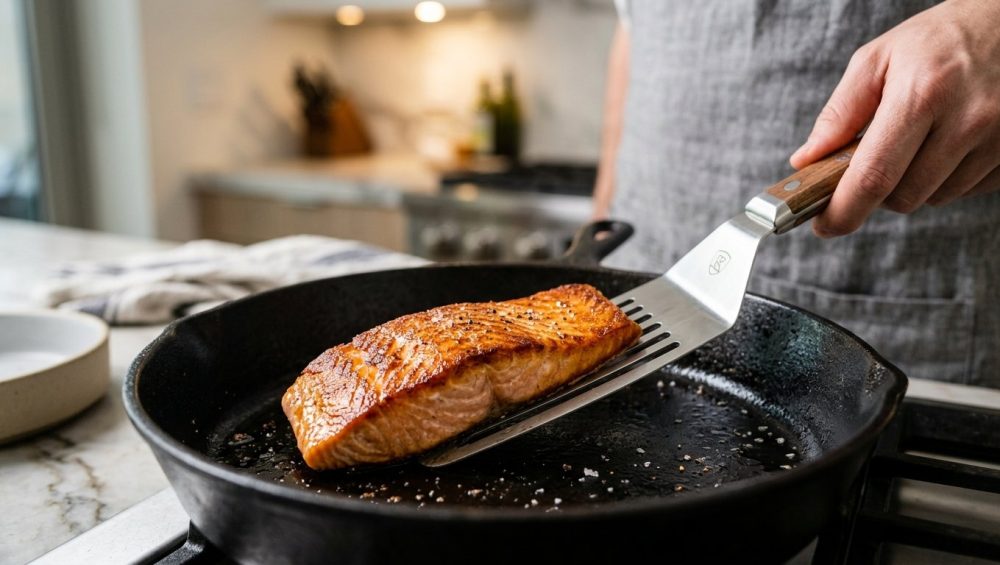
Once the fish is ready, approach it with your flexible spatula. Do not come in perfectly flat. Instead, angle the leading edge of the spatula downward at a 10 to 15-degree angle. Use the offset handle to keep your wrist relaxed. Slide that razor-thin beveled edge firmly and swiftly under the skin or crust of the fish. Because the blade of the spatula is elongated, it will support the entire length of the fillet, preventing the fish from sagging or breaking in the middle.
Once the fish is fully resting on the metal, lift it gently. Do not flick your wrist aggressively. To stop ruining your salmon, you must use a smooth, confident, rolling motion to turn the fillet over. The flexibility of the steel will absorb the shock as you lay the fish down on its raw side, preserving the beautiful crust you just built.
The Fried Egg Rescue Mission
If there is one food that strikes fear into the hearts of weekend breakfast cooks, it is the sunny-side-up egg. You want those beautifully crisp, lacy, brown edges, but you also want a perfectly intact, runny yolk. A thick plastic turner will brutally tear those lacy edges to shreds and aggressively pop the yolk before the egg ever leaves the pan.
You absolutely need a slotted fish turner to execute a flawless fried egg. The thin, flexible edge of the steel acts like a scalpel. You can gently pry the delicate, stuck-on edges of the egg white away from the cast iron without disturbing the center. The wide base of the spatula easily scoops up the entire egg, supporting the heavy yolk in the middle while the excess butter or bacon fat drains cleanly through the slots. It is a breakfast rescue mission executed with military precision.
Pancakes and Baked Goods
Pancakes require a confident, fully-supported flip. If you use a small, square spatula, the edges of the pancake will drape over the sides, leading to a messy, folded, half-raw disaster when you try to turn it. The elongated head of the fish spatula acts like a massive landing pad, supporting the entire diameter of the pancake. You slide it under, lift two inches off the griddle, and flip with a quick, decisive snap of the wrist.
This tool is also a baker’s best friend. When you pull a tray of fragile, chewy chocolate chip cookies out of the oven, they are soft and prone to tearing. The razor-thin edge of the fish spatula glides under the cookies seamlessly, allowing you to transfer them to a wire cooling rack without crumpling them into an accordion.
Beyond Flipping: The Secret Versatility of the Fish Spatula
If you think this tool is only for flipping, you are vastly underestimating its power. Because time is money during a busy weeknight, I rigorously prioritize tools that can perform multiple functions, eliminating the need to wash a mountain of utensils at the end of the night.
Smashing Burgers Like a Diner Cook
You might assume that a flexible spatula is too flimsy to execute a proper smashburger. You would be wrong. The genius of the fish spatula lies in its variable tension. Yes, the front two inches of the blade are highly flexible and springy. However, the back three inches of the blade—right where the steel meets the handle—are incredibly rigid and structurally sound.
To make a diner-style smashburger, place a ball of ground beef into a screaming hot cast-iron skillet. Rest the rigid, back-end of your fish spatula directly over the meat. Then, take the handle of a wooden spoon and press down hard on the center of the spatula blade. You can exert an immense amount of downward force, smashing the beef flat against the iron to maximize surface contact and create an unbelievable crust.
Scraping Fond and Deglazing
When you sear a steak or a chicken breast, you leave behind a layer of browned, caramelized proteins and sugars stuck to the bottom of the pan. This is called fond, and it is the flavor base for any incredible pan sauce.
A blunt nylon spatula will simply glide uselessly over the top of this fond, leaving all that incredible flavor glued to the pan. The sharp, straight edge of a stainless steel fish spatula acts exactly like a bench scraper for your skillet. When you pour in a splash of wine, broth, or vinegar to deglaze the pan, you use the front edge of the spatula to systematically shave and scrape the fond off the metal, dissolving those rich, savory bits directly into your sauce.
Draining Oil from Fried Foods
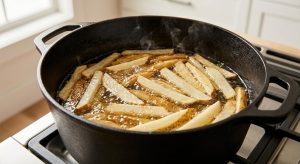
Whether you are shallow-frying eggplant for parmesan or deep-frying chicken wings, getting the food out of the hot oil quickly and safely is paramount. Tongs can often pierce the crispy breading, allowing juices to escape and oil to seep in.
The fish spatula is the ultimate extraction tool. You can slide it under a massive chicken cutlet, lift it out of the 350°F oil, and hold it hovering over the pan for three seconds. The wide slots allow the excess grease to cascade back into the skillet, reducing oil carryover by up to 25%. This ensures your breading stays shatteringly crisp instead of turning into a soggy, greasy sponge.
How to Choose the Perfect Fish Spatula
Not all fish spatulas are created equal. If you are ready to make the upgrade, you need to know exactly what to look for to ensure you are getting a high-quality tool that will last a lifetime.
Stainless Steel vs. Silicone-Edged
I am a culinary purist, which means I strongly advocate for a 100% stainless steel blade. It offers the sharpest edge, the best flexibility, and the longest lifespan. However, I know that many home cooks are absolutely terrified of ruining your nonstick pans with metal utensils.
If you are hopelessly devoted to your Teflon skillets, you can purchase a hybrid fish spatula that features a stainless steel core coated with high-heat silicone at the edge. These will protect your nonstick coatings while still offering the elongated shape and offset angle. Just be aware of the drawbacks: silicone is thicker than bare steel, so you lose that razor-thin sliding ability. Furthermore, silicone can absorb aggressive odors and chemicals over time. If your silicone spatulas taste soapy or smell like last week’s garlic, it is because the porous material is holding onto dishwasher detergents and food oils. A pure stainless steel spatula never retains odors.
Handle Materials: Wood vs. Composite
The handle of your spatula dictates how you must care for it. Traditional fish spatulas often feature gorgeous wooden handles made of walnut or rosewood, secured with brass rivets. They are aesthetically stunning and offer a fantastic, warm grip. However, wood and dishwashers are mortal enemies. The heat and harsh detergents will strip the oils from the wood, causing it to crack, splinter, and eventually fail. If you buy a wooden-handled spatula, you must commit to hand-washing it forever.
If you value efficiency and time-saving above all else, opt for a handle made of composite plastic, fiberglass, or polyoxymethylene (POM). These materials are virtually indestructible, highly sanitary, and completely dishwasher safe. You can toss them in the machine every single night without a second thought.
Left-Handed vs. Right-Handed Angles
Here is a crucial detail that most beginners completely overlook: fish spatulas are asymmetrical. Look closely at the front edge of the blade. It is not cut straight across; it is cut on a bias, creating a sharp leading point on one side and a shorter trailing edge on the other.
For a standard, right-handed fish spatula, the longer, sharper leading edge is on the left side of the blade. When you hold the spatula in your right hand and sweep it across the pan from right to left, that sharp point easily wedges under the food.
If you are a southpaw, you cannot use a standard fish spatula. If a left-handed cook tries to use a right-handed spatula, they will be attacking their food with the blunt, trailing side of the blade, completely defeating the purpose of the tool. Left-handed cooks must actively seek out and purchase a specifically manufactured left-handed fish spatula, where the bias is reversed.
Caring for Your New Favorite Tool
A high-quality stainless steel fish spatula is a workhorse, but it still requires a modicum of respect to keep it performing at its peak.
Washing and Maintenance
The main drawback of the slotted design is that sticky proteins, melted cheese, or thick pancake batter can easily get trapped inside the long metal slots. Do not let this food dry and harden into cement. As soon as you are done cooking, run the spatula under hot water and use a stiff brush to clear the slots. If you opted for a stainless steel and composite handle model, throw it straight into the dishwasher. If you chose wood, wash it by hand, dry it immediately with a towel, and occasionally rub the handle with a drop of food-safe mineral oil to keep the wood hydrated and smooth.
Protecting Your Pans
Can a stainless steel spatula scratch a pan? Yes, if you are reckless. Obviously, you should never use raw metal on a delicate Teflon coating. However, if your ceramic pan lost its non-stick capabilities, it is highly likely due to a buildup of invisible, polymerized cooking oils, not just surface scratches.
I strongly advocate that every home cook should be transitioning toward durable cookware like stainless steel, carbon steel, and bare cast iron. On these surfaces, a metal spatula is not a hazard; it is an asset. Using a flexible fish spatula on a cast iron skillet actually helps maintain the pan. As you scrape the flat edge across the iron, you are actively leveling the seasoning, shearing off microscopic burnt food particles, and keeping the cooking surface impeccably smooth.
Final Thoughts: Stop Fighting Your Food
Cooking should be a joyful, relaxing, and empowering experience, even on a chaotic Wednesday evening. It should not feel like a wrestling match between you, your skillet, and a mangled piece of protein. You do not need years of professional training to plate a beautiful, intact, perfectly seared piece of fish or a flawless sunny-side-up egg. You just need to stop handicapping yourself with tools that belong in a children’s sandbox.
Ditching that thick, melting, toxic plastic paddle in favor of a precision-engineered, stainless steel offset spatula is the easiest, cheapest, and fastest way to stop ruining your dinners. The fish spatula is proof that sometimes, the secret to culinary success isn’t a complicated new technique or an exotic ingredient. Sometimes, the secret is just having the right piece of metal in your hand. Now get back in the kitchen, get that pan smoking hot, and go flip something with confidence.