Listen up, weekend culinary warriors. We need to have a serious, brutally honest conversation about a tragedy unfolding in kitchens across the globe every single night. You know the exact scenario I am talking about. You go to the farmer’s market, you spend an exorbitant amount of money on beautiful, artisanal heirloom greens, and you whisk together a stunning, perfectly balanced vinaigrette using that expensive extra-virgin olive oil you’ve been hoarding. You toss it all together in a gorgeous wooden bowl, serve it to your guests, and what happens?
By the time the forks hit the plates, the leaves are limp, the flavor is aggressively bland, and at the bottom of the bowl lies a depressing, watery puddle of separated oil and vinegar.
You blame the recipe. You blame the olive oil. You might even blame the lettuce. But I am here to tell you that the fault lies entirely in your prep work. If you are not aggressively and thoroughly removing every single microscopic drop of surface moisture from your greens before dressing them, you are setting yourself up for failure. I have zero patience for pretentious chef-speak, but I also have absolutely no tolerance for a soggy side dish when the solution is so painfully simple. Professional-level results in a home kitchen do not require a culinary degree; they require an understanding of basic physics and the right equipment.
Today, we are taking a deep, uncompromising dive into the food science of why your dressing won’t stick to your greens, why patting lettuce dry with paper towels is a culinary crime, and why a high-RPM, pump-action salad spinner is the unsung, non-toxic hero your kitchen desperately needs.
The Unforgiving Chemistry of Oil and Water
To understand why a wet leaf destroys a salad, we have to look at the foundational chemistry of a vinaigrette. At its core, a standard vinaigrette is a temporary emulsion—a forceful, unnatural marriage of two liquids that absolutely despise each other: oil and vinegar (water).
Water molecules are polar, meaning they have a slight electrical charge. Oil molecules are non-polar and incredibly hydrophobic, meaning they literally repel water. When you vigorously whisk mustard, vinegar, and oil together, you are breaking the oil down into millions of tiny droplets and suspending them in the water-based vinegar. However, this suspension is fragile.
When you pour this beautiful, fragile emulsion over a piece of lettuce that is still clinging to the water from your kitchen sink, you are introducing a massive, polar barrier. The hydrophobic oil in your dressing hits the water on the leaf and immediately repels. The emulsion breaks. The oil literally slides right off the wet surface of the green, sliding down into the bottom of the bowl and taking all your carefully balanced seasonings with it. This is exactly why your homemade vinaigrette always separates before you even have a chance to take your first bite.
Furthermore, that residual tap water dilutes the acid and salt in your dressing. You are left with leaves that taste like nothing, sitting in a puddle of watered-down oil. If you want restaurant-quality salads where the dressing clings to every single leaf in a glossy, flavorful coating, the surface of that leaf must be bone dry.
The Paper Towel Fallacy and the Biology of Bruising
Now that we agree the water has to go, let’s address the elephant in the room: the paper towel method. I see home cooks doing this all the time. They wash their greens, lay out a mile of paper towels, place the greens on top, roll them up, and press down.
First of all, time is money, people. When you are trying to get a healthy weekday meal on the table after a nine-hour workday, meticulously patting down individual spinach leaves is an infuriating waste of your evening. Secondly, it is an egregious waste of paper products. But most importantly, from a culinary perspective, patting and pressing your greens actively destroys them.
Let’s look at the cellular biology of a lettuce leaf. Leafy greens maintain their crispness due to turgor pressure—the water pressure inside the plant’s delicate cell walls. When you press down on these leaves with your hands and a paper towel, you are inflicting mechanical damage. You are literally crushing and rupturing the cellular membranes.
When these cell walls break, they release cytoplasmic enzymes, specifically polyphenol oxidase, which reacts with oxygen to create melanin. This is the exact chemical process that causes your beautiful greens to develop brown, necrotic edges. The structural collapse from this physical trauma is the primary reason your salad greens wilt and turn into a sad, mushy mess within hours of being prepped. You aren’t just drying the lettuce; you are beating it to death. We need a method that removes the surface water with extreme prejudice, without ever crushing the cellular structure of the leaf.
Enter the Centrifuge: The Physics of a Salad Spinner
This is where we bring industrial physics into the home kitchen. A salad spinner is not just a plastic bowl; it is a mechanical centrifuge. When you operate a salad spinner, you are utilizing centripetal acceleration to separate two materials of different densities: the heavy water and the light lettuce leaves.
As the inner basket spins at high speeds, the rotation creates a powerful outward force. According to the physics of circular motion, the water droplets resting on the leaves want to travel in a straight line, but the spinning basket forces them into a circular path. The centrifugal force overcomes the surface tension holding the water to the leaves, forcefully ejecting the water droplets radially outward through the slits in the basket.
Because the leaves are physically contained and supported by the rigid walls of the spinning basket, they do not experience any targeted mechanical crushing or compression. The water is stripped away at high velocity, hitting the outer bowl and draining to the bottom, while the cellular walls of your delicate arugula remain perfectly intact. This is the same reason why your fresh herbs turn slimy when you crush them in a towel, but stay perfectly crisp and vibrant when you spin them dry. A spinner allows you to achieve absolute dryness without inflicting a single microscopic bruise.
Pump-Action vs. Crank Handle: An Ergonomic Masterclass
Not all salad spinners are created equal, and I have very strong opinions on their mechanical design. Broadly speaking, the market is divided into three categories: the pull-cord, the hand-crank, and the pump-action (or plunger) spinner.
Let’s immediately dismiss the pull-cord. It relies on a string that inevitably frays, snaps, or harbors bacteria because it can never be fully cleaned. It is a gimmick that belongs in the trash.
Next, we have the traditional hand-crank. This design utilizes a protruding handle connected to a simple gear system. To use it, you must securely hold the bowl down with one hand while rapidly cranking the handle in a circle with the other. It is awkward, it requires significant grip strength, and the circular motion often causes the entire bowl to wobble violently across your countertop. Furthermore, the protruding crank handle means the lid cannot be stacked, making it a nightmare to store in your refrigerator or cabinets. Using a poorly designed crank spinner is just like the danger of dull knives slipping on a cutting board—it requires too much forced, uncontrolled effort for a task that should be effortless.
This brings us to the absolute pinnacle of kitchen engineering: the pump-action spinner.
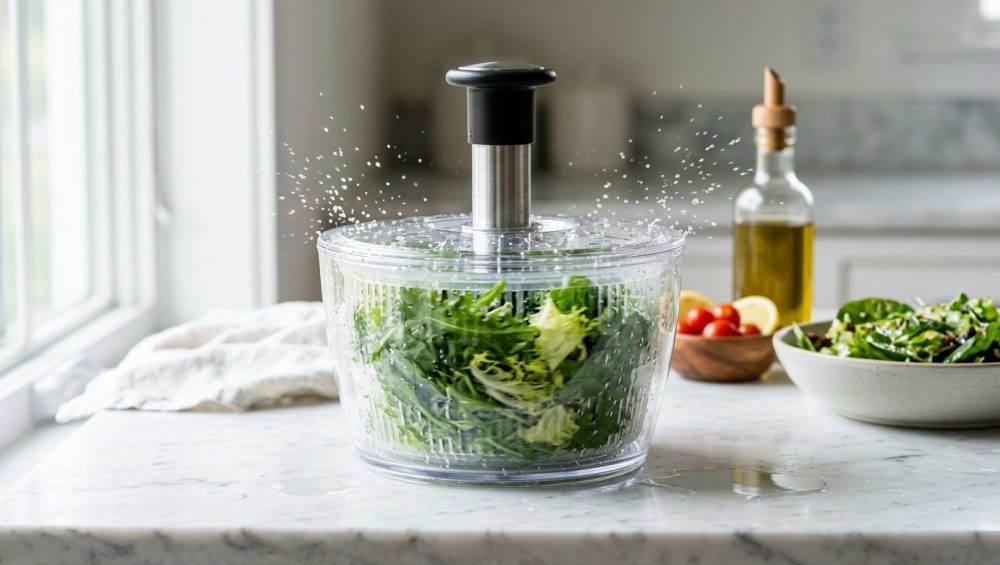
The mechanics of a pump-action spinner are genuinely brilliant. The lid features a central, spring-loaded plunger. Inside this pump mechanism is a vertical shaft with helical (spiral) grooves cut into its length. When you push down on the pump with a single, ergonomic downward motion, internal protrusions engage with these helical grooves, forcing the shaft to rotate. This rotational energy is transferred directly to the basket, spinning it at incredibly high RPMs. When you release the pump, the spring pushes the handle back up without interrupting the basket’s spin.
Why is this superior? First, it requires only one hand. You push down using the natural weight of your body, rather than relying on wrist torque. Second, the downward force naturally stabilizes the bowl against the countertop, eliminating the wobble. Third, the best pump-action models feature a built-in mechanical brake button. Pressing this brake instantly halts the basket, which not only saves you time but provides one final, aggressive mechanical shock that shakes loose any stubborn, lingering droplets of water. Finally, the pump locks down flat into the lid, allowing you to stack other items on top of it in the fridge.
If you are wondering why cheap wooden spoons keep cracking or why your flimsy kitchen gadgets break after a month, it is because they lack this kind of thoughtful, durable, force-distributing mechanical engineering.
The “No-Go” Rule: Banishing Toxic and Flimsy Spinners
You know my core philosophy: I despise cheap, toxic kitchenware. The market is flooded with discount salad spinners made from low-grade polystyrene or mystery plastics that feel brittle to the touch. These cheap plastics warp in the dishwasher, their gears strip after a dozen uses, and worse, they can leach endocrine-disrupting chemicals into your food.
I am uncompromising in my strict rule on banishing toxic kitchen gear from your home. If you are going to invest in a pump-action spinner, you must look for high-quality, food-safe materials.
If you prefer a clear bowl so you can see the water accumulating, demand BPA-free Tritan plastic. Tritan is shatter-resistant, crystal clear, and can withstand the heat of a dishwasher without degrading. However, if you want to truly elevate your kitchen game, invest in a spinner with a heavy-gauge stainless steel outer bowl.
A stainless steel outer bowl is virtually indestructible. It will never stain, it will never retain garlic or onion odors, and it eliminates the frustrating issue of why your plastic containers stay greasy despite endless scrubbing. Even better, a beautiful stainless steel bowl doubles as an elegant serving piece. You can wash, spin, dump the water, dress the salad directly in the stainless bowl, and carry it straight to the dining table. That is the kind of ruthless, dish-saving efficiency we demand for weeknight cooking.
Advanced Spinner Hacks: Expanding Your Culinary Arsenal
Once you own a high-quality pump-action spinner, you will quickly realize it is not a unitasker. Its ability to gently but firmly remove surface moisture makes it one of the most versatile prep tools in your kitchen.
The Ultimate Berry Wash
Berries are notoriously delicate and highly susceptible to mold if stored wet. Place your strawberries, blueberries, or raspberries in the spinner basket. Submerge the basket in the outer bowl filled with water and a splash of white vinegar to kill spores. Let them soak, lift the basket to drain the dirty water, and then give them a very gentle, slow-speed spin. Your berries will last twice as long in the fridge.
Crispy Hash Browns and Fritters
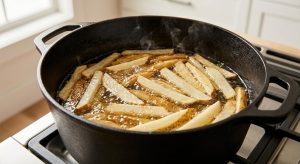
If you have ever tried to make potato hash browns or zucchini fritters, you know that excess vegetable water is the enemy of a crispy sear. Instead of wringing out shredded potatoes in a kitchen towel (which stains the towel and exhausts your hands), throw the shreds into the salad spinner. A few high-speed pumps will extract an astonishing amount of starchy water, guaranteeing a perfectly crispy, golden-brown crust in the skillet.
Weekday Meal Prep Efficiency
For the busy home cook, the spinner is a weekend meal-prep savior. On Sunday, chop and wash three heads of romaine or kale. Spin them until they are bone dry. Leave the dry greens right in the spinner basket, place the basket inside the outer bowl, put the lid on, and stick the whole unit in the fridge. The basket keeps the greens elevated above any residual humidity, allowing air to circulate. You will have crisp, ready-to-eat greens waiting for you every single night of the week.
The Perfect Vinaigrette Equation (Because Dry Greens Deserve Better)
Now that you have perfectly dry, unbruised greens, you have earned the right to dress them properly. A dry leaf is a blank canvas; it will grip your vinaigrette, resulting in a glossy, deeply flavorful salad where every single bite is perfectly seasoned.
To create an emulsion that stays together long enough to coat those leaves, you need to understand the classic 3:1 ratio: three parts oil to one part acid. But oil and acid won’t hold hands without a chemical mediator. You need an emulsifier. Emulsifiers are miraculous molecules that contain both a hydrophilic (water-loving) head and a hydrophobic (oil-loving) tail. They act as a bridge, grabbing the oil with one hand and the vinegar with the other, binding them together into a thick, creamy suspension.
While egg yolks and honey are great, I rely on the absolute magic of dijon mustard as a binder for my everyday vinaigrettes. A single teaspoon of Dijon provides enough emulsifying power to hold a half-cup of dressing together beautifully, while adding a sharp, savory backbone to the flavor profile.
Combine your high-quality olive oil, a splash of champagne vinegar, a dollop of Dijon, a minced shallot, and a generous pinch of kosher salt in a jar. Shake it violently until it looks creamy and opaque. Pour it over your bone-dry greens in a wide bowl. Use your immaculately clean hands—not tongs—to gently toss the leaves, massaging the dressing into every fold and crevice.
Taste a leaf. If it feels heavy or oily, you need a squeeze of fresh lemon juice, because understanding why your dinner actually needs acid is the final secret to balancing rich fats. The acid will cut through the oil, brightening the entire bowl and leaving you with a salad that rivals any high-end bistro in the city.
Final Thoughts for the Home Cook
You do not need a Michelin star to make mind-blowing food in your own home. You just need to stop accepting mediocrity and start understanding the physical properties of your ingredients. Water is the enemy of flavor adhesion. Bruising is the enemy of texture.
By ditching the wasteful paper towels and investing in a durable, high-RPM pump-action salad spinner, you are respecting your ingredients. You are saving time on a busy Tuesday night, and you are setting yourself up for absolute perfection on a lazy Sunday afternoon. Stop letting your beautiful, expensive olive oil pool at the bottom of the bowl. Dry your greens, emulsify your dressing, and go make a salad that actually tastes like something. You’ve got this.