Listen, we need to have a serious conversation about what is happening in your salad bowl. I am pouring myself a generous glass of Pinot Grigio, and I suggest you do the same, because I am about to deliver some tough culinary love.
We have all been there. You spend your precious Saturday afternoon curating a gorgeous array of expensive, farmers-market heirloom vegetables. You carefully wash your delicate spring mix. You spend twenty minutes meticulously prepping your ingredients, wondering why your knives go dull so quickly, only to toss everything together into what should be a vibrant, restaurant-quality masterpiece. You whisk up a beautiful, tangy vinaigrette, pour it over the top, and take a bite.
And it tastes like absolute, watery sadness.
The dressing has completely vanished from the leaves, pooling at the bottom of the bowl in a murky, unappetizing puddle of diluted oil and vinegar. Your greens are limp. Your vegetables are flavorless. You are frustrated, and honestly, you have every right to be. But the culprit isn’t your recipe, your ingredients, or your culinary prowess. The villain ruining your dinner is microscopic, and it is entirely preventable: it is the residual surface water clinging to your lettuce.
Today, we are stripping away the pretentious chef-speak and diving deep into the actual food science of why wet greens repel oil-based dressings. More importantly, we are going to talk about the unsung hero of the home kitchen—the salad spinner. If you think this device is just a bulky, annoying uni-tasker taking up space in your cabinets, prepare to have your mind blown. By the time we are done here, you will view the salad spinner as a non-negotiable, scientific necessity for achieving absolute perfection in your everyday meals.
The Soggy Salad Epidemic: Why We Are Even Having This Conversation
Let’s get one thing straight: anyone can cook like an expert. You do not need a culinary degree from Le Cordon Bleu to make mind-blowing food in a standard home kitchen. What you do need is an understanding of basic food mechanics.
The “soggy salad epidemic” is a plague that haunts weeknight dinners and weekend dinner parties alike. It happens because we treat salads as an afterthought. We meticulously dry our steaks before searing them, we pat down our chicken, but when it comes to lettuce, we run it under the tap, give it a half-hearted shake over the sink, and throw it into a bowl.
When you do this, you are effectively sabotaging your meal before it even begins. A salad is not just a pile of raw vegetables; it is a delicate balance of textures and flavors. The dressing is meant to be a cohesive, clinging glaze that coats every single millimeter of surface area, delivering a perfectly balanced hit of fat, acid, and salt in every bite. When water is present on the leaves, that glaze cannot adhere. Instead, it slides right off, taking all your hard work down to the bottom of the bowl.
The Food Science of Vinaigrettes: Oil, Water, and Your Arch Nemesis
To truly understand why your salad dressing won’t stick, we have to put on our lab coats and look at the molecular reality of what is happening in your bowl. It all comes down to the fundamental laws of chemistry.
Hydrophobia 101: Why Oil Hates Wet Lettuce
You already know the old adage: oil and water do not mix. But let’s look at why. Water molecules are polar, meaning they have a positive charge on one end and a negative charge on the other. Because of this, they love to stick to other water molecules. Oil molecules, on the other hand, are non-polar. They have no charge, and they are entirely hydrophobic (water-fearing).
When you make a classic vinaigrette, you are typically using a ratio of three parts oil to one part acid (like vinegar or lemon juice, which are predominantly water). Because these two liquids naturally repel each other, you have to force them together through a process called emulsification.
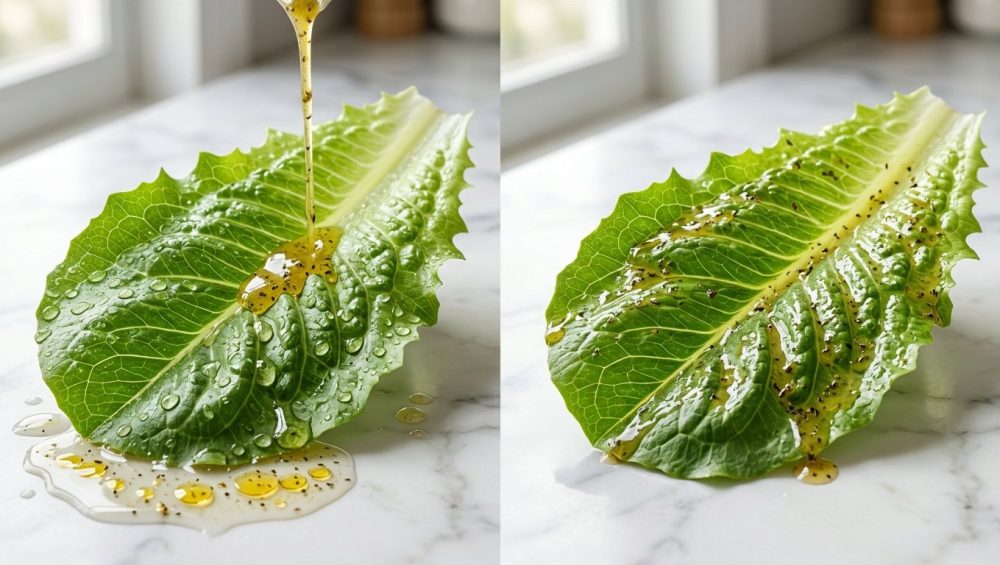
When you pour an oil-based dressing over a wet lettuce leaf, the non-polar oil in your dressing comes face-to-face with the polar water molecules clinging to the leaf. The oil is instantly repelled. The water acts as an invisible, microscopic forcefield, completely blocking the dressing from adhering to the cellular structure of the green. Gravity then takes over, pulling the heavy, separated dressing down to the bottom of the bowl.
The Emulsion Illusion: What Happens When Dressing Hits a Puddle
An emulsion is simply a suspension of two liquids that normally wouldn’t mix, held together by an emulsifier. You might rely on the power of Dijon mustard, egg yolks, or honey to bind your oil and vinegar together into a creamy, cohesive dressing. Emulsifiers work because they have one hydrophilic (water-loving) end and one lipophilic (fat-loving) end, effectively acting as a bridge holding the oil and water droplets together.
However, emulsions are fragile. They require a very specific ratio of fat to water to remain stable. When your perfectly emulsified dressing hits a puddle of unbound water sitting on your wet lettuce, that delicate ratio is instantly destroyed. The excess water dilutes the continuous phase of the emulsion. The emulsifier can no longer hold the oil droplets in suspension, causing the dressing to “break” or separate.
This is why, halfway through eating a wet salad, you notice that your beautiful, creamy vinaigrette has turned into a separated, greasy, watery mess. The only way to prevent this chemical catastrophe is to ensure your greens are bone-dry before the dressing ever touches them.
The Anatomy of a Salad Spinner: Not Just Another Bulky Uni-Tasker
So, how do we get greens bone-dry without spending thirty minutes individually patting down every single leaf with a paper towel? Enter the salad spinner.
I know what you are thinking. “It takes up too much space! It’s annoying to wash!” Listen to me: time is money, my friends. If you want to survive weeknight cooking without ordering expensive takeout, you need tools that rigorously prioritize efficiency. The salad spinner is a marvel of kitchen engineering that accomplishes in ten seconds what would otherwise take you ten minutes.
Centrifugal Force: Physics in the Kitchen
A salad spinner is not a toy; it is a manual, low-tech centrifuge. It operates on Newton’s First Law of Motion: an object in motion stays in motion with the same speed and in the same direction unless acted upon by an unbalanced force.
When you pump, pull, or crank a salad spinner, you are rapidly rotating the inner perforated basket. A high-quality manual salad spinner can easily reach rotational speeds of 600 to 800 Revolutions Per Minute (RPM). As the basket spins, the lettuce leaves and the water droplets on them are pulled into a circular path.
However, the water droplets are small enough to pass through the perforations in the basket. Because of inertia, the water wants to continue moving in a straight line, tangent to the circle. The solid plastic of the outer bowl catches the water, while the inner basket retains the lettuce. This centrifugal force effectively rips the moisture right off the surface of the leaves without applying the blunt physical pressure that would crush or bruise their delicate cell walls. Just as you need proper heat control for your stainless steel pans to prevent food from sticking, you need proper rotational velocity here to achieve dry greens without structural damage.
The Drive Mechanisms: Pump, Pull, or Crank?
Not all spinners are created equal. The physics remain the same, but the ergonomics differ wildly:
- The Pump: Popularized by brands like OXO, this mechanism uses a top-mounted plunger that you push down to engage the gears. It is incredibly easy to use one-handed and usually features a built-in brake button to stop the spinning instantly.
- The Pull-Cord: Similar to starting a lawnmower, this mechanism generates massive RPMs very quickly. It is highly efficient but can be prone to cord fraying over years of heavy use.
- The Crank: The old-school, traditional method. It requires a bit more elbow grease and two hands to stabilize the bowl, but it is mechanically simple and less likely to break down over time.
Whichever mechanism you choose, the goal is rapid acceleration. The faster you can safely spin the basket, the more G-force you generate, and the drier your greens will be.
The “No-Go” Rule on Toxic Gear: Choosing a Safe Salad Spinner
Now, we need to talk about my absolute least favorite thing in the culinary world: cheap, toxic kitchenware. I am a massive advocate for banishing toxic kitchen gear from your home, and the salad spinner market is unfortunately flooded with dangerous, mystery plastics.
The Dangers of Cheap, Mystery Plastics
When you buy a five-dollar salad spinner from a discount bin, you are almost certainly buying a product made with low-grade polycarbonate or PVC plastics. These materials frequently contain Bisphenol A (BPA) and phthalates.
Phthalates are chemical plasticizers used to make plastics flexible, and BPA is an industrial chemical used to make plastics hard and shatterproof. Both of these chemicals are known endocrine disruptors. When they enter the human body, they mimic hormones like estrogen, leading to a terrifying array of potential health issues, including reproductive dysfunction, developmental disorders, and metabolic interference.
Here is the most critical part that most home cooks do not realize: these chemicals leach out of the plastic significantly faster when exposed to heat, fats, or acids. What is a vinaigrette? It is literally a combination of pure fat (oil) and highly concentrated acid (vinegar or citrus). If you are using the bowl of a cheap plastic salad spinner to actually dress and serve your salad—which many people do to save on dishes—you are creating the ultimate chemical solvent. The acid and oil will actively strip the BPA and phthalates right out of the plastic and into your food. We all know how cheap plastic containers stain orange after one batch of leftover chili; that is a visual indicator of how porous and chemically reactive cheap plastic truly is.
What to Look For: BPA-Free, Stainless Steel, and Durability
Do not compromise on your health to save ten dollars. When selecting a salad spinner, you have two safe routes:
- High-Quality, BPA-Free Plastic: If you prefer the lightweight nature of plastic, you must verify that the manufacturer explicitly guarantees the product is 100% BPA-free and phthalate-free. Look for reputable brands that use Tritan or other advanced, food-safe polymers.
- Stainless Steel or Tempered Glass: This is the gold standard for the serious home cook. Many premium salad spinners now feature an outer bowl made of high-grade stainless steel or shatter-resistant glass. Not only are these materials completely inert and non-toxic, but they also double as stunning, elegant serving bowls. Furthermore, stainless steel retains temperature beautifully. You can chill the bowl in the fridge before serving, ensuring your salad stays crisp and cold at the dinner table.
Masterclass: The Step-by-Step Guide to Perfectly Dried Greens
Having the right gear is only half the battle; knowing how to use it with professional precision is where the magic happens. Let’s walk through the exact, step-by-step process for prepping greens that will grip your dressing like a vice.
The Pre-Soak: Removing Grit and Grime
Do not just throw your lettuce into the basket and run it under the faucet. Running water is highly inefficient at removing stubborn dirt trapped in the microscopic crevices of leafy greens.
Instead, use the salad spinner bowl as a wash basin. Fill the bowl with cold water—add ice cubes if your greens are looking a bit sad and wilted. The ice-cold water will shock the plant cells, increasing their turgor pressure and restoring their crisp, crunchy texture. Submerge the inner basket containing your greens into the water. Agitate the leaves gently with your hands to loosen the dirt.
Let it sit for three to five minutes. Gravity will do the heavy lifting here, pulling the heavy grit, sand, and microscopic bugs down through the basket and into the bottom of the bowl. When you are ready, lift the basket straight up. The dirt stays trapped in the water below, and your greens emerge pristine. Dump the dirty water and rinse the bowl clean.
The Spin Cycle: How Fast is Too Fast?
Place the basket back into the empty bowl and lock the lid. Here is the biggest rookie mistake: overstuffing. If you pack the basket to the brim, the centrifugal force cannot properly pull the water from the greens trapped in the dead center of the mass. You must leave room for the leaves to shift and breathe. Never fill the basket more than two-thirds full. If you have a massive amount of lettuce, do it in two batches. Time is money, yes, but ruining your dinner to save forty-five seconds is a false economy.
Spin the greens in short, aggressive bursts. A continuous, endless spin is unnecessary. Give it a vigorous spin for about ten to fifteen seconds, hit the brake, and let it stop completely. Remove the lid, gently toss the greens with your hands to redistribute them, and give it one more ten-second spin. You will be shocked at how much water accumulates in the bottom of the bowl on that second spin.
The Paper Towel Trick (For the Absolute Perfectionist)
If you are meal-prepping for the week, you want your greens to last in the fridge without turning into a slimy, brown mess. The enemy of longevity is, once again, moisture.
After spinning your greens, line a large, breathable storage container with a single, dry paper towel. Place the spun greens inside, and put another paper towel on top before loosely sealing the lid. The paper towels will act as a desiccant, absorbing any ambient humidity and residual microscopic moisture. Stored this way, a batch of washed greens can stay shatteringly crisp for over a week, buying you immense amounts of time on busy weekday evenings.
Beyond Lettuce: Unexpected Ways a Salad Spinner Buys You Time
I despise kitchen tools that only do one thing. Space is at a premium, and if a tool is going to take up the footprint of a small dog, it better pull its weight. Fortunately, the salad spinner is a multi-tasking powerhouse. Once you understand the physics of centrifugal drying, you will find yourself reaching for this tool constantly.
Drying Herbs Without Bruising Them
Fresh herbs like basil, cilantro, and parsley are incredibly delicate. If you try to dry them by aggressively rubbing them with a kitchen towel, you will crush their cell walls. This releases their essential oils prematurely, leading to rapid oxidation (turning them black) and a loss of flavor. A quick, gentle spin in the salad spinner removes the water instantly while keeping the delicate leaves entirely intact.
Prepping Berries, Beans, and Fungi
Washing berries is a nightmare. They hold onto water, and if you put wet strawberries back into the fridge, they will mold in twenty-four hours. A very gentle, slow spin removes that excess moisture, extending their shelf life dramatically.
The same goes for mushrooms. Yes, you should wash your mushrooms. The old myth that they act like sponges and shouldn’t be washed is largely exaggerated, provided you dry them immediately. If your sautéed mushrooms are soggy, it is because they were waterlogged before they ever hit the heat. Toss them in the spinner after a quick rinse, blast the water off, and they will sear beautifully in a hot pan.
You can also use the inner basket as a colander to drain and rinse canned beans or pasta. Just be careful not to pour boiling pasta water into a cheap plastic spinner, as the heat can warp the plastic. (Yet another reason to invest in a stainless steel or glass model!)
Meat and Seafood Prep
This is a game-changer for the weekend culinary hobbyist. When you are searing scallops or shrimp, surface moisture is your worst enemy. Water creates steam, and steam prevents the Maillard reaction—the chemical process responsible for that beautiful, flavorful brown crust.
If you want to achieve perfectly seared fish, shrimp, or scallops, you must dry them thoroughly. You can line the basket of your spinner with a paper towel, place your rinsed shrimp inside, and give them a quick spin. The centrifugal force pulls the water out of the crevices of the seafood far more effectively than patting them down by hand.
The Dressing Application: Coating Every Leaf Like a Michelin-Starred Chef
You have conquered the food science. You have banished the toxic plastics. You have utilized centrifugal force to achieve bone-dry, pristine greens. Now, it is time for the grand finale: the dressing application.
The Bowl Toss Technique
Do not ever pour dressing over a salad while it is sitting in the serving bowl, and absolutely never pour it directly onto greens sitting on a dinner plate. This results in uneven distribution—some bites will be overwhelmingly acidic, while others will be completely dry.
You must dress your salad in a separate, massive mixing bowl. The bowl should look comically large for the amount of lettuce you are using. This gives you the necessary real estate to move the greens around without bruising them or spilling them all over your counter.
Drizzle a small amount of your emulsified vinaigrette around the sides of the bowl, not directly onto the leaves. Then, use your hands. Yes, your impeccably clean, bare hands. Form your fingers into wide claws and gently lift and fold the greens, wiping them against the sides of the bowl to pick up the dressing. Your hands are the most sensitive, intuitive tools in your kitchen. They will tell you exactly when every single leaf is lightly, perfectly coated.
Flavor Pacing and When to Add the Acid
Timing is everything. Vinegar and citrus juices are highly acidic, and acid breaks down the cellular structure of leafy greens. If your salads are always soggy by the time they reach the table, you might be dressing them too early.
For delicate greens like arugula, butter lettuce, or spring mix, you must practice strict flavor pacing. Do not add the dressing until the absolute last possible second before serving. Toss it, plate it, and immediately put it in front of your guests.
The only exception to this rule is hearty, fibrous greens like kale or shredded cabbage. These sturdy vegetables actually benefit from a bit of chemical breakdown. You can dress a kale salad fifteen to twenty minutes before serving; the acid will gently macerate the tough fibers, softening the texture and infusing the flavor deeply into the leaves without turning them to mush.
Weekday Efficiency vs. Weekend Artistry
I firmly believe that mastering these simple, scientific concepts is the key to transforming cooking from a stressful chore into a joyful, creative outlet.
During the week, when you are exhausted from work, efficiency is your lifeline. Just as nobody wants a side dish where the roasted veggies are soggy, nobody wants a limp, depressing salad on a Tuesday night. By batch-washing and spinning your greens on Sunday, and storing them properly with the paper towel trick, you buy yourself back precious time. You can throw together a vibrant, perfectly textured salad in three minutes flat. Even if your weeknight chicken breast turns out dry, a bright, perfectly dressed, crunchy salad can elevate the plate and save the entire meal.
On the weekends, when you have the luxury of time, this fundamental technique allows you to play. You can experiment with complex, emulsified dressings featuring roasted shallots, fresh herbs, and expensive finishing oils, knowing confidently that your dressing will cling beautifully to your meticulously dried greens.
Final Thoughts: Reclaiming Your Salad Dignity
A great salad is a revelation. It provides the necessary acidic, crunchy counterpoint to rich, heavy proteins and starches. It wakes up the palate. But it demands respect.
The next time you are tempted to skip the drying process, I want you to visualize those hydrophobic oil molecules aggressively bouncing off the wet puddles on your lettuce. I want you to remember the tragedy of a broken emulsion pooling at the bottom of the bowl.
Embrace the physics. Ban the toxic, cheap plastics. Invest in a high-quality, stainless steel or BPA-free salad spinner, and treat it with the reverence it deserves. It is not a uni-tasker; it is a centrifugal moisture-eradication system, and it is the only thing standing between you and the flawless, restaurant-quality salads you absolutely deserve to be eating.
Now, finish your wine, go wash your greens, and give them a spin. You’ve got this.