Let’s have a brutally honest conversation about the bottles currently sitting in the door of your refrigerator. If you were to walk over to your kitchen right now, open the fridge, and pull out a bottle of store-bought salad dressing, I can almost guarantee you will find a horror show of an ingredient list. You will likely see high-fructose corn syrup listed as the second or third ingredient, followed closely by highly refined, inflammatory soybean or canola oils, and a laundry list of unpronounceable chemical stabilizers, artificial colors, and synthetic preservatives. We have somehow been conditioned to believe that making a simple liquid to pour over our greens is a task so monumentally difficult that we must outsource it to massive food conglomerates.
As a home cook who believes firmly that you deserve restaurant-quality food without needing a culinary degree, I am here to tell you that buying bottled salad dressing is a culinary crime. It is a waste of your hard-earned money, a disservice to your fresh produce, and completely unnecessary. You can make a mind-blowing, perfectly balanced, utterly delicious vinaigrette in your own kitchen in exactly two minutes.
However, I also know exactly why you might be intimidated by the prospect of making your own dressing. We have all been there. You mix some expensive extra virgin olive oil with some fancy balsamic vinegar, give it a hopeful stir, and for about thirty seconds, it looks glorious. But by the time you carry the salad bowl to the dining table, a tragedy has occurred. The dressing has completely separated into a sad, distinct layer of dense, dark vinegar trapped beneath a thick, greasy slick of oil.
When you pour this unstable mess over your beautiful, crisp greens, the results are disastrous. The heavy oil immediately coats the leaves, suffocating them and turning them into a wilted, greasy mess. Meanwhile, the watery vinegar slides right off the oil-coated lettuce and pools at the very bottom of the bowl. Your first few bites of the salad taste like nothing but pure fat, and your last few bites are an aggressively sour, acidic shock to the palate. Serving a salad like this is one of those common rookie kitchen mistakes that will instantly downgrade an otherwise spectacular dinner party.
But do not panic, and absolutely do not go back to the grocery store aisle of despair. You do not lack culinary talent; you are simply losing a battle against basic molecular physics. Today, we are going to dive deep into the fascinating, highly accessible kitchen chemistry of emulsification. We are going to explore why oil and water despise each other, and more importantly, we are going to learn how to force them to get along using the simple, scientific magic of Dijon mustard. Grab a glass of wine, get comfortable, and let’s master the art of the perfect, unbreakable vinaigrette.
The Anatomy of a Vinaigrette Disaster
To understand how to fix your salad dressing, we first have to understand why it fails. If your homemade vinaigrette always separates, it is not because you used the wrong brand of olive oil or because you didn’t whisk it hard enough. It is because you are fighting against the fundamental laws of thermodynamics and molecular polarity.
Vinegar is essentially composed of acetic acid dissolved in water. Water molecules are polar, meaning they have a slightly positive electrical charge on one end and a slightly negative charge on the other end, much like a magnet. Because of these charges, polar molecules love to stick to other polar molecules. They are hydrophilic, which translates to “water-loving.”
Oil, on the other hand, is composed of lipids and fats. These molecules are non-polar. They do not have uneven electrical charges, and they absolutely despise water. They are hydrophobic, or “water-fearing.”
When you pour oil and vinegar into the same bowl, they immediately recognize that they are fundamentally incompatible. The water molecules aggressively pull toward each other, effectively squeezing the oil molecules out of the way. Because oil is less dense than water, it floats to the top, creating two distinct, stubbornly separate layers.
Now, you might think that putting them in a mason jar and shaking it with the fury of a thousand suns will solve the problem. When you violently shake the jar, you are applying mechanical shear force. You are physically shattering the oil into millions of microscopic droplets and temporarily scattering them throughout the vinegar. For a brief, shining moment, it looks creamy and unified. This is called a temporary suspension.
But the moment you stop shaking, thermodynamics takes over again. The microscopic oil droplets are desperate to escape the water. They bump into each other, fuse together to minimize their surface area, and rapidly coalesce back into a single, greasy layer at the top of the jar. You cannot beat physics with elbow grease alone. You need a chemical mediator. You need a diplomat. You need a surfactant.
Enter the Hero: What Actually Is Emulsification?
If we want to create a permanent peace treaty between oil and water, we have to introduce a third party that understands both sides. In the culinary world, this process is called emulsification, and the magical ingredient that makes it happen is called an emulsifier, or a surfactant.
You do not need a PhD in chemistry to understand how this works. Imagine an emulsifier as a microscopic molecule shaped like a tadpole. The “head” of this molecule is hydrophilic; it absolutely loves water and wants to bury itself in the vinegar. The “tail” of the molecule is hydrophobic; it hates water but loves fat, and wants to bury itself in the oil.
When you introduce an emulsifier into your salad dressing and begin to whisk, something incredible happens. As the mechanical force of your whisk breaks the oil down into tiny droplets, the emulsifier molecules rush in. They embed their fat-loving tails into the oil droplets, leaving their water-loving heads sticking out into the surrounding vinegar.
Because the entire surface of the oil droplet is now coated in these water-loving heads, the vinegar is suddenly perfectly happy to surround it. Furthermore, these coated oil droplets now repel each other, meaning they can no longer fuse back together into a giant oil slick. The oil is permanently trapped in a microscopic state of suspension within the liquid. The result? A dressing that transforms from two thin, watery liquids into a rich, creamy, velvety, unified sauce that will beautifully coat every single leaf of your salad without ever making it soggy.
The Simple Magic of Dijon Mustard
So, where do we find these magical emulsifying molecules? The food industry relies on highly processed, lab-created additives like polysorbates or heavily extracted soy lecithin to keep their bottled dressings stable on a supermarket shelf for three years. But in a home kitchen, we have access to one of the most powerful, flavorful, and entirely natural emulsifiers on the planet: the humble mustard seed.
Mustard is not just a sharp, tangy condiment meant for hot dogs and deli sandwiches. It is a structural powerhouse. The secret lies in the outer coating of the mustard seed, which contains a highly complex polysaccharide compound known as mucilage.
Mucilage is essentially a natural, plant-based gum. When it comes into contact with water, it hydrates, swells, and becomes incredibly viscous and gel-like. This mucilage performs a brilliant double-duty in your vinaigrette. First, the complex proteins and carbohydrates within the mucilage act as powerful surfactants, physically binding the oil and water together. Second, the mucilage acts as a thickener, increasing the viscosity of the water phase, which drastically slows down the movement of the oil droplets and prevents them from bumping into each other.
Why Dijon Reigns Supreme
You might be wondering if you can just squeeze some bright yellow hot dog mustard into your bowl and call it a day. While any mustard seed contains some level of mucilage, not all prepared mustards are created equal when it comes to culinary science. If you want a truly bulletproof, restaurant-quality emulsion, Dijon mustard is the undisputed king.
Here is the science behind why Dijon is non-negotiable. Traditional Dijon mustard is manufactured using brown mustard seeds (Brassica juncea), whereas standard yellow mustard is made using white or yellow mustard seeds (Sinapis alba). This distinction is chemically massive. Scientific assays have shown that brown mustard seeds yield a staggering 12.7% mucilage content, compared to a mere 4.1% found in yellow mustard seeds. By using Dijon, you are packing over three times the emulsifying power into your bowl.
Furthermore, authentic Dijon mustard is processed using white wine vinegar and verjuice (the highly acidic juice of unripe grapes), rather than the harsh distilled white vinegar used in cheap yellow mustards. This specific blend of acids gives Dijon mustard an optimal pH level hovering between 3.6 and 3.9. At this exact pH, the galactomannan backbone of the mustard’s mucilage remains perfectly hydrated and viscoelastic, allowing it to form the strongest possible barrier around your oil droplets.
While you might be tempted to build deep, complex flavor in your dressing by taking your dried herbs and blooming them in oil first, you must remember that the structural integrity of your vinaigrette relies entirely on the hydration of this mustard mucilage. The mustard must be thoroughly mixed with the water-based acid before a single drop of oil is introduced.
What About Dry Mustard or Whole Grain?
Can you use dry mustard powder? Yes, absolutely. Dry mustard is simply ground mustard seeds, meaning it contains all the necessary mucilage. However, because it is dehydrated, it requires time to absorb the vinegar and activate its gel-like properties. It is also significantly more pungent and spicy than prepared Dijon, which can easily overpower a delicate salad.
Whole grain mustard is another beautiful option, as the intact seed hulls provide a wonderful rustic texture. However, the mucilage is largely locked inside those intact hulls, meaning its emulsifying power is slightly lower than the finely pureed Dijon. If you want the aesthetic of whole grain mustard, the smartest chef trick is to use a 50/50 split: half smooth Dijon for structural stability, and half whole grain for visual appeal and texture.
The Sassy Sous-Chef’s Foolproof Vinaigrette Formula
Now that you understand the molecular warfare happening in your salad bowl, it is time to put the science into practice. Making a stable vinaigrette is not about following a rigid recipe; it is about memorizing a fundamental ratio and executing a specific physical technique.
The golden, unbreakable rule of vinaigrettes is the 3-to-1 ratio. That is exactly three parts oil to one part acid. To this base, you add your emulsifier and your seasonings. If you memorize this ratio, you will never need to look up a salad dressing recipe for the rest of your life.
Here is the step-by-step masterclass on how to execute it flawlessly.
Step 1: Establish the Acid Base
In a heavy mixing bowl, begin by adding your acid. For a standard batch that will dress a large salad for four people, start with 1 tablespoon of acid. This can be a high-quality white wine vinegar, apple cider vinegar, champagne vinegar, or freshly squeezed lemon juice.
This is also the moment to add your salt, pepper, and aromatics. Salt dissolves beautifully in water (vinegar), but it absolutely refuses to dissolve in oil. If you add your salt at the end, your dressing will be gritty. Add a generous pinch of kosher salt to the vinegar now. If you are using minced shallots or garlic, add them to the vinegar as well. Allowing pungent alliums to sit in acid for five minutes will gently “cook” them, taking away their harsh, raw bite and ensuring that your garlic always burns perfectly bright and mellow on the palate rather than stinging your tongue.
Step 2: Activate the Binding Agent
Next, add 1 full teaspoon of high-quality Dijon mustard to the vinegar mixture. Do not add the oil yet! You must aggressively whisk the mustard into the vinegar until the mixture is completely smooth and homogeneous.
This step is critical. By whisking the mustard into the water phase first, you are giving the mucilage time to hydrate, swell, and unfold its surfactant proteins. You are priming the chemical trap, getting the water-loving heads of the emulsifier ready to receive the fat.
Step 3: The Slow Oil Emulsion
Now comes the mechanical magic. You need 3 tablespoons of high-quality extra virgin olive oil.
Place a damp kitchen towel flat on your counter, and set your mixing bowl on top of it. This brilliant restaurant trick will hold the bowl completely steady, freeing up both of your hands. Take your whisk in your dominant hand, and the measuring cup of oil in your other hand.
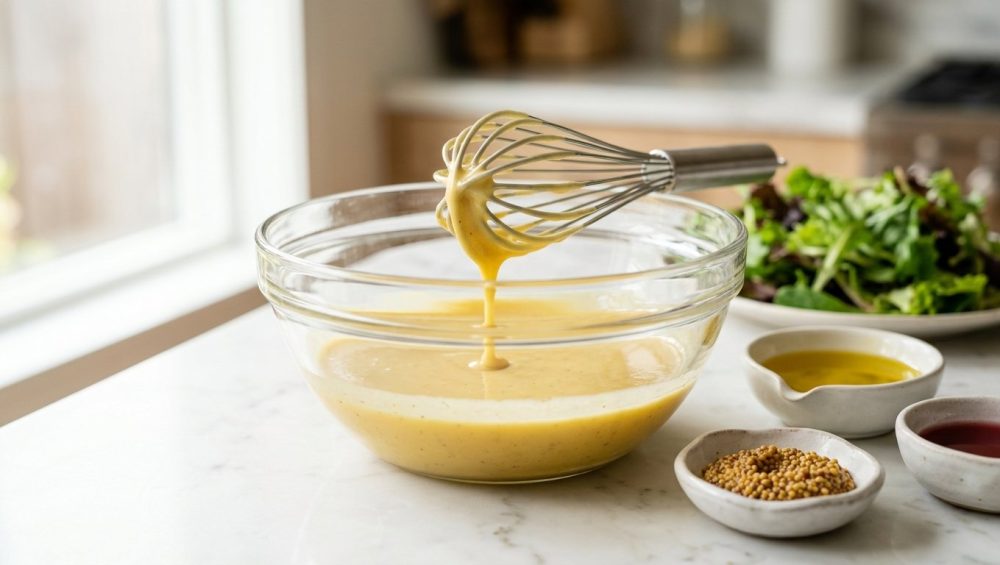
Begin whisking the vinegar and mustard mixture rapidly in a tight, circular motion. While whisking constantly, begin adding the olive oil just a few drops at a time. Do not rush this. If you dump all the oil in at once, the mustard mucilage will be overwhelmed, the oil droplets will remain too large, and the emulsion will instantly break.
As you slowly drizzle and vigorously whisk, you will witness a physical transformation. The dark, watery liquid will suddenly turn pale, opaque, and noticeably thicker. The whisk will start to leave distinct trails in the liquid. Just as the water drop test gives you a visual cue that a skillet is perfectly preheated, this sudden thickening is your visual cue that the emulsion has successfully formed. Once the base is thick and stable, you can pour the remaining oil in a slightly faster, steady stream, whisking until everything is lush and velvety.
The “No-Go” Rule on Toxic Gear
Let’s take a brief but incredibly important detour to talk about the equipment you are using to make this dressing. I have zero patience for cheap, toxic kitchenware, and neither should you. The tools you use directly impact both the success of your emulsion and the health of your family.
First, absolutely never whisk a vinaigrette in a cheap plastic mixing bowl. Plastic is highly porous. It absorbs the pungent odors of old garlic and rancid oils, and it inevitably leaches microplastics into your acidic ingredients. If you notice that your plastic containers stay greasy no matter how many times you run them through the dishwasher, it is because the plastic is fundamentally degrading. Throw them in the recycling bin immediately.
You must use a heavy-gauge, non-reactive stainless steel mixing bowl, or a thick, tempered glass bowl. These materials are completely non-porous, meaning they will not react with the high acidity of the vinegar, and they will never harbor leftover flavors.
Second, let’s talk about your whisk. You need a sturdy, stainless steel balloon whisk with plenty of thin, flexible tines. The more tines the whisk has, the more sheer force it generates, and the smaller the oil droplets become. Do not use those flimsy, silicone-coated whisks. The silicone coating inevitably chips, peels, and flakes off into your food. Just like the cheap aerosol cooking sprays that are ruining your nonstick pans with a sticky, polymerized chemical residue, peeling silicone is a kitchen hazard that has no place in your food.
A proper stainless steel bowl and a high-quality stainless steel whisk are lifetime investments. They are inexpensive, completely safe, and they perform infinitely better than their toxic, plastic counterparts. Just like a heavy-duty bench scraper is an absolute necessity for handling dough and transferring chopped vegetables, a flawless set of stainless steel bowls is the non-negotiable foundation of a safe, efficient kitchen.
Troubleshooting: How to Rescue a Broken Dressing
We are all human, and sometimes, especially on a chaotic weeknight when you are trying to manage three pans on the stove at once, mistakes happen. Maybe you poured the oil in too fast, or maybe your arm got tired and you stopped whisking. Suddenly, you look down into your bowl and see that your beautiful, creamy dressing has split into a horrifying, oily, curdled mess.
Do not throw it away! A broken emulsion is simply a chemical imbalance, and because we understand the science, we can easily reverse it. Here are two foolproof ways to rescue a split vinaigrette.
The Hot Water Trick:
Sometimes, a dressing breaks because the oil was too cold and the viscosity became too high for the whisk to properly shear the droplets. To fix this, simply add one single teaspoon of very warm (not boiling) water to the broken dressing, and whisk violently. The slight heat will lower the viscosity of the oil, and the added water will give the hydrophilic heads of the mustard mucilage a little more room to maneuver and realign. Within ten seconds of aggressive whisking, the dressing will magically snap back together into a creamy state.
The Fresh Mustard Hail Mary:
If you dumped an entire cup of oil into the bowl at once and the hot water trick isn’t working, you need to start a new emulsion and feed the broken one into it. Grab a clean glass bowl. Add one fresh teaspoon of Dijon mustard and a tiny splash of vinegar. Whisk them together to activate the mucilage. Now, treat your broken, separated dressing as if it were pure oil. Very, very slowly, drop by drop, whisk the broken dressing into the new mustard base. Because you are introducing the fat slowly into a highly concentrated surfactant environment, it will re-emulsify perfectly.
Beyond Dijon: Other Natural Emulsifiers to Play With
Once you have mastered the classic Dijon vinaigrette, you can start treating your kitchen like a culinary laboratory. While mustard mucilage is incredibly reliable, there are several other natural ingredients that contain powerful surfactants and can stabilize a dressing while introducing entirely new flavor profiles.
Honey:
Honey is a highly viscous, thick liquid that acts as a fantastic physical stabilizer. While it does not have the chemical surfactant power of mustard, its sheer thickness prevents oil droplets from moving quickly enough to coalesce. Combining a teaspoon of honey with a teaspoon of Dijon creates the ultimate, unbreakable Honey Mustard dressing.
Mayonnaise:
Mayonnaise is already a perfectly stable emulsion of oil, egg yolks, and acid. The egg yolks contain lecithin, which is arguably the most powerful natural emulsifier on earth. Whisking a tablespoon of high-quality mayonnaise into your vinaigrette base will yield a dressing that is incredibly rich, creamy, and practically impossible to break.
Miso Paste:
For an umami-packed, Asian-inspired dressing, fermented soybean paste (miso) is a brilliant binder. Soybeans naturally contain high levels of soy lecithin, and the thick, paste-like texture of the miso acts just like mustard to thicken the water phase and lock the oil droplets in place.
Storing Your Masterpiece
Because making a vinaigrette takes mere minutes, I highly recommend making a fresh batch every time you need it. However, if you want to save time and meal-prep for the week, a properly emulsified Dijon vinaigrette will hold together beautifully in the refrigerator for up to a week.
Store your dressing in a small glass mason jar with a tight-fitting lid. Do not freeze it! Food science studies have shown that freezing a vinaigrette causes the water to expand into ice crystals, which violently and irreversibly ruptures the delicate galactomannan mucilage networks. A thawed mustard vinaigrette will experience 100% phase separation and can never be fully rescued.
When you pull your refrigerated dressing out to use it, you might notice that it looks thick, cloudy, and slightly solidified. Do not panic; your emulsion hasn’t failed. Extra virgin olive oil contains natural waxes and saturated fats that solidify at cold refrigerator temperatures. Simply let the jar sit on the kitchen counter for fifteen minutes to come up to room temperature, give it a quick, vigorous shake to wake up the molecules, and it will be perfectly fluid and creamy again.
Finally, a quick note on fresh additions. If you love adding chopped parsley, basil, or dill to your dressings, do not add them to the jar if you plan on storing it. The high acidity of the vinegar will aggressively break down the delicate cellular walls of the greens. Nobody wants to chew on a salad where the fresh herbs get slimy, oxidized, and brown. Keep your base dressing plain in the fridge, and whisk in your freshly chopped herbs at the exact moment you are ready to serve.
The Final Whisk
Cooking does not have to be a stressful, chaotic guessing game. When you stop blindly following internet recipes and start understanding the simple, underlying science of your ingredients, the kitchen transforms from a place of anxiety into a place of empowerment.
By utilizing the incredible mucilage power of Dijon mustard, respecting the 3-to-1 ratio, and investing in safe, high-quality stainless steel gear, you have officially conquered one of the foundational pillars of the culinary arts. You have banished toxic, sugar-laden bottled dressings from your life forever, and you possess the knowledge to elevate a simple bowl of Tuesday night greens into a masterpiece.
Taking the time to master these small, fundamental techniques is exactly how you build a beautifully organized dream kitchen where every action is intentional, efficient, and exceptionally delicious. Now, go grab your whisk, trust the science, and go make a salad that is actually worth eating.