Hosting a weekend gathering should be about connection, laughter, and sharing a great meal—not quietly panicking in the kitchen because your produce is dying a rapid death. Setting up a gorgeous, interactive DIY salad bar is the perfect host move: it’s customizable, it looks vibrant and abundant on the kitchen island, and it supposedly saves you from sweating over a hot stove while everyone else is sipping Pinot Noir. You prep everything a few hours early, feeling like an absolute domestic genius. But when the time comes for your guests to actually build their bowls, you look down in horror. Your beautiful, perky romaine looks like it just ran a marathon in a sauna. Your spring mix resembles wet tissue paper.
Welcome to the tragic reality of the wilted salad bar.
Look, I have zero patience for pretentious chef-speak, but I also have zero tolerance for ruined food when the fix is entirely rooted in basic, accessible science. You don’t need a culinary degree to keep lettuce crisp for hours; you just need to understand what the heck is actually happening to those leaves on a cellular level. We are going to dive deep—and I mean deep—into the biology of your greens, the thermodynamics of your fridge, and the absolute garbage kitchenware you need to throw away immediately if you want to stop serving sad, limp salads. Time is money, especially on a Friday night, so let’s cut the fluff and get into the masterclass.
The Science of the Slump: What Actually Causes Wilting?
Before you can fix the problem, you have to understand the enemy. And the enemy, my friends, is a loss of something called turgor pressure.
Think of a plant cell like a microscopic water balloon stuffed inside a cardboard box (the cell wall). When that water balloon is completely full, it pushes hard against the inside of the box, making the whole structure rigid and firm. This internal water pressure is turgor pressure. High turgor pressure equals crisp, crunchy lettuce that snaps when you bite into it. When the water escapes, the balloon deflates, the pressure drops, and the cell wall collapses inward. Congratulations, you now have a wilted leaf.
But how does the water escape? Through a biological process called transpiration. Even after a head of lettuce is violently severed from its roots and shipped to your local grocery store, its tissues are still technically breathing. The leaves contain microscopic pores called stomata, which constantly release water vapor into the air. A freshly harvested head of lettuce can lose up to 5% of its weight in water in just the first 24 hours.
When you leave your prepped salad greens sitting out on the counter in a decorative bowl for your party, you are essentially speeding up this dehydration process. Temperature drives transpiration rates, meaning that for every 10°F increase in ambient temperature, the rate of water loss practically doubles.
This isn’t just a minor annoyance; it’s a massive driver of global food waste. According to the 2024 Food Waste Index Report by the United Nations Environment Programme (UNEP), households generate a staggering 631 million tonnes of food waste globally every year. A huge chunk of that is highly perishable produce like leafy greens. We are literally throwing away sad veggies and flushing our hard-earned grocery money down the drain because we don’t know how to manage a little cellular hydration.
Moisture: The Ultimate Frenemy of Fresh Greens
Here is the grand paradox of the salad bar: lettuce needs moisture to survive, but surface moisture will absolutely destroy it. Let me explain.
When you wash your greens—which you absolutely must do, because nobody wants a side of E. coli or grit with their dinner—you are introducing water to the exterior of the leaves. If you don’t remove that surface water before storing or serving the greens, you are inviting disaster. Excess surface moisture creates a breeding ground for bacteria and mold, accelerating the breakdown of the leaf tissue. Furthermore, if your leaves are wet, your dressing won’t stick to them. Oil and water famously despise each other. A wet piece of lettuce will just repel your beautiful homemade vinaigrette, leaving a puddle of sad, diluted liquid at the bottom of the bowl.
The Salad Spinner: A Non-Negotiable Kitchen Tool
If you are still drying your lettuce by rolling it up in paper towels and aggressively patting it down, I need you to stop. You are bruising the delicate cell walls, which triggers the release of enzymes that digest pectin (the glue holding the cells together), leading to rapid decay. You need a salad spinner.
However, we need to have a serious talk about the gear you are using. I absolutely despise cheap, toxic kitchenware. If you are using a flimsy, mystery-plastic salad spinner that you bought for five dollars at a discount store, you are doing it wrong. Those cheap plastics often contain bisphenols and other endocrine-disrupting chemicals that can leach into your food, especially if they are ever exposed to heat (like being tossed in the bottom rack of a dishwasher). Plus, they crack if you look at them wrong.
Invest in a high-quality, durable stainless steel or heavy-duty borosilicate glass salad spinner. Yes, they cost a bit more upfront, but they will outlive you. A stainless steel bowl can also double as a chilling vessel for your salad bar, holding cold temperatures far better than plastic ever could.
Temperature and Humidity: Creating a Crunch-Preserving Microclimate
To halt transpiration and keep your greens in a state of suspended, crisp animation until your guests arrive, you have to master the microclimate. The ideal storage environment for leafy greens is between 32°F and 39°F (0°C to 4°C), paired with a relative humidity of 90% to 95%.
Your refrigerator’s main compartment is cold, but it is aggressively dry. The cold air in a standard fridge holds only about 20% of the moisture capacity of room-temperature air. If you just toss a bowl of naked, unprotected lettuce into the fridge, the dry air will violently suck the moisture right out of the stomata, leaving you with limp greens.
This is why the crisper drawer exists, but for a DIY salad bar, you are likely prepping large volumes of greens that won’t fit in the drawer.
The “Damp Towel” Method for Make-Ahead Prep
If you want to prep your greens on a Friday morning for a Friday night gathering (because time is money and you have better things to do than chop lettuce while your guests are arriving), here is the foolproof method:
- Wash and Spin: Wash your greens in cold water and spin them until they are bone dry.
- The Towel Wrap: Line a large, non-toxic storage container (glass or stainless steel) with a slightly damp—not soaking wet, just barely damp—clean cotton kitchen towel or unbleached paper towel.
- Layering: Place the spun greens inside the container. If you have a massive amount, layer another slightly damp towel in the middle.
- Seal It Up: Seal the container airtight.
This creates a high-humidity microclimate that prevents the dry fridge air from stealing the leaves’ internal moisture, while the towel absorbs any excess surface water that could cause rotting.
And please, for the love of all things culinary, stop storing your food in degrading plastic tubs. You know the ones—they are warped, scratched, and you are constantly wondering why your plastic containers stain orange after one encounter with tomato sauce. Scratched plastic harbors bacterial biofilms that even the dishwasher can’t eradicate. Upgrade to tempered glass or high-grade stainless steel storage containers. Your health and your lettuce will thank you.
The Dressing Dilemma: Acid, Oil, and Cellular Destruction
Let’s address the elephant in the room: why your salads are always soggy the second you add the vinaigrette.
Many well-meaning hosts think they are doing their guests a favor by pre-tossing the salad in a massive bowl before setting it out on the buffet. This is a catastrophic mistake. The moment dressing touches a delicate leafy green, a biological countdown clock begins, and you have about 15 minutes before total structural failure.
The Chemistry of a Vinaigrette Attack
A standard vinaigrette is an emulsion of oil and an acid (like vinegar or citrus juice). Both of these components are highly destructive to plant cells, but in entirely different ways.
First, let’s look at the acid. Vinegar typically has a highly acidic pH level. Plant cells have an outer membrane made of lipids. When exposed to an acidic environment, the molecules making up this lipid membrane begin to break apart. The tiny hydrogen ions from the acid penetrate the cell membrane, lowering the internal pH, denaturing proteins, and destroying the cell wall’s integrity. The result? The cell leaks its water, turgor pressure plummets, and the leaf collapses.
But what if you just use oil? Some old-school, outdated cookbooks claim that you should toss greens in oil first to create a protective barrier against the acid. Science says otherwise. Lettuce leaves actually have a natural, microscopic waxy coating designed to repel rainwater. Water-based liquids bead up and roll off. However, oil is lipophilic (fat-loving). It clings aggressively to the waxy surface, seeping into the microscopic cracks and air pockets between the cells. The heavy oil literally suffocates the leaf, weighing it down and causing it to darken and wilt even faster than vinegar does.
The Salad Bar Solution: Separation is Survival
The secret to a mindful, stress-free salad bar is keeping the dressing entirely separate until the exact moment of consumption. Set up a dedicated dressing station with small ladles or pourers.
If you are making your own dressings (which you should, because store-bought ones are often filled with cheap, inflammatory seed oils and artificial stabilizers), you know the struggle of keeping them emulsified. There is nothing less appetizing than a serving cruet where the salad dressing always separates into a murky layer of vinegar and a thick slick of oil. To prevent this, use a strong mechanical emulsifier (like an immersion blender) and a chemical binding agent, such as a dollop of Dijon mustard or a touch of honey, which helps lock the oil and water molecules together for the duration of your party.
Prepping the Ultimate Stress-Free Salad Bar
A successful weekend gathering is all about front-loading the work so you aren’t trapped in the kitchen while your friends are gossiping in the living room. But prepping a salad bar requires strategic timing. Not all ingredients can be treated equally.
The Anatomy of the Greens
Different greens have different structural breaking points.
- Iceberg and Romaine: These are the tanks of the lettuce world. Their thick cell walls and high water content make them incredibly resilient. You can wash, chop, and store these a full 24 to 48 hours in advance using the damp towel method.
- Spring Mix, Arugula, and Spinach: These are the divas. Their delicate, thin leaves are highly susceptible to bruising and rapid moisture loss. Handle them like fragile glass. Do not chop them. Leave them whole, spin them gently, and prep them no more than 12 hours in advance.
When it comes to breaking down the sturdier lettuces, there is an ongoing debate: tear or chop? Tearing along the natural fault lines of the leaf supposedly prevents the edges from oxidizing and turning brown. However, if you are prepping for a party that same day, chopping is perfectly fine and much faster—provided you are using a ruthlessly sharp knife. A dull knife crushes the cells rather than slicing them, causing massive cellular damage and rapid browning.
Managing the “Wet” Toppings
The greens are only half the battle. The toppings you offer can easily ruin the structural integrity of the bowls if not handled correctly.
Tomatoes, cucumbers, and bell peppers are essentially little water bombs. If you chop them hours in advance and let them sit in a bowl, they will release their juices, turning into a swampy mess. When your guests scoop those wet toppings onto their greens, they are introducing excess moisture that will instantly wilt the lettuce.
To combat this, prep your wet veggies properly. When slicing tomatoes, never use a standard chef’s knife unless it is razor-sharp; otherwise, you will just squish the tomato and lose all the juice. You absolutely need a high-quality serrated utility knife to saw cleanly through the tough skin without rupturing the flesh. After chopping wet vegetables, place them in a strainer set over a bowl in the fridge to allow excess juices to drain off before serving.
Cutting Board Hygiene and Maintenance
While we are on the subject of chopping, let’s talk about your prep surface. A massive salad bar requires a lot of knife work. If you are using a cheap, thin plastic cutting board, you are dulling your knives and potentially shaving microplastics into your food. A heavy, end-grain wooden cutting board is the only acceptable prep surface for a serious home cook.
However, wood requires respect. If you leave wet tomato guts and cucumber juice sitting on your board for hours, the wood will swell. When it dries, it contracts. This constant swelling and shrinking is exactly why your wooden cutting board cracks and warps over time. As soon as you finish prepping your wet ingredients, wipe the board down, wash it gently with mild soap, and dry it immediately.
The Herb Station
Fresh herbs like cilantro, basil, and parsley elevate a basic salad bar into a gourmet experience. But herbs are notoriously fragile. If you just toss a bunch of cilantro into a plastic bag in the fridge, you’ll quickly discover why your fresh herbs turn slimy and black within days.
Herbs should be treated like fresh-cut flowers. Snip the bottom stems, place them upright in a heavy glass jar with an inch of cold water, and loosely drape a reusable silicone bag or a slightly damp cloth over the top. Store them in the fridge (except for basil, which hates the cold and should stay on the counter). Chop them at the very last possible minute before your guests arrive to preserve their volatile aromatic oils.
The Ice Water Shock: Resurrecting the Dead
Let’s say the worst has happened. You got distracted, you left the greens out on the counter, or your fridge ran too warm, and now your lettuce is looking incredibly sad and limp just an hour before the doorbell rings.
Do not panic, and do not throw it away. Science has a neat little trick for reversing transpiration and restoring turgor pressure: the ice bath shock.
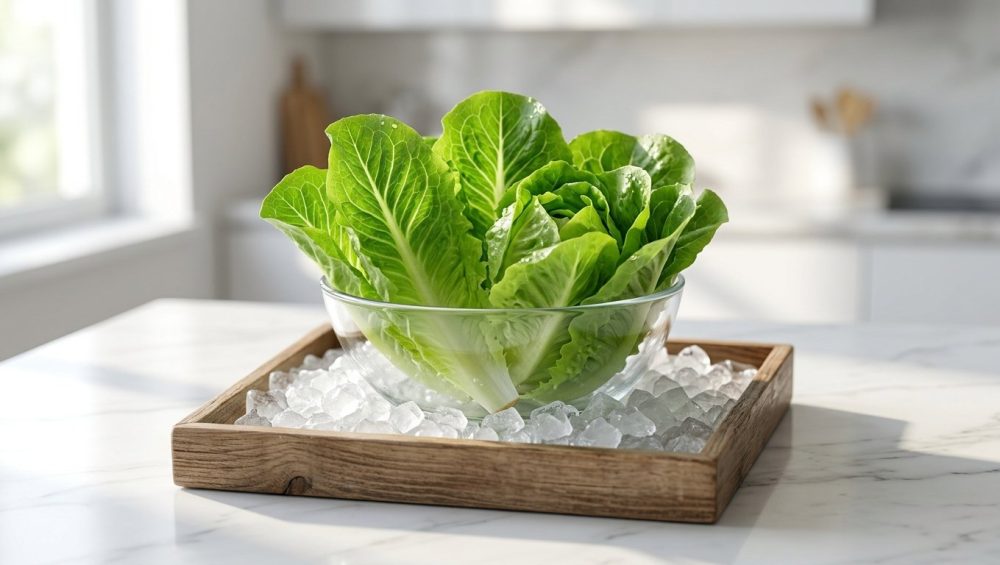
Because wilting is simply a loss of internal cellular water, you can often force the cells to rehydrate through osmosis. Fill a large, stainless steel mixing bowl with freezing cold water and a generous amount of ice cubes. Submerge the wilted greens completely. The temperature of the water should be between 32°F and 36°F (0°C to 2°C).
Let the greens sit in this icy plunge pool for 10 to 30 minutes. The icy temperature slows down the enzymatic breakdown of the cell walls, while the abundant surrounding water rushes back into the plant cells, re-inflating the microscopic water balloons.
Once the leaves feel crisp and rigid again, immediately transfer them to your salad spinner. Spin them aggressively until they are completely dry. If you skip the drying step, the residual ice water will dilute the dressings and cause rapid rot. This method is a lifesaver, but it only works if the cell walls haven’t entirely degraded; if the lettuce has turned yellow or slimy, it’s destined for the compost bin.
Beyond the Greens: Protecting the Rest of the Bar
A truly mindful salad bar isn’t just about the lettuce; it’s an ecosystem of textures and temperatures. You want contrasting elements: the crunch of the greens, the creaminess of avocado or cheese, and the savory heft of a cooked topping.
If you are serving warm elements—like roasted sweet potatoes, toasted chickpeas, or grilled chicken—temperature management is critical. Never place warm ingredients directly next to or on top of the raw greens on the buffet. Heat transfers rapidly, and placing a hot roasted sweet potato on a bed of delicate spring mix will instantly steam and cook the leaves, turning them into a slimy, unappetizing mess.
Keep your warm items in heavy ceramic or cast-iron serving dishes that retain heat, and place them at the far end of the salad bar line. This forces guests to add the hot items last, right before eating, minimizing the contact time with the raw greens.
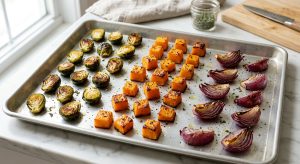
Furthermore, make sure your cooked items are actually appetizing. If you overcrowd your baking sheet when prepping your toppings, they will steam in their own moisture rather than caramelize. It’s the most common reason why your roasted veggies get soggy instead of developing that beautiful, crispy exterior. Give them space on a bare, heavy-duty aluminum sheet pan, and roast them at a high temperature.
And if you are offering a sweet element to finish the meal, like a fresh fruit salad or a yogurt parfait station, apply the same rigorous moisture control. Wash your berries in a diluted vinegar bath to kill mold spores, then dry them completely on a wire rack before storing. Nobody wants a dessert where the berries get moldy so fast they ruin the end of an otherwise flawless evening.
The Art of the Setup: Serving for Success
The final hurdle in maintaining the integrity of your salad bar is the physical presentation.
Ditch the massive, deep communal salad bowl. When you pile delicate greens high in a deep bowl, the sheer weight of the top layers crushes the leaves at the bottom. The bottom layer also becomes a trap for any residual moisture, leading to a soggy, compressed mess by the time the last guest serves themselves.
Instead, use wide, shallow serving platters or wide-set bowls. This spreads the greens out, reducing vertical pressure and allowing air to circulate. It also makes the buffet look significantly more abundant and colorful.
To keep the greens cold while sitting out on the counter, utilize thermal mass. This is where your investment in high-quality gear pays off. Before the party, place your heavy glass or stainless steel serving bowls in the freezer for 30 minutes. When you transfer the dry, crisp greens into these chilled vessels, the cold metal or glass will slowly radiate cool air, maintaining a crisp microclimate around the lettuce for much longer than a room-temperature plastic bowl ever could.
If you want to be an absolute pro, you can even create a DIY chilling station. Fill a large, shallow decorative tub or roasting pan with crushed ice, and nestle your serving bowls directly into the ice. This guarantees the temperature of the greens stays in that optimal 32°F to 39°F range, completely halting transpiration and enzymatic breakdown while your guests mingle.
By understanding the basic biology of turgor pressure, respecting the destructive power of moisture and temperature, and investing in safe, high-quality, non-toxic kitchen tools, you can completely eliminate the stress of the wilted salad. You don’t need to be a professionally trained chef to pull off an awe-inspiring, flawlessly crisp salad bar. You just need a little bit of science, a ruthless commitment to drying your greens, and the good sense to keep the vinaigrette on the side. Now go pour yourself that glass of wine, chill your serving bowls, and enjoy your own party. You’ve earned it.