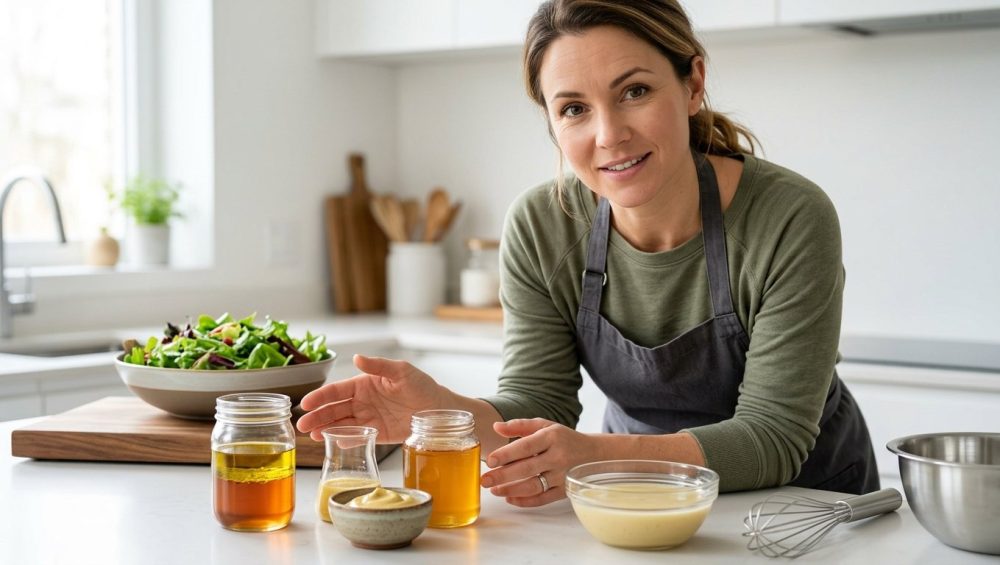
Listen up, folks. We need to have a serious chat about the puddle of sad, oily disappointment currently sitting at the bottom of your salad bowl. You know exactly what I am talking about. You decided to be a responsible adult, eat your greens, and whip up a quick homemade dressing rather than relying on that bottled, preservative-laden sludge from the supermarket. You measured your olive oil, poured your vinegar, and shook that jar like it owed you money. You poured it over your beautiful butter lettuce, feeling like an absolute culinary genius.
And then, within three minutes, it happened. The dressing separated. You were left with a slick, greasy oil slick floating on top of a harsh, watery pool of vinegar. Your greens wilted under the weight of the oil, and every bite was an unpredictable game of roulette between “way too sour” and “drinking straight from the olive oil bottle.”
As your resident Sassy Sous-Chef, I am here to tell you that this is not a personal failure. You are not a bad cook. You simply brought a knife to a physics fight. Making a proper, stable vinaigrette that clings beautifully to a leaf of romaine without weeping into a puddle requires a foundational understanding of kitchen science. During the week, we are all about time-saving hacks and efficiency—because time is money and nobody wants to spend an hour making a salad on a Tuesday night. But on the weekend, we perfect our craft. We learn the why behind the food.
Today, we are going to dive deep into the molecular biology of your salad bowl. We are going to explore the chemistry of emulsions, the thermodynamic forces that want to ruin your dinner, and the natural pantry staples that act as microscopic peacemakers. By the time you finish this masterclass, you will never serve a broken, greasy salad again.
The Cold, Hard Science of Why Your Dressing Hates You
Let’s get one thing straight right out of the gate: oil and vinegar absolutely despise each other. This is not a culinary opinion; it is an undeniable law of physical chemistry.
The Hydrophobic and Hydrophilic Divide
Vinegar is essentially a solution of acetic acid and water. Water molecules are polar, meaning they have a slight positive charge on one end and a slight negative charge on the other. Because of this, water molecules love to stick together. In the scientific community, water and water-based liquids are known as hydrophilic (water-loving).
Oil, on the other hand, is composed of lipids. Lipid molecules are nonpolar; they have no electrical charge to share and absolutely zero interest in bonding with water. They are hydrophobic (water-fearing). When you pour olive oil into a bowl of vinegar, the oil molecules will violently reject the water molecules, clustering together to minimize their exposure to the vinegar. You are essentially trying to force two opposing magnets to stick together.
The Physics of Phase Separation
When you shake a jar of oil and vinegar, you are applying mechanical energy to the system. This energy physically tears the oil apart into smaller droplets, temporarily dispersing them throughout the vinegar. If you want to decode pretentious recipe jargon, the term you are looking for here is a “colloidal suspension” or an “oil-in-water emulsion”.
But here is the kicker: the universe favors a state of low energy. The moment you stop shaking that jar, Brownian motion (the random movement of particles in a fluid) takes over. The tiny oil droplets bump into each other, and because they are hydrophobic, they immediately fuse together in a process called coalescence. The droplets get larger and larger until they eventually rise to the top, completely separating from the heavier vinegar. This is known as phase separation.
To create a stable emulsion that lasts longer than the walk from your kitchen counter to your dining table, you have to reduce the oil droplet size to a microscopic 2 to 5 micrometers in diameter. But even if you whisk with the fury of a thousand angry chefs, mechanical energy alone is not enough. You need a bridge. You need a chemical mediator. You need an emulsifier.
Enter the Peacemakers: The Molecular Magic of Emulsifiers
If oil and vinegar are two sworn enemies standing on opposite sides of a room, an emulsifier is the highly skilled diplomat who grabs both of them by the hand and forces them to get along.
What is an Amphiphilic Molecule?
Emulsifiers are unique because they are amphiphilic molecules (or surfactants). This means they have a split personality at the molecular level. One end of the emulsifier molecule is hydrophilic (it loves water and vinegar), while the other end is hydrophobic (it loves oil).
When you add an emulsifier to your vinaigrette and begin to whisk, a beautiful microscopic dance occurs. As the mechanical shearing force of your whisk breaks the oil down into tiny droplets, the emulsifier molecules rush in. They embed their hydrophobic tails directly into the oil droplets, while their hydrophilic heads face outward, clinging to the surrounding vinegar.
Reducing Interfacial Tension
By coating the oil droplets, the emulsifier creates a protective physical barrier. When two coated oil droplets bump into each other in the bowl, the hydrophilic heads of the emulsifier repel each other, preventing the oil droplets from fusing back together. In scientific terms, the emulsifier drastically reduces the interfacial tension between the two liquids, allowing them to coexist in a creamy, stable, unified sauce.
This is the secret to a vinaigrette that coats a lettuce leaf like velvet instead of sliding off it like water off a duck’s back. But you don’t need a chemistry lab to find these magical molecules. You already have them sitting in your pantry.
The Ultimate Pantry Emulsifiers
Not all emulsifiers are created equal. Some form incredibly strong, permanent bonds (like the lecithin in egg yolks that creates mayonnaise), while others form weaker, temporary bonds that are just strong enough to get you through dinner. Let’s break down the heavy hitters in your kitchen arsenal.
Dijon Mustard: The Holy Grail of Vinaigrettes
If there is one ingredient you should never make a vinaigrette without, it is Dijon mustard. The hull of the mustard seed contains a complex carbohydrate and protein matrix called mucilage. When ground into a paste, this mucilage acts as a fiercely powerful natural surfactant.
The power of Dijon mustard is twofold: not only does it provide the amphiphilic molecules needed to bridge the gap between the oil and the acid, but it also adds a sharp, pungent depth of flavor that perfectly complements almost any salad. A mere half-teaspoon of smooth Dijon is enough to stabilize a standard cup of vinaigrette for hours, if not days. Note that whole-grain mustard, while delicious, is not nearly as effective because the mucilage is trapped inside the intact seed hulls. You need the smooth stuff for the science to work.
Honey and Maple Syrup: The Viscosity Stabilizers
While honey and maple syrup are frequently used in dressings, it is important to understand that they are not true chemical emulsifiers. They do not have the hydrophobic and hydrophilic ends required to coat oil droplets. Instead, they act as physical stabilizers.
Because honey and maple syrup are incredibly thick and viscous, they physically thicken the water phase of the dressing. By making the vinegar thicker, they slow down the movement of the oil droplets, making it much harder for them to bump into each other and coalesce. When combined with a true emulsifier like Dijon mustard, a touch of honey creates an unbreakable, velvety texture.
Garlic and Shallots: The Hidden Surfactants
You probably add minced garlic or finely diced shallots to your dressing strictly for flavor, but they are secretly working behind the scenes to keep your emulsion intact. Alliums contain amphipathic sulfur compounds, such as diallyl sulfide and diallyl trisulfide. When you crush or mince garlic, these compounds are released and act as mild emulsifying agents.
For the best results, smash your garlic into a fine paste with a pinch of coarse salt using the side of your chef’s knife before adding it to the vinegar. This releases maximum flavor and maximum surfactant power.
Mayonnaise: The Seed Emulsion
If you are struggling to get a vinaigrette to hold together, cheat. Mayonnaise is already a perfectly stable, permanent emulsion of oil, egg yolks (which contain the powerhouse emulsifier lecithin), and acid. By whisking just a half-teaspoon of mayonnaise into your vinegar before adding your oil, you are introducing millions of pre-emulsified droplets that act as a “seed” to help stabilize the rest of the dressing. It won’t make your vinaigrette taste like mayonnaise, but it will make it undeniably creamy.
Miso Paste: The Umami Binder
For Asian-inspired dressings, miso paste is an absolute game-changer. Like mustard, fermented soybean paste contains proteins and complex carbohydrates that act as excellent binders and mild emulsifiers. It brings a deeply savory, salty, umami-rich backbone to the dressing while giving it a gorgeous, opaque body that clings perfectly to sturdy greens like kale or cabbage.
The Golden Ratio and the Art of Flavor Balancing
You can have all the emulsifiers in the world, but if your ratios are off, your dressing will taste like a science experiment gone wrong. The foundation of every great vinaigrette relies on a specific mathematical balance.
The 3:1 Rule
The universally accepted golden ratio for a classic vinaigrette is 3 parts oil to 1 part acid (vinegar or citrus juice). This ratio exists for a very specific reason. If you use too much acid, the dressing will be violently tart, causing your mouth to pucker and completely masking the delicate flavor of your vegetables. If you use too much oil, the dressing becomes heavy, greasy, and cloying.
The 3:1 ratio provides enough fat to coat the palate and carry fat-soluble flavor compounds, while providing just enough acidity to cut through the richness. Remember, your dinner actually needs acid to taste bright and alive. Acid triggers the salivary glands and acts as a flavor enhancer, much like salt.
Adjusting for pH and Personal Preference
While 3:1 is the gold standard, you must adapt to the specific ingredients you are using. Not all acids are created equal.
- Harsh Acids: Standard white vinegar or cheap red wine vinegar can be incredibly sharp (with a pH around 2.4 to 2.6). If you are using a very harsh acid, you may need to push the ratio to 4:1, or temper the acid with a splash of water or a heavy squeeze of honey.
- Mellow Acids: High-quality aged balsamic vinegar, seasoned rice vinegar, or Meyer lemon juice are much sweeter and milder (pH 3.2 to 3.6). When using these, you can often get away with a 2:1 ratio or even a 1:1 ratio if you prefer a punchier, brighter salad.
The Role of Salt
Never under-salt your vinaigrette. The dressing is responsible for seasoning the entire bowl of unseasoned greens and vegetables. When you taste your vinaigrette straight from the bowl, it should taste slightly too salty and slightly too acidic. Once it is dispersed over a massive bowl of water-rich lettuce, the flavors will dilute and balance out perfectly. Proper seasoning is the easiest way to stop throwing away sad veggies; when they are dressed beautifully, you will actually crave them.
Gear Talk: The Right (and Wrong) Tools for the Job
Alright, gather round, because the Sassy Sous-Chef is about to go on a rant. You cannot expect professional-level culinary results if you are using garbage equipment. I am deeply passionate about banishing toxic kitchen gear from the modern home, and salad dressing prep is one of the worst offenders.
Ditch the Cheap Plastic Shakers
We have all seen those cheap, plastic salad dressing shaker bottles with the peeling measurement lines and the rubber gaskets that harbor mold. Stop using them. When you aggressively shake highly acidic vinegar and abrasive salt inside cheap plastic, the plastic microscopically degrades over time. This is exactly why your plastic containers stay greasy and hold onto phantom garlic smells for three years. The porous plastic traps the oil and the odors, ruining the flavor profile of your next batch of dressing.
Furthermore, simply shaking a jar is the least effective way to create a stable emulsion. It does not provide enough continuous, high-speed mechanical shearing force to break the oil droplets down to the required 2 to 5 micrometers. Shaken dressings will almost always separate within twenty minutes.
The Proper Mixing Vessels
You need weight, and you need a non-reactive surface. Use a heavy glass mixing bowl or a high-quality stainless steel bowl. If the bowl slips around on your counter while you are trying to whisk, take a damp paper towel and place it flat underneath the bowl. This acts as an anchor, locking the bowl to the countertop so you can use both hands freely.
The Whisk Matters
Do not use a fork. Do not use a tiny, flimsy dollar-store whisk where the metal loops are barely glued into a plastic handle. Those cheap handles are unsealed, which is why your whisk leaks dirty dishwater into your pristine food days after you washed it. Buy a professional-grade, fully sealed stainless steel balloon whisk. It is one of the most essential beginner kitchen tools you can own, and it will give you the aeration and shearing power necessary to force the oil and vinegar to bind.
The Foolproof, Science-Backed Mixing Technique
We have the science, we have the emulsifiers, and we have the gear. Now we need the technique. The way you introduce the oil to the vinegar is the single most critical step in the entire process. If you dump all the oil into the vinegar at once and try to whisk it, you will fail. The volume of oil will overwhelm the emulsifier, the droplets will immediately coalesce, and the dressing will break.
Method 1: The Classic Slow Drizzle
- Create the Base: In your anchored glass or stainless steel bowl, combine your acid (vinegar or citrus juice), your emulsifier (a generous dollop of Dijon mustard), your salt, your pepper, and any minced aromatics (garlic, shallots).
- Whisk the Base: Vigorously whisk this mixture together until the salt is completely dissolved and the mustard is fully integrated into the acid. You should have a cloudy, watery liquid.
- The Drizzle: Take your whisk in your dominant hand and your measuring cup of oil in your non-dominant hand. Begin whisking the vinegar base rapidly. While whisking continuously, add the oil in a painfully slow, microscopic, thread-like stream.
- Watch the Magic: As you slowly introduce the oil, the mechanical shearing of the whisk breaks it into tiny droplets, and the mustard mucilage immediately coats them. You will physically see the liquid transform. It will increase in volume, lighten in color, and thicken into a creamy, opaque sauce. Once the emulsion is established (after about a third of the oil is incorporated), you can pour the remaining oil slightly faster, but never stop whisking.
Method 2: The Immersion Blender (The Weekday Cheat Code)
If you are exhausted after a long day of work and cannot be bothered to whisk by hand, the immersion blender is your best friend. A standard immersion blender spins at around 8,000 to 10,000 RPM. This violent mechanical force shatters the oil droplets into microscopic perfection, creating an emulsion so thick and stable it can sit in your fridge for two weeks without separating.
Place all your ingredients (vinegar, mustard, seasonings, and all of the oil) into a tall, narrow cylindrical jar. Plunge the immersion blender all the way to the bottom. Turn it on high and hold it perfectly still at the base for five seconds. As the vortex forms and the emulsion begins to turn white and creamy at the bottom, slowly pull the blender upward to pull the rest of the floating oil down into the vortex. It takes ten seconds, and it is entirely foolproof.
The Crucial Olive Oil Warning
There is one massive caveat to the immersion blender method. If you use high-quality, cold-pressed Extra Virgin Olive Oil (EVOO), blending it at high speeds will ruin it.
Extra virgin olive oil is packed with incredibly healthy, but highly astringent, antioxidant compounds called polyphenols. In their natural state, these bitter polyphenols are safely trapped inside microscopic fatty acid structures. When you gently whisk EVOO by hand, those structures remain intact. But when you subject EVOO to the violent, high-speed steel blades of an immersion blender or food processor, you completely obliterate those fatty structures, squeezing the bitter polyphenols out into the liquid.
The result? A vinaigrette that tastes like metallic, acrid, horribly bitter poison.
The Fix: If you want to use the immersion blender method for speed, use a neutral oil (like avocado oil, grapeseed oil, or a light, refined olive oil) for the blending process. If you want the rich flavor of EVOO, blend your vinegar, mustard, and a small splash of neutral oil with the blender to establish the base, then take the blender out and gently whisk the EVOO in by hand at the very end.
Troubleshooting: How to Rescue a Broken Vinaigrette
Even the best home cooks occasionally break an emulsion. Maybe your kitchen was too hot, maybe you poured the oil too fast, or maybe you just got distracted by your dog barking at the mailman. If you look down and see a separated, greasy mess, do not throw it away. Emulsions can be resurrected.
The Water Drop Rescue
Sometimes, an emulsion breaks because there is simply too much oil and not enough water phase for the droplets to disperse in. The emulsion becomes “inverted.” To fix this, grab a clean bowl. Add one single tablespoon of rapidly boiling water to the empty bowl. Slowly, drop by drop, whisk your broken vinaigrette into the hot water. The heat helps relax the surface tension, and the fresh water provides a new base for the oil droplets to disperse into. Nine times out of ten, it will whip right back into a creamy frenzy.
The Extra Mustard Rescue
If the water trick fails, your emulsion lacks sufficient surfactant. Grab a clean bowl and add a fresh half-teaspoon of Dijon mustard. Slowly whisk the broken dressing into the new mustard, just as you did when you first made it. The fresh influx of mucilage will coat the rogue oil droplets and bind the sauce back together.
Temperature Matters
Emulsions hate extreme temperatures. If you store your vinaigrette in the fridge, the olive oil will solidify and the emulsion will temporarily break. Do not panic. Let the jar sit on the counter for twenty minutes to come up to room temperature, give it a vigorous shake, and it will usually reform. Never try to whisk cold, congealed oil.
Master Vinaigrette Formulas to Memorize
Now that you are an official kitchen scientist, you need a few master formulas to keep in your back pocket. Stop buying the bottled stuff. Memorize these ratios, scale them up or down as needed, and your salads will instantly taste like they came from a high-end bistro.
The Classic French Dijon
This is the workhorse of the culinary world. It is sharp, peppery, and perfectly balanced.
- 1/4 cup high-quality white wine vinegar or Champagne vinegar
- 1 generous tablespoon Dijon mustard
- 1 small shallot, minced into a fine paste
- 3/4 cup Extra Virgin Olive Oil
- Generous pinch of kosher salt and freshly cracked black pepper
The Maple Balsamic
Perfect for bitter autumn greens, roasted squash, or salads with heavy cheeses like gorgonzola or goat cheese.
- 1/4 cup aged Balsamic vinegar
- 1 teaspoon Dijon mustard (for stabilization)
- 1 tablespoon real maple syrup (for viscosity and sweetness)
- 1 clove garlic, smashed to a paste
- 3/4 cup Extra Virgin Olive Oil
- Salt and pepper to taste
The Miso Ginger Sesame
A creamy, umami-bomb dressing that will make you want to eat raw cabbage every day of the week.
- 1/4 cup unseasoned rice vinegar
- 1 tablespoon white miso paste
- 1 teaspoon freshly grated ginger
- 1/2 cup neutral oil (like grapeseed or avocado)
- 1/4 cup toasted sesame oil (added at the very end)
Beyond the Salad Bowl
Once you master the stable emulsion, you will realize that vinaigrettes are not just for raw lettuce. A bright, acidic, perfectly emulsified dressing is the ultimate finishing sauce. Drizzle the Classic French Dijon over a piece of pan-seared salmon. Toss warm, freshly roasted fingerling potatoes in the Maple Balsamic while they are still hot so they absorb the flavor.
You will also find that understanding the magic of a little vinegar and how it interacts with fats will transform your hot cooking. A splash of vinegar emulsified into the fat of a pan sauce or a heavy stew right before serving works on the exact same principles we just discussed—it cuts the grease, binds the liquids, and elevates the entire dish.
A Note on Storage and Herbs
If you are making a large batch of vinaigrette for the week, do not add fresh chopped herbs (like basil, parsley, or cilantro) directly into the storage jar. The high acidity of the vinegar will aggressively break down the delicate cell walls of the greens. This is exactly why your fresh herbs get slimy, turn a hideous swamp-brown color, and make your dressing taste like lawn clippings.
Instead, make your base vinaigrette and store it in a clean glass jar in the fridge (it will easily last for two weeks). When you are ready to eat, pour the amount of dressing you need for that specific meal into a small bowl, and whisk in your freshly chopped herbs right before tossing your salad.
The Sassy Sous-Chef’s Final Word
Cooking is not magic. It is just applied physics and chemistry, wrapped in an apron and served with a glass of wine. When you understand why ingredients behave the way they do, you strip away the anxiety of the kitchen. You stop crossing your fingers and hoping a recipe works, and you start taking total control of your food.
The next time you make a salad, respect the oil. Respect the acid. Give them the chemical bridge they desperately need, use the proper tools to shear them into submission, and enjoy the velvety, restaurant-quality perfection that you created with your own two hands. Now go whisk something.