Listen, I know exactly what your kitchen drawer looks like right now. Tucked somewhere between a potato peeler that has seen better days and a set of measuring spoons you got as a wedding favor, lies a rusty, grime-covered, traditional rotary can opener. You probably bought it for three dollars at a local grocery store during a desperate, late-night chili-making session. Every time you use it, it squeaks in protest, skips over the metal, and forces you to perform a dangerous game of culinary operation to fish a jagged, razor-sharp lid out of a pool of tomato sauce.
If you are nodding your head right now, pour yourself a glass of wine and pull up a stool. We need to have a serious talk about the tools you allow into your cooking space.
As a home cook who learned everything the hard way—yes, including setting off the smoke detector while trying to impress a date—I have absolutely zero patience for kitchen equipment that actively works against you. You do not need a pretentious culinary degree to make mind-blowing food, but you absolutely cannot do it if you are constantly battling cheap, toxic, and downright dangerous gear. Weeknight cooking is all about efficiency. Time is money, and spending five minutes wrestling with a tin of chickpeas while trying not to slice a tendon is not my idea of a relaxing evening.
Today, we are diving deep into one of the most overlooked, yet profoundly important upgrades you can make in your kitchen: the smooth-edge can opener. Also known as a side-cutting or safe-cut opener, this brilliant piece of kitchen engineering permanently resolves the frustrations of rusty blades, cross-contamination, and falling lids. It is time to stop compromising on the basics. We are throwing that terrifying medieval torture device you call a can opener into the trash, and we are stepping into the modern era.
The Anatomy of a Kitchen Disaster: Why Traditional Can Openers Belong in the Trash
To understand why the smooth-edge can opener is a revolutionary upgrade, we must first examine the inherent mechanical and hygienic flaws of the traditional top-cutting rotary opener. It is a tool we have all accepted as normal, but when you actually break down its mechanics, it is nothing short of a nightmare.
A Brief, Blood-Soaked History of the Can Opener
Canned food is a brilliant concept, but the invention of the can opener is one of the most baffling timelines in culinary history. In 1810, a British merchant named Peter Durand patented the idea of preserving food in tin-plated wrought iron cans. These early cans were incredibly thick—sometimes up to 3/16 of an inch—and the manufacturer’s official instructions for opening them were literally to cut round the top near the outer edge with a chisel and a heavy hammer. Yes, you read that correctly. For nearly fifty years, people were smashing their dinner open with masonry tools.
It was not until 1858 that an American inventor, Ezra J. Warner, patented the first specialized can opener. It was a terrifying, bayonet-style blade that pierced the lid and sawed around the edge, leaving a brutally jagged rim of metal. It was so dangerous that it was mostly relegated to grocery store clerks who would open cans for customers before they took them home. In 1870, William Lyman introduced the rotary wheel design, and in 1925, the Star Can Company added a second serrated wheel to grip the rim.
And that is pretty much where the innovation stopped for the average home cook. The traditional top-cutting opener you have in your drawer right now is essentially the exact same design from a century ago. It was designed for a different era, and frankly, it shows.
The Filthy Reality of the Rotary Blade
Let us talk about hygiene, because this is where the traditional can opener truly becomes horrifying. A standard top-cutting can opener works by piercing the flat surface of the lid and shearing across it. This means that the cutting blade physically enters the can and makes direct contact with the food inside.
Think about the last time you washed your can opener. I mean actually washed it. If you are like most people, you probably just toss it back in the drawer, or maybe give it a half-hearted wipe with a sponge. Over time, microscopic bits of food, starches, and sugars build up on that rotary blade and the gears. Because the blade is made of cheap carbon steel or low-grade stainless steel, this moisture and food residue inevitably leads to rust.
According to food safety experts and the USDA, cross-contamination is one of the leading causes of foodborne illness. When you use a dirty blade to open a can of beans, and then use that same unwashed blade a week later to open a can of coconut milk, you are transferring bacteria—potentially harmful pathogens like Salmonella or E. coli—directly into your fresh food. Commercial kitchens are frequently docked points during health inspections for dirty can openers, because health inspectors know exactly how much bacteria those gears can harbor. When you are gathering essential kitchen tools for beginners, you must prioritize tools that are inherently sanitary. A blade that punches into your food and then sits in a dark drawer to fester is the exact opposite of sanitary.
The Jagged Metal Death Trap
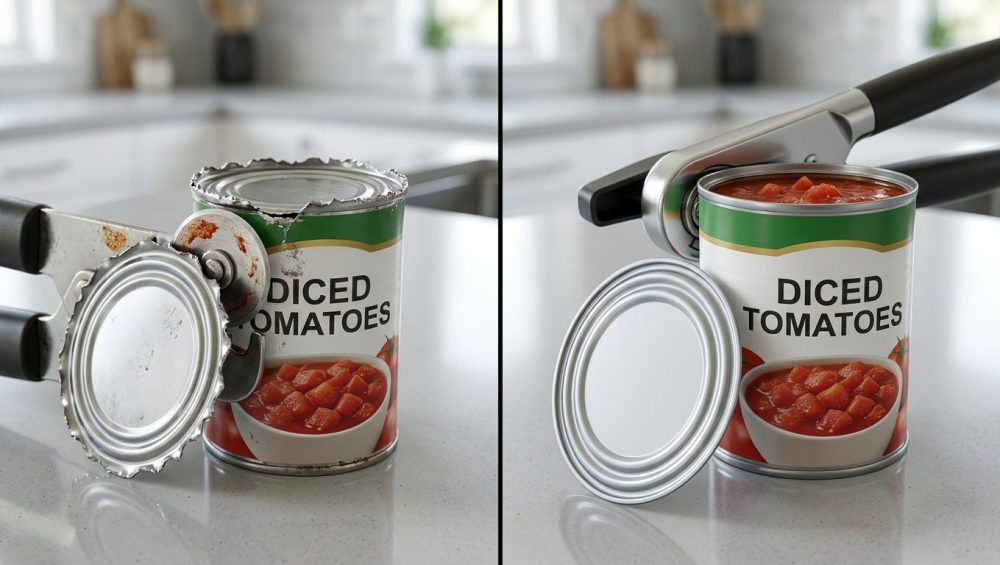
Beyond the bacteria, there is the physical danger. When a top-cut opener shears through the metal lid, it leaves behind what industry professionals refer to as “shark-tooth” edges. Both the rim of the can and the detached lid become razor-sharp hazards.
Hospitality workers and restaurant staff frequently suffer from severe cuts and lacerations due to can opener injuries and mishandling jagged lids. But you don’t have to be a line cook to understand this pain. Every home cook has experienced the sheer panic of the lid dropping into the can of diced tomatoes. You then have to take a butter knife or, worse, your bare fingers, and try to pry the slippery, razor-sharp disc out of the acidic juice. It is a recipe for a trip to the emergency room, or at the very least, a ruined manicure and a bloody cutting board.
Furthermore, when the blade violently cuts through the metal, it often creates microscopic metal shavings. These tiny shards of tin and steel can easily fall into your food. Ingesting metal shavings is not exactly on the menu for a relaxing weeknight dinner. When your primary goal is surviving kitchen disasters, the last thing you need is your equipment actively trying to sabotage your meal from the inside out.
Enter the Smooth-Edge Can Opener: A Masterclass in Kitchen Engineering
So, what is the alternative? If we are throwing out the traditional rotary opener, what are we replacing it with? Enter the smooth-edge can opener. Sometimes called a side-cutting or safe-cut opener, this tool looks similar to a standard opener, but it operates on a fundamentally different mechanical principle. It doesn’t cut metal; it un-crimps it.
Un-Crimping vs. Cutting: The Mechanical Difference
To understand the magic of a smooth-edge opener, you need to understand how a can is manufactured. The lid of a tin can is not welded on. It is attached using a mechanical process called a “double seam.” The edge of the cylindrical body and the edge of the flat lid are folded over each other and tightly crimped together, creating an airtight, hermetic seal.
A traditional opener violently slices right through the flat part of the lid, destroying the metal. A smooth-edge opener, however, approaches the can from the side. The cutting wheel doesn’t touch the flat lid at all. Instead, it wedges itself directly into that outer double seam. As you turn the handle, the opener physically separates the layers of the folded metal, cleanly un-crimping the factory seal from the outside.
It is a small mechanical difference, but the results are completely different in terms of safety, hygiene, and everyday handling. Because you are un-crimping the seam rather than shearing raw metal, there are absolutely no sharp edges. You can literally run your finger along the rim of the opened can and the edge of the lid, and it feels completely smooth. It is a masterclass in kitchen engineering that completely eliminates the “shark-tooth” hazard.
The “Lid as a Lid” Phenomenon
One of my absolute favorite features of the side-cutting mechanism is what happens after the can is open. With a traditional opener, the lid is smaller than the rim, which is why it immediately falls into your food. Because a smooth-edge opener un-crimps the outer seam, the lid remains the exact same diameter as the can.
When you finish turning the crank, the lid just sits neatly on top of the can. It doesn’t fall in. You simply lift it off. Most high-quality smooth-edge openers even come with tiny built-in pliers or a magnet on the side specifically designed to grab the lid so you don’t even have to touch it with your hands.
Even better, because the lid is intact and smooth, it functions perfectly as a temporary cover. If you only need half a can of tomato paste or a portion of dog food, you can just pop the smooth lid right back onto the can and stick it in the fridge. It fits snugly over the rim, protecting your food without the need for plastic wrap or transferring the contents to a separate container. This is exactly the kind of smart, efficient design that makes weekend cooking a joy rather than a stressful chore.
The Undeniable Health and Safety Benefits of Upgrading
We have established that the engineering is superior, but let’s talk about how this translates to your actual day-to-day life in the kitchen. The benefits of upgrading to a smooth-edge opener extend far beyond simple convenience; they directly impact your health, your safety, and the longevity of your other kitchen tools.
Eliminating Bloodshed from Your Meal Prep
I cannot stress this enough: your kitchen should not be a hazard zone. Cooking should be an act of creativity and relaxation, not an exercise in physical risk management. By eliminating sharp edges entirely, the smooth-edge can opener removes one of the most common causes of minor kitchen injuries.
If you have children who like to help out in the kitchen, or if you are preparing food in a chaotic environment, a safe-cut opener is non-negotiable. You never have to worry about a rogue, jagged lid slicing a finger when someone reaches into the recycling bin. You never have to gingerly tap the bottom of a can to coax out a stubborn block of pumpkin purée, terrified that the sharp rim will catch your hand. It brings a profound sense of peace of mind to your prep work. If you are serious about banishing toxic kitchen gear from your life, banishing tools that actively cause physical harm should be step one.
The Hygiene Factor: Keeping the Blade Out of Your Beans
Let’s return to the issue of cross-contamination. Because the side-cutting blade un-crimps the outer seam, the blade never actually enters the can. It never touches the food.
This is a massive upgrade for food safety. You are no longer dipping a questionable, rusty wheel into your sterile canned goods. The risk of transferring bacteria from one can to another is virtually eliminated. Furthermore, because the blade stays clean, the can opener itself requires significantly less maintenance. You don’t have to scrub dried, crusty food out of the gears with a toothbrush. A simple wipe down with a damp cloth is usually all it takes to keep a smooth-edge opener in pristine condition.
This is particularly crucial when dealing with acidic foods like tomatoes or citrus segments, which can rapidly accelerate the rusting process on cheap traditional openers. Keeping the cutting mechanism on the outside of the can preserves the integrity of your food and the lifespan of your tool.
Protecting Your Expensive Cookware
Here is a side benefit you might not have considered: smooth-edge cans protect your other kitchen gear. When you use a traditional opener, the jagged rim of the can becomes a weapon. If you use a silicone spatula to scrape out the last bits of condensed milk or refried beans, those sharp metal teeth will aggressively chew up the soft silicone.
I have seen countless home cooks ruin expensive, heat-resistant spatulas because they dragged them against a jagged tin can. (And if you’ve ever wondered why your silicone spatulas taste like soap, it’s often because micro-tears in the silicone trap dish detergent—tears caused by sharp edges!). By leaving the rim of the can perfectly smooth, you can scrape every last drop of food out of the container without damaging your utensils. It is a small detail, but it speaks to the interconnected ecosystem of a well-curated kitchen.
Why Smooth-Edge Openers Are a Weeknight Time-Saver
I am a firm believer that time is your most valuable asset during the workweek. When you get home at 6:00 PM and need to get dinner on the table, you do not have time for equipment malfunctions. You need tools that work effortlessly, every single time.
Less Mess, Zero Stress
Think about the workflow of opening a can of black beans with a traditional opener. You pierce the lid. You crank the handle. The lid falls into the bean juice. You fish it out, getting bean liquid all over your fingers. You carry the dripping lid to the trash, leaving a trail of starchy water on your floor. You then have to wash your hands before you can continue cooking.
With a side-cut opener, the workflow is entirely different. You un-crimp the seal. You lift the dry, clean lid off the top. You dump the beans into your colander. You toss the lid in the recycling bin. Your hands are clean. Your floor is clean. Your stress levels are non-existent. It streamlines the prep process, allowing you to focus on the actual cooking. It is these tiny micro-efficiencies that separate chaotic amateur kitchens from confident, well-oiled culinary spaces. It is one of the easiest rookie kitchen mistakes you can fix with a simple ten-dollar purchase.
The Environmental and Economic Case for Ditching Cheap Gear
I absolutely despise the modern culture of disposable kitchenware. Buying a three-dollar tool, watching it rust and break after six months, and throwing it in a landfill is a false economy. It costs you more money in the long run, and it is terrible for the environment.
Traditional can openers are notorious for breaking down quickly. The gears strip, the blades dull, and the rust takes over. High-quality smooth-edge can openers are generally built with better internal mechanics because the un-crimping process requires a more precise gear ratio. When you invest in a durable, well-made side-cutting opener, you are buying a tool that will last for years, if not decades.
Furthermore, because the lids and cans are left with smooth edges, they are much safer and easier to recycle. Sanitation workers don’t have to handle razor-sharp shrapnel, and you don’t have to worry about the lids tearing through your garbage bags. It is a responsible choice all around.
Addressing the Learning Curve (Because I Know You’re Going to Complain)
Okay, let’s get real for a second. I know exactly what is going to happen when you buy your first smooth-edge can opener. You are going to take it out of the packaging, try to use it exactly like your old opener, fail miserably, and then send me an angry email.
I am going to stop you right there. Yes, there is a slight learning curve. But you are a capable, intelligent adult, and you can learn how to use a new tool.
How to Actually Use the Damn Thing
The biggest mistake people make is trying to clamp the smooth-edge opener vertically onto the top of the can, just like a traditional opener. That will not work.
Here is how you do it: Place the can on the countertop. Hold the smooth-edge opener horizontally, parallel to the counter. Place the cutting wheel against the side of the can, right on the outer rim. Squeeze the handles together. You will feel it lock onto the rim.
Now, start turning the crank. At first, you might feel like nothing is happening. Because it is un-crimping the seal rather than tearing metal, there is very little resistance. It glides smoothly. You won’t hear that terrible metal-on-metal grinding noise. Keep turning until you have gone completely around the can. You will feel a slight drop in tension when you complete the circle.
Stop turning, open the handles to release the tool, and simply lift the lid off. That is it. It is not magic, it is just physics. Once you do it twice, it will become second nature, and you will wonder how you ever lived without it.
Troubleshooting Common Side-Cutting Fails
Sometimes, you might encounter a can with an unusually thick seam, or a can that was dented during shipping. If the opener seems to skip or fails to un-crimp a section, do not panic. Simply back the opener up a half-inch, re-clamp it, and turn the crank again.
Another common issue is realizing you have gone all the way around, but the lid still seems stuck. This usually happens because the hermetic seal was incredibly tight, and a tiny bit of food vacuum-suction is holding the lid down. Just use the little built-in pliers on the side of the opener (or your fingernail) to gently lift the edge. The vacuum will break, and the lid will pop right off.
What to Look for When Buying a Smooth-Edge Can Opener
Not all smooth-edge can openers are created equal. Just because a tool uses the right mechanical principle does not mean it is built with quality materials. If you are going to upgrade, you need to know what to look for so you don’t end up with another piece of junk in your drawer.
Ergonomics and Grip
A can opener requires manual dexterity and grip strength. If the handles are thin, hard plastic, they will dig into your palms and make the process miserable. Look for an opener with thick, contoured handles coated in a non-slip, comfortable material like high-quality silicone or santoprene.
The turning knob is equally important. It should be oversized and easy to grip, providing plenty of leverage. If you have arthritis or limited hand strength, a large, ergonomic turning knob will make a world of difference. You want the tool to do the work, not your joints. If you are looking for aesthetic kitchen upgrades, there are plenty of sleek, matte-black or stainless steel models that look stunning while providing superior ergonomics.
Material Quality: Say No to Mystery Metals
I have a strict “no-go” rule on toxic, cheap materials in the kitchen. When buying a can opener, you must inspect the cutting wheel and the gears. They should be made from hardened, high-carbon stainless steel.
If the packaging does not specify the type of metal, or if it feels suspiciously lightweight, put it back on the shelf. Cheap pot-metal gears will strip under pressure, and low-grade steel will rust the moment it looks at a drop of water. You are upgrading to avoid rust and cross-contamination; do not defeat the purpose by buying a poorly manufactured knock-off.
Additionally, check the overall build quality. The hinge should feel tight and secure, with no lateral wobbling. The handles should not flex when you squeeze them. A good can opener should feel like a solid, reliable piece of hardware.
Beyond the Can: The Ripple Effect of Better Tools
Upgrading a single, seemingly insignificant tool like a can opener might feel like a minor change, but it represents a broader philosophy of kitchen management. When you stop tolerating equipment that frustrates you, you begin to transform your cooking space into an environment of joy and efficiency.
You start realizing that you don’t have to accept that your plastic containers stay greasy forever, or that scrubbing stainless steel pans doesn’t have to be a nightmare if you learn proper temperature control. You realize that a kitchen is only as good as the sum of its parts.
When you eliminate the friction of prep work, you free up mental bandwidth for actual culinary artistry. You can focus on balancing the acidity in your pan sauce, or achieving the perfect sear on a chicken thigh, rather than fighting with a tin of chicken broth. It is about unlocking kitchen creativity by removing the mundane obstacles that stand in your way.
And if you’ve ever found yourself frustrated because your spices turn into hard bricks, you know exactly what I mean. The right tools and the right storage solutions dictate your success before you even turn on the stove.
Conclusion: Stop Compromising on the Basics
The traditional rotary can opener is a relic of the past. It is an unhygienic, dangerous, and inefficient tool that has no place in a modern home kitchen. By forcing a dirty blade into your food and leaving behind razor-sharp metal edges, it actively works against your goals of cooking safe, delicious, and stress-free meals.
The smooth-edge can opener is the definitive solution. By un-crimping the factory seal from the outside, it eliminates cross-contamination, prevents physical injuries, and preserves the integrity of your ingredients and your cookware. It is a small investment that yields massive returns in daily convenience and peace of mind.
So, do yourself a favor. Open that kitchen drawer, take out that rusty, squeaky, terrifying metal claw, and throw it in the garbage where it belongs. Upgrade your gear, protect your fingers, and start cooking with the confidence and efficiency of a true home expert. You deserve a kitchen that works for you, not against you. Now, go make something spectacular.