Welcome to the intervention. I am pouring myself a generous glass of Pinot Noir, and I strongly suggest you do the same, because we need to have a very serious, brutally honest conversation about the state of your cookware. If you are currently standing over your stove, violently scraping a mangled, shredded piece of salmon off the bottom of a skillet while questioning every life choice that led you to this moment, take a deep breath. You are not alone. We have all been there. We have all fallen victim to the same rookie kitchen mistakes that leave us ordering emergency takeout at 8:00 PM while our smoke detectors scream in the background. But today, that cycle of culinary despair ends.
I am here to tell you a fundamental truth: you do not need a culinary degree to cook like an absolute expert in your own home. You do not need the knife skills of a Michelin-starred chef, and you certainly do not need a pan coated in toxic forever chemicals just to fry an egg. What you need is a basic understanding of thermodynamics, a decent stainless steel skillet, and a ridiculously simple technique known as the water drop test.
For decades, the home cookware industry has thrived on your fear. They have convinced you that stainless steel is an intimidating, professional-only material that will inevitably ruin your delicate proteins and leave you scrubbing burnt carbon for hours. They sold you on the illusion of “convenience” through cheap, easily damaged non-stick coatings. Well, I have zero patience for pretentious chef-speak, but I have even less patience for the absolute garbage being sold to weekend culinary hobbyists. It is time to reclaim your kitchen, master your heat control, and unlock the natural, stick-free magic of uncoated metal.
The “No-Go” Rule: Why Your Cheap Non-Stick Pan is Sabotaging Your Health
Before we dive into the beautiful science of perfectly seared food, we need to address the elephant in the room—or rather, the flaking black specks in your scrambled eggs. I have a strict, uncompromising “No-Go” rule when it comes to toxic kitchen gear. I absolutely despise cheap non-stick pans. If you are cooking on a scratched, peeling, mystery-metal skillet that you bought for fifteen dollars at a discount store, I need you to walk into your kitchen right now and throw it in the trash. I am not being dramatic; I am being fiercely protective of your health and banishing toxic kitchen gear from your life forever.
The vast majority of traditional non-stick pans are coated in PTFE (polytetrafluoroethylene), which belongs to a massive family of synthetic compounds known as PFAS (per- and polyfluoroalkyl substances)—colloquially known as “forever chemicals” because they simply do not break down in the environment or in your body. For years, we were told these coatings were perfectly safe as long as we didn’t overheat them. The science is now telling a profoundly different, highly alarming story.
In December 2023, the International Agency for Research on Cancer (IARC) officially reclassified PFOA—a legacy processing aid historically used in the manufacturing of these non-stick coatings—as a Group 1 carcinogen. To put that into perspective, that places it in the exact same hazard tier as tobacco smoke and asbestos. While the industry claims to have phased out PFOA, they have largely replaced it with “GenX” chemicals and other PFAS variations that are showing similar toxicological profiles, linked to everything from kidney and testicular cancer to thyroid disease and weakened immune responses.
But it gets worse. A 2022 peer-reviewed study published in Science of the Total Environment revealed a horrifying statistic: a single, minor scratch from a metal spatula on a standard Teflon-coated pan can release roughly 9,100 microscopic PTFE plastic particles directly into your food. If the coating is visibly broken or peeling, that number skyrockets to up to 2.3 million microplastics per meal. When you wonder why your losing their slip, it is because you are literally eating the chemical coating, one microscopic bite at a time.
Furthermore, when these pans are heated past 500°F (which can happen in mere minutes on a standard gas burner), the coating begins to invisibly degrade and off-gas toxic fumes. This off-gassing causes a very real, documented medical condition called “polymer fume fever,” widely known as the “Teflon Flu.” The Washington Post reported a staggering 267 cases of this illness in 2024 alone. These fumes are so acutely toxic that they are famously known to be instantly fatal to pet birds kept in the same house. If a pan’s ambient fumes can kill a parrot in the living room, why on earth are we searing our family’s dinner on it?
The tide is finally turning against this industry. As of January 1, 2025, Minnesota became the first state in the United States to outright ban the sale of non-stick cookware coated with PFAS, with states like Maine, Colorado, and Vermont swiftly following suit with their own legislative bans rolling out between 2026 and 2028.
You deserve better. You deserve durable, high-quality, lifetime-lasting cookware that doesn’t poison your food. Stainless steel is entirely non-toxic, practically indestructible, and capable of producing a restaurant-quality sear that a non-stick pan could never dream of achieving. The only thing standing between you and stainless steel mastery is a little bit of knowledge.
The Microscopic Truth: Why Food Actually Sticks to Stainless Steel
To stop food from sticking, we first have to understand why it sticks in the first place. The answer lies in the microscopic anatomy of the metal itself.
When you look at a high-quality stainless steel skillet, it appears perfectly smooth and polished. However, if you were to look at that exact same surface under a powerful microscope, it would look like a rugged, jagged mountain range full of deep valleys, crevices, and pores. Stainless steel is highly porous on a microscopic level.
When the metal is cold, these microscopic pores are static. When you apply heat to the pan, the metal undergoes thermal expansion. As the steel heats up, the metal expands and those jagged microscopic pores actually begin to shrink, effectively smoothing out the surface of the pan.
Here is where the disaster usually happens for the uninitiated home cook: You take a cold pan, you splash some oil into it, you turn on the burner, and you immediately toss in a cold, raw chicken breast.
As the pan slowly heats up, the cold, protein-rich food sits directly inside those open microscopic pores. As the temperature rises, the metal attempts to expand and the pores attempt to close. Because the soft, raw protein is resting inside those crevices, the contracting metal literally pinches and bites down onto the food. Simultaneously, the complex proteins in the meat begin to chemically bond with the iron atoms present in the stainless steel alloy.
The result? The chicken becomes molecularly glued to the pan. When you inevitably panic and try to force a spatula under it, you tear the meat to shreds, leaving a thick, burnt ring of carbonized protein permanently cemented to your once-beautiful skillet. This is the exact moment most people throw their hands up in defeat, toss the pan into the sink to soak for three business days, and swear allegiance to toxic Teflon forever.
But it doesn’t have to be this way. By mastering temperature control and preventing protein adhesion through precise preheating, you can force the pan to create its own natural, frictionless barrier.
Enter the Hero: The Science of the Leidenfrost Effect
The secret to turning a sticky, porous metal surface into a slick, naturally non-stick wonderland relies on a magnificent principle of physics known as the Leidenfrost effect.
This phenomenon is not a new, trendy internet cooking hack. It was first observed and scientifically documented way back in 1756 by a German physician and theologian named Johann Gottlob Leidenfrost. In his extensively titled manuscript, De Aquae Communis Nonnullis Qualitatibus Tractatus (A Tract About Some Qualities of Common Water), Leidenfrost noted a bizarre occurrence: when a liquid droplet is placed onto a surface that is significantly hotter than the liquid’s boiling point, the droplet does not instantly boil away. Instead, it seemingly defies gravity and hovers.
Here is exactly what is happening on a thermodynamic level: When a drop of water hits a properly heated stainless steel pan, the extreme heat causes the very bottom layer of that water droplet to vaporize instantly. This instantaneous vaporization creates a microscopic, highly pressurized cushion of steam directly underneath the rest of the water droplet. Because steam is a relatively poor conductor of heat compared to direct metal contact, this vapor layer actually acts as an insulator, protecting the rest of the water droplet from rapidly boiling off.
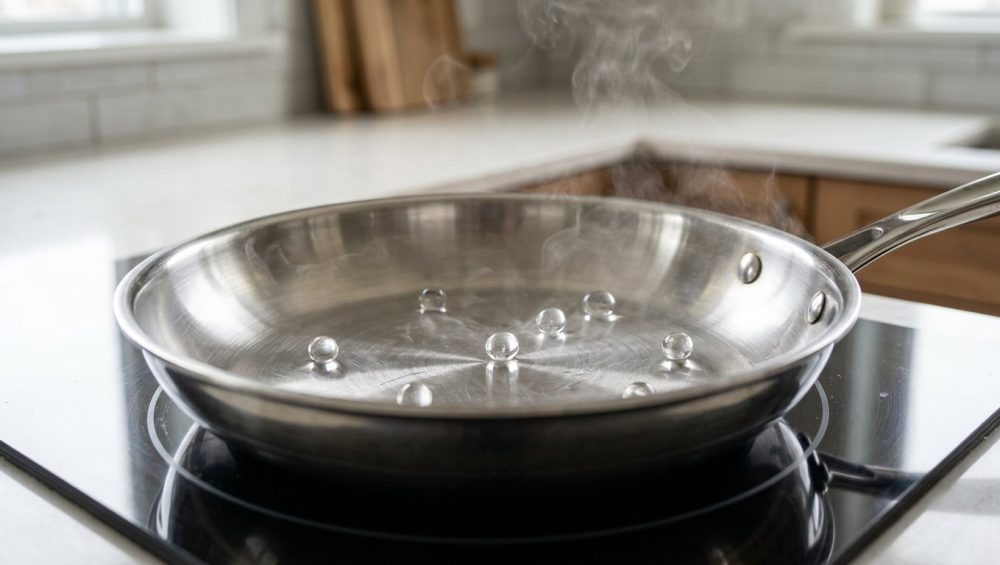
The result is a droplet of water that completely levitates on its own self-generated cushion of gas, skittering and trampolining across the surface of the pan almost entirely without friction, looking exactly like a rolling bead of liquid mercury.
When a pan has reached the precise temperature required to sustain this levitating vapor barrier, it has reached the “Leidenfrost point”. And this, my friends, is the exact thermal environment you want to transform your daily meals.
When you introduce moisture-rich food (like a steak, a chicken breast, or a piece of fish) into a pan that is hovering at the Leidenfrost point, the exact same physics apply. The intense, perfectly calibrated heat instantly vaporizes the surface moisture of the food, creating a micro-cushion of steam that physically lifts the protein away from the metal. The food glides. It sears beautifully. It releases effortlessly. It never has the opportunity to sink into the microscopic pores of the steel, because it is literally floating on a molecular layer of vapor.
So, what is the magic temperature? While purely scientific texts often cite the absolute minimum Leidenfrost point for water at around 379°F (193°C), practical kitchen testing reveals a slightly different reality. Because standard home burners heat pans from the center outward, aiming for the absolute minimum temperature often results in cold spots near the edges. Exhaustive culinary temperature testing has shown that to achieve a robust, fully sustained Leidenfrost effect across the entire cooking surface, the center of your stainless steel skillet should ideally reach between 420°F and 430°F (215°C to 221°C).
You don’t need a laser thermometer to find this sweet spot. You just need a quarter teaspoon of tap water and a little bit of patience.
The Masterclass: Executing the Water Drop Test Like a Pro
We are going to break this down into a rigorous, foolproof, step-by-step masterclass. This is the foundational technique that will permanently change how you interact with your kitchen. It is one of the most essential tools every beginner needs in their mental arsenal. Do not skip steps. Do not rush. Time is money on a weekday, yes, but taking three minutes to properly preheat your pan will save you twenty minutes of aggressive scrubbing later.
Step 1: The Naked Pan
Place your completely clean, completely dry, entirely empty stainless steel skillet onto the burner. Do not add oil. I repeat: do not put a single drop of fat into this pan yet. If you add oil to a cold pan and let it sit there while the metal slowly comes up to 430°F, the oil will begin to prematurely break down, polymerize, and turn into a sticky, gummy, smoking mess before your food ever touches it. We heat the metal naked.
Step 2: The Medium Heat Sweet Spot
Turn your burner to medium heat. Not high. Never high. One of the most catastrophic mistakes home cooks make is blasting their cookware with maximum heat in an attempt to save time. High heat will not only permanently warp your beautiful multi-clad stainless steel pan through thermal shock, but it will also cause the pan to wildly overshoot the Leidenfrost point, resulting in a surface so aggressively hot that it will instantly incinerate your cooking oil the second you pour it in. Medium heat allows the pan to warm up gradually and evenly, ensuring the microscopic pores expand and smooth out at a controlled rate. Let the pan preheat undisturbed for about 2 to 3 minutes.
Step 3: The Drop (Reading the Visual Cues)
After two minutes, it is time to test the thermodynamics of your surface. Wet your fingers under the tap, or take a 1/4 teaspoon of water, and flick a few drops directly into the center of the pan. You are looking for one of three very specific reactions:
- Stage 1: The Sad Fizzle (Under-heated)
If the water hits the pan and immediately aggressively bubbles, sizzles, and evaporates into thin air within a second or two, your pan is too cold. It has crossed the boiling point of water (212°F), but it has not reached the Leidenfrost point. If you add food now, the pores will grab it, and it will stick violently. Wait another 30 to 60 seconds and test again. - Stage 2: The Mercury Ball (Perfectly Heated)
When you flick the water into the pan and it instantly beads up into a perfect, cohesive sphere that glides, dances, and slides rapidly across the surface without evaporating, congratulations. You have achieved the Leidenfrost effect. The water is levitating on its own vapor. The metal has expanded, the pores are tight, and the pan is perfectly primed. - Stage 3: The Explosive Shatter (Over-heated)
If you flick the water in and it instantly explodes into dozens of tiny, erratic, violent micro-beads that skitter uncontrollably in every direction, your pan is entirely too hot. You have overshot the sweet spot. If you add oil now, it will instantly smoke and ignite. Turn the burner off, pull the pan off the heat for a minute to let it cool down, and re-test.
Step 4: The Oil Barrier
Once you have confirmed the glorious dancing mercury ball, take a dry paper towel and quickly wipe the water droplet out of the pan (do not leave the water in there, or it will violently splatter when the oil hits it). Now, and only now, do you add your cooking oil. Pour in just enough high-smoke-point oil (like avocado, grapeseed, or clarified butter) to thinly coat the bottom of the pan. Because the pan is already hot, the oil will immediately heat up, thin out, and begin to shimmer like glass. Swirl it around to coat the newly smoothed microscopic surface. You have just created a flawless, temporary non-stick barrier.
Step 5: The Food (And the Virtue of Patience)
Immediately add your protein to the pan. You should hear a loud, aggressive, deeply satisfying sizzle. That is the sound of surface moisture vaporizing and the Maillard reaction (the chemical browning of amino acids) kicking into high gear. Once the food hits the pan, do not touch it. Put the tongs down. Step away. Let the heat do its job.
Troubleshooting: Why the Magic Sometimes Fails
Even with the water drop test executed flawlessly, I still hear from readers who claim their food stuck. If you achieved the mercury ball but still ended up with a shredded mess, you likely committed one of the following cardinal sins. If you want to ensure you have stopped burning dinner, audit your technique against these common failures:
The Ice-Cold Protein Drop
The Leidenfrost effect relies entirely on maintaining a high, steady surface temperature. If you take a massive, dense, ice-cold steak directly out of the refrigerator and drop it into your perfectly preheated pan, you will cause a massive localized temperature crash. The metal’s temperature will plummet, the Leidenfrost vapor barrier will instantly collapse, and the sudden drop in heat will cause the metal’s microscopic pores to rapidly widen and bite down onto the cold meat. Always, always let your proteins rest on the counter to take the chill off (bringing them closer to room temperature) for 20 to 30 minutes before searing.
The Moisture Trap
If your chicken breast is dripping wet with packaging liquid or marinade when it hits the oil, the pan’s thermal energy will be entirely wasted trying to boil off that excess surface liquid rather than searing the meat. This creates a steaming effect, dropping the pan’s temperature and causing sticking. Always thoroughly pat your proteins bone-dry with heavy-duty paper towels before they go anywhere near the skillet. This is the absolute secret to why your chicken always turns out dry and pale instead of golden and crusty. Dry surface = fast sear = sealed-in juices.
Overcrowding the Pan
You are cooking for a family of four, and you want to save time, so you jam four massive chicken thighs into a standard 10-inch skillet. They are shoulder-to-shoulder, completely covering the metal. This is a disaster. Overcrowding traps evaporating moisture, turning your frying pan into a steamer. Furthermore, adding that much mass to the pan plummets the temperature below the Leidenfrost point. The meat will stew in its own juices and stick stubbornly to the bottom. Work in batches. Leave at least an inch of breathing room between every piece of food.
Panic Flipping
This is the hardest habit to break. You put the fish in the pan, wait 45 seconds, get nervous, and try to violently shove a spatula underneath it to see if it’s burning. The fish tears.
Listen to me: The pan will release the food when it is ready.
When cold-ish protein hits hot metal, there is an initial, temporary microscopic grip. As the heat equalizes and the Maillard reaction creates a crispy, caramelized crust on the surface of the food, the structural integrity of that crust will naturally detach itself from the metal. When a steak or a piece of chicken is properly seared, it will release voluntarily. If you feel resistance when you slide your spatula underneath, stop pulling. Give it another 60 seconds. Trust the thermodynamics.
The Searing Playbook: Applying the Test to Everyday Meals
Once you have mastered the water drop test, your stainless steel skillet becomes the most versatile workhorse in your kitchen. Here is how this technique translates to your everyday cooking.
The Ultimate Steak:
Preheat the pan to the Leidenfrost point. Add a high-smoke-point oil. Lay down a heavily salted, room-temperature, bone-dry ribeye. The intense, sustained heat will trigger a violently beautiful Maillard reaction, creating an edge-to-edge mahogany crust that rivals any high-end steakhouse. Because the vapor barrier prevents sticking, you can easily flip the steak multiple times to ensure an incredibly even internal temperature.
Crispy-Skinned Salmon:
Fish is notoriously delicate, which is why people cling to their toxic Teflon. But stainless steel produces vastly superior fish. Score the skin of the salmon lightly to prevent curling. Execute the water drop test. Add oil. Press the salmon, skin-side down, firmly into the pan for the first 10 seconds to ensure total contact. Then, leave it alone. The skin will render its fat, crisp up like a potato chip, and naturally release from the pan after about 4 to 5 minutes. It will slide around the metal like it’s on an ice rink.
The Perfect Sautéed Vegetables:
The Leidenfrost effect isn’t just for heavy proteins. If you want blistered green beans or perfectly charred mushrooms that don’t turn into a soggy, sticking mess, the water drop test ensures your pan is hot enough to instantly sear the vegetables without allowing them to steam in their own released moisture.
The Cleanup: Ditch the Chisel, Embrace the Deglaze
One of the great myths of stainless steel is that it is a nightmare to clean. If you are spending twenty minutes at the sink with a chainmail scrubber and a chisel, you are doing it wrong.
When you cook proteins in stainless steel, even with a perfect Leidenfrost execution, you will be left with a thin layer of caramelized, browned bits stuck to the bottom of the pan. This is not a mistake. This is called fond, and in the culinary world, fond is liquid gold. It is the concentrated, umami-packed essence of whatever you just cooked, and it is the foundational base for any professional pan sauce.
Instead of aggressively scrubbing that fond down the drain, you are going to deglaze the pan. While the skillet is still hot (after you have removed your food to rest), pour in half a cup of liquid—chicken broth, white wine, or even just tap water. The liquid will instantly boil and aggressively bubble up. Take a wooden spoon and gently scrape the bottom of the pan. The thermal shock of the liquid hitting the hot pan will instantly lift all of those stuck-on browned bits, dissolving them into the liquid.
Let that liquid reduce by half, swirl in a tablespoon of cold butter, and you have just created a mind-blowing, restaurant-quality sauce in sixty seconds. More importantly? Your pan is now practically spotless. You have essentially tricked the pan into cleaning itself while turning burnt bits into sauce.
For routine maintenance and the occasional protein haze or oil stain that stubbornly refuses to wash away with standard dish soap, keep a canister of Bar Keepers Friend under your sink. A quick sprinkle of this mildly abrasive, oxalic acid-based powder on a damp sponge will wipe away polymerized oil stains and heat tint in seconds, restoring your stainless steel to a mirror-like factory shine. There is absolutely no heavy scrubbing required.
Conclusion: Your Kitchen Independence
Ditching your cheap, peeling non-stick pans and embracing the beautiful, durable reality of uncoated stainless steel is a profound culinary milestone. It is the moment you stop relying on chemical crutches and start cooking with actual technique.
The water drop test is not just a neat party trick; it is a fundamental lesson in applied physics. It teaches you to listen to your cookware, to respect temperature gradients, and to understand the microscopic interactions happening between your food and your tools.
Yes, it requires an extra two minutes of patience. Yes, it forces you to actually pay attention to the heat of your burner rather than just blindly throwing cold food into a cold pan. But the reward is a lifetime of flawless, deeply flavorful, perfectly crusted meals cooked on a non-toxic surface that will literally outlive you. Stop letting cheap gear dictate your success. Learn the science, master the heat, and watch your daily routine evolve from a stressful chore into kitchen artistry. Now, go pour yourself that glass of wine, preheat your skillet, and let the water dance.