Listen to me, you beautiful, well-intentioned weekend warriors. We need to have a serious, sit-down conversation about what you are doing to your chicken, your flank steaks, and your lamb chops. For decades, home cooks have been fed a massive, pervasive culinary lie. You’ve been told that to achieve restaurant-quality, melt-in-your-mouth tender meat, you need to drown it in a highly acidic bath. You’ve been dutifully pouring bottles of cheap Italian dressing, cups of straight lemon juice, and harsh vinegars over your expensive proteins, crossing your fingers, and hoping for a miracle.
And what happens? You pull that beautiful chicken breast off the grill, slice into it, and it has the exact texture of a pencil eraser. Or worse, it’s chalky, stringy, and somehow dry on the inside while being completely soggy on the outside. If your chicken always turns out dry, it’s probably because you’ve been aggressively acid-burning it before it even hits the heat.
I have zero patience for pretentious chef-speak, but I do have an absolute obsession with the actual science of cooking. Because when you understand the science, you stop making the same frustrating mistakes. Today, we are going to completely dismantle the myth of the acidic marinade. We are going to look at the physics of protein denaturation, the absolute tragedy of mushy meat, and why swapping your harsh vinegars for the gentle, enzymatic power of yogurt is the single greatest upgrade you can make in your kitchen. This isn’t just a trendy substitute; it is a scientifically superior method grounded in enzymatic biochemistry and microbial ecology. By the end of this masterclass, you will never look at a tub of plain whole-milk yogurt the same way again.
The Tragedy of the Acid Bath
Let’s get one thing straight right out of the gate: marinating is not just about flavor. It is a highly active chemical process. When you drop a piece of raw meat into a liquid, you are initiating a cascade of reactions that will fundamentally alter the physical structure of that protein.
The Anatomy of a Muscle Fiber
To understand why harsh acids are ruining your dinners, we have to put on our lab coats for a second and look at what meat actually is. Meat is essentially a complex, microscopic network of muscle fibers—specifically proteins called actin and myosin—bundled together and wrapped in a tough connective tissue known as collagen. Think of these protein strands as tightly wound, microscopic springs. In their raw state, these springs are relaxed and holding onto a massive amount of water. This trapped water is what makes a perfectly cooked steak or chicken thigh taste juicy and succulent.
When we cook meat, heat causes these protein springs to unwind (a process called denaturation) and then link up with each other (coagulation). As they link together, they squeeze tight, wringing out the water like a wet sponge. This is why an overcooked piece of meat is dry, tough, and hard to swallow.
Why Citric and Acetic Acids Are Culinary Bullies
Here is where the traditional marinade goes horribly wrong. Most standard marinades rely heavily on strong acids: lemon juice (citric acid) or vinegar (acetic acid). Lemon juice has a highly aggressive pH of around 2.0, while white vinegar sits right around 2.4.
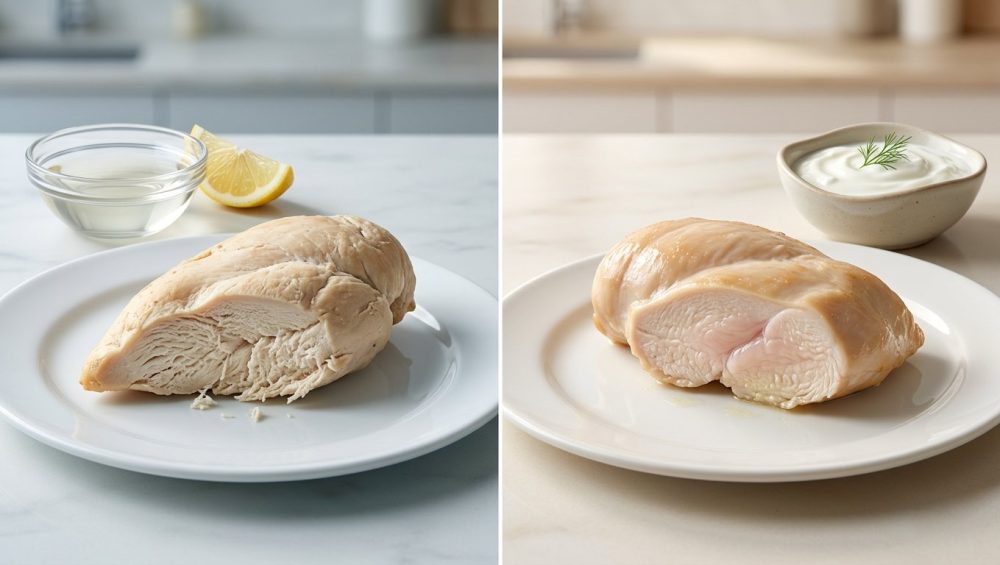
When you submerge raw meat into an environment with a pH that low, you are rapidly protonating the actin and myosin proteins. In plain English? The acid aggressively attacks the protein strings, causing them to denature and cross-link wildly before the meat ever sees a heat source. The acid effectively “cooks” the outside of the meat. If you’ve ever seen ceviche, where raw fish turns opaque and firm in lime juice, you’ve witnessed this exact chemical reaction in real-time.
But chicken, beef, and pork aren’t delicate fish. When you leave a chicken breast in a red wine vinaigrette for a few hours, the outer layers of the meat become tightly bound and cross-linked. The moisture is violently squeezed out, and the structural integrity of the protein is destroyed. The result is a surface texture that is simultaneously mushy, chalky, and rubbery, while the inside remains completely unseasoned. It is a textural nightmare. You are quite literally destroying the meat to save it, and it simply does not work.
Enter Yogurt: The Ultimate Culinary Loophole
So, if harsh acids are the enemy of good texture, how do we tenderize meat and infuse it with flavor without turning it into a science experiment gone wrong? We look to a technique that originated thousands of years ago in Central Asia and was perfected during the Mongol Empire. We look to dairy. Specifically, we look to yogurt.
Before we get into the molecular biology of your dinner, let’s look at the historical precedent. Yogurt marination isn’t some modern internet hack; it is a culinary tradition that spans millennia. Nomadic tribes would ferment mare’s milk into a primitive, highly acidic yogurt. When dealing with tough, old cuts of meat from their livestock, they discovered that soaking the meat in this fermented milk completely transformed the texture, rendering it edible and tender. This technique migrated and evolved. In India, it became the foundational technique for Tandoori chicken, where poultry is heavily coated in yogurt and spices before being lowered into a scorching 800°F clay tandoor oven. In the Middle East, lamb and beef are soaked in yogurt for Shish Kebabs, allowing the meat to withstand the intense, dry heat of an open charcoal fire without turning to leather.
This is a globally tested, historically verified method. Utilizing this ancient technique is the absolute ultimate cheat code for simple weeknight dinners that taste like they took three days of professional prep.
The Lactic Acid Advantage
The primary secret behind yogurt’s tenderizing superpower is lactic acid. Unlike the harsh, aggressive citric and acetic acids, lactic acid is incredibly gentle. Yogurt operates at a much higher, safer pH level, typically hovering between 4.0 and 4.6.
Because lactic acid only partially dissociates when it comes into contact with the meat, it doesn’t shock the proteins into a sudden, aggressive cross-linking panic. Instead, it slowly and gently breaks down the tough connective tissues (the collagen) while leaving the actin and myosin relatively intact. This means the meat softens and relaxes without squeezing out its internal moisture. The muscle fibers are tenderized, but their structural integrity is preserved. You get the melt-in-your-mouth tenderness without the dreaded chalky mush.
The Calcium-Calpain Connection (The Real Magic)
But lactic acid is only half of the story. This is the part of the masterclass where the food science gets truly fascinating. Yogurt is, of course, a dairy product, which means it is absolutely packed with calcium.
Inside the muscle tissue of all meat, there are naturally occurring, endogenous enzymes called calpains. Think of calpains as tiny, biological scissors that exist solely to break down muscle proteins. In the beef industry, the activation of these calpains is the entire reason the dry-aging process works. As meat ages, these enzymes slowly degrade the structural proteins, transforming a tough piece of muscle into a tender delicacy.
Here is the brilliant catch: calpains are calcium-activated proteases. When you coat a piece of meat in yogurt, the abundant calcium in the dairy slowly seeps into the surface of the meat. This influx of calcium acts like a biological key, unlocking and activating the meat’s own native calpain enzymes. The meat literally begins to tenderize itself from the inside out using its own internal machinery. It is an elegant, biological hack that no vinaigrette or lemon-oil soak could ever hope to replicate. You are working with the meat’s natural biology, rather than fighting against it with harsh chemicals.
The Maillard Miracle: Building a Better Crust
We eat with our eyes first, and nobody wants a pale, sad-looking piece of poultry on their dinner plate. A proper marinade shouldn’t just tenderize the interior; it needs to facilitate a gorgeous, caramelized crust on the exterior.
Caramelizing Lactose and Milk Proteins
The Maillard reaction is the complex chemical process where amino acids and reducing sugars react under high heat to create hundreds of new flavor compounds and that beautiful, deep brown color. When you use a yogurt marinade, you are coating the meat in lactose (milk sugar) and milk proteins.
When this dairy coating hits a screaming hot pan or a grill grate, those milk sugars and proteins caramelize rapidly, creating a stunning, deeply flavorful crust. It’s the exact same science that gives traditional Indian Tandoori chicken its iconic, slightly charred, intensely savory exterior. The yogurt infiltrates the microscopic crevices of the meat and builds a beautiful layer of caramelization that a standard oil-and-lemon marinade simply cannot achieve.
Fat as a Buffer
Furthermore, if you are doing this right and using whole-milk yogurt (and you absolutely should be, because non-fat dairy is a culinary tragedy), the milk fat acts as a thermal buffer. The fat clings to the surface of the meat, insulating it slightly from the harsh, direct heat of the pan. This allows the crust to develop beautifully while protecting the delicate proteins just below the surface from overcooking and drying out.
Understanding how to build this protective buffer is one of the most vital tools every beginner needs in their mental culinary arsenal. The fat also serves a second, equally important purpose: it is a carrier for flavor. Many of the aromatic compounds in spices like cumin, coriander, and paprika are fat-soluble, meaning they need fat to fully release and penetrate the food. The milk fat in the yogurt traps these flavors and holds them directly against the meat, ensuring that every single bite is heavily seasoned.
Time is Money: The Weekday Warrior’s Marinating Strategy
I am a firm believer that anyone can produce mind-blowing food without spending their entire life in the kitchen. On a busy Tuesday, time is your most valuable commodity. You do not have the luxury of babysitting a highly reactive acid marinade, constantly checking the clock to make sure your chicken hasn’t turned to jerky.
The Forgiveness Factor of Dairy
This is the logistical beauty of the yogurt marinade: it is incredibly forgiving. If you drop chicken breasts into a lemon and vinegar marinade, you have a strict window of maybe two hours before the texture is ruined. But because yogurt’s lactic acid and enzymatic action are so gentle, you can leave meat in a yogurt marinade for 12, 18, or even 24 hours without any negative textural consequences.
You can toss your chicken, lamb, or beef into a yogurt bath on Monday night, leave it in the fridge while you go to work on Tuesday, and cook it the second you walk through the door on Tuesday evening. The meat won’t be mushy; it will be perfectly tenderized, deeply flavored, and ready for the heat.
When mixing up your marinade on a busy weeknight, be mindful of your utensils. Always use a clean stainless steel whisk. If you use a cheap, degraded silicone tool, you might quickly discover why your spatulas taste like soap after they absorb low-quality dishwasher detergent. Keep your tools clean, neutral, and out of the way of your flavor profile.
Flavor Synergy and Penetration
While the salt in your marinade is the only ingredient that will actually penetrate deep into the center of the muscle tissue through osmosis, the yogurt ensures that the surface level of the meat is packed with flavor. The live cultures in plain, unpasteurized yogurt also provide a competitive microbial environment that actually helps inhibit the growth of bad bacteria (like Listeria and Salmonella) on the surface of the meat while it marinates in the fridge. It is a safer, smarter, and vastly superior way to prep your proteins.
The “No-Go” Rule: Stop Using Toxic Gear for Marinades
We need to take a brief, highly necessary detour to talk about your kitchen equipment. I have a strict “no-go” rule when it comes to cheap, toxic, or highly reactive kitchenware. You can have the greatest, most scientifically sound yogurt marinade in the world, and you will completely ruin it if you put it in the wrong vessel or cook it on the wrong pan.
The Aluminum Reaction Trap
Never, under any circumstances, marinate your meat in an aluminum pan or an unlined copper bowl. The lactic acid in the yogurt is highly reactive with aluminum. If you leave a yogurt marinade in an aluminum tray for even a few hours, the acid will literally dissolve microscopic amounts of the metal, leaching metallic ions directly into your food. It will give your beautiful, expensive meat a distinct, highly unpleasant battery-acid flavor and rapidly catalyze lipid oxidation.
Instead, always use non-reactive containers. High-quality glass, ceramic, or food-grade stainless steel are your best friends here. A lot of home cooks complain that yogurt-marinated meat sticks to stainless steel, but I promise you, that is almost entirely a temperature management issue during the cooking phase, not a flaw in the marinade or the metal itself. For storage, stainless steel is perfect.
The Non-Stick Nightmare
When it comes time to cook your yogurt-marinated masterpiece, you need high heat to trigger that Maillard reaction. This means cheap, lightweight, Teflon-coated non-stick pans are completely banned from this process.
Traditional non-stick coatings (PTFE) begin to degrade and off-gas toxic fluoropolymer fumes at temperatures above 450°F. To get a proper sear on a yogurt-coated piece of meat, you need a pan that can handle serious thermal mass. If you are still ruining your nonstick pans by blasting them on high heat to get a crust, you are eating flaking chemicals with your dinner. Throw them away. Use heavy-bottomed tri-ply stainless steel, well-seasoned carbon steel, or classic cast iron. These materials can take the heat necessary to caramelize the lactose in the yogurt safely and effectively.
And please, if your cheap glass baking dish shattered the last time you tried to roast at high heat, make the investment in genuine borosilicate glass. It won’t hold onto odors, it won’t warp, and it won’t react with your lactic acid.
The Masterclass: Building the Perfect Yogurt Marinade
Now that we understand the deep science and have banished the toxic gear from our kitchens, let’s talk execution. Building a proper yogurt marinade is an exercise in layering flavors and respecting the ingredients.
Step 1: Choosing the Right Dairy
Do not buy non-fat yogurt. Do not buy vanilla-flavored yogurt. Do not buy yogurt with added gums, stabilizers, or gelatin. You want full-fat, whole-milk, plain yogurt. Greek yogurt is fantastic because it is strained and incredibly thick, meaning it will cling to the meat beautifully. If your Greek yogurt is too thick to coat the meat evenly, you can thin it out with a tiny splash of whole milk or a small squeeze of fresh lemon juice (just a tablespoon for flavor, not enough to drastically drop the pH).
Step 2: The Aromatic Alchemy
Yogurt is a blank canvas. It is begging for aggressive seasoning. Garlic, ginger, cumin, coriander, smoked paprika, turmeric, and garam masala are all phenomenal choices.
If you want to completely elevate your marinade, do not just dump raw, dusty spices from a five-year-old jar directly into the cold yogurt. Spices contain volatile oils that need heat to properly awaken. You can exponentially amplify those aromatics by blooming them in oil in a small skillet over medium heat for about thirty seconds before folding them into your dairy base. The hot, spiced oil will mix with the fat in the yogurt, creating a deeply complex, restaurant-tier flavor profile that will penetrate the outer layers of the meat. Add a generous amount of kosher salt—more than you think you need, as the salt will travel deep into the muscle tissue over time.
Step 3: The Marination Window
Coat your meat thoroughly. Massage the yogurt mixture into every crevice. If you are doing bone-in, skin-on chicken thighs, make sure to get the marinade under the skin. Place the meat in your non-reactive glass container, cover it tightly, and place it in the refrigerator. We all know why your plastic containers stay greasy and permanently stained after holding onto heavy, spice-laden marinades, so do yourself a favor and stick to glass prep bowls.
For delicate proteins like fish or shrimp, 30 to 60 minutes is plenty. For chicken breasts, thighs, pork chops, or flank steak, aim for a minimum of 4 hours, though 12 to 24 hours is the absolute sweet spot for maximum enzymatic tenderization.
Execution: From Fridge to Fire
You’ve done the prep. The lactic acid has gently unwound the proteins. The calcium has triggered the calpains. The meat is incredibly tender and packed with flavor. Now, you have to cook it without ruining all your hard work.
Prepping the Meat for the Pan
When you pull the meat out of the fridge, do not rinse it under water. Rinsing meat is a terrible practice that just splashes bacteria around your sink. However, you do want to gently wipe off the excess marinade with a paper towel. You want a thin, even coating of yogurt clinging to the meat, not huge, gloppy mounds.
If you leave too much yogurt on the surface, the excess moisture will create steam pockets when it hits the hot pan. Remember, the Maillard reaction cannot occur while water is evaporating. If the pan is full of steam, your meat will boil in its own juices rather than searing, completely bypassing the caramelization phase. A thin layer of yogurt is all you need to form that gorgeous crust. In controlled sear tests, towel-dried samples achieved target crust formation significantly faster than meat left dripping with excess marinade.
Managing the Heat
Preheat your stainless steel or cast-iron skillet thoroughly. The pan needs to be hot enough to instantly start evaporating the surface moisture and searing the milk proteins. Yogurt’s residual sugars caramelize rapidly above 425°F.
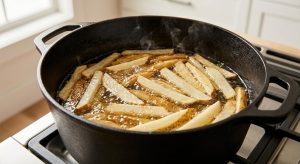
Place the meat in the pan and leave it alone. Do not poke it, do not prod it, and do not try to flip it after thirty seconds. The yogurt coating needs time to caramelize and release from the metal. If you preheat the pan properly, use enough cooking fat, and let the thermodynamics of the Maillard reaction do their job, the meat will release naturally when the crust is fully formed. You will get a beautiful, deep char, and you won’t be scrubbing stainless steel pans at midnight with a wire brush.
The Final Verdict on Tender Meat
Cooking is not magic; it is applied physics and chemistry. Once you understand the basic rules of the game, you can manipulate them to your advantage. Harsh, highly acidic marinades are a relic of bad culinary advice. They punish your meat, destroy its texture, and leave you chewing on dry, chalky regret.
By harnessing the gentle power of lactic acid, the biological activation of calcium and calpains, and the crust-building magic of milk proteins, you can transform the cheapest, toughest cuts of meat into absolute masterpieces. Yogurt is the ultimate culinary equalizer. It is cheap, it is accessible, and it works flawlessly every single time.
So the next time you find yourself staring at a pack of chicken thighs and a bottle of harsh vinegar, put the vinegar down. Grab the whole-milk yogurt, bloom some spices, and let the science do the heavy lifting for you. Your dinner guests—and your palate—will thank you. Now get out of here, go check your cookware, and start cooking like you actually know what you’re doing.