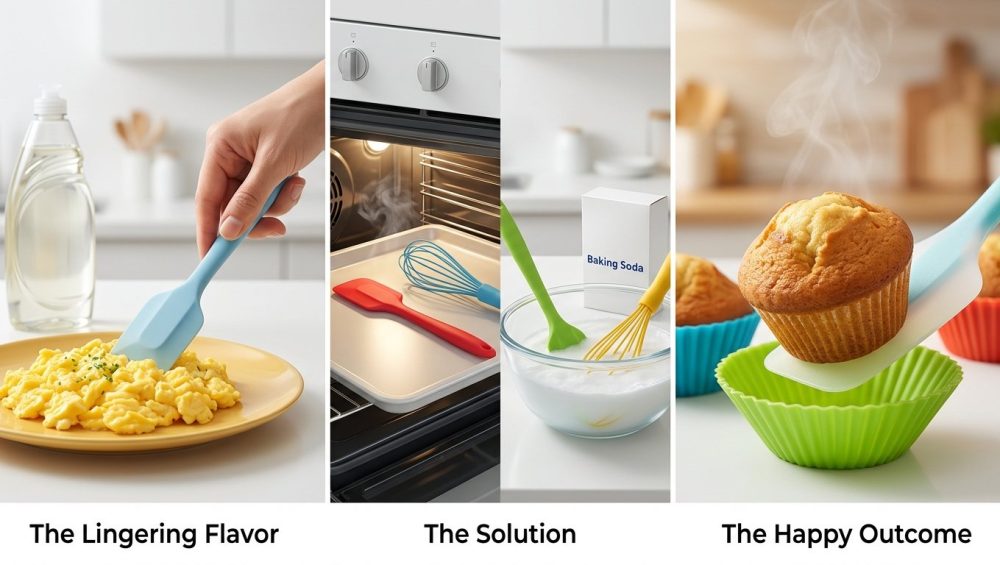
Picture this: It is a beautiful Saturday morning. You have survived another grueling work week, and you are finally taking the time to treat yourself. You are standing at your stove, whisking up a batch of gorgeous, slow-cooked, French-style scrambled eggs. You have invested in the good butter. You have perfectly seasoned the pan. You gently fold the curds with your trusty, bright red silicone spatula. You plate the eggs, pour yourself a hot cup of coffee, and take that highly anticipated first bite.
And then, tragedy strikes.
Instead of the rich, savory, buttery perfection you were expecting, your mouth is flooded with the distinct, overpowering flavor of a lavender bath bomb. Your eggs taste exactly like your dish soap. You spit it out, question your sanity, and stare at your spatula in absolute betrayal.
Welcome to my kitchen, weekend warriors. Grab a glass of wine (or another cup of coffee, I certainly do not judge). If you are reading this, you have likely fallen victim to the dreaded soapy silicone phenomenon. As someone who firmly believes that anyone can cook like an expert without a pretentious culinary degree, I have zero patience for kitchen equipment that actively sabotages our meals. When you are dedicated to transforming your daily cooking into a joyful, creative outlet, the absolute last thing you want is a chemical warfare experiment happening in your breakfast skillet.
Today, we are going to dive deep into the fascinating, slightly infuriating science of why your silicone spatulas, baking mats, and storage bags are hoarding the ghost of dish soaps past. More importantly, I am going to give you the definitive, science-backed masterclass on how to strip those foul odors from your gear forever. We are also going to have a very brutally honest conversation about the unregulated, toxic junk flooding the kitchenware market, and how to ensure you are only cooking with the good stuff.
Time is money during the week, but today, we are taking the time to fix this problem permanently. Let’s get into it.
The Phantom Menace: Why Your Breakfast Suddenly Tastes Like a Perfume Counter
To understand how to fix the problem, we have to understand why it happens in the first place. You might look at your silicone spatula and see a smooth, impenetrable, brightly colored surface. But on a microscopic level, silicone is hiding a dark secret.
The Science of Silicone: It Is Basically a High-Tech Sponge
Silicone is a synthetic polymer made up of a backbone of alternating silicon and oxygen atoms, known as siloxane bonds. This unique chemical structure is what makes silicone so incredibly heat-resistant, flexible, and durable. It is why we can plunge a spatula into boiling sugar or leave a baking mat in a scorching oven without it melting into a puddle.
However, this same molecular structure is highly permeable. At a microscopic level, silicone is incredibly porous. In the world of industrial chemistry, solid silicone is actually utilized specifically for its ability to absorb Volatile Organic Compounds (VOCs). In fact, environmental engineering studies have demonstrated that silicone materials are highly effective at absorbing and damping VOCs from industrial exhaust, boasting absorption efficiencies of up to 90%. Furthermore, scientific research has shown that silicone tubing acts as a massive reservoir for VOCs, absorbing them rapidly and holding onto them tightly.
Why does this matter to your morning eggs? Because the synthetic fragrances and essential oils used in your dish soap are literally Volatile Organic Compounds.
When you wash your silicone spatula in the sink, the hot water causes the polymer matrix of the silicone to expand slightly. The highly concentrated VOCs from your dish soap’s fragrance oils slip right into those microscopic pores and set up camp. The silicone absorbs these chemical scents like a high-tech sponge. Later, when you use that same spatula to cook your eggs, the heat of the pan causes the silicone to expand again, releasing those trapped VOCs directly into your food through a process called thermal desorption.
Just like figuring out why your chicken always turns out dry, understanding the underlying chemistry of your kitchen is the first step to solving the problem.
The Culprits: Synthetic Fragrances and Aggressive Detergents
You might be wondering why this only seems to happen to certain utensils and not others. The answer lies in your sink and your dishwasher.
Most commercial dish soaps are heavily loaded with synthetic perfumes, limonene, linalool, and essential oils designed to make your kitchen smell like a “Mountain Spring” or a “Citrus Orchard.” While these scents are lovely when you are scrubbing pots, they are the absolute enemy of silicone. Strong dish soaps, particularly those with added essential oils, are the primary culprits behind the soapy taste.
The dishwasher is an even more hostile environment. Dishwasher pods are packed with aggressive, highly concentrated detergents and long-lasting fragrances designed to survive a two-hour wash cycle. Brands like Stasher, which manufacture high-end silicone storage bags, have specifically pointed out that using heavy-duty dishwasher detergents like Cascade is often one of the main causes of silicone absorbing a soapy taste. The combination of the dishwasher’s extreme heat (which opens the silicone’s pores) and the heavily perfumed detergent creates the perfect storm for VOC absorption.
It is the same infuriating mystery as why your baking sheets keep warping in the oven; once you understand the physics behind it, you realize it was entirely preventable.
How to Tell if Your Silicone Gear is Actually Safe (Or Just Cheap, Toxic Junk)
Before we start deep-cleaning your spatulas, we need to have a serious talk about the quality of the gear you are using. I have a strict “No-Go” rule in my kitchen: I absolutely despise cheap, toxic kitchenware. If you are buying mystery-metal pans or peeling non-stick skillets, you are actively doing yourself a disservice. The same applies to silicone.
Not all silicone is created equal. The market is flooded with cheap knock-offs that are cut with dangerous fillers to lower manufacturing costs. I am a massive advocate for banishing toxic kitchen gear from your home entirely, so let’s test your tools right now.
The Infamous Pinch Test and What It Actually Means
There is a very simple, at-home diagnostic you can run on your silicone tools right now. It is called the “Pinch Test.”
Take your silicone spatula, baking cup, or mat. Pinch a thick section of the silicone tightly between your thumb and index finger, and twist it or bend it sharply. Observe the color of the silicone at the apex of the bend.
If the silicone retains its solid, uniform color, congratulations! You likely have pure, high-quality silicone.
If the stressed area suddenly turns a stark, chalky white, you have a problem. That white discoloration indicates that the manufacturer has bulked up the silicone with cheap chemical fillers, such as chalk, talc, or low-grade silica.
While some industrial manufacturers argue that silica fillers are necessary for stiffness, the reality for home cooks is that filler-laden silicone is generally less durable, more prone to absorbing odors, and significantly more likely to degrade and leach unwanted chemical residues into your food when exposed to high heat. If your gear turns white when you pinch it, I highly recommend throwing it in the trash. You deserve better.
When you are stocking up on beginner kitchen tools, it is tempting to buy the cheapest bundle of brightly colored spatulas you can find online. Do not do it. Those cheap tools will cost you more in ruined meals and frustration than a single, high-quality tool ever would.
Platinum-Cured vs. Peroxide-Cured Silicone
If you want to be a truly savvy consumer, you need to look at how the silicone was cured. Silicone manufacturing requires a curing agent to bond the polymers together.
Cheap silicone is typically “peroxide-cured.” This process is inexpensive but often leaves behind volatile organic acids and byproducts that can outgas during baking, leading to strange chemical smells and potential food contamination.
High-end, premium silicone is “platinum-cured.” This process utilizes platinum as a catalyst. It is significantly more expensive to produce, but it results in a vastly superior product. Platinum-cured silicone is incredibly pure, completely odorless, highly durable, and leaves behind absolutely no toxic byproducts. It is the standard used for medical tubing, baby bottle nipples, and professional-grade bakeware.
When shopping, always look for products that explicitly state they are made from “100% Platinum-Cured Silicone” and boast LFGB certification. The FDA (US) food safety standards are relatively lax, but the LFGB (European) standards are incredibly strict and require rigorous testing to ensure absolutely no harmful chemicals transfer to food.
The Masterclass: How to Banish the Soap Taste Forever
Alright, assuming your silicone has passed the pinch test and is worthy of saving, it is time to get to work. We know that the soap flavor is caused by trapped VOCs hiding inside the polymer matrix. We cannot simply wash them away with cold water; we have to force them out.
Here are the three most effective, science-backed methods for stripping your silicone clean. If you want to eliminate kitchen chaos, you need to master these simple maintenance routines.
Method 1: The Baking Soda Spa Treatment (The Gentle Approach)
This is the best method for light odor contamination, or for routine maintenance of your favorite gear. Baking soda (sodium bicarbonate) is an amphoteric compound, meaning it can react with both acids and bases. It is a natural deodorizer that excels at neutralizing and absorbing lingering chemical odors and residues without damaging the silicone.
The Step-by-Step Process:
- Dampen the Silicone: Rinse your soapy-tasting spatula or baking mat with hot water to slightly open the pores of the material.
- Create the Paste: In a small bowl, mix a generous amount of baking soda with just enough hot water to form a thick, spreadable paste (think the consistency of toothpaste).
- Apply and Scrub: Using a soft, non-abrasive sponge or your fingers, massage the baking soda paste heavily into the surface of the silicone. Ensure every square inch is covered.
- The Waiting Game: This is the most crucial step. Let the paste sit and dry on the silicone for at least a few hours, though leaving it overnight is significantly more effective. The baking soda needs time to pull the VOCs out of the polymer matrix.
- Rinse and Dry: Once the paste has dried into a crust, rinse the silicone thoroughly with very hot water. Wash it one final time with an unscented dish soap, and let it air dry completely.
Method 2: The Boiling Water and Vinegar Exorcism (The Deep Clean)
If the baking soda spa treatment didn’t fully eradicate the ghost of your dish soap, it is time to escalate the situation. We talk a lot about how your dinner actually needs acid to taste balanced, but guess what? Acid is also a miracle cleaner.
White vinegar contains acetic acid, which is incredibly effective at cutting through grease, breaking down stubborn soapy residues, and neutralizing odors. When combined with the heat of boiling water, which forces the silicone pores to expand, this method performs a deep-tissue cleanse on your utensils.
The Step-by-Step Process:
- The Vinegar Soak: Fill a large basin or your sink with a mixture of equal parts hot water and distilled white vinegar.
- Submerge: Drop your offending silicone gear into the acidic bath and let it soak for a minimum of 30 to 60 minutes. The acetic acid will penetrate the surface and begin breaking down the trapped fragrance oils.
- The Boil (Optional but Highly Recommended): For a truly rigorous clean, transfer the silicone to a large pot on your stove. Fill it with water, add a splash of vinegar, and bring it to a rolling boil. Boil the silicone for 5 to 10 minutes. Crucial Warning: Only do this if your utensil is 100% silicone or has a solid stainless steel core. If your spatula has a cheap plastic handle or a wooden dowel attached, boiling it will destroy it.
- The Lemon Rinse: For an extra layer of freshness, you can rinse the boiled silicone with diluted lemon juice. Lemon juice acts as a natural degreaser and deodorizer.
- Final Wash: Rinse the gear thoroughly with hot water and let it air dry, preferably in direct sunlight, which helps further eliminate residual odors.
Method 3: The Heat Curing Method (The Nuclear Option)
If you have tried the baking soda. If you have tried the vinegar. If your spatula still tastes like a perfumery, it is time for the nuclear option. This is the absolute most effective, scientifically proven method for stripping silicone of odors, and it relies on the principle of thermal desorption.
As we established earlier, heat causes silicone to release trapped VOCs. By subjecting the silicone to sustained, high heat in a controlled environment, we can force the polymer matrix to aggressively off-gas every single molecule of trapped fragrance.
Massive Disclaimer: You can ONLY use this method if you are absolutely certain your product is 100% pure, high-quality, food-grade silicone (like Souper Cubes, Stasher bags, or premium spatulas). If your gear failed the pinch test, putting it in the oven will cause it to melt, warp, or release toxic smoke into your kitchen.
The Step-by-Step Process:
- Preheat the Oven: Preheat your oven to a temperature between 250°F and 350°F (120°C to 175°C). Do not exceed 350°F, as you want to bake out the odors, not degrade the material.
- Prep the Gear: Wash the silicone thoroughly with hot water and unscented soap to remove any surface oils. Dry it completely.
- The Bake: Place the silicone items on a clean, ungreased baking sheet. Ensure the silicone is not touching the heating elements or the walls of the oven.
- The Desorption Phase: Bake the silicone for 20 to 60 minutes. During this time, the heat will force the trapped VOCs to vaporize and exit the silicone. You might actually smell the dish soap fragrance venting from your oven—this means it is working!
- Cool Down: Carefully remove the baking sheet from the oven using mitts (the silicone will be incredibly hot) and let it cool completely at room temperature.
- The Sniff Test: Once cool, give it a sniff. It should smell like absolutely nothing. If a faint odor remains, you can repeat the bake for another 20 minutes.
Preventative Maintenance: How to Wash Silicone Properly
Congratulations! You have successfully exorcised the soapy demons from your kitchenware. Now, how do we prevent this highly annoying phenomenon from ever happening again? It requires a few minor adjustments to your daily routine, but I promise it is worth it.
Ditch the Heavily Scented Dish Soaps
The easiest way to stop silicone from absorbing fragrance is to stop exposing it to fragrance. You do not need your dishes to smell like a tropical rainforest for them to be clean.
Invest in a high-quality, unscented, clear, degreasing dish soap. Brands like Seventh Generation or plain, unscented Dawn are excellent choices. Keep a small pump bottle of this unscented soap specifically for washing your silicone spatulas, baking mats, and storage bags. The neutral pH and lack of essential oils will ensure that your gear stays pristine and odor-free.
The Dishwasher Debate: Friend or Foe?
I know that on a busy Tuesday night, the dishwasher is your best friend. But when it comes to silicone, the dishwasher is a minefield.
Using heavily perfumed dishwasher pods on your delicate gear is one of those rookie kitchen mistakes that will ruin your food. The high-heat drying cycles essentially bake the detergent’s synthetic fragrances directly into the silicone’s pores.
If you absolutely must put your silicone in the dishwasher, follow these strict rules:
- Always place silicone items on the top rack, as far away from the heating element as possible.
- Switch to an unscented, natural, powder-based dishwasher detergent rather than heavily scented liquid pods.
- Skip the heated dry cycle. Let the silicone air dry instead.
Honestly? Just handwash your silicone. It takes thirty seconds, and it will extend the lifespan of your tools by years.
When to Cut Your Losses and Buy New Spatulas
Even with the best maintenance in the world, kitchen tools do not live forever. Knowing when to retire a piece of equipment is a crucial skill for any home cook. Much like the reason your non-stick pans keep losing their slippery finish, the degradation of silicone is an inevitable chemical reality over a long enough timeline.
Identifying the Point of No Return
If you have tried the baking soda, the vinegar, and the oven, and your spatula still tastes like soap, the polymer matrix may be permanently compromised.
Furthermore, you need to inspect your silicone for physical damage. If the edges of your spatula are frayed, nicked, or peeling, it is time to throw it away. Those microscopic tears are breeding grounds for bacteria and will trap cooking oils that eventually turn rancid.
Most importantly, if your silicone has developed a permanently sticky, tacky film that cannot be removed by boiling or scrubbing, the material is dead. That stickiness is a sign that the silicone polymers are breaking down, usually as a result of absorbing too much polymerized grease or due to cheap manufacturing. Do not feed your family with degrading plastics. Throw it out.
Upgrading Your Arsenal
When you are ready to replace your ruined gear, do not make the same mistake twice. Be a ruthless, informed consumer.
Look for tools that are explicitly labeled as “100% Platinum-Cured Silicone”. Look for the LFGB certification badge, which guarantees the product has passed the strictest European food safety standards. Look for seamless designs—spatulas that are molded from a single piece of silicone are infinitely better than spatulas with removable heads, as they leave no crevices for mold, water, or soap to hide in.
Yes, a premium platinum silicone spatula might cost you fifteen dollars instead of five. But it will never turn your morning eggs into a soapy disaster, it will never leach fillers into your food, and it will likely outlast you in the kitchen. That is what I call a worthy investment.
Conclusion: Taking Back Your Tastebuds
Cooking should be a joyful, deeply satisfying experience, not a source of stress or chemical contamination. You do not need to be a professionally trained chef to demand high-quality, safe, and effective tools in your home kitchen.
By understanding the porous nature of silicone, avoiding heavily scented detergents, and utilizing science-backed cleaning methods like thermal desorption and alkaline soaks, you can ensure your food tastes exactly the way you intended it to.
Throw out the toxic, filler-laden junk. Treat your good gear with respect. And please, for the love of all things culinary, stop washing your spatulas with lavender soap.
Stay tuned for my latest kitchen discoveries as I continue to test, review, and occasionally rant about the tools that make our culinary lives better. Now, go back to the kitchen, make yourself a fresh batch of eggs, and enjoy your weekend. You have earned it.