Grab your favorite glass of wine, pull up a stool, and let’s have a brutally honest chat about what is currently happening in your kitchen. If you are staring at a scorched pan, a pile of wilted spinach that cost you six dollars, or a takeout menu because the mere idea of chopping an onion makes you want to cry (and not just from the fumes), you are in the exact right place. I am your Sassy Sous-Chef, and I am here to tell you a fundamental, liberating truth: you do not need a fancy culinary degree to cook mind-blowing food. You do not need a monogrammed white coat, you do not need tweezers to plate your Tuesday night dinner, and you certainly do not need to tolerate pretentious chef-speak.
What you do need is a little tough love, some rock-solid techniques, and the willingness to stop making the same rookie mistakes that are actively costing you time, money, and your sanity.
I get it. I really do. I learned to cook by setting off the smoke detector so many times my neighbors thought my apartment was the local fire testing facility. I survived the dark era of rubbery chicken breasts, tragically soggy vegetables, and pasta that resembled papier-mâché. But I figured it out through trial, error, and a stubborn refusal to eat bad food. Now, I use ruthless efficiency during the week so I can be an absolute perfectionist on the weekends. Time is money, especially on a Wednesday at 6:30 PM, and I am going to teach you exactly how to reclaim both.
In this definitive, leave-no-stone-unturned masterclass, we are going to dissect the most common rookie kitchen woes. We are going to look at the cold, hard statistics of why your current habits are failing you, and I am going to give you the smart, practical fixes to transform you from a kitchen liability into a supremely confident home cook. Let’s get into it.
The Dull Knife Dilemma (And Why You Are a Danger to Yourself)
Let us start with the most terrifying thing in your kitchen, which ironically is probably the tool you think is the safest: your incredibly dull chef’s knife. If you are sawing through a tomato and crushing it into a pulp just to get a slice, you are committing a culinary crime and putting yourself in imminent danger.
The Bloody Statistics of Bad Blades
You might think a sharp knife is dangerous, but the data paints a vastly different picture. When a knife is dull, you have to apply significantly more downward force to cut through your ingredients. When that dull blade inevitably slips off the slick skin of an onion, all that excessive force sends the blade directly into your hand.
The numbers are staggering. According to 2024 data from the Consumer Product Safety Commission, housewares (which includes cookware, dishes, and utensils) were linked to 808,462 injuries. Each year, an estimated 350,000 people head to the emergency department with knife injuries alone. When we look at professional and institutional kitchens, cuts and lacerations consistently top the list of injuries, accounting for 22% of incidents in higher-education dining facilities. You are not immune to these statistics just because you are in your pajamas making a salad. A dull knife is a rogue agent. It does not want to cut the food; it wants to bounce off the food and ruin your evening.
The Smart Fix: Honing, Sharpening, and the Claw
First, throw away that flimsy, serrated plastic knife you got for free at a college job fair. You need one good, high-carbon stainless steel chef’s knife. An 8-inch blade is the sweet spot for most home cooks. It does not need to cost three hundred dollars, but it does need to be cared for.
You must understand the difference between honing and sharpening. That metal rod that came with your knife block? That is a honing steel. It does not sharpen your knife. As you use a knife, the microscopic edge of the blade folds over on itself. Honing simply pushes that microscopic edge back into a straight line. You should be honing your knife every single time you use it. Sharpening, on the other hand, actually grinds away metal to create a brand new edge. You only need to sharpen your knives (or have them professionally sharpened) two to three times a year, depending on how aggressively you cook.
Next, we need to fix your grip. Stop holding the knife handle like you are swinging a tennis racket. You need to use the “pinch grip.” Pinch the actual base of the metal blade (the heel) between your thumb and your index finger, and wrap your remaining three fingers loosely around the handle. This gives you total control over the blade.
Finally, your non-dominant hand needs to form “The Claw.” Curl your fingertips inward, like a bear paw, and rest your knuckles against the flat side of the knife blade as you chop. If the knife slips, it hits the flat plane of your knuckles, not your vulnerable fingertips. Master the pinch grip and the claw, and you will instantly chop faster, safer, and with the swagger of a seasoned line cook.
The Chaos of the Weekday Kitchen (Mise en Place or Bust)
If cooking dinner feels like a high-stakes panic attack where you are frantically chopping garlic while the oil is smoking and the pasta water is boiling over, you are suffering from a severe lack of preparation. Cooking should not be an extreme sport.
The Financial Toll of Kitchen Anarchy
When your kitchen feels like a chaotic war zone, you naturally start avoiding it. This avoidance leads directly to the takeout trap. The financial drain of this habit is immense. According to a 2024 survey by US Foods, Americans spend an average of $191 per month per person dining out, and an additional $88.50 per month on delivered or carried-out meals. Furthermore, 77% of consumers report ordering takeout or delivery every single month.
People are shelling out hundreds of dollars a month not because takeout tastes better than home-cooked food, but because the friction of cooking at home feels insurmountable after a long workday. You are paying a premium for convenience because your kitchen workflow is broken. Time is money, and when you lack efficiency, you hemorrhage both.
The Smart Fix: Aggressive Prep and Time Management
The French culinary world has a term for the solution: Mise en place, which translates to “everything in its place.” Before you even think about turning on a burner, you must read the recipe from start to finish. I cannot stress this enough. A recipe is a roadmap, and you would not start driving without knowing where you are going.
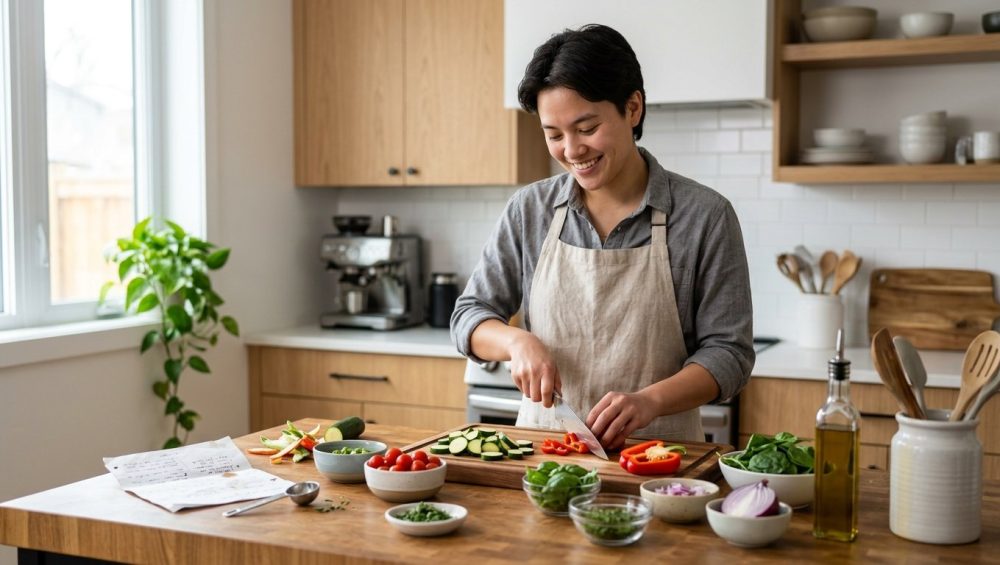
Once you have read the recipe, prep everything. Chop the onions, mince the garlic, measure out the spices into a little bowl, and have your cooking oil uncapped and ready. Yes, this dirties a few extra small bowls, but it buys you peace of mind. When the recipe says “add garlic and sauté for 30 seconds before adding the wine,” you will not be scrambling to peel garlic while your onions burn to a crisp. You will simply toss in your pre-minced garlic, wait 30 seconds, and casually deglaze the pan like a professional.
Furthermore, adopt the “clean as you go” philosophy. Keep a “garbage bowl” on your counter for onion skins, carrot peels, and food wrappers so you do not have to walk back and forth to the trash can twenty times. While the sauce is simmering for ten minutes, wash your cutting board and your prep bowls. When dinner is finally ready, the only things left to clean should be the plates you eat on and the pan you cooked in. Efficiency is the ultimate weekday luxury.
The Non-Stick Trap (My Absolute Biggest Pet Peeve)
We need to have a very serious conversation about the cookware you are using. If you open your cabinets and see a stack of lightweight, scratched, peeling, mystery-metal non-stick pans, I want you to march them directly to the nearest hazardous waste disposal site. I have absolutely zero patience for cheap, toxic kitchenware, and neither should you.
The Toxic Truth About “Forever Chemicals”
For decades, the cookware industry sold us on the convenience of Teflon and other non-stick coatings made with PFAS (per- and polyfluoroalkyl substances). These are widely known as “forever chemicals” because they do not break down in the environment or in the human body. When cheap non-stick pans are heated to high temperatures, or when they inevitably get scratched by a metal spatula, those chemicals can flake off into your food and release toxic fumes into your air.
Thankfully, the legislative landscape is finally catching up to this nightmare. Starting January 1, 2025, Minnesota’s Amara’s Law officially banned the sale of cookware with intentionally added PFAS. By January 1, 2026, states including Colorado, Connecticut, Maine, and Vermont will implement their own comprehensive bans on PFAS in cookware. While the industry is lobbying hard to protect its cheap manufacturing processes, the writing is on the wall: toxic cookware is on its way out. Yet, millions of home cooks are still unknowingly exposing themselves to these chemicals every time they make an omelet.
Stop treating your family’s health as a secondary concern to easy dishwashing. You cannot achieve a proper, restaurant-quality sear on a piece of meat in a cheap non-stick pan anyway. They are terrible at heat retention and they degrade rapidly, meaning you end up buying a new one every year. It is a false economy and a health hazard.
The Smart Fix: Upgrading to Real Cookware
You need to invest in safe, high-quality, durable equipment. Your kitchen arsenal should be built around three core materials: Cast Iron, Carbon Steel, and Tri-ply Stainless Steel.
Cast iron is practically indestructible, holds heat like a furnace, and when properly seasoned (which simply means baking thin layers of oil onto the surface to create a natural polymer), it is virtually non-stick. Carbon steel offers the same natural non-stick properties and heat retention as cast iron, but it is lighter and more responsive to temperature changes—perfect for weekday stir-fries or searing fish.
“But Sassy Sous-Chef,” you whine, “everything sticks to my stainless steel pan!” That is because you are using it wrong. To cook on stainless steel without sticking, you must understand the Leidenfrost effect. Heat your dry stainless steel pan over medium heat for a few minutes. Drop a tiny bead of water into the pan. If it fizzles and evaporates immediately, the pan is too cold. If it shatters into a million tiny droplets, it is too hot. But if the water droplet beads up like a little mercury marble and glides effortlessly around the pan, your temperature is perfect. Wipe the water out, add your oil, let it heat for ten seconds, and add your food. It will not stick. Welcome to the big leagues.
The Refrigerator Graveyard (Stop Throwing Your Money Away)
Let’s open your refrigerator. Look at the crisper drawer. Is it a vibrant ecosystem of fresh produce, or is it a soggy, tragic graveyard where good intentions go to die? If you are regularly throwing away slimy cilantro, moldy berries, and fuzzy leftovers, you are burning your hard-earned cash.
The Staggering Reality of Food Waste
The macroeconomic statistics on food waste are frankly embarrassing. According to the U.S. Department of Agriculture (USDA), Americans waste between 30% and 40% of their total food supply every single year. In 2019, the U.S. generated 66 million tons of wasted food, with the vast majority ending up in landfills.
What does this mean for your wallet? The average American household loses approximately $1,500 per year on food that is purchased but never eaten. Furthermore, when this food rots in a landfill, it produces methane—a greenhouse gas that is 28 times more potent than carbon dioxide. You are essentially paying top dollar to contribute to environmental degradation because you forgot you bought zucchini on Tuesday.
The Smart Fix: Strategic Storage and Repurposing
We are going to stop this bleeding immediately by implementing basic inventory management and proper storage techniques. First, adopt the FIFO method: First In, First Out. When you buy new groceries, push the older items to the front of the fridge so they are the first things you see and use.
Second, stop suffocating your produce in the plastic bags from the grocery store. Treat your fresh herbs like a bouquet of flowers: snip the ends and place them in a glass with an inch of water, then cover them loosely with a plastic bag in the fridge. They will last for weeks. Wrap your leafy greens in a damp paper towel before putting them in a storage container to regulate humidity. If your carrots or celery go limp, do not throw them away! They have just lost hydration. Submerge them in an ice water bath for thirty minutes, and they will crisp right back up.
Finally, institute a mandatory “Kitchen Sink” dinner once a week. This is where you look at all the random half-onions, slightly wrinkled bell peppers, and leftover proteins, and you turn them into a cohesive meal. Frittatas, fried rice, and robust minestrone soups are the ultimate trash-can-avoidance vehicles. You will save money, reduce your carbon footprint, and feel incredibly smug about your resourcefulness.
Heat Management 101 (Patience is a Virtue, Even on Tuesdays)
One of the most agonizing things to watch a rookie cook do is throw a beautiful, expensive piece of meat into a cold pan, turn the heat to high, and poke at it relentlessly while it turns gray and sad. Heat management is the invisible ingredient in every recipe, and mastering it separates the amateurs from the pros.
The Crowded Pan Catastrophe
When you want your food to taste incredible, you are usually looking for the Maillard reaction. This is the chemical reaction between amino acids and reducing sugars that gives browned food its distinctive, complex flavor. It is what makes a seared steak taste like steak, rather than boiled beef. The Maillard reaction requires high, dry heat (typically starting around 285°F).
Here is where rookies fail: they treat their skillet like a clown car. If you pack a pan full of mushrooms or chicken pieces, the temperature of the pan plummets. Furthermore, as the food cooks, it releases moisture. Because the pan is crowded, that moisture has nowhere to evaporate. It gets trapped under the food, and suddenly, instead of searing your chicken, you are gently steaming it in its own lukewarm juices. You will never, ever get a golden-brown crust this way.
The Smart Fix: Letting the Pan Do the Work
The fix requires two things: space and patience. First, cook in batches if you have to. Leave at least a quarter-inch of space between every piece of food in your pan. Yes, batch cooking takes an extra five minutes, but the resulting flavor is exponentially better.
Second, you must preheat your pan properly before the food ever touches it. Let the pan get hot, then add your fat (oil or butter). Wait until the oil is shimmering—it should look like a rippling pool of water, and you might see the very first whisper of smoke. That is your cue.
Place your protein in the pan, and then—and this is the most crucial step—step away. Do not poke it. Do not lift it to peek underneath. Do not aggressively shake the pan like you are on a chaotic cooking game show. When the Maillard reaction has created a sufficient crust, the food will naturally release itself from the metal. If you try to flip a piece of fish and it feels stuck, it is not ready. Walk away, take a sip of your wine, and let the heat do its job.
The Great Seasoning Scare (Why Your Food Tastes Like Sadness)
I have eaten at the homes of many well-intentioned friends, and nine times out of ten, their food suffers from the exact same terminal illness: chronic under-seasoning. If you follow a recipe perfectly and the end result tastes flat, boring, or “missing something,” you did not mess up the cooking technique. You messed up the seasoning.
The Anatomy of Flavor: Beyond the Salt Shaker
Rookie cooks are terrified of salt. They sprinkle a microscopic pinch of iodized table salt over a massive pot of soup and wonder why it tastes like dishwater. Salt is not just a flavor in itself; it is a flavor enhancer. It suppresses bitterness, enhances sweetness, and makes ingredients taste more intensely like themselves.
But salt is only half the battle. The secret weapon of every restaurant kitchen in the world—the thing that makes restaurant food pop on your palate—is acid. When a dish feels heavy, rich, or dull, it is crying out for acidity.
The Smart Fix: Layering, Tasting, and Trusting Your Palate
First, we need to upgrade your salt. Throw away the iodized table salt; it tastes metallic and the grains are so fine that it is incredibly easy to over-salt your food. Buy a box of Kosher salt (Diamond Crystal is the chef standard, as its hollow, flaky structure makes it easy to crush and control). Keep it in a small bowl or salt cellar by your stove so you can physically pinch it with your fingers. You need to feel the salt to understand how much you are adding.
Second, you must season in layers. Do not wait until the very end of the cooking process to add salt. Season your meat before it goes in the pan. Season your onions as they sauté (the salt draws out moisture and helps them soften). Season the sauce as it simmers. By layering the salt, it permeates the food rather than just sitting on the surface.
Finally, buy some lemons, limes, and a few good bottles of vinegar (apple cider, red wine, and rice vinegar are a great start). If you taste your chili, your tomato sauce, or your roasted vegetables and they seem a little boring, do not just reach for more salt. Add a splash of vinegar or a squeeze of fresh lemon juice. The acid will cut through the fat, brighten the entire flavor profile, and absolutely blow your mind.
The Recipe Rebellion (Learning to Cook, Not Just Read)
The final rookie woe we must conquer is the absolute, blind obedience to recipes. A recipe is written by someone in a different kitchen, at a different altitude, using a different stove, with different ingredients. If you follow a recipe blindly without engaging your own senses, you are setting yourself up for failure.
The Trap of Blind Obedience
Let me let you in on a secret: your oven is lying to you. Unless you have calibrated it recently, when you set your oven to 350°F, it might actually be 325°F, or it might be 380°F. Furthermore, “medium heat” on my gas range is going to be vastly different than “medium heat” on your electric coil stove.
When a recipe says “bake for 25 minutes,” that is a polite suggestion, not a legally binding contract. If you pull your cookies out exactly at 25 minutes without checking to see if the edges are golden brown, and they turn out raw, that is on you, not the recipe author.
The Smart Fix: Engaging Your Senses
You must learn to cook with your senses, not just your timer.
Look: Pay attention to visual cues. Is the garlic turning golden, or is it turning a dangerous shade of dark brown? Is the sauce reducing and coating the back of a spoon? Listen: The sound of your pan is a dead giveaway. When you add meat, it should sound like a violent, aggressive sizzle. If it sounds like a quiet, bubbling whisper, your pan is too cold. If the sizzle suddenly stops, you have crowded the pan. Smell: Your nose will tell you when a cake is done baking, or when toasted nuts are seconds away from burning. Touch: Press on your steaks to learn what medium-rare feels like compared to well-done. Feel your dough to know if it needs more flour or more water.
Cooking is a tactile, sensory experience. The moment you stop staring at the clock and start paying attention to the food in front of you, you transition from someone who merely follows instructions to someone who actually knows how to cook.
You have the tools. You have the statistics. You have the smart fixes to overcome every major rookie hurdle standing between you and culinary greatness. Throw out the toxic pans, sharpen your knife, organize your prep, and do not be afraid of the salt. The kitchen is yours to conquer. Now, pour yourself another glass of wine, turn on some good music, and go make something spectacular. You’ve completely got this.