Listen up, buttercup. You have finally decided it is time to stop relying on overpriced delivery apps, sad microwave meals, and that one tragic pasta dish you have been making since college. Welcome to the culinary club. I am thrilled you are here, but we need to have a very serious talk about your kitchen setup.
If you are currently staring at a kitchen drawer full of melted plastic spatulas and a dull knife that couldn’t cut through a warm stick of butter, take a deep breath. You are not alone. In 2026, a staggering 93% of adults report that they plan to cook at home just as much, if not more, than they did last year, largely driven by economic pressures and a desperate desire to eat healthier. That is a massive wave of people suddenly realizing their kitchen arsenal is woefully inadequate.
Here is the good news: you do not need a culinary degree to make mind-blowing food, and you absolutely do not need to spend thousands of dollars on single-use gadgets that will just gather dust. Cooking is not magic; it is simply a combination of heat, time, and having the right tools for the job. As a home cook who learned by trial, error, and setting off the smoke detector more times than I care to admit, I am going to save you a lot of money, a lot of tears, and potentially a trip to the emergency room.
During the weekday grind, time is money. We need efficiency, shortcuts, and tools that perform flawlessly so you can get dinner on the table and pour yourself a glass of wine. On the weekends, when you have the luxury of time to be an absolute perfectionist, those same tools need to step up and deliver professional-level results.
So, grab your notepad. We are going to build your kitchen from the ground up, focusing only on durable, high-quality essentials that offer real value. No fluff, no pretentious chef-speak, and absolutely no toxic garbage. Let’s get to work.
The “No-Go” Rule: Banishing Toxic Cookware Forever
Let me be brutally clear right out of the gate: I have zero patience for cheap, toxic kitchenware. If you are currently cooking on a flimsy aluminum skillet with a scratched, peeling black non-stick coating, I want you to walk into your kitchen, pick it up, and throw it in the trash. I am not joking.
For decades, the cookware industry has peddled cheap non-stick pans coated in PFAS (per- and polyfluoroalkyl substances), commonly known as “forever chemicals.” When heated to high temperatures, or when scratched by metal utensils, these coatings can degrade and leach into your food. Governments are finally waking up to this nightmare. As of January 1, 2026, states like Colorado have outright banned the sale of cookware containing intentionally added PFAS. Europe is also dropping the hammer; France implemented strict PFAS bans at the start of 2026, with Denmark following suit in July 2026, and a universal European Union restriction on thousands of these chemical compounds is currently barreling toward a final decision. Even the US EPA is enforcing new, rigorous TSCA reporting rules for PFAS usage starting in April 2026.
If you are serious about banishing toxic kitchen gear, you need to invest in materials that are safe, reliable, and capable of outliving you. Here is the holy trinity of safe cookware every beginner needs.
The Fully Clad Stainless Steel Skillet
This is your everyday workhorse. You want a 10-inch or 12-inch “fully clad” or “tri-ply” stainless steel skillet. This means the pan has a core of highly conductive aluminum sandwiched between layers of durable, non-reactive stainless steel. It heats evenly, it can go from the stovetop straight into a 500-degree oven, and it is virtually indestructible.
Beginners are often terrified of stainless steel because they think food will stick to it. Food only sticks if you do not know how to preheat your pan. You must utilize the Leidenfrost effect: place your pan on medium heat for a few minutes, then flick a tiny drop of water into it. If the water sizzles and evaporates instantly, the pan is too cold. If the water forms a cohesive little bead that glides and dances across the surface like mercury, your pan is perfectly preheated. Add your oil, add your protein, and it will release effortlessly once a proper crust has formed.
The Indestructible Cast Iron Skillet
Cast iron is the heavy-duty beast of the kitchen. It is inexpensive, it retains heat like a furnace, and it is the only way to get a steakhouse-quality sear on a piece of meat in a home kitchen. A 10-inch cast iron skillet is perfect for shallow frying, baking cornbread, roasting whole chickens, or smashing burgers.
Yes, cast iron requires a tiny bit of maintenance called “seasoning”—which is just polymerizing a very thin layer of oil onto the iron using high heat to create a natural, non-toxic, non-stick surface. Do not let the cast iron purists intimidate you. Wash it with a little mild soap and water, dry it immediately and thoroughly on the stove, wipe it with a drop of neutral oil, and it will literally last for five generations. Never, under any circumstances, put it in the dishwasher.
The Enameled Cast Iron Dutch Oven
While the stainless steel and bare cast iron skillets will conquer your quick weekday meals, the enameled Dutch oven is the undisputed king of weekend culinary projects. This is a heavy, thick-walled pot made of cast iron, but coated in a smooth, hard glass enamel.
Because it is enameled, it is completely non-reactive, meaning you can slowly simmer highly acidic foods—like a rich, Sunday afternoon tomato ragu or a red wine braised beef short rib—without the acid eating away at the iron and making your food taste like pennies. It is also the ultimate vessel for deep-frying chicken safely (thanks to its high sides and heat retention) and baking crusty, artisanal sourdough bread. Buy a 5.5-quart or 6-quart model. It is an investment, but it is worth every single penny.
The Holy Trinity of Knives (And Why Knife Blocks Are a Scam)
Let us talk about the most heavily marketed scam in the culinary world: the 15-piece knife block. You have seen them taking up massive amounts of counter space in every suburban kitchen. They contain a dozen identical, flimsy blades made of cheap mystery metal that cannot hold an edge, plus kitchen shears that break after a month. You do not need them.
You only need three knives. Quality over quantity. This is not just a matter of aesthetics; it is a matter of physical safety. Did you know that approximately 350,000 people are injured by kitchen knives every single year? Furthermore, a comprehensive analysis of US emergency department visits between 2018 and 2022 revealed that knives accounted for a massive 11% of all hand and wrist injuries, making them the most common consumer product responsible for such accidents.
The overwhelming majority of these injuries do not happen because a knife is too sharp; they happen because the knife is dangerously dull. A dull blade requires you to apply excessive downward force. When that dull blade inevitably slips off the skin of an onion, all that force drives the blade directly into your fingers. When it comes to the only beginner kitchen tools you actually need for food prep, invest your budget into these three essential blades.
The 8-Inch Chef’s Knife
This is the undisputed extension of your arm. You will use an 8-inch chef’s knife for 90% of your kitchen tasks: dicing onions, mincing garlic, slicing meat, and chopping root vegetables.
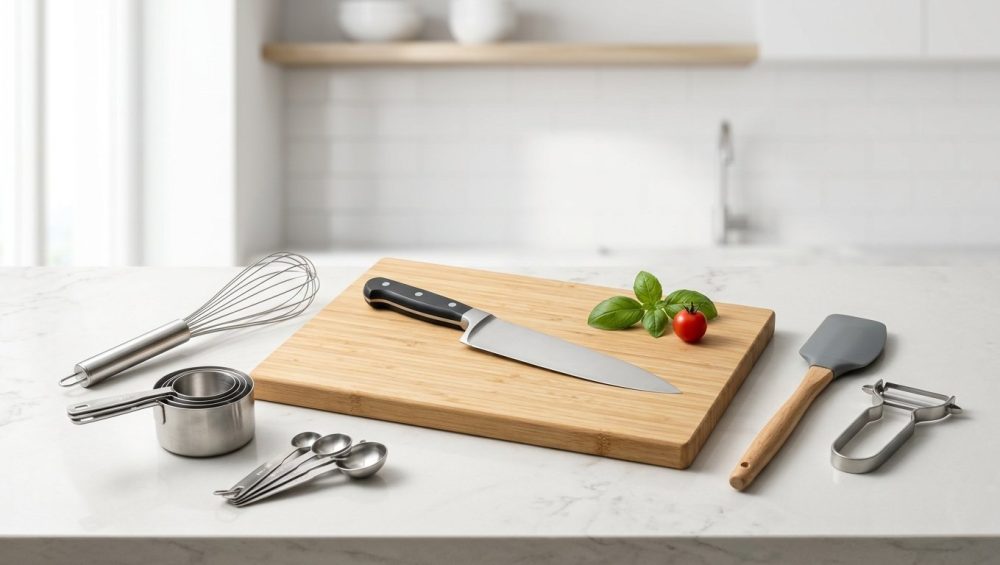
Look for a knife made from high-carbon stainless steel. It offers the perfect balance: the carbon allows the blade to take and hold a razor-sharp edge, while the stainless steel prevents it from rusting the second you look at it wrong. You must also learn the “pinch grip.” Do not wrap your entire fist around the handle like you are holding a tennis racket. Instead, pinch the actual base of the metal blade (the heel) between your thumb and your index finger, wrapping your remaining three fingers loosely around the handle. This gives you ultimate control, balance, and precision.
The Paring Knife
The paring knife is a tiny, 3-inch or 4-inch blade designed strictly for “off-board” work. This means tasks you do while holding the ingredient in your hand, suspended in the air. You will use this for peeling apples, hulling strawberries, deveining shrimp, or precisely scoring the skin of a piece of pork. Because it is so small, you do not need to spend a fortune here. A simple, inexpensive paring knife from a reputable brand will do the trick perfectly.
The Serrated Bread Knife
A chef’s knife, no matter how sharp, will crush a delicate loaf of crusty bread or butcher a ripe tomato. You need a 10-inch serrated knife. The saw-like teeth bite into hard crusts and slippery skins, allowing you to slice cleanly without applying downward pressure. Serrated knives are notoriously difficult to sharpen at home, so view this as a tool you will replace every five to ten years once the teeth eventually wear down.
Prep Like a Pro: Cutting Boards and the Science of Measuring
Now that you have beautiful, sharp knives, you need a proper surface to cut on. If I catch you using a glass cutting board, I will personally come to your house and confiscate it. Glass, marble, and granite cutting boards are an absolute crime against your kitchen. They will permanently destroy the microscopic edge of your chef’s knife in a matter of seconds, and the sound they make when the metal hits the glass is enough to induce a migraine.
The Great Cutting Board Debate
You need two types of cutting boards. First, a large, heavy wooden board (preferably end-grain maple, walnut, or teak) for chopping your vegetables, slicing bread, and carving cooked meats. Wood is naturally antimicrobial and gentle on your knife edges. You do need to care for it by occasionally rubbing it down with food-grade mineral oil so it doesn’t dry out and crack.
Second, you need a heavy-duty plastic cutting board specifically designated for raw meat, poultry, and seafood. While wood is great, you cannot put it in the dishwasher. A plastic board can be tossed right into the dishwasher on a high-heat sanitizing cycle, ensuring you do not cross-contaminate your kitchen with raw chicken juice.
The Digital Kitchen Scale
Baking is a hard science; cooking is a fluid art. But both require a baseline of precision. If you are measuring flour with a standard volume measuring cup, you are setting yourself up for failure. Depending on how densely you pack the flour into the cup, a “cup” of flour can weigh anywhere from 100 grams to 150 grams. That massive variance is the reason your cookies are turning out like dry hockey pucks.
Buy a cheap, flat digital kitchen scale that measures in grams. It makes baking foolproof, it makes portioning meat incredibly easy, and it saves you from having to wash six different measuring cups. Failing to measure accurately is one of the most common rookie kitchen mistakes that will ruin your dinner before you even turn on the oven.
Mise en Place Bowls
“Mise en place” is a French culinary phrase that translates to “everything in its place.” It is the secret to not panicking while you cook. Before you ever turn on the stove, every onion should be chopped, every spice should be measured, and every sauce should be mixed. Buy a stack of cheap, small glass or stainless steel nesting bowls to hold your prepped ingredients. When it is time to cook, you simply dump the bowls into the pan one by one. It turns chaotic weekday cooking into a peaceful, assembly-line breeze.
The Unsung Heroes: Gadgets That Actually Matter
Kitchen gadget marketing preys on beginners. You do not need a specialized avocado slicer, a strawberry huller, or a garlic press that is impossible to clean. You need multi-functional, durable hand tools.
Heat-Resistant Silicone Spatulas
Notice I said silicone, not rubber or cheap plastic. A high-quality, seamless silicone spatula can withstand temperatures up to 600 degrees Fahrenheit. You will use this for scrambling eggs, folding delicate cake batters, and scraping every last drop of expensive sauce out of your food processor. Buy them in a seamless, one-piece design so bacteria cannot hide in the crevice where the handle meets the head.
The Fish Spatula
Despite its highly specific name, the fish spatula is the greatest flipper in the culinary world. It features a thin, flexible, slotted metal head that is angled at the edge. It is designed to slide gracefully under a delicate piece of pan-seared salmon and asparagus without tearing the crispy skin, but it is equally brilliant for flipping pancakes, smashing burgers, or lifting roasted vegetables off a baking sheet.
The Bench Scraper
This is a flat, rectangular piece of stainless steel with a handle on top. It costs about ten dollars, and it will change your life. You use it to scoop up massive piles of chopped onions to transfer them to the pot without dropping them all over the floor. You use it to divide bread dough, smash garlic cloves, and scrape stubborn, dried-on flour off your countertops. Once you own one, you will constantly discover new uses for your bench scraper.
The Instant-Read Thermometer (Non-Negotiable)
If you take only one piece of advice from this entire masterclass, let it be this: buy a high-quality, digital instant-read meat thermometer. You cannot eyeball a chicken breast to see if it is cooked safely. You cannot touch a steak to accurately gauge its internal temperature unless you have been cooking steaks professionally for twenty years.
Food safety is not a joke. The CDC estimates that 48 million people get sick, 128,000 are hospitalized, and 3,000 die from foodborne illnesses every single year in the United States. Shockingly, a recent USDA study revealed that a terrifying 21% of consumers incorrectly rely on visual cues—like the color of the meat or the presence of grill marks—to determine if their food is safe to eat. Color is a liar. The only way to definitively know that your poultry has reached a safe 165 degrees Fahrenheit is to probe it in the thickest part of the meat.
The market for these devices is exploding, projected to reach $535 million by 2026, because people are finally realizing that precision temperature control is the secret to both food safety and restaurant-quality tenderness. Stop overcooking your pork chops into dry leather just to be “safe.” Use a thermometer, pull the meat off the heat 5 degrees early, and let the residual “carryover cooking” finish the job while the meat rests.
Bakeware for the Weekend Perfectionist
Even if you do not consider yourself a baker, you need proper bakeware for roasting vegetables, baking chicken thighs, and making the occasional batch of emergency chocolate chip cookies.
Heavy-Duty Half-Sheet Pans
Throw away the dark, flimsy, non-stick cookie sheets you bought at the grocery store. Dark metal absorbs heat too quickly, which is why the bottoms of your cookies are always burnt while the tops are raw. Furthermore, cheap pans warp violently under high heat, jumping in the oven and spilling hot oil everywhere.
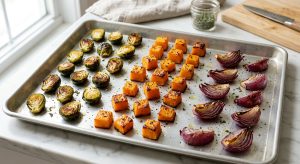
You need commercial-grade, bare aluminum “half-sheet” pans (18 by 13 inches) with rolled steel rims. They are thick, they conduct heat perfectly evenly, and they will never warp. Having a reliable canvas for roasting is the first step toward unlocking kitchen creativity.
Parchment Paper and Silicone Baking Mats
Because you are using bare aluminum, you need a barrier to prevent sticking. Unbleached parchment paper is your best friend. It makes cleanup virtually non-existent. For a more eco-friendly, reusable option, invest in a couple of silicone baking mats (like Silpats) that fit perfectly inside your half-sheet pans.
Wire Cooling Racks
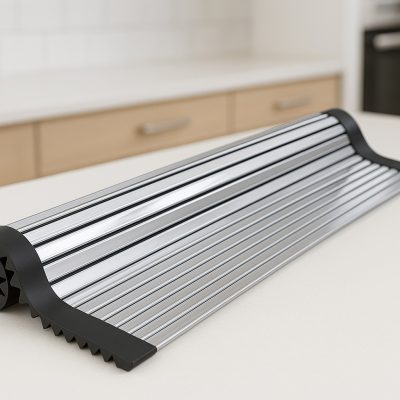
A stainless steel wire rack that nests perfectly inside your half-sheet pan is a multi-tasking powerhouse. Yes, it cools your baked goods so the bottoms don’t get soggy. But more importantly, you can place a steak on the wire rack over the sheet pan and leave it in the fridge overnight to “dry-brine” (the air circulation dries out the surface of the meat, guaranteeing a phenomenal crust). You can also use it to bake bacon in the oven, allowing the grease to drip away from the meat.
Small Appliances That Earn Their Counter Space
Counter space is the most valuable real estate in your home. I do not advocate for buying bulky appliances unless they genuinely save you massive amounts of time and effort. You do not need a stand mixer unless you are baking bread or cakes every single week. However, there are two motorized tools that absolutely earn their keep.
The Immersion Blender
Also known as a stick blender, this is a handheld motor with a blade at the bottom. Instead of transferring boiling hot soup into a traditional blender in dangerous batches (which inevitably results in an exploding blender lid and a burned ceiling), you simply lower the immersion blender directly into the hot pot and purée the soup right there. It is also the ultimate tool for making foolproof, 30-second mayonnaise, emulsifying salad dressings, and smoothing out lumpy gravy. It takes up the space of a rolling pin in your drawer and is the ultimate shortcut for transforming your daily cooking.
The Food Processor
While a traditional blender requires liquid to create a vortex, a food processor uses wide, flat blades to chop, shred, and puree dry or semi-dry ingredients. It is essential for grating massive blocks of cheese in seconds (pre-shredded bagged cheese is coated in anti-caking cellulose that prevents it from melting smoothly), blitzing fresh basil and pine nuts into vibrant pesto, or effortlessly cutting cold butter into flour for a flaky pie crust. A solid 8-cup or 11-cup food processor will save you hours of manual labor on your weekend meal prep.
Storage and Organization: Keeping the Chaos at Bay
You have spent all this time and money creating beautiful food. Do not ruin it by shoving it into a mismatched, stained plastic container without a lid.
Glass Storage Containers
Plastic food storage containers absorb odors, stain permanently orange the second they look at tomato sauce, and degrade over time. Invest in a matching set of tempered glass storage containers with airtight, silicone-sealed locking lids. They are microwave-safe, oven-safe, and dishwasher-safe. Being able to clearly see exactly what is in your fridge is a massive tactical advantage for surviving kitchen disasters and preventing food waste.
Deli Containers
If glass is too heavy or expensive for bulk storage, look to the restaurant industry. Professional kitchens run entirely on plastic deli containers (the kind you get wonton soup in). They come in three standard sizes (pint, quart, and half-gallon), but the absolute genius of the system is that they all use the exact same size lid. No more tearing your cabinets apart looking for the right lid. They are incredibly cheap, stackable, and perfect for storing homemade chicken stock in the freezer.
The Art of Presentation and Hosting
Once you have mastered the tools and the techniques, the final step in your culinary journey is sharing your creations. You eat with your eyes first, and presentation matters.
You do not need a pair of professional plating tweezers to make your food look beautiful. You just need wide, shallow bowls (often called “blate” bowls—a hybrid between a bowl and a plate) which naturally cradle pasta and salads, keeping the food warm and visually contained. Mastering the art of food plating is simply about contrasting colors, utilizing fresh green herb garnishes, and keeping the rim of the plate spotlessly clean.
When you trust your tools, the panic of cooking for others completely evaporates. You will no longer be sweating over a hot stove while your guests sit in the living room. Armed with a reliable thermometer, a properly preheated skillet, and an organized prep station, you can actually pour yourself a drink, converse with your friends, and throw a flawless dinner party without breaking a sweat.
Building a capable, high-quality kitchen arsenal is not an overnight process, nor should it be. Do not rush out and buy everything on this list today. Start with the absolute essentials: one great chef’s knife, a heavy cutting board, an instant-read thermometer, and a safe, non-toxic skillet. Learn how they feel in your hands. Respect them, keep them clean, and they will reward you with a lifetime of incredible meals. Cooking is a lifelong journey, and with the right tools, you are already halfway there. Now get off the internet, go preheat a pan, and start cooking. You’ve got this.