Look, I’ll be brutally honest with you: nobody wants to chop onions at 6:30 PM on a Tuesday in a kitchen that looks like a 1990s DMV waiting room. If you’re constantly opting for overpriced takeout instead of cooking, don’t immediately blame your lack of culinary prowess. Blame your kitchen.
We talk a lot about technique, recipes, and knife skills, but we rarely address the elephant in the room: the physical space where the magic is supposed to happen. If your cooking environment features peeling linoleum, overhead lighting that makes you look sleep-deprived, and countertops cluttered with mail and a blender you haven’t used since 2022, your motivation to cook is going to flatline.
You don’t need a culinary degree to make mind-blowing food, and you certainly don’t need a $50,000 gut renovation to create a kitchen that inspires you to actually use it. Whether you are a renter dealing with the classic “landlord special” or a new homeowner staring down honey-oak cabinets, there are highly effective, budget-friendly aesthetic upgrades you can make right now. We are going to prioritize efficiency, banish the cheap toxic garbage, and turn your kitchen into a space where you actually want to pour a glass of wine and get to work.
The Psychology of Kitchen Aesthetics: Why Looks Actually Matter
Let’s get one thing straight: caring about how your kitchen looks isn’t shallow; it’s basic human psychology. Your environment dictates your behavior. If your kitchen stresses you out, you will avoid it. Period.
A 2026 analysis of home design psychology reveals a direct correlation between the visual appeal of a kitchen and the frequency of home cooking. When a space feels chaotic, our brains interpret the prospect of cooking as an exhausting chore rather than a creative outlet. We aren’t aiming for an untouchable, sterile museum exhibit here. We are aiming for “functional beauty”—a space that feels intentional, warm, and ready for action.
When everything has a place and the space is visually cohesive, your cognitive load decreases. You aren’t fighting the environment to find your favorite spatula; you are simply cooking. This is the foundation of organizing your kitchen into distinct zones. Once you master the workflow, the aesthetics naturally follow.
Lighting: Banish the Fluorescent Interrogation Room Vibe
I cannot overstate this: bad lighting is the number one killer of kitchen ambiance. If you are prepping dinner under a single, buzzing, cool-white fluorescent bulb, you are doing yourself a massive disservice. It’s depressing, it casts terrible shadows on your food, and frankly, it makes everyone look slightly jaundiced.
According to a University of Toronto study on the psychology of lighting, bright, harsh lights intensify our emotional reactions—and not in a good way when you’re already stressed from a long workday. Lighting directly impacts your mood, energy levels, and circadian rhythm.
Here is how you fix it without calling an electrician:
Layer Your Lighting
A well-designed kitchen uses three types of lighting: task, ambient, and accent. For task lighting (the light you actually use to chop vegetables without losing a finger), aim for a neutral color temperature around 3500K to 4100K. This provides a clean, productive feel without feeling clinical.
Renter-Friendly Under-Cabinet Magic
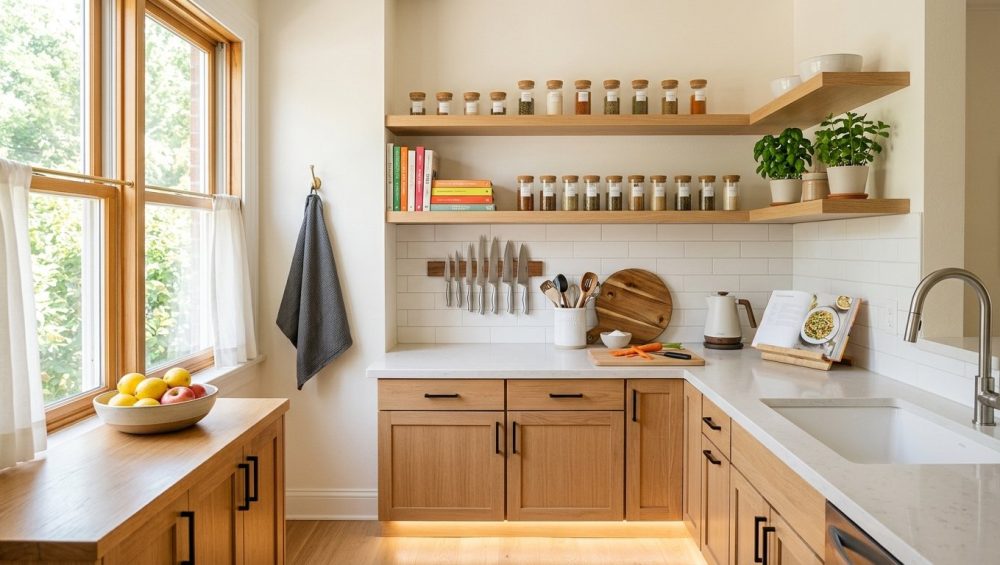
You do not need hardwired lighting to get the high-end look. In 2026, rechargeable, motion-sensor LED light strips are incredibly cheap and attach via magnets or adhesive. Stick these under your upper cabinets. Instantly, your countertops are bathed in warm, intentional light. It is one of the most effective tricks for making a small kitchen feel more spacious and luxurious.
The Kitchen Lamp
Yes, you read that right. Put a small, stylish lamp on your kitchen counter. When the cooking is done and you are just cleaning up or grabbing a glass of water, turn off the overheads and leave the small lamp on. A warm 2700K to 3000K bulb creates a cozy, inviting atmosphere that signals to your brain that the frantic part of the day is over.
The “No-Go” Rule on Toxic Gear: Upgrading Your Daily Workhorses
I am going to get on my soapbox now, and I refuse to apologize for it. One of the most impactful aesthetic upgrades you can make is throwing away your cheap, scratched, peeling non-stick pans.
Not only are they an absolute eyesore, but they are a legitimate health hazard. Let’s look at the facts: PTFE (the chemical coating on most traditional non-stick pans) begins degrading at just 260°C (500°F)—a temperature you can easily hit on a standard gas burner while preheating a pan. When it degrades, it releases “forever chemicals” (PFAS) right into your food and the air. In fact, the issue is so severe that Minnesota legally banned PFAS-containing cookware in January 2025, and consumer awareness is finally catching up, with over 65% of US adults expressing concern about their non-stick pans in recent surveys.
You cannot cook like a pro on toxic, flaking plastic. Period.
The Beauty of Safe Cookware
Upgrading your cookware is both a health imperative and a massive aesthetic win. Beautiful tools make you want to use them. These are the tools every beginner needs to invest in:
- Stainless Steel: It gleams, it’s indestructible, and it makes you feel like a line cook at a Michelin-starred restaurant. Hang a pristine stainless steel skillet on the wall, and it doubles as industrial decor.
- Enameled Cast Iron: A heavy Dutch oven in a gorgeous, saturated color (think deep emerald or classic cherry red) should live permanently on your stovetop. It says, “I might braise short ribs today, or I might just boil pasta, but I have my life together.”
- Carbon Steel: The professional’s secret to a naturally non-stick surface. As it seasons, it develops a beautiful, dark patina that screams authenticity.
Stop hiding ugly, toxic pans in your cabinets. Invest in safe, high-quality materials, display them proudly, and watch how it instantly elevates the room.
Countertop Curation: The Fine Line Between Styled and Cluttered
Your countertops are prime real estate. Time is money, especially on a weeknight, and you cannot afford to waste ten minutes moving junk out of the way just to chop a carrot. Clutter is the enemy of efficiency, but completely bare countertops look sterile and uninviting. The secret lies in curation.
Evicting the Ugly Appliances
Apply the “Rule of Daily Use.” If you do not use an appliance every single day, it does not deserve countertop space. The toaster you use once a week? In the cabinet. The massive stand mixer you use only on Thanksgiving? Top shelf of the pantry. Keep only the absolute essentials out: your coffee maker, a beautiful cutting board, and perhaps a stylish kettle.
Coralling the Chaos with Trays
If you have olive oil bottles, salt cellars, and pepper grinders scattered aimlessly next to the stove, it looks messy. Place those exact same items on a beautiful wooden, marble, or brass tray, and suddenly it looks like a deliberate design choice. Trays create visual boundaries. They tell the eye, “This is a designated station,” rather than a random pile of ingredients.
Upgrading the Mundane
Since we are aiming for aesthetics, stop keeping your dish soap in its garish plastic bottle. Buy a simple glass dispenser with a pump. Grab a beautiful ceramic crock to hold your wooden spoons and whisk. (And while you’re organizing, don’t forget to keep your scraper handy—there are plenty of unexpected uses for a bench scraper that make it a daily essential). When the functional items are beautiful, you don’t need to add useless decorative knick-knacks.
Hardware and Fixtures: The “Jewelry” of the Kitchen
If you are renting or stuck with cabinets you hate, you might feel hopeless. Don’t. You can fundamentally change the personality of a kitchen simply by swapping out the hardware.
Cabinet Pulls and Knobs
Standard-issue builder-grade knobs are usually cheap, flimsy, and visually offensive. Swapping them out is a 30-minute job that requires nothing more than a screwdriver. In 2026, we are seeing a strong trend toward matte black, brushed brass, and even leather pulls.
If you rent, just put the ugly original knobs in a Ziploc bag, stash them in the back of a drawer, and put them back on before you move out. It is the lowest-effort, highest-impact upgrade you can make. It immediately distracts the eye from less-than-stellar cabinetry.
The Faucet Swap
People are terrified of plumbing, but changing a kitchen faucet is surprisingly straightforward (YouTube is your friend here). If you are staring at a leaky, calcified, chrome monstrosity from 1998, replace it. A sleek, high-arc, pull-down faucet in a modern finish transforms the entire sink area. It makes washing dishes feel slightly less like a punishment. If you own your home, this is a no-brainer. If you rent, ask your landlord—many will gladly let you upgrade their property for free, or you can simply swap the old one back when you leave.
Walls, Backsplashes, and Color: High Impact, Low Commitment
A kitchen is inherently full of hard lines and cold surfaces—appliances, cabinets, countertops. To make it inviting, you have to introduce texture and color.
The Peel-and-Stick Backsplash Revolution
Forget the cheap, shiny plastic stickers of the past. The renter-friendly peel-and-stick backsplashes of 2026 are remarkably sophisticated. You can find options that mimic real subway tile, complete with faux grout lines, or intricate Moroccan patterns. If your current backsplash is a depressing expanse of greige drywall, spending $40 on a high-quality peel-and-stick tile will dramatically elevate the space.
Paint and Open Shelving
If you have permission to paint, do it. But don’t just default to stark white. Earthy, saturated tones—like deep olive green, terracotta, or moody navy—are dominating kitchen design right now because they add warmth and depth.
If you have a blank wall, install a single, chunky wooden floating shelf. Do not use this shelf to store your ugly plastic Tupperware. Use it to display your favorite cookbooks, a trailing pothos plant, and your best ceramic mugs. It breaks up the monotony of upper cabinets and gives the room personality.
Art in the Kitchen
Why do we restrict art to the living room and bedroom? The kitchen deserves beauty, too. Hang a framed vintage poster, a small oil painting, or even a beautiful printed menu from your favorite restaurant. Keep it away from the immediate splash zone of the stove or sink, but put it somewhere you can admire it while you wait for water to boil. It immediately makes the room feel less utilitarian and more like a true living space.
Organization as an Aesthetic: Making the Inside Match the Outside
You can have the most beautiful marble countertops in the world, but if opening your pantry results in an avalanche of stale cereal boxes and half-empty bags of flour, you are still going to hate cooking. Organization is not just about finding things; it is a visual aesthetic that calms the mind.
The Decanting Debate
Let’s be clear: you do not need to decant every single item in your kitchen into a matching glass jar. That is performative social media nonsense, and nobody has time for it. However, decanting strategic items makes a huge difference.
Take your baking staples—flour, sugar, oats, rice. These usually come in flimsy paper bags that leak everywhere and look terrible. Transferring them into airtight glass or acrylic canisters keeps them fresh, prevents pantry moths, and looks incredibly satisfying. It turns chaotic packaging into a uniform, visually pleasing display.
The Spice Drawer Revolution
If you are still rummaging through a cabinet filled with mismatched, sticky spice jars from four different brands, it is time for an intervention. This is one of the easiest ways of fixing common cooking mistakes—because when you can actually see what you have, you won’t accidentally use cumin instead of cinnamon.
Buy a set of uniform glass spice jars and a pack of minimalist labels. Transfer your spices, and lay them flat in a drawer using a tiered insert. It takes one hour on a Sunday afternoon, and I promise you, opening that perfectly organized drawer will give you a hit of dopamine every single time you cook. It is a survival guide for clumsy cooks who need a streamlined workflow.
Textiles and Greenery: Breathing Life Into the Sterile Box
Kitchens are inherently cold environments. They are full of metal, stone, and wood. To make the space feel like a place you actually want to hang out in, you need to soften it up.
Rugs That Can Survive a Spill
A runner rug placed between the island and the sink, or down a galley kitchen, completely changes the vibe. It adds color, pattern, and warmth underfoot. The trick? It absolutely must be washable. Do not put a precious, dry-clean-only vintage Persian rug in the room where you regularly splatter tomato sauce. Opt for a high-quality, machine-washable runner that mimics the look of a vintage rug without the anxiety.
Herbs You Won’t Immediately Kill
Every kitchen needs a touch of life. But let’s be realistic: if you are a busy professional, you do not have the time to cultivate a delicate indoor greenhouse. Stick to the hardy stuff. A pot of basil or rosemary on the windowsill not only looks fantastic, but it also smells incredible and is functionally useful for your cooking. If your kitchen gets zero natural light, a high-quality fake plant on a high shelf is totally acceptable. I won’t tell anyone. Bringing life into the kitchen is a great first step when hosting a relaxed dinner party, as it signals freshness and care to your guests.
Upgraded Linens
Throw away your stained, frayed dish towels. Right now. Go buy a stack of 100% cotton or linen kitchen towels in a solid color or classic stripe. Drape one neatly over your oven handle. It is a $20 upgrade that makes the kitchen look instantly more put-together.
Putting It All Together: Your Weekday Workflow
The ultimate goal of all these aesthetic upgrades is not just to make your kitchen look good on Instagram. We don’t care about that. The goal is to remove the visual and mental friction that stops you from cooking.
When your knives are sharp and stored on a beautiful magnetic walnut strip, when your heavy-bottomed stainless steel skillet is gleaming on the stove, and when your countertops are clear and bathed in warm, ambient light, cooking stops being a chore. It becomes a ritual.
You will find yourself wanting to spend time in that space. You’ll be more inclined to tackle mastering modern recipes instead of defaulting to the microwave. When the environment supports you, even throwing together a quick pan-seared salmon on a random Wednesday feels like an event, rather than a frantic race to the finish line.
You’ll have the mental bandwidth for decoding pretentious recipe jargon because you aren’t simultaneously fighting an avalanche of Tupperware and squinting under fluorescent lights.
A beautiful kitchen is an efficient kitchen. An efficient kitchen respects your time. And when your time is respected, you can finally unleash your inner chef. So, pour that glass of wine, turn on the under-cabinet lights, throw out that peeling Teflon pan, and reclaim your culinary domain. You’ve got this.