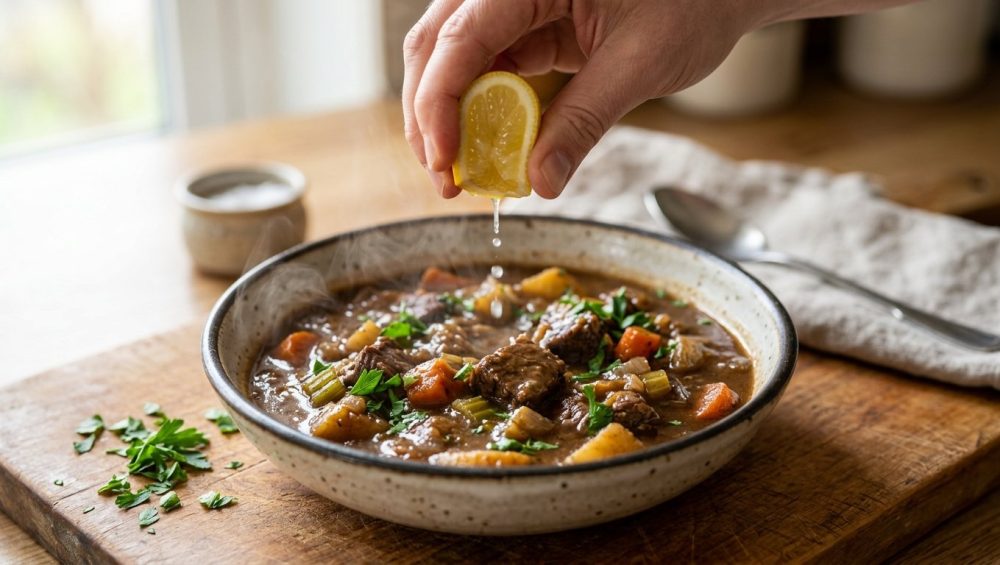
Picture this: It is 6:30 PM on a Tuesday. You are exhausted from a long day, but you decided to be a responsible adult and make a massive, comforting pot of beef and root vegetable stew. You dutifully followed the recipe. You chopped the carrots, you seared the meat, and you let the whole concoction bubble away on the stove. Finally, you take a steaming spoonful, blow on it gently, and take a taste.
It tastes like… warm, brown liquid. It is completely one-dimensional. It is heavy, muddy, and profoundly boring.
What is the first thing you do? If you are like 99 percent of home cooks, you instinctively reach for the salt shaker. You aggressively twist the grinder over the pot, stir, and taste again. Nothing changes. You add another massive pinch. Now, your stew just tastes like salty warm, brown liquid. The complexity is still missing, but now your sodium intake for the week has peaked.
I have been there. Before I learned how to actually balance a flavor profile, I spent years fighting with bland, uninspired food. But here is the brutal truth from your favorite Sassy Sous-Chef: If you want to stop ruining your dinners with panic-induced over-salting, you need to put down the shaker and step away from the spice rack.
You do not need more salt. You need an intervention. Specifically, you need an acidic one.
Welcome to the definitive, no-nonsense masterclass on the secret power of finishing acids. We are going to completely deconstruct the biological science of human taste, dissect exactly why your slow-cooked meals are falling flat, and teach you the restaurant-quality finishing techniques that will instantly elevate your everyday cooking. We are skipping the pretentious culinary school jargon and getting straight to the hard, actionable science. Your time is money, especially on a weeknight, so let’s fix your food.
The Physiology of Flavor: Why We Misunderstand “Blandness”
To understand why your soup tastes flat, we first have to understand how your mouth actually works. The human tongue is covered in thousands of taste buds, each equipped with highly specialized receptors designed to detect five primary tastes: salty, sweet, bitter, sour, and umami (savory).
When you take a bite of food, your brain is looking for a balanced stimulation of these receptors. If a dish is heavily weighted toward just one or two of these tastes—like a beef stew, which is overwhelmingly umami and slightly sweet from the root vegetables—your palate quickly becomes fatigued. This phenomenon is known as sensory adaptation. After the third spoonful, your taste receptors essentially get bored and stop sending strong signals to your brain. You perceive this sensory fatigue as “blandness.”
This is the exact moment when home cooks make their fatal error. Because salt is a universal flavor enhancer, our brains are hardwired to think, “If it tastes bland, it needs salt.” But salt can only amplify the flavors that are already present; it cannot create contrast.
When a dish is heavy, fat-laden, and rich, the lipids literally coat your tongue, creating a physical barrier over your taste buds. Salt cannot cut through that layer of fat. Acid, however, can. The introduction of hydrogen ions (the chemical basis of acidity) triggers an immediate physiological response. It cuts through the lipid barrier, cleanses the palate, and stimulates your salivary glands. This mouth-watering effect physically washes away the palate fatigue, resetting your taste buds for the next bite. This biological mechanism is exactly dinner actually needs acid to truly shine. Acid doesn’t just add a sour flavor; it acts as a chemical spotlight, illuminating the other ingredients in the pot.
The Anatomy of a One-Dimensional Soup
So, why do soups and stews suffer from this flat, muddy flavor profile more than other dishes? It comes down to the physics of wet cooking and the breakdown of aromatic compounds.
The Missing Maillard Reaction
The Maillard reaction is the chemical process responsible for the complex, savory, caramelized flavors you get when you sear a steak or roast vegetables. It requires high heat—typically above 285°F (140°C)—and a dry environment. When you make a soup, the ingredients are submerged in a liquid that boils at 212°F (100°C). Because the temperature of a wet cooking environment can never exceed the boiling point of water, the Maillard reaction is completely halted the moment you add your broth. If you rush the initial searing phase of your aromatics and meats, your soup is doomed to be one-dimensional from the start.
Trapped Fat-Soluble Compounds
Many of the complex flavor molecules in herbs, spices, and aromatics (like onions and garlic) are fat-soluble, meaning they only release their full aromatic potential when heated in lipids. If you skip the crucial step of blooming in oil and simply dump raw spices into a watery broth, those flavor compounds remain trapped inside their cellular walls. You get the color of the spice, but only a fraction of the taste.
The Destruction of Top Notes
Cooking is essentially a process of controlled destruction. Long, slow simmers are fantastic for breaking down tough collagen in cheap cuts of meat and extracting gelatin from bones. However, that same prolonged heat absolutely obliterates delicate, volatile flavor compounds. The secret to a gentle simmer is keeping the temperature low enough to prevent the liquid from aggressively boiling and emulsifying fats into a cloudy mess, but even a perfect, barely-there simmer will eventually cook off the bright, fresh “top notes” of your ingredients. After three hours on the stove, the sharp bite of the garlic, the fresh herbaceousness of the thyme, and the natural sweetness of the carrots have all melted into a single, indistinguishable baseline flavor.
Enter the Acid: The Culinary Magic Trick
This is where the magic happens. By the time your soup or stew has finished its marathon cooking session, its pH level is likely sitting somewhere in the neutral to slightly alkaline range, especially if it contains a large volume of water, potatoes, beans, or dairy.
When you introduce a finishing acid—like a splash of vinegar or a squeeze of fresh lemon juice—you instantly drop the pH of the entire pot. This slight acidification actually changes the electrical charge of the protein molecules on your tongue, altering their shape and allowing them to interact more efficiently with the aromatic compounds in the food.
The magic of a little vinegar is that, when used correctly, it does not make your soup taste sour. It works sub-perceptually. A teaspoon of apple cider vinegar stirred into a massive pot of beef stew will not make the stew taste like apples or vinegar; it will simply make the beef taste infinitely more “beefy.” It lifts the heavy, muddy baseline flavors up to the surface, restoring the bright top notes that were destroyed during the long simmer.
The Sassy Sous-Chef’s Essential Acid Arsenal
Do not just grab that giant plastic jug of harsh distilled white vinegar you use to descale your coffee maker. We are cooking, not doing household chores. Different soups require different acidic profiles. Here is your definitive guide to matching the right acid to the right dish.
1. Apple Cider Vinegar (The Workhorse)
If you only keep one finishing vinegar in your kitchen, make it a high-quality, unfiltered apple cider vinegar (ACV). ACV has a fruity, slightly sweet undertone that pairs flawlessly with earthy, savory flavors.
- Best For: Beef and barley stews, lentil soups, split pea soup, butternut squash bisque, and hearty vegetarian chilis. The subtle apple notes perfectly complement root vegetables and heavy legumes.
2. Sherry Vinegar (The Secret Weapon)
Sherry vinegar is the undisputed king of the culinary world. Aged in oak barrels, it possesses a deeply complex, nutty, and slightly oxidized flavor profile that is far more sophisticated than standard wine vinegars. It has a rounded acidity that punches through heavy fats without tasting sharp or astringent.
- Best For: French onion soup, mushroom potage, rich chicken stews, and anything involving roasted garlic. It is the ultimate umami enhancer.
3. Red Wine Vinegar (The Bold Balancer)
Sharp, aggressive, and highly acidic, red wine vinegar is not for delicate broths. It is designed to stand up to aggressively heavy, fat-laden dishes that need a serious palate cleanser.
- Best For: Texas-style chili, pork and bean stews, minestrone, and any tomato-based soup that has cooked down so long it has become overly sweet.
4. White Wine Vinegar & Champagne Vinegar (The Delicate Lifters)
These vinegars have a much softer, more floral acidity compared to their red counterpart. They provide a clean, crisp finish without altering the color of pale broths.
- Best For: Chicken noodle soup, potato leek soup, clam chowder, and delicate seafood bisques.
5. Rice Vinegar (The Gentle Giant)
A staple of Asian pantries, rice vinegar is incredibly mild and slightly sweet. It is perfect for dishes where you want to lift the flavors without introducing any harsh Western grape or apple notes.
- Best For: Egg drop soup, hot and sour soup, miso broth, and ginger-heavy chicken soups.
6. Balsamic Vinegar (The Sweet Finisher – With a Warning)
Real, aged balsamic vinegar from Modena is thick, syrupy, and intensely sweet-tart. However, the cheap, watery stuff sold in most grocery stores is just white vinegar dyed with caramel color. Use balsamic sparingly, as its high sugar content can easily overpower a savory dish.
- Best For: Drizzling over a bowl of roasted tomato basil soup right before serving, or finishing a rich, dark beef bourguignon.
7. Fresh Citrus (Lemon and Lime)
Sometimes, you don’t want the fermented funk of a vinegar; you just want pure, bright sunshine. Citrus juices provide a sharp, immediate hit of citric acid alongside highly aromatic essential oils.
- Best For: Lime juice is mandatory for chicken tortilla soup, pho, and posole. Lemon juice is the ultimate savior for Greek avgolemono, chicken and rice soup, and anything featuring heavy cream or spinach.
Once you master the art of pairing these acids with their complementary flavor profiles, you will effortlessly decode pretentious recipe jargon like “brightening the palate” and “finishing the broth.” You are no longer just following instructions; you are cooking with intent.
Timing is Everything: The Golden Rule of Finishing Acids
Here is where even experienced home cooks completely ruin the technique: You must never boil your finishing acid.
To understand why, we have to look at the chemistry of vinegar. According to gas chromatography-mass spectrometry studies on vinegar production, the complex, beautiful flavors of a high-quality vinegar do not come from the acetic acid itself; they come from volatile organic compounds (VOCs). These VOCs—which include delicate esters, aldehydes, and complex alcohols—are created during the fermentation and aging process.
The defining characteristic of a volatile compound is that it has an incredibly low boiling point. If you pour a tablespoon of expensive, barrel-aged sherry vinegar into a pot of soup that is aggressively boiling on the stove, those delicate esters will instantly vaporize. The heat will literally cook the flavor right out of the vinegar. The harsh acetic acid will remain in the liquid, but the beautiful, nuanced aromas will immediately evaporate, getting sucked right up into your kitchen exhaust fan.
The Golden Rule of Acid is this: Always add your finishing acid off the heat.
When your soup is completely done cooking, turn off the burner. Remove the pot from the heat source. Let it stop bubbling entirely. Only then should you stir in your splash of vinegar or squeeze of lemon juice. The residual heat of the soup will be enough to integrate the flavors without destroying the delicate VOCs.
Toxic Gear Alert: The “No-Go” Rule for Cooking with Acid
Before we move on to the practical application of these techniques, your Sassy Sous-Chef needs to issue a severe warning about your cookware. I am fiercely dedicated to banishing toxic kitchen gear from the home kitchen, and there is no scenario where this is more critical than when you are cooking with acidic ingredients.
If you are simmering a tomato-based minestrone, a chili, or a soup heavily finished with vinegar in a cheap, bare aluminum stockpot, you are making a massive, potentially hazardous mistake.
Bare aluminum is highly reactive to low-pH (acidic) foods. When you expose bare aluminum to acids like tomatoes, wine, or vinegar, a violent chemical reaction occurs. The acid literally eats away at the surface of the metal, leaching aluminum ions directly into your food.
This causes two massive problems. First, from a culinary perspective, it completely ruins your food. The leached aluminum imparts a harsh, bitter, distinctly metallic taste to your soup, while simultaneously turning bright red tomatoes and green vegetables a dull, unappetizing gray. Second, from a health perspective, you are needlessly ingesting heavy metals. While the FDA and the European Food Safety Authority (EFSA) note that small amounts of environmental aluminum are processed by the body, regularly boiling acidic foods in degraded aluminum cookware can lead to aluminum migration that exceeds recommended safety thresholds.
Do not come crying to me when your painstakingly crafted Sunday chili tastes like a mouthful of loose change because you used a twenty-dollar aluminum pot you bought at a discount store.
You must use non-reactive cookware for soups and stews. If you have ever wondered which pan to use instead, the answer is a high-quality, heavy-bottomed, fully clad 18/10 stainless steel stockpot, or a premium enameled cast-iron Dutch oven. The glass-like enamel coating on a Dutch oven is completely inert, meaning you can simmer a highly acidic tomato stew for six hours, finish it with a cup of red wine vinegar, and the pot will not react, leach, or alter the flavor of your food in any way. Buy good gear once, and it will take care of you for a lifetime.
Step-by-Step Masterclass: Rescuing a Ruined Pot of Soup
Alright, let’s put the science into practice. You have a pot of soup on the stove, and it tastes wrong. Here is exactly how to troubleshoot and fix it using the Sassy Sous-Chef’s foolproof methodology.
Step 1: The Spoon Test (Never Season the Whole Pot)
Never, ever pour vinegar directly into a giant pot of soup without testing it first. If you add too much, you cannot take it out, and you will have ruined an entire batch of food. Instead, use the Spoon Test.
Ladle a small amount of the hot soup into a small bowl or a large spoon. Add literally one or two drops of your chosen vinegar to that isolated sample. Stir it, and taste it. Does the flavor brighten? Does the muddiness disappear? If yes, you have found your solution, and you can confidently scale up the ratio for the main pot.
Step 2: Fixing the “Too Salty” Soup
If your soup tastes like seawater because you panicked and over-salted it earlier, acid can help, but it needs a partner. First, you must dilute the sodium concentration slightly by adding a splash of unsalted broth or water. Then, add a splash of white wine vinegar or a squeeze of lemon juice. The acid will distract the palate from the aggressive sodium, bringing the flavor profile back into a tolerable balance.
Step 3: Fixing the “Too Sweet” Soup
Soups made with massive quantities of carrots, sweet potatoes, butternut squash, or caramelized onions often end up tasting like dessert instead of dinner. When a soup is cloyingly sweet, salt will not save it. You need a sharp, aggressive acid to cut the sugar. Apple cider vinegar or a dry sherry vinegar works wonders here. The sourness directly counteracts the sweetness, pulling the dish back into savory territory.
Step 4: Fixing the “Too Heavy” Soup
Beef stews, pork chilies, and cream-based chowders suffer from lipid overload. The fat coats the palate and mutes the herbs and spices. In this scenario, you want an acid that provides a sharp, clean break. A squeeze of fresh lemon juice in a heavy cream soup, or a tablespoon of red wine vinegar in a beef stew, will instantly slice through the fat and make the dish feel lighter and more vibrant on the tongue.
Step 5: The Over-Correction Protocol (When You Add Too Much Acid)
What happens if your hand slips, and you accidentally dump a quarter cup of vinegar into your soup? Suddenly, the broth is incredibly harsh, sour, and astringent. Do not panic. You can use high school chemistry to fix this.
You need to neutralize the acid by raising the pH. The power of baking soda is your ultimate fail-safe here. Baking soda (sodium bicarbonate) is highly alkaline. If your soup is too sour, stir in a microscopic amount of baking soda—literally an eighth of a teaspoon. The soup will momentarily foam up as the alkaline powder reacts with the acid, creating harmless carbon dioxide gas. Once the foam subsides, taste the soup. The harsh sourness will be completely neutralized, without having to dump cups of sugar into your dinner to mask the mistake.
The Aftermath: Storing and Evolving Flavors
It is a universally acknowledged culinary truth that soups and stews taste significantly better the next day. This is not just an old wives’ tale; it is organic chemistry in action. As the soup cools and sits in the refrigerator overnight, the proteins, fats, and starches continue to interact. The sharp, jagged edges of the different ingredients mellow out, and the flavors physically bond together in a process known as flavor maturation.
However, how you store your highly seasoned, acid-finished soups matters immensely. If you pour a hot, acidic, fat-laden tomato and vinegar stew into a cheap, flimsy plastic storage container, you are going to ruin the container forever. The acid and heat will cause the plastic to expand, allowing the pigmented fats (like the lycopene from tomatoes) to permanently embed themselves into the porous surface of the plastic.
If you are currently staring at a cabinet full of stained, orange, perpetually greasy Tupperware and wondering how to actually clean them, the trick is to wash them with cold water and dish soap first, which prevents the fats from melting further into the plastic. But honestly? Throw them away. Stop putting highly acidic, heavily pigmented foods into cheap plastic. Invest in a set of tempered glass storage containers. Glass is entirely non-porous and non-reactive. It will not stain, it will not hold onto odors, and it will not leach microplastics into your beautifully balanced, perfectly acidic soup when you reheat it in the microwave the next day for lunch.
The Universal Law of Acid
The principles you have learned today do not just apply to a pot of soup. This is a universal culinary law. Once you understand how acid manipulates the human palate, you can apply this secret weapon to every single meal you cook.
Are your roasted vegetables tasting a little dull when they come out of the oven? Toss them in a teaspoon of balsamic vinegar before plating. Is your pan-seared chicken breast lacking dimension? Deglaze the pan with a splash of white wine and a squeeze of lemon to create a vibrant pan sauce. Is your rich, cheesy pasta dish feeling too heavy after three bites? A tiny pinch of lemon zest or a microscopic dash of white wine vinegar in the sauce will cut the richness and keep you coming back for more.
Cooking at a high level does not require a culinary degree. It does not require expensive truffles, complicated foam dispensers, or hours of tedious labor. It requires an understanding of the fundamental building blocks of flavor. It requires knowing how to manipulate salt, fat, heat, and—most importantly—acid.
So the next time you find yourself standing over a simmering pot, tasting a spoonful of flat, boring broth, do not reach for the salt. Reach for the vinegar. Trust the science, trust your palate, and trust your Sassy Sous-Chef. You are officially ready to cook like a pro. Now get into the kitchen and make something amazing.