Imagine this: It is a beautiful Sunday afternoon. You have spent the better part of your day carefully chopping onions, crushing San Marzano tomatoes by hand, and simmering a beautiful, rustic marinara on the stove. The house smells exactly like an Italian grandmother’s kitchen. You dip a wooden spoon in, blow on it gently, and take a taste, fully expecting a symphony of sweet, vibrant tomato goodness. Instead, your palate is assaulted by a harsh, bitter tang that tastes suspiciously like you just licked the inside of a rusty tin can or chewed on a handful of pennies.
Congratulations, my friend. You have just experienced the culinary heartbreak of a reactive cookware disaster.
As someone who learned to cook by trial, error, and ruining more meals than I care to admit, I know firsthand how frustrating it is when a perfectly good recipe goes completely sideways for seemingly no reason. You did not burn the garlic. You did not over-salt the broth. But somehow, your dinner is ruined. The culprit is not your technique; it is the invisible chemistry happening between your food and your pan.
Welcome to my kitchen. I am your resident sassy sous-chef, and today, we are going to dive incredibly deep into the fascinating, slightly terrifying, and entirely preventable world of cookware metal leaching. I have zero patience for pretentious chef-speak, but I also have a strict, non-negotiable “no-go” policy when it comes to toxic, cheap, or inappropriately used kitchen gear. We are going to audit your cabinets, banish your bad habits, and make absolutely sure you never have to rescue a ruined dinner from the clutches of a metallic aftertaste ever again.
The Chemistry of a Ruined Recipe: Why Your Sauce Tastes Like Pennies
Before we start throwing pots and pans out the kitchen window, we need to understand the crime scene. Cooking is, at its core, applied chemistry. Every single time you apply heat to food, you are initiating a complex cascade of molecular reactions. Proteins denature, sugars caramelize, and complex flavor compounds develop. But heat does not just affect your ingredients; it also interacts heavily with the vessel you are cooking them in.
The Acid Test: What Makes Tomatoes So Aggressive?
Tomatoes are the undisputed divas of the produce aisle. They are vibrant, delicious, and highly acidic. On the pH scale—where 7.0 is neutral, anything higher is alkaline, and anything lower is acidic—fresh tomatoes typically clock in somewhere between 4.0 and 4.6. When you cook them down, reducing their water content and concentrating their natural sugars and acids, that acidity becomes even more pronounced.
This is exactly why your dinner actually needs acid to taste bright and balanced. Acid cuts through heavy fats and wakes up dull flavors. However, it is also why acidic ingredients like tomatoes, wine, vinegar, and citrus juice act as aggressive chemical solvents when they come into contact with certain metals.
To make matters worse for your cookware, if you are using high-quality canned tomatoes (like whole peeled San Marzanos), you are dealing with even more acid. Commercial canneries frequently add naturally derived citric acid to their tomatoes to drop the pH level safely below 4.2 to prevent the growth of botulism spores during the canning process. Tomato paste is even more concentrated. You are essentially dropping a highly reactive acid bomb into your pan.
The Galvanic Reaction in Your Kitchen
When you simmer a highly acidic liquid in a reactive metal pan, you are essentially creating a very weak, very unappetizing battery. The acid in the tomatoes acts as an electrolyte. When heat is applied, molecular activity skyrockets, and the acid begins to literally dissolve microscopic amounts of the metal, pulling metal ions directly from the surface of the pan and into your food. This chemical migration process is known as leaching.
If you have ever wondered why your beautiful red sauce turned a muddy, unappetizing brown or tasted like a mouthful of loose change, this is exactly why. The acid has stripped the metal from the walls of your pot and incorporated it into your dinner. Not only does this absolutely destroy the flavor profile of your carefully crafted meal, but it also physically degrades your cookware over time, leading to microscopic pitting, permanent discoloration, and a ruined cooking surface.
Reactive Cookware: The Usual Suspects You Need to Demote
If you want to cook like an expert without spending years in culinary school, the first thing you need to do is understand your tools. Not all pans are created equal, and using the wrong pan for a highly acidic job is one of the most common beginner cooking mistakes I see on a weekly basis. Let’s look at the highly reactive metals that have absolutely no business touching your marinara.
Bare Aluminum: The Budget Trap
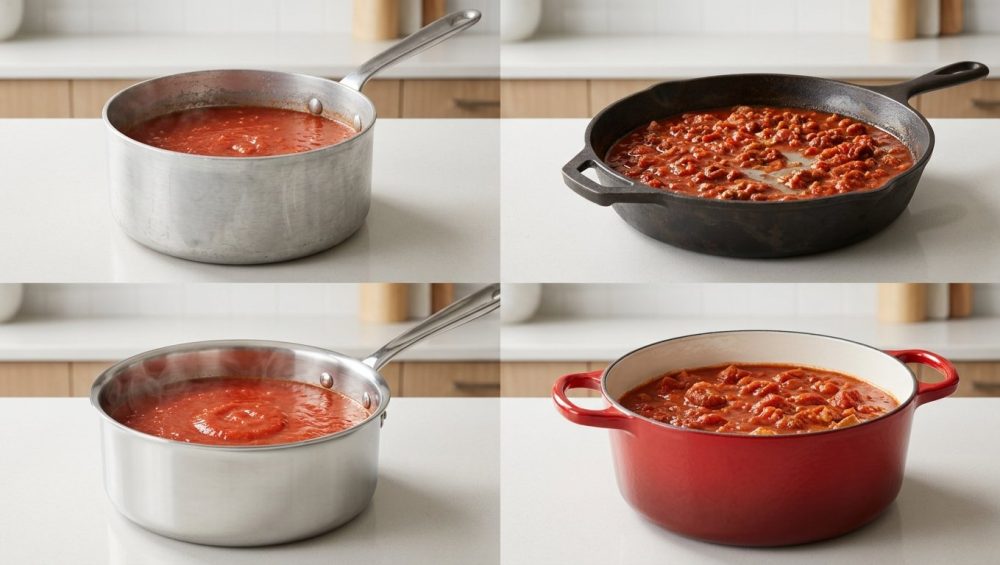
Let’s get one thing straight right out of the gate: I absolutely despise cheap, uncoated aluminum cookware. It is the quintessential budget trap for new home cooks. Yes, from a purely thermodynamic standpoint, aluminum is an incredible conductor of heat. It heats up rapidly, cools down almost instantly when removed from the burner, and is incredibly lightweight. But bare, untreated aluminum is a highly reactive, amphoteric metal, meaning it reacts violently to both strong acids and strong alkalis,.
When you simmer tomato sauce in a bare aluminum pot, the acidic environment goes to work immediately. The acid reacts with the aluminum, causing the metal to leach into the food at an alarming rate. Studies have shown that cooking acidic foods in plain aluminum can pull between 1 to 2 milligrams of aluminum per serving into your meal. Now, let me be clear about the health science: while this is generally considered safe by health organizations and will not come close to exceeding the World Health Organization’s weekly safety threshold of 140 milligrams for an average adult, it is still objectively disgusting. (And no, cooking with aluminum will not give you Alzheimer’s; that specific myth has been largely debunked by modern neurology).
The real tragedy here is the culinary destruction. Uncoated aluminum will impart a harsh, bitter, and distinctly tinny taste to your food. It will also cause your vibrant red tomatoes to oxidize and take on a dull, grayish-brown hue. Furthermore, the acid literally eats away at the pan, creating microscopic pits and craters that make the surface impossible to clean and prone to holding onto rancid cooking oils. If you are still holding onto that flimsy, dented aluminum stockpot from your college dormitory days, consider this your official intervention. It is time for banishing toxic kitchen gear from your life forever. Throw it in the recycling bin.
Cast Iron: The Heartbreak of Stripped Seasoning
I love my cast iron skillet. I really do. It is a workhorse, a weapon against pale food, and a beloved family heirloom all rolled into one heavy package. But it is absolutely not the right tool for a long-simmered Sunday sauce.
Cast iron is, by its very chemical nature, highly reactive. To protect the raw iron from rusting in the open air and to create a natural non-stick surface, we build up a layer of polymerized oil—what we lovingly call the “seasoning.” This layer acts as a physical barrier between the raw metal and your food. However, the seasoning cast iron relies on is a fragile matrix of cross-linked triglycerides. It is not invincible.
When you introduce a highly acidic liquid like tomato sauce to a cast iron pan and let it simmer, the acid begins to rapidly eat away at that hard-earned polymer layer. If you simmer it long enough, the acid will dissolve the seasoning right off the pan, exposing the raw, porous iron underneath. Once the raw iron is exposed, it leaches rapidly into your food.
Now, is dietary iron bad for you? Not necessarily. In fact, cooking in cast iron has historically been recommended by dietitians as a legitimate way to combat anemia. A single serving of tomato sauce cooked in a raw cast iron skillet can provide up to 5 milligrams of dietary iron (a significant chunk of the 8 milligrams adult men need daily),. But from a culinary perspective, it is a total disaster. The Journal of Food Science published a study noting that when acidic foods are cooked in iron, the iron content skyrockets, which imparts a heavy, rusty, blood-like flavor to your meal.
America’s Test Kitchen actually put this exact scenario to the test and found a crucial, science-backed loophole: you can cook acidic foods in a well-seasoned cast iron pan, but only for a strict maximum of 30 minutes,. Anything longer than that, and the professional tasters began to detect that telltale metallic bitterness, and the pans showed visible signs of surface degradation,. So, while a quick blistered cherry tomato pan-sauce is fine, a slow-cooked bolognese is a hard, unequivocal no.
Unlined Copper: Beautiful but Dangerous
Copper cookware is the Ferrari of the culinary world. It is breathtakingly beautiful, insanely expensive, and offers unparalleled, instantaneous thermal conductivity. But raw, unlined copper is highly reactive and genuinely dangerous when mixed with acidic foods.
When acidic ingredients react with raw copper, they dissolve the copper directly into the food. Consuming leached copper can cause acute copper toxicity, leading to severe gastrointestinal distress, nausea, and worse. This is exactly why almost all modern copper cookware is lined with a non-reactive metal barrier, typically hand-wiped tin or bonded stainless steel. If you happen to score a vintage, unlined copper pot at a French flea market, polish it up and hang it on your wall as art. Do not, under any circumstances, use it to make chili or tomato soup.
Non-Reactive Cookware: The Heroes of the Simmer
Now that we have successfully eliminated the troublemakers and the toxic traps, let’s talk about the MVPs of the kitchen. These are the non-reactive materials that you can confidently rely on for your longest, most acidic, most demanding simmers.
Stainless Steel: The Undisputed Heavyweight Champion
If I were forced to only own one type of cookware for the rest of my natural life, it would be fully clad stainless steel. It is the ultimate, indestructible workhorse for the serious home cook. It will not rust, it will not chip, and most importantly, it is entirely non-reactive to acidic foods.
But why is stainless steel immune to the aggressive acidic attacks of tomatoes, vinegars, and wines? The secret lies in a microscopic, self-healing shield known in metallurgy as the “passive layer.” Stainless steel is an alloy made primarily of iron, carbon, and at least 10.5% chromium. When the chromium in the steel matrix is exposed to oxygen in the ambient air, it instantly forms an invisible, ultra-thin layer of chromium oxide on the surface of the pan.
This chromium oxide layer is incredibly dense, chemically stable, and tightly adherent to the underlying steel. It acts as an impenetrable forcefield, preventing moisture, oxygen, and acidic foods from reaching the vulnerable iron underneath. The true magic of this material is that it is self-healing. Even if you aggressively scratch the surface of your pan with a metal spatula, the newly exposed chromium instantly reacts with the oxygen in the room to rebuild the protective oxide layer in milliseconds.
Because of this brilliant metallurgical magic, you can simmer a highly acidic tomato sauce in a high-quality stainless steel pot for ten straight hours, and it will taste exactly as it should: sweet, rich, and vibrant. While some extreme laboratory studies have shown that absurdly long cooking times (we are talking 20+ hours of continuous boiling) can cause trace, microscopic amounts of nickel and chromium to leach into food, the amounts are so incredibly low that they are well within established safety limits for the vast majority of people.
For the busy professional dealing with weeknight cooking anxiety, a multi-clad stainless steel pan (where a highly conductive aluminum or copper core is sandwiched permanently between layers of stainless steel) is the ultimate time-saving tool. You get the rapid, even heating of aluminum without any of the toxic, flavor-ruining reactivity.
Enameled Cast Iron: The Heirloom Solution
If you desperately want the incredible heat retention and rustic charm of cast iron without the stress of stripped seasoning and rusty flavors, enameled cast iron is your absolute best friend.
Enameled cast iron is simply traditional, heavy-duty cast iron that has been coated in a thick layer of vitreous enamel—essentially, a specialized liquid glass frit that has been baked and fused to the metal at incredibly high temperatures. This glass coating is 100% non-reactive. It forms a permanent, impermeable barrier between the reactive iron core and your acidic food.
This makes an enameled cast iron Dutch oven the absolute perfect vessel for slow-cooking heavy stews, braising tough meats in red wine, or simmering massive, bubbling batches of Sunday gravy. You get the massive thermal mass of the iron, which holds a steady, low simmer perfectly without burning the bottom, combined with the inert, non-reactive safety of glass. It is a match made in culinary heaven, provided you treat the enamel with respect and avoid banging metal spoons against the rim, which can cause the glass to chip.
Anodized Aluminum: The Compromise
Remember how I said I passionately despise bare aluminum? Well, hard-anodized aluminum is a completely different story.
Through a specialized electrochemical process called anodization, the naturally occurring oxide layer on the surface of the aluminum is artificially thickened and hardened in an acid bath. This process transforms the soft, highly reactive raw metal into a dark grey, incredibly durable, and non-reactive surface. Hard-anodized aluminum is actually twice as hard as standard stainless steel and is considered completely safe for cooking acidic foods.
However, there is a massive catch that you need to be aware of. Almost all hard-anodized cookware on the consumer market is also coated with a non-stick PTFE (Teflon) layer on the interior. While the anodized aluminum underneath is safe, I am notoriously strict about non-stick coatings. They are fragile, they degrade rapidly over time, and they absolutely cannot handle high heat searing. If you use metal utensils, wash them in the dishwasher, or heat the pan too high, the coating will inevitably scratch and flake toxic chemicals directly into your food. This exact degradation is the losing their slip phenomenon that forces millions of home cooks to throw their expensive pans away after barely a year of use.
If you choose to use anodized aluminum for your tomato sauces, ensure the interior coating is pristine. The very moment it starts peeling or scratching, it goes straight in the trash.
Ceramic and Glass: Safe but Flawed
100% pure ceramic and tempered glass cookware (like vintage Pyrex visions) are completely, undeniably non-reactive. You can simmer pure citric acid in them until the end of time, and they will never leach a single metallic flavor into your food.
However, from a practical, time-saving, weeknight cooking perspective, I rarely recommend them for stovetop use. They are notoriously poor conductors of heat, meaning you will struggle immensely to get a proper, flavorful sear on your onions and garlic before adding your liquids. They are also highly susceptible to thermal shock—if you add a cold liquid to a hot glass pot, the rapid temperature change can cause it to shatter violently into a thousand pieces across your stove. Save the glass and ceramic for baking casseroles in the oven, and stick to clad metal for the stovetop.
The “Will It Leach?” Test: How to Audit Your Kitchen Cabinets Right Now
If you are currently staring at a chaotic cabinet full of scratched, mystery-metal pots and pans and wondering which ones are actually safe for your next batch of chili, it is time to perform a rigorous kitchen audit. As a staunch advocate for the home cook, I firmly believe you should never have to guess what your tools are made of. Here is how you can easily identify your cookware right now.
The Magnet Test and Visual Cues
The absolute easiest way to identify a mystery pan is by its weight, its color, and its magnetic properties. Go grab a standard refrigerator magnet.
- If the magnet sticks strongly: The pan is likely cast iron, carbon steel, or a specialized magnetic grade of stainless steel (often used for the exterior base of induction-compatible pans). If the pan is incredibly heavy, pitch black, and feels slightly greasy to the touch, it is seasoned cast iron (highly reactive). If it is shiny, silver, and relatively heavy, it is stainless steel (non-reactive).
- If the magnet does not stick at all: The pan is likely aluminum or copper. If it is lightweight, dull silver, and easily scratched with a fingernail, it is bare aluminum (highly reactive, throw it away). If it is dark grey or black with a smooth, matte finish, it is hard-anodized aluminum (non-reactive, but check closely for scratched non-stick coatings).
The Baking Soda and Vinegar Test
If you have an old, unmarked silver pot passed down from a relative and you aren’t sure if it is cheap bare aluminum or high-quality stainless steel, you can perform a quick, definitive chemical test on your stove.
- Add one cup of water and two tablespoons of standard baking soda to the pot.
- Bring the mixture to a rolling boil for 15 minutes.
- Dump the water out and inspect the interior of the pot.
Aluminum is an amphoteric metal, meaning it reacts aggressively to both acids and strong alkalines (like baking soda). If the pot is bare aluminum, the highly alkaline baking soda will cause the metal to rapidly oxidize and turn a dark, ugly grey or black. If the pot remains shiny, silver, and completely unaffected, congratulations, you have a non-reactive stainless steel pot.
Alternatively, you can boil a simple solution of equal parts water and white vinegar. If the boiling liquid takes on a harsh, metallic smell and the pot becomes slightly discolored or abnormally clean in weird patches, it is reactive aluminum.
Weeknight Hacks: Saving Time Without Sacrificing Flavor
As a busy professional who values efficiency just as much as flavor, I live and die by the rule that time is money. While I absolutely love a slow-simmered, all-day weekend cooking project, my weekday meals need to be fast, efficient, and foolproof. Here is how you can manage highly acidic ingredients without wasting your precious time or ruining your dinner.
Batch Cooking Tomato Sauce Safely
If you want to save serious time during the week, batch cooking is your ultimate strategy. I highly recommend making a massive, bubbling batch of marinara on Sunday afternoon in a large, non-reactive enameled Dutch oven or a heavy-bottomed multi-clad stainless steel stockpot. This guarantees a pure, sweet, untainted flavor profile.
Once the sauce is fully cooked, cool it rapidly and store it in glass jars or high-quality, BPA-free plastic containers. Never, ever store acidic foods in metal containers, and absolutely never cover a bowl of tomato sauce with bare aluminum foil. The acid in the tomatoes will react with the aluminum foil overnight in your fridge, literally eating tiny, visible pinholes through the metal and leaving a toxic dusting of aluminum oxide directly on the surface of your food.
When it is time to reheat the sauce on a chaotic Tuesday night, you can quickly warm it up in whatever pan you happen to have clean. Because the rapid reheating process only takes a few minutes, you do not have to worry about the prolonged acid exposure that causes severe metal leaching. Speaking of rapid reheating, to avoid scrubbing a messy stove, make sure you know exactly why your pasta pot boils over—always turn the heat down to a gentle simmer the second it starts bubbling!
The Quick-Simmer Exception
I know I just spent a significant portion of this article aggressively telling you to keep tomatoes away from your cast iron skillet. But I am also a culinary pragmatist. Can you ever use cast iron for tomatoes? Yes.
If you are making a rapid pan sauce, deglazing fond with a quick splash of white wine, or throwing a handful of halved cherry tomatoes into a blistered vegetable medley, your cast iron skillet will be perfectly fine. The golden rule of thumb, backed by rigorous laboratory testing, is the 30-minute rule. If the acidic ingredient is going to be simmering in the pan for less than 30 minutes, a well-maintained, highly polymerized layer of seasoning will provide enough of a physical barrier to prevent noticeable leaching.
However, if you are planning to walk away, pour a glass of wine, and let the sauce bubble away for an hour, you must switch to stainless steel. Why risk stripping your hard-earned seasoning and ruining your dinner when grabbing a different pot takes exactly three seconds? And if you find yourself constantly scorching your sauces because you walked away for too long, invest in a fully-clad stainless steel saucier. The curved, cornerless edges prevent thick tomato purees from getting trapped and burning, saving you hours of miserable scrubbing.
How to Rescue a Metallic-Tasting Sauce (If It’s Not Too Late)
Alright, let’s say you ignored my advice, or you are frantically reading this article on your phone in a sheer panic because your sauce is currently bubbling away in a cheap aluminum pot and it tastes like a handful of nickels. Can it be saved?
Sometimes. If the leaching is incredibly severe and the sauce has turned a muddy, grayish-brown color, you need to cut your losses, throw it in the trash, and order a pizza. You cannot un-dissolve metal. However, if the metallic tang is subtle and you catch it early enough, you can use some basic culinary chemistry to mask the flaw, balance the palate, and save your pride.
The Baking Soda Trick
The harsh, metallic taste is intrinsically linked to the intense acidity of the sauce. By chemically neutralizing a portion of that acid, you can effectively dull the sharp, bitter notes of the leached metal.
Take a tiny, microscopic pinch of baking soda—absolutely no more than an eighth of a teaspoon to start—and stir it directly into the bubbling tomato sauce. Baking soda (sodium bicarbonate) is highly alkaline. When it hits the acidic tomatoes, it will immediately foam and bubble as a rapid chemical reaction releases carbon dioxide gas. Do not panic; this is supposed to happen. Once the foaming subsides, taste the sauce again. The sharp, metallic acidity will be significantly muted. Be incredibly careful not to overdo this trick, or your sauce will end up tasting soapy, flat, and completely lifeless.
Adding Fat and Sweetness
If the baking soda trick does not completely mask the metallic tang, you need to aggressively coat the palate. Fat is an incredible flavor modulator. It coats the tongue, altering how your tastebuds perceive chemical compounds, and effectively blunts the perception of bitter and metallic notes.
Stir in a generous pat of high-quality unsalted butter, a heavy splash of cream, or a finishing drizzle of robust, peppery extra-virgin olive oil. The lipids will round out the harsh edges of the sauce and provide a luxurious mouthfeel.
Next, address the sweetness. Tomatoes naturally contain sugars, but the metallic leaching can completely overpower them. Add a small pinch of granulated sugar, a finely grated carrot (which adds natural, complex sweetness as it melts into the sauce), or a splash of aged balsamic vinegar.
Finally, if your sauce feels thin, watery, and is separating after all your frantic adjustments, you might be dealing with an emulsion issue. If you are frustrated because your magic of a lemon squeeze didn’t fix the texture, remember the ultimate trick for broken sauces: vigorously stir in a splash of highly starchy pasta water right before serving. The starch acts as a binder, forcing the fats and liquids together into a glossy, cohesive finish.
Final Thoughts: Stop Eating Heavy Metals and Start Cooking Like a Boss
Cooking incredible, restaurant-quality food in your own home does not require a fancy culinary degree. It does not require a sprawling kitchen outfitted with ten thousand dollars worth of imported French copper gear. But it absolutely does require a basic, foundational understanding of your tools and the chemistry of your ingredients.
Your cookware is not just a passive vessel; it is an active, chemical participant in your recipes. When you treat a highly acidic ingredient like tomato sauce with the respect it deserves and pair it with an inert, non-reactive pan like fully clad stainless steel or enameled cast iron, you allow the natural, vibrant, sweet flavors of the food to shine through exactly as intended.
Stop settling for sauces that taste like old tin cans. Stop letting cheap, toxic aluminum pans ruin your hard work and your weeknight dinners. Take ten minutes today to audit your cabinets, throw away the scratched non-stick and bare aluminum, invest in one or two high-quality stainless steel pots, and take total control of your kitchen.
You have the power to make mind-blowing food. Now, go grab a non-reactive pot, crush some fresh garlic, and let’s get cooking. Keep it snarky, keep it safe, and never stop simmering.