The Daily Battle Against the Fibrous Root
Picture this: It is a Tuesday evening. You are exhausted from a long day of pretending to care about spreadsheets, but you have heroically decided to cook a beautiful, aromatic weeknight curry instead of ordering takeout for the third time this week. You have your mise en place mostly sorted. The chicken is diced, the coconut milk is waiting, and the spices are ready to be bloomed. Then, you pick up that knobby, alien-looking rhizome we call fresh ginger.
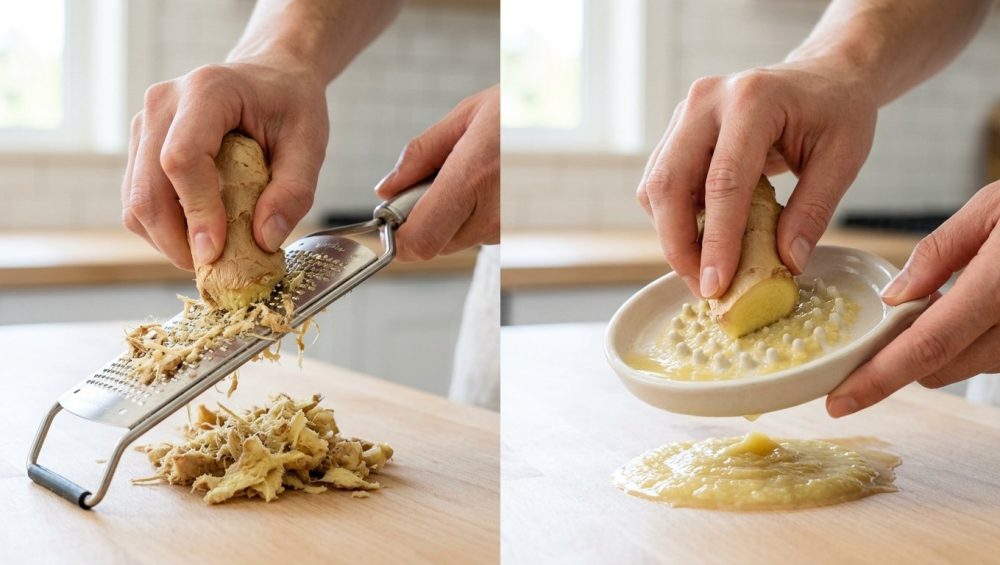
You grab your trusty metal box grater or your sleek, razor-sharp microplane. You start grating. Within thirty seconds, your culinary zen is entirely shattered. Your grater is hopelessly clogged with wet, hairy strings. You have managed to extract exactly half a teaspoon of usable ginger juice, most of which is dripping down the handle of the tool. You have a clump of mangled fibers stuck to the metal, and you have narrowly avoided shaving off the top layer of your knuckles.
I have been there. We have all been there. But here is the absolute truth that I preach to every weekend culinary hobbyist: professional-level results are completely achievable in a standard home kitchen, provided you aren’t actively sabotaging yourself with the wrong equipment. You do not need a fancy culinary degree to make mind-blowing food; you just need to understand basic food mechanics, respect your ingredients, and stock your drawers with the right beginner kitchen tools.
The struggle with ginger is not a failure of your cooking skills. It is a failure of mechanical engineering. We have been conditioned to believe that sharp metal teeth are the answer to all of our prep woes. But when it comes to highly fibrous, moisture-rich ingredients, sharp metal is actually your worst enemy. It is time to stop fighting the stringy mess and embrace a tool that has been perfected over centuries: the Japanese ceramic grater.
In this definitive masterclass, we are going deep into the botany of aromatics, the physics of grating, and the material science of kitchenware. By the end of this guide, you will understand exactly why your current methods are failing, and how a simple, inexpensive ceramic dish will permanently revolutionize your weeknight cooking.
The Botanical Nightmare: Why Ginger Fights Back
To understand why ginger is such a relentless nightmare to prep, we have to get a little bit nerdy about plant anatomy. Ginger (Zingiber officinale) is not actually a root; it is a rhizome, which is a subterranean plant stem that sends out roots and shoots from its nodes.
Because it is a subterranean stem designed to push through dense soil and store nutrients for the plant, its internal architecture is incredibly robust. A fresh ginger rhizome is typically composed of 83% to 94% moisture, but the remaining dry weight is a dense, highly structured network of fibers.
As a ginger rhizome matures in the ground, it undergoes significant anatomical changes. Botanical studies show that during maturation, the rhizome develops three to five distinct layers of fiber bundles in its xylem. This maturation process leads to a massive accumulation of a compound called lignin. Lignin is a complex organic polymer that binds to cellulose, forming the chief structural material of the plant’s cell walls. In layman’s terms? Lignin is the stuff that makes wood woody. It is incredibly tough, rigid, and resistant to mechanical breakdown.
When you try to chop mature ginger with a chef’s knife, unless your blade is honed to a microscopic, razor-sharp edge, you are often just mashing the fibers rather than slicing them cleanly. This intense friction and resistance is exactly why your knives get dull so fast when processing tough, woody ingredients on the wrong cutting boards.
But here is the catch: the flavor of the ginger—the pungent essential oils, the spicy [6]-gingerol compounds, and the sweet juices—does not live in those tough lignin fibers. The flavor lives in the delicate, moisture-rich parenchyma cells that are woven between the structural fiber bundles.
Therefore, the ultimate goal of prepping ginger is to rupture those delicate parenchyma cells to extract the juice and flavor, while somehow leaving the tough, woody lignin fibers behind. Unfortunately, standard Western kitchen tools are designed to do the exact opposite.
The Microplane Massacre: Why Metal Fails
I love a good microplane. It is an indispensable tool for zesting citrus, showering a plate of pasta with hard Parmigiano-Reggiano, or grating whole nutmeg. But using a microplane to process fresh ginger is one of the most common rookie kitchen mistakes that will ruin your prep time.
To understand why, we have to look at the mechanics of photo-etched metal graters. A microplane is covered in hundreds of tiny, razor-sharp metal teeth. These teeth are designed to shear and slice at high velocity. When you drag a piece of citrus across them, they cleanly shave off the oil-rich zest.
But when you drag a fibrous ginger rhizome across these teeth, disaster strikes. The razor-sharp metal easily slices through the soft parenchyma cells, but when it hits the dense, longitudinal lignin fibers, it fails to cut through them completely. Because the fibers are so strong and stringy, they act like a net. The metal teeth essentially comb through the ginger, catching and snagging the fibers, which then become hopelessly wrapped around the blades and stuffed into the tiny holes of the grater.
Within seconds, the grating surface is completely clogged. You are no longer grating ginger; you are just aggressively rubbing a piece of ginger against a wet mat of its own hair. This drastically reduces your yield, wastes precious ingredients, and creates a slippery surface that practically guarantees you will eventually slip and grate your own fingers.
Furthermore, there is a hidden chemical downside to using high-speed metal teeth. The aggressive shearing action and localized friction generate heat—sometimes raising the surface temperature of the ginger significantly in just a few seconds. This rapid mechanical stress can accelerate the enzymatic degradation of [6]-gingerol (the compound responsible for ginger’s fresh, zesty heat) into less potent shogaols.
The high-velocity slicing also aerosolizes the volatile essential oils, such as zingiberene and beta-bisabolene. This means that the incredible aroma you smell while grating isn’t going into your food; it is evaporating into the air. It is the exact same mechanical phenomenon that explains why you find yourself weeping over chopped onions—brute-force cellular destruction sprays volatile, irritating compounds directly into the atmosphere instead of preserving them on the cutting board.
The Garlic Press Delusion: A Waste of Good Flavor
When home cooks finally get fed up with the stringy, clogged mess of a box grater or a microplane, they often pivot to another common kitchen gadget: the garlic press. They chop the ginger into small cubes, load it into the hopper of the press, and squeeze with all their might.
I cannot stress this enough: please stop doing this.
A garlic press operates on the principle of blunt, high-pressure compression. When you squeeze a chunk of ginger in a press, the mechanical force will indeed rupture the parenchyma cells and extract a small amount of ginger juice. However, the dense network of lignin fibers acts like an impenetrable filter. The juice drips out, but the vast majority of the flavorful pulp, essential oils, and aromatic compounds remain permanently trapped inside the hopper, bound up in a dry, woody puck of compressed fiber.
You are essentially throwing away the best part of the ingredient. If you want to build a deeply flavorful curry base, or if you want to stop your garlic from burning in the pan by insulating it with ginger pulp, you need the whole, textural puree. You do not just need the watery juice. Squeezing ginger in a garlic press is an inefficient, exhausting waste of money and flavor.
The “No-Go” Rule: The Hidden Toxicity of Cheap Metal Gear
Before we talk about the ultimate solution, it is time for my signature strict rule, the hill I will absolutely die on: I despise cheap, toxic kitchenware. We must actively banish toxic kitchen gear from our homes.
When you buy a flimsy, mystery-metal box grater or a cheap garlic press from a discount bin, you are bringing active hazards into your food preparation space. Cheap metal graters are notorious for rusting at the welds. They bend under pressure, and the poorly stamped holes harbor ancient, decaying food particles that are impossible to clean out.
Even worse are the cheap, non-stick coated tools that have flooded the market. Just like the sneaky, abrasive habits ruining your non-stick pans, using acidic ingredients or abrasive scrubbing pads on cheap coated metals causes the chemical coating to micro-flake directly into your food. Once a Teflon or mystery-polymer coating begins to scratch and peel, it can release harmful compounds, and the exposed aluminum underneath can leach into your acidic marinades.
This is exactly why I advocate so fiercely for advanced ceramics in the kitchen. High-purity alumina (aluminum oxide) and zirconia ceramics are modern engineering marvels. These materials are chemically inert, meaning they will never rust, they will never corrode, and they will absolutely never react with the acidic juices of your ginger, garlic, or citrus.
During manufacturing, these ceramics are fired at extreme temperatures, resulting in a material that is incredibly dense and phenomenally durable. In fact, advanced technical ceramics rank just below diamonds on the Mohs scale of hardness. They do not leach heavy metals, they do not harbor bacterial biofilms like scratched plastic, and they will outlast almost every other tool in your kitchen.
Enter the Oroshigane: The Genius of Japanese Ceramic Graters
So, if sharp metal teeth clog, and blunt compression wastes the pulp, what is the solution? The answer lies in a tool that has been perfected over centuries in Japan: the oroshigane (literally translated as “grating metal”).
Historically, dating back to the Edo period, traditional Japanese graters were made of tin-coated copper plates. Artisans would hand-hammer the metal to create tiny, raised, irregular spikes rather than punching holes through the metal. For highly delicate ingredients like fresh wasabi root, chefs even utilized wooden boards covered in sharkskin, using the natural, sandpaper-like dermal denticles to grind the root into a perfectly smooth paste.
Today, modern culinary engineering has taken the brilliance of the traditional oroshigane and translated it into the ultimate home kitchen tool: the ceramic ginger grater. Companies like Kyocera have pioneered the use of advanced zirconia-toughened ceramics to create small, saucer-like dishes featuring a raised center dome covered in dozens of tiny, distinct ceramic pegs.
Notice that I said pegs, not teeth. And notice that I did not say they were sharp.
This is the mechanical secret that makes the ceramic grater a masterpiece. The ceramic pegs are intentionally dull compared to a metal blade. When you rub a fibrous ginger rhizome over these dull pegs, they do not attempt to slice through the tough lignin fibers. Instead, they utilize controlled, blunt-force cellular disruption.
As you move the ginger in a circular motion, the ceramic pegs bypass the woody fibers entirely. They gently compress and burst the delicate parenchyma cell walls, releasing all of the sweet juice, the pungent [6]-gingerol, and the aromatic essential oils.
Because the pegs are not slicing, the tough, stringy lignin fibers remain entirely intact and attached to the un-grated nub of ginger in your hand. The result is a luscious, juicy, incredibly aromatic, and completely fiber-free puree that collects perfectly in the deep moat surrounding the grating dome. There are no strings in your food. There are no clogged holes, because the dish has no holes. Just like finally understanding why your silicone spatulas taste like soap, understanding the mechanics of your materials changes absolutely everything about how you cook.
The Sassy Sous-Chef’s Masterclass: How to Use a Ceramic Grater Properly
Owning the right tool is only half the battle; using it correctly is what separates the stressed-out weeknight cook from the confident home chef. Here is my definitive, no-nonsense method for extracting perfect ginger puree every single time.
Step 1: The Spoon Peel
Put the vegetable peeler down. A sharp vegetable peeler will take off way too much of the precious ginger flesh along with the skin. Instead, grab a standard stainless steel teaspoon. Hold the ginger root firmly in one hand, and use the edge of the spoon to scrape away the thin, papery skin. The blunt edge of the spoon easily navigates the weird, knobby contours of the rhizome without wasting any of the good stuff. (Note: If you are using very young, spring ginger with translucent skin, you don’t even need to peel it. Just wash it thoroughly).
Step 2: The Circular Motion
Hold your peeled ginger and press it against the raised ceramic pegs. Do not grate in a straight back-and-forth motion. If you grate in a straight line, the longitudinal fibers of the ginger will align with the pegs and start to act like a brush, slowing you down. Instead, grate in a firm, continuous circular motion. This constant rotation ensures that the ceramic pegs are hitting the cell walls from every angle, maximizing the yield of your puree and keeping the fibers attached to the root.
Step 3: The Gathering
As you grate, a beautiful, golden, juicy paste will begin to pool in the moat around the ceramic teeth. Once you have grated down to a fibrous nub (which you can now throw away or toss into a pot of tea), it is time to gather your prize. Because the ceramic pegs are relatively dull, you can safely use your fingers to sweep the puree out of the dish. Alternatively, a small silicone spatula or a bamboo brush works perfectly to gather every last drop of the juice and pulp. If you want to stop eating bland tofu, you need to be scraping every ounce of this incredibly potent flavor base into your marinades.
Step 4: The Five-Second Cleanup
There is a popular internet “hack” promoted by chefs like Alton Brown, which suggests wrapping your ceramic grater in plastic wrap before grating the ginger, so you can just lift the plastic away for zero cleanup. With all due respect to the culinary legends, this is an absurd waste of single-use plastic. You do not need plastic wrap. Because ceramic is naturally non-porous and non-stick, all you have to do is hold the grater under warm running water immediately after using it. The few remaining fibers will slide right off. If you let it dry and crust over, a quick scrub with a dedicated kitchen toothbrush will remove it in seconds.
Beyond the Rhizome: What Else Can This Little Dish Do?
While it is the undisputed champion of ginger, a high-quality ceramic grater is far from a unitasker. Once you have it in your kitchen, you will find yourself reaching for it constantly for a variety of aromatic tasks.
The Ultimate Garlic Paste
If you hate the bitter, harsh bite that comes from crushing garlic in a metal press, try running a clove over your ceramic grater. The blunt bursting of the garlic’s cell walls (rather than slicing them) creates a remarkably smooth, sweet, and mellow garlic paste. It melts instantly into vinaigrettes, marinades, and pan sauces without leaving harsh, raw chunks in your food. Pro tip: leave the hard root end of the garlic clove intact to act as a “handle” while you grate, saving your fingertips.
Taming Fresh Turmeric
Fresh turmeric root offers a vibrant, earthy flavor that powdered turmeric simply cannot match. However, it shares the same fibrous, stringy anatomy as ginger. The ceramic grater handles turmeric beautifully. A word of caution: curcumin, the pigment in turmeric, is notoriously staining. Wash your ceramic grater immediately after use to prevent the bright yellow oils from temporarily tinting the white ceramic.
Daikon Snow
In Japanese cuisine, grated daikon radish (daikon oroshi) is a classic accompaniment to grilled fish, tempura, and rich broths. A larger ceramic grater easily reduces dense daikon into fluffy, watery clouds of radish snow, adding a refreshing, enzyme-rich bite to heavy meals.
Hard Cheeses and Spices
While I still prefer a microplane for showering pasta, in a pinch, a ceramic grater makes quick work of hard blocks of Parmesan or Pecorino. It is also highly effective for grating whole nutmeg or cinnamon sticks, as the extreme hardness of the ceramic easily grinds down the dense spices without dulling the pegs.
Buying Guide: Choosing the Right Ceramic Grater
Not all ceramic graters are created equal. When you are ready to upgrade your kitchen arsenal, here is exactly what you need to look for to ensure you are buying a tool that will last a lifetime.
1. Seek Out Advanced Materials
Avoid cheap, glazed pottery or standard low-fired earthenware. You want a grater explicitly made from high-fired technical ceramics, such as Zirconia Toughened Alumina (ZTA) or high-grade porcelain. Brands like Kyocera are the gold standard here. These advanced ceramics ensure that the grating pegs will not chip, wear down, or lose their structural integrity even after years of aggressive use.
2. The Silicone Anchor
This is a non-negotiable feature. You must buy a ceramic grater that features a built-in silicone ring or rubber gasket permanently affixed to the bottom of the dish. When you are grating a tough root with one hand, you need the dish to stay firmly planted on your countertop. A grater without a silicone base will slide around dangerously, turning a simple prep task into a frustrating balancing act.
3. A Deep Moat
Look for a design that features a pronounced, deep trough or moat surrounding the central grating dome. Fresh ginger and daikon radish release a massive amount of liquid when their cell walls are ruptured. A shallow dish will overflow, spilling sticky, pungent juice all over your cutting board. A deep moat ensures that you capture every single drop of that liquid gold.
4. Pronounced, Well-Spaced Pegs
Examine the grating surface. The pegs should be distinct, raised, and spaced far enough apart that water can easily flow between them during cleanup. If the teeth are too small or clustered too tightly together, the grater will act more like a sanding block than a cellular disruptor, and it will be significantly harder to rinse clean.
Conclusion: Reclaim Your Weeknights
Cooking should never feel like a punishment. It should not be a battle against your ingredients, and it certainly should not involve scraping your knuckles against toxic, rusting metal just to extract a teaspoon of flavor.
By understanding the botanical structure of the foods we eat and pairing them with the correct mechanical tools, we can eliminate the friction that makes weeknight cooking feel like a chore. Investing in a beautiful, durable, scientifically optimized tool like a Japanese ceramic grater is a small step that yields massive daily rewards. It transforms a chaotic cooking routine into an efficient, mindful, and highly rewarding practice.
So, toss that clogged, bent metal box grater into the recycling bin. Stop squeezing the life out of your aromatics in a garlic press. Upgrade to a ceramic grater, buy a fresh, plump rhizome of ginger, and get back to making the vibrant, deeply flavorful meals you actually deserve to eat.