Listen up, culinary weekend warriors. We need to have a serious, unfiltered conversation about the absolute state of your skillets. If you are reading this, I can safely assume you have experienced the unique, soul-crushing heartbreak of buying a beautiful, expensive piece of protein—perhaps a pristine, skin-on chicken breast or a delicate filet of wild-caught salmon—only to watch it violently fuse to the bottom of your stainless steel pan. You try to flip it, panic sets in, you scrape frantically with a spatula, and you are left with a mangled, shredded disaster while the best, crispiest parts of your dinner remain permanently cemented to the metal. If you are tired of your weeknight meals turning into a string of beginner cooking disasters, it is time to learn the science of your skillet.
You do not need a culinary degree to cook like an expert, and you certainly do not need to rely on cheap, disposable cookware to prevent your eggs from sticking. What you need is a fundamental understanding of thermodynamics. Today, we are going completely scorched-earth on the pretension surrounding professional cooking. I am going to teach you how to master the Leidenfrost effect—a thermodynamic phenomenon that will transform your intimidating, sticky stainless steel pan into a naturally non-stick surface. We are going to dive deep into the molecular chemistry of proteins, the exact temperature thresholds required for perfect searing, and the fluid dynamics of cooking oils. Grab a coffee, or pour yourself a glass of wine, because we are leaving absolutely no stone unturned.
The Toxic Elephant in the Room: Why Non-Stick is a Scam
Before we get into the beautiful physics of vapor barriers, we have to address the villain of this story: the modern non-stick pan. I have a strict “no-go” rule when it comes to cheap, toxic kitchenware. I am absolutely militant about banishing toxic kitchen gear from my home, and you should be too. The vast majority of non-stick pans on the market rely on a synthetic fluoropolymer called polytetrafluoroethylene (PTFE), most commonly known by the brand name Teflon.
For decades, the cookware industry has sold home cooks a massive lie: that you need a slick chemical coating to cook eggs or fish. This is a false economy and a legitimate health hazard. PTFE coatings are inherently fragile. The moment you use a metal utensil, stack them improperly in your cabinets, or heat them a little too aggressively, that coating begins to scratch, degrade, and flake off directly into your food. But the physical flaking is only the beginning of the nightmare.
The real danger lies in the temperature limitations of these synthetic polymers. Studies and chemical analyses demonstrate that PTFE begins to break down and decompose at temperatures above 500°F (260°C). Now, you might be thinking, “I never cook at 500 degrees!” But if you place a lightweight aluminum non-stick pan on a high-BTU gas burner or a powerful induction cooktop to preheat, the surface temperature can easily blast past 500°F in less than two minutes. When this happens, the PTFE matrix undergoes pyrolysis—a thermal decomposition that releases highly toxic perfluorinated compounds (PFAS) and fluorocarbon gases into the air in your kitchen.
Inhalation of these toxic fumes leads to a well-documented medical condition known as “polymer fume fever,” colloquially referred to as the “Teflon flu”. The symptoms include severe chills, headaches, fevers, chest tightness, and respiratory distress. These fumes are so acutely toxic that they are famously known to be instantly fatal to pet birds kept in the same house. Furthermore, the legacy of manufacturing these pans involves perfluorooctanoic acid (PFOA) and its modern replacement, GenX—so-called “forever chemicals” that accumulate in the human body and the environment, linked to kidney cancer, testicular cancer, thyroid disease, and immune system suppression.
We are done with this. We are done treating pans as disposable items that need to be thrown into a landfill every eight months. A heavy-bottomed, uncoated stainless steel skillet will literally outlive you, and it will give you a restaurant-quality sear that a non-stick pan could never dream of achieving. You just have to learn how to drive it.
Meet Your New Best Friend: Johann Gottlob Leidenfrost
To understand how to make uncoated metal naturally non-stick, we have to travel back to the 18th century. Mastering this single thermodynamic principle is your golden ticket to truly understanding the art of the kitchen.
In 1756, a German physician and theologian named Johann Gottlob Leidenfrost published a highly influential scientific manuscript entitled De Aquae Communis Nonnullis Qualitatibus Tractatus (A Tract About Some Qualities of Common Water). Leidenfrost was deeply fascinated by the properties of water, motion, and heat. In his laboratory, he conducted a series of incredibly precise experiments using a highly polished iron spoon that he heated red-hot over glowing coals in a fireplace.
Using the swings of a pendulum to measure time, Leidenfrost began dropping small amounts of water into the glowing hot spoon. He observed something that completely defied conventional logic. Common sense dictates that the hotter a surface is, the faster water should evaporate. But Leidenfrost noticed that when the iron spoon was heated beyond a certain extreme threshold, the water did not instantly flash-boil into steam. Instead, the water droplet formed a perfect, spherical globe that skittered and danced around the glowing metal, surviving for an astonishingly long time—up to 30 seconds—before finally evaporating.
Leidenfrost had discovered a phenomenon where a liquid, when brought into near contact with a mass significantly hotter than its boiling point, produces an insulating vapor layer that keeps the liquid from boiling rapidly. Today, we call this the Leidenfrost effect, and the specific temperature at which it occurs is known as the Leidenfrost point. This is not just a quirky physics trick; it is the exact mechanism we are going to use to prevent a $30 steak from adhering to your cookware.
The Physics of the Vapor Barrier: Stages of Boiling
To truly grasp how the Leidenfrost effect protects your food, we must take a highly analytical deep-dive into the thermodynamic phases of boiling water. A heavy-bottomed, uncoated skillet is one of those essential beginner kitchen tools that will outlive you if treated properly, but you have to understand how it transfers heat. When you introduce moisture (which is abundant in all raw proteins and vegetables) to a heated pan, the water goes through several distinct physical stages depending on the surface temperature of the metal.
1. Nucleate Boiling
This is the stage you are most familiar with. When the surface of your pan is slightly above the boiling point of water (212°F / 100°C), small bubbles of water vapor begin to form. These bubbles originate at “nucleation sites”—microscopic scratches, pits, and protrusions on the surface of the metal. The water is in direct physical contact with the metal, and the heat transfer is highly efficient, causing the water to boil away steadily. If you put food in a pan at this temperature, it will absolutely stick.
2. Flash Boiling
As the temperature of the metal increases significantly, the heat transfer becomes incredibly aggressive. If you drop water into a pan at this stage, it vaporizes almost instantly with a loud, violent hissing noise. The water is still making direct contact with the hot metal, but the thermal energy is so high that the liquid flashes into steam in a fraction of a second. If you put a chicken breast into a pan at this stage, the surface moisture flashes off, and the protein immediately welds itself to the metal.
3. Transition Boiling
As we push the temperature even higher, we enter a chaotic phase. The water begins to break up into tiny, violently spitting droplets that bounce erratically on the surface before noisily vaporizing. The heat is trying to form a continuous vapor barrier, but the temperature is not quite high enough to sustain it, causing the barrier to collapse and reform rapidly.
4. Film Boiling (The Leidenfrost Point)
Finally, we reach the holy grail of high-heat cooking: film boiling. When the surface of the stainless steel pan reaches a temperature significantly higher than the boiling point of water, a thermodynamic miracle occurs. The moment a droplet of water touches the metal, the very bottom of the droplet vaporizes instantaneously. This instantaneous vaporization creates a microscopic, pressurized cushion of steam directly underneath the rest of the water droplet.
Because steam (a gas) is a remarkably poor conductor of heat compared to liquid water, this vapor barrier acts as an incredible thermal insulator. The droplet is literally levitating on its own steam, completely decoupled from the hot metal surface. It glides around the pan with zero friction. When we apply this principle to cooking, the moisture inherent in your food creates a microscopic steam cushion that physically lifts the protein away from the metal, preventing the chemical bonds of adhesion from ever forming.
The Chemistry of Adhesion: Why Your Food Hates You
Why does food stick in the first place? This isn’t just a parlor trick for clumsy cooks to avoid scrubbing pans; it is fundamental chemistry. The phenomenon of a beautiful filet of fish tearing apart in a stainless steel pan is the result of highly specific chemical reactions occurring at the molecular level.
First, we have to look at the physical topography of your cookware. To the naked eye, a high-quality stainless steel skillet looks perfectly smooth and polished. However, if you were to look at that same surface under a high-powered electron microscope, you would see a rugged, chaotic mountain range. The surface is covered in microscopic hills, valleys, crevices, and pores. When metal is cold, these pores are relatively static. But as the pan heats up, the metal expands, and these microscopic fissures open up. When cold, raw food is dropped into the pan, it sinks into these valleys. As the food cooks, the metal grips it like a microscopic vice.
But the mechanical gripping is only half the battle; the real enemy is chemical bonding. Protein-rich foods—like eggs, poultry, beef, and fish—are complex structures made of long chains of amino acids. In their raw state, these proteins are tightly folded into intricate, three-dimensional shapes. When you introduce these proteins to high heat, a process called denaturation occurs. The heat energy causes the complex protein structures to aggressively unfold and unravel, exposing highly reactive amino groups, carboxylate groups, and side chains.
Stainless steel is an alloy, primarily composed of iron, chromium, and nickel. While it is less reactive than pure cast iron, the surface of a stainless steel pan still contains an abundance of free metallic atoms. When the denatured, unraveled proteins from your food come into direct physical contact with the hot metal, they actively seek out these metallic atoms.
The proteins and the metal form chemical bonds. Some of these are relatively weak van der Waals forces, but many of them are incredibly strong covalent bonds. The proteins literally form complex chemical compounds with the iron atoms in the pan. Your chicken breast isn’t just “stuck” to the pan; it has chemically welded itself to the cookware. To break these covalent bonds, you have to apply massive physical force (scraping with a spatula), which inevitably tears the delicate flesh of the food. The Leidenfrost effect—by creating a levitating vapor barrier—prevents the denatured proteins from ever making direct physical contact with the reactive iron atoms, stopping the chemical welding process before it can even begin.
The Holy Grail: Exact Thermodynamics and Temperature Thresholds
So, what is the magic number? You cannot even dream of mastering the Maillard reaction if your food is hopelessly welded to the bottom of the pan. We know that water boils at 212°F (100°C), but the Leidenfrost point requires a significantly higher temperature to sustain the continuous film boiling phase.
For a heavy-bottomed stainless steel pan, extensive thermodynamic testing reveals that the Leidenfrost effect begins to manifest around 400°F (204°C). However, at exactly 400°F, the vapor barrier is highly unstable. Water droplets will initially form the characteristic mercury-like balls, but they will quickly fizzle out and evaporate as the localized temperature of the metal drops upon contact.
To achieve a fully stable, bulletproof Leidenfrost effect where the vapor barrier persists continuously without collapsing, the surface of the stainless steel needs to reach approximately 420°F (215°C) to 430°F (221°C).
Here is a crucial caveat that most amateur cooking blogs completely ignore: pans do not heat perfectly evenly. Even the most expensive, fully-clad, 5-ply copper-core stainless steel skillets on the market will heat from the center outward, directly above the heat source. If you measure the exact center of the pan with an infrared surface thermometer and it reads 400°F, the outer edges of the cooking surface might only be 350°F. If you drop a large piece of meat into the pan, the edges of the protein will hit the cooler zones, fail to generate a vapor barrier, and instantly chemically bond to the metal.
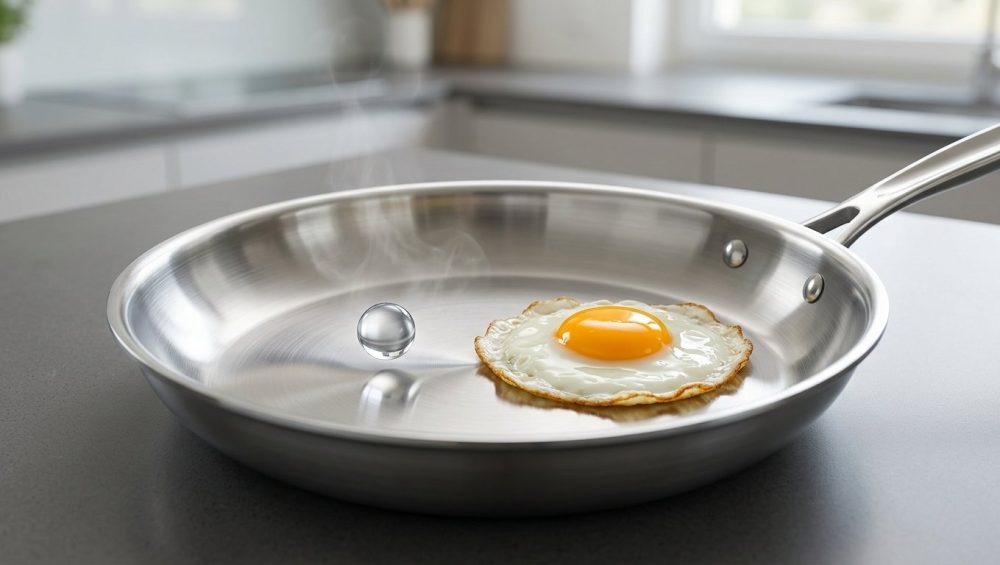
Therefore, the scientifically validated sweet spot is to heat the pan until the absolute center reaches 430°F (221°C) to 450°F. At this precise thermal threshold, the center is hot enough to sustain the vapor barrier, and the conductive heat has had enough time to radiate outward, ensuring that the entire usable surface of the skillet has crossed the 400°F minimum threshold. At 430°F, a droplet of water will ball up, dance wildly around the pan, and maintain its perfect spherical form even when crossing over cooler spots where previous droplets evaporated.
The Mercury Ball Test: Executing the Water Drop Method
You do not need an expensive infrared surface thermometer to find the Leidenfrost point. Physics has provided us with a built-in, foolproof visual indicator. This is known in culinary circles as the “Water Drop Test” or the “Mercury Ball Test.” If you want to survive the kitchen without relying on cheap crutches, you have to embrace the physics of cooking.
Here is exactly how to execute it with flawless precision:
- Start Dry: Place your completely clean, completely dry, bare stainless steel skillet on the burner. Do not add oil yet. This is critical.
- Apply Medium Heat: Turn your burner to medium. Never preheat an empty pan on high heat. High heat will cause the metal to expand too rapidly, permanently warping the pan. It will also cause you to wildly overshoot the Leidenfrost point, which we will discuss later.
- Wait and Test: After about two to three minutes (depending on the thickness of your pan and the power of your stove), run your fingers under the tap and flick a few drops of water into the center of the pan.
- Observe the Reaction:
- Too Cold (Nucleate/Flash Boiling): The water instantly sizzles, splatters aggressively, and evaporates within a second or two. The pan is not ready. Wait 30 seconds and test again.
- The Sweet Spot (Film Boiling): The water hits the pan and instantly pulls together into a single, perfect, shimmering sphere that looks exactly like a bead of liquid mercury. It will glide effortlessly across the surface of the metal without hissing or evaporating. Congratulations, you have achieved the Leidenfrost effect.
- Too Hot: If the water hits the pan and violently shatters into dozens of tiny, erratic micro-beads that zip around at lightning speed, your pan is dangerously hot. If you add oil now, it will instantly smoke, polymerize, and turn into a sticky, bitter resin. Take the pan off the heat for a minute to let it cool down.
The Crucial Role of Lipids: Hot Pan, Cold Oil
Now that we have reached the correct temperature, we must introduce our secondary barrier: fat. This technique is the secret to executing flawlessly simple weeknight dinners without spending an hour soaking dishes.
The golden rule of cooking with stainless steel is: Hot Pan, Cold Oil.
Why do we wait to add the oil until after the pan has reached the Leidenfrost point? Why not just heat the oil and the pan together?
First, heating oil from a cold state over a long preheating period degrades the lipid structure. Cooking oils have specific smoke points, and exposing them to prolonged, rising heat causes them to break down, oxidize, and release bitter, acrid flavors before the food even hits the pan.
Second, we need to manipulate the viscosity of the oil. When you add room-temperature oil to a 430°F pan, the thermal shock causes the oil to instantly become hyper-fluid. Remember those microscopic hills and valleys we discussed earlier? Cold oil is viscous and thick; it sits on top of the microscopic mountain range. But when cold oil hits a hot pan, its viscosity plummets. It immediately flows like water, aggressively seeping into every single microscopic crevice, valley, and pore on the metal’s surface.
By filling in these microscopic gaps, the hyper-fluid oil creates a perfectly smooth, temporary physical barrier. Furthermore, the hot oil acts as the ultimate heat transfer medium. When your protein hits the hot oil, the oil immediately sears the exterior of the food, forcing the moisture inside the food to rapidly vaporize. This creates the “steam effect”. The combination of the oil filling the pores and the food’s own moisture vaporizing creates a dual-layer barrier: a liquid lipid layer and a gaseous vapor layer. The food is literally suspended above the metal.
Step-by-Step Masterclass: Searing Without Sticking
Let’s put all of this thermodynamic theory into practice. Here is your definitive, step-by-step masterclass for searing a piece of protein on a stainless steel pan without a single torn fiber.
Step 1: The Dry Down
Moisture is the mortal enemy of the Maillard reaction. If you take a wet chicken breast straight from the packaging and throw it into a hot pan, the pan’s thermal energy will be entirely wasted on boiling off that surface water (which caps at 212°F) instead of searing the meat (which requires 300°F+). Furthermore, excessive water will crash the temperature of the pan, destroying the Leidenfrost vapor barrier and causing instant chemical adhesion. You must aggressively pat your protein completely dry with paper towels. If you have the time, salt the meat and leave it uncovered in the fridge overnight to deeply dry out the pellicle (the surface layer).
Step 2: The Pre-Heat
Place your clean, dry stainless steel skillet on a burner set to medium heat. Walk away and prep your garnishes. Let the pan heat up gradually and evenly for 2 to 3 minutes.
Step 3: The Mercury Ball Test
Flick a few drops of water into the center of the pan. Wait for the water to form a perfect, gliding sphere of liquid mercury. If it sizzles and dies, wait. If it forms the ball, you are thermodynamically primed. Take a paper towel and quickly wipe the water droplet out of the pan (water and hot oil do not mix).
Step 4: The Lipid Addition
Pour in your cooking fat. Because the pan is sitting at roughly 430°F, you must use an oil with a high smoke point—avocado oil, grapeseed oil, clarified butter (ghee), or refined olive oil. Do not use extra virgin olive oil or whole butter, as the milk solids and unrefined particles will instantly burn and turn black at this temperature. Swirl the oil around the pan. You will notice it immediately shimmers and forms thin, spiderweb-like streaks as the viscosity drops and it fills the microscopic pores.
Step 5: The Drop and The Wait
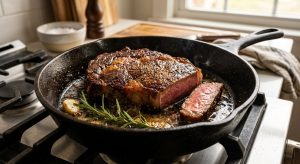
Gently lay your dry, seasoned protein into the pan, laying it away from you so the hot oil doesn’t splash back onto your hands. You should immediately hear a violent, aggressive sizzle. That is the sound of surface moisture vaporizing and creating the Leidenfrost steam cushion.
Now, listen to me very carefully: Do not touch it.
Flipping your meat too early is one of the most classic beginner cooking mistakes you can make. When the cold protein first hits the pan, the local temperature of the metal directly underneath the meat will drop slightly. During the first 60 to 90 seconds, the proteins will begin to denature, and the meat will temporarily grip the pan. This is normal. Do not panic, and do not try to pry it off with a spatula.
As the heat transfers into the meat, the Maillard reaction begins. The amino acids and reducing sugars on the surface of the meat begin to recombine into hundreds of new, complex flavor compounds. The surface of the meat dehydrates and polymerizes into a crispy crust. Once this crust fully forms, the structure of the proteins fundamentally changes, and the meat will naturally release its grip on the metal. If you gently shake the pan after 3 or 4 minutes, the protein should slide around freely. If it resists, it is not ready. Patience is a culinary virtue.
Troubleshooting Your Searing Failures
Even with a PhD in thermodynamics, things can go wrong in the kitchen. If you followed the steps above and your food still stuck, one of these variables was out of alignment.
“My oil instantly started billowing thick, black smoke!”
You overshot the Leidenfrost point by a massive margin. If your pan is sitting at 550°F and you pour in avocado oil (which has a smoke point of 520°F), the oil will instantly undergo thermal degradation. The lipid molecules break down, releasing free radicals and acrolein (the chemical that makes burnt oil smell bitter and sting your eyes). Furthermore, overheated oil will polymerize—it will literally turn into a sticky, plastic-like resin that bonds to the stainless steel, acting like a glue for your food. If your oil instantly smokes, dump it out, take the pan off the heat, let it cool, wipe it clean, and start over.
“My meat just steamed and turned grey, and then it stuck!”
You overcrowded the pan, or your meat was soaking wet. Stainless steel retains heat well, but it is not magic. If you drop three massive, fridge-cold, wet chicken breasts into a 10-inch skillet all at once, you will violently crash the temperature of the metal. The temperature will plummet from 430°F down to 250°F. The Leidenfrost vapor barrier will instantly collapse. The water will pool in the bottom of the pan, boiling the meat instead of searing it. The proteins will denature slowly, find the iron atoms, and chemically weld themselves to the pan. Cook in batches, ensure your meat is bone-dry, and let your protein sit at room temperature for 20 minutes before cooking to take the chill off.
“I got the mercury ball, I added the oil, but the food still stuck immediately!”
You likely used a pan with severe, baked-on carbon buildup. The Leidenfrost effect and the fluid dynamics of hot oil rely on the relatively smooth (albeit microscopically porous) surface of clean stainless steel. If your pan has yellow, brown, or black polymerized grease stains burned into the sides and bottom from previous cooking sessions, those stains act as highly textured, sticky nucleation sites. The proteins in your food will latch onto that polymerized grease instantly. You must keep your stainless steel pristine. Invest in a canister of Bar Keepers Friend (oxalic acid), make a paste, and scrub your pans back to their original factory shine before attempting high-heat searing.
The Final Polish
Cooking is not magic; it is applied physics and chemistry. Once you understand the underlying thermodynamic principles governing the tools in your kitchen, you unlock a level of freedom and confidence that no expensive gadget can ever provide. While you might be distracted by fancy aesthetic kitchen upgrades, the real upgrade happens in your technique.
You do not need to poison your indoor air quality with degrading PTFE coatings just to cook a piece of salmon. By mastering the Leidenfrost point, utilizing the hot-pan-cold-oil method, and practicing the patience required to let the Maillard reaction run its course, you can turn a standard piece of uncoated stainless steel into the most powerful, naturally non-stick tool in your culinary arsenal.
Stop fighting your cookware. Learn its rules, respect its thermal thresholds, and let the thermodynamics do the heavy lifting. Now get into the kitchen, dry off your steaks, heat up your skillets, and start cooking like you actually know what you are doing.