Welcome to the Kitchen (Put Down the Takeout Menu)
Look, I get it. You’ve had a long day, the dog is barking, your inbox is a disaster zone, and the absolute last thing you want to do is stand over a hot stove trying to decipher what “julienne” means. We have all been there. I learned to cook by trial, error, and setting off the smoke detector so many times that my neighbors thought it was my kitchen’s ambient soundtrack. But here is the unvarnished truth: you do not need a culinary degree, a trust fund, or a chef’s coat to make mind-blowing, restaurant-quality food in your own home. You just need a little bit of patience, some basic problem-solving skills, and the willingness to learn from your disasters.
Despite the convenience of delivery apps, home cooking is officially having a massive renaissance. According to recent demographic data, roughly 36% of Americans cook at home on a daily basis, but a staggering 163 million people still eat out at least once a week. However, the tide is turning. With restaurant prices skyrocketing and inflation tightening budgets, the USDA projects food-away-from-home prices to continue rising, pushing consumers straight back to their cutting boards. In fact, 2025 industry data shows that social media conversations about homemade food have surged by nearly 19% year-over-year. People want the comfort, the cost-savings, and the satisfaction of feeding themselves.
But here is the catch: when you are a weekend culinary hobbyist or a weekday warrior just trying to get dinner on the table before 8:00 PM, mistakes are going to happen. You will over-salt the soup. You will burn the garlic. You will break the hollandaise. And when you do, I do not want you panicking and tossing the whole pot into the trash. I am here to be your snarky but fiercely supportive culinary cheerleader. I have zero patience for pretentious chef-speak, and I firmly believe that every kitchen disaster has a logical, scientific fix.
This masterclass is your definitive, heavily researched, no-fluff guide to troubleshooting the most common kitchen dilemmas. We are going to prioritize efficiency because time is money, we are going to debunk some ridiculous kitchen myths, and we are going to talk about why your cheap cookware is actively sabotaging you. Tie your apron. Pour a glass of wine. Let’s fix your food.
The Salt Disaster: Over-Seasoning and the Great Potato Lie
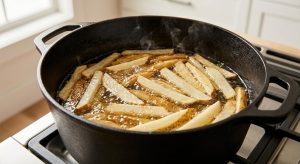
There is no sinking feeling quite like taking a confident slurp of your simmering Sunday stew, only to realize it tastes like you dredged it directly from the Dead Sea. Over-salting is the number one mistake beginners make, usually because they layer salt at every stage without tasting in between, or they blindly use high-sodium broths. When faced with an overly salty dish, almost everyone’s mother, grandmother, or favorite Pinterest board will tell them to do the same thing: “Just drop a raw potato in the pot! It acts like a sponge and absorbs the salt!”
I am here to tell you that the potato trick is 100% garbage.
Why the Potato Myth is a Culinary Delusion
Let’s look at the actual food physics. A 2026 scientific review of culinary chemistry completely debunked the potato myth, proving that it has absolutely no basis in osmosis kinetics. When you drop a raw potato into an over-salted soup, the potato does absorb some liquid, but it absorbs water, starch, and dissolved solids non-selectively. It does not magically hunt down sodium ions. In peer-reviewed lab testing across 127 over-salted preparations, adding a potato failed to reduce the sodium concentration below sensory detection thresholds in 94% of cases, typically reducing sodium by a negligible 2% or less.
Worse yet, dropping a raw, unpeeled root vegetable into a simmering broth at 60–75°C (140–167°F) can actually introduce microbial risks, as bacteria like spore-forming Bacillus thrive in that exact temperature range. At best, the potato breaks down and releases a gelatinous starch slurry that thickens your broth and makes it cloudy. You do not get a fixed soup; you just get a salty soup with a bland, salty potato floating in it. Skip the potato. Use what actually works.
The Actual Fixes for Over-Salting
If you cannot magically sponge the salt out, you have to rely on proven culinary mechanics: dilution, acid-base balance, and palate trickery.
1. Dilution (The Most Effective Route): If it is a liquid-based dish like a soup, stew, or curry, the only true way to reduce the concentration of sodium is to increase the volume of everything else. Add unsalted broth, water, or a splash of non-dairy milk or cream. If it is a solid dish like a stir-fry or a casserole, add more unseasoned bulk. Toss in some unsalted cooked rice, plain noodles, or unseasoned roasted vegetables. You are simply spreading the existing salt over a larger volume of food.
2. The Acid Counter-Punch: Your tastebuds can be easily distracted. If a dish is only slightly too salty, a hit of acid can brighten the flavor profile and mask the aggressive sodium. Squeeze in some fresh lemon or lime juice, or add a splash of apple cider or white wine vinegar. The sharp, bright acidity competes with the salt for your tongue’s attention, bringing the dish back into balance.
3. Sweetness and Fat: Fat coats the tongue and mutes sharp flavors. Swirling in a tablespoon of unsalted butter, a dollop of heavy cream, or some sour cream can round out the harshness of a salty dish. Alternatively, a tiny pinch of sugar, a drizzle of honey, or a splash of maple syrup can counteract the saltiness. Just be careful—you want to balance the dish, not turn your beef bourguignon into candy.
The “My Mouth is on Fire” Spice Fix
While we are on the topic of over-seasoning, let’s talk about chili heat. You got a little too heavy-handed with the cayenne, and now your chili is weaponized. Do not drink water—capsaicin (the chemical that makes chilies hot) is an oil-based molecule. Water will just spread the fiery oil around your mouth like a slip-and-slide of pain.
To fix an overly spicy dish, you need dairy. Dairy contains a protein called casein, which acts like a biological detergent. Casein binds to the capsaicin molecules and literally washes them away from your pain receptors. Stir in yogurt, sour cream, crème fraîche, or heavy cream. If the dish is dairy-free, reach for fat and sugar. A spoonful of peanut butter, a drizzle of tahini, or some diced creamy avocado will help coat the palate, while a touch of brown sugar or honey will distract your tastebuds from the burn.
Burnt, Stuck, and Ruined: The Heat Control Crisis
Professional chefs consistently cite “heat control” as one of the most disastrous areas for home cooks. Beginners seem to operate under the delusion that cooking is a race, violently cranking their stovetop dials to “HIGH” in a misguided attempt to make dinner happen faster. Alternatively, they drop cold meat into a cold pan, resulting in a sad, grey, steamed piece of protein.
Stop Crowding the Pan
When you throw a beautiful, expensive steak or a handful of mushrooms into a pan, the surface moisture of that food hits the hot oil and immediately turns to steam. If you have crowded the pan by shoving too much food into it at once, that steam gets trapped. The temperature of the pan plummets, and instead of achieving the glorious, crusty, caramelized Maillard reaction (the chemical reaction between amino acids and reducing sugars that gives browned food its distinctive flavor), you end up boiling your food in its own juices.
The Fix: Cook in batches. Yes, I know I said time is money, but ruining an expensive cut of meat costs you both time and money. Give your ingredients room to breathe. The pan should sizzle, not hiss and bubble.
How to Save a Scorched Dish
You looked away for three minutes to answer a text, and now the bottom of your chili is burnt black. Do not panic, and whatever you do, DO NOT SCRAPE THE BOTTOM OF THE POT.
The moment you scrape that blackened layer of carbon, you mix the bitter, acrid taste of ash into the rest of the dish, ruining the entire batch. Instead, immediately remove the pot from the heat. Carefully ladle or pour the unburnt top portion of the food into a brand-new, clean pot. Leave the burnt crust glued to the bottom of the old pot (you can deal with soaking that nightmare later).
Taste the rescued portion. If it has a slight smoky or bitter undertone, you can mask it using the same tricks we use for over-salting: a splash of acid (like vinegar) or a touch of sweetness (like caramelized onions or a pinch of sugar). If you are making a stew or chili, adding a dash of smoked paprika or a splash of barbecue sauce can trick the palate into thinking the smokiness was an intentional, rustic choice. You’re not a failure; you’re just “rustic.”
The Sassy Sous-Chef’s Absolute No-Go: Toxic Kitchenware
Alright, pull up a chair, because this is where I get serious. As a home cook, you are going to invest time, love, and money into your ingredients. I absolutely refuse to let you cook those beautiful ingredients in cheap, peeling, toxic garbage.
The “No-Go” rule in my kitchen is strict: I despise mystery metals and degrading non-stick coatings. If you have a $10 non-stick pan from a discount store that has scratches in the coating, throw it directly into the sun. I am not being hyperbolic; I am talking about your health.
The Horrifying Truth About “Forever Chemicals”
For decades, traditional non-stick cookware (like Teflon) was manufactured using per- and polyfluoroalkyl substances (PFAS), specifically chemicals like PFOA and PTFE. These are known as “forever chemicals” because they do not break down in the environment or in the human body. While PFOA has largely been phased out of US manufacturing, a terrifying amount of cookware still relies on PTFE. In fact, an extensive study by the Ecology Center found that 79% of non-stick cooking pans tested—including those from top brands and dollar stores—were coated with PTFE.
Why is this a problem? When non-stick pans are heated past 500°F (260°C)—which can happen in just a few minutes if you preheat an empty pan—the coating begins to rapidly degrade. It emits invisible, toxic fumes that can cause a short-term illness known as “polymer fume fever” (or Teflon flu). More alarmingly, long-term exposure to PFAS has been linked by the EPA and oncologists to severe health crises. Current scientific research ties PFAS exposure to kidney cancer, testicular cancer, thyroid disease, immune system dysfunction, and developmental delays in children. The risk is so severe that in April 2024, the EPA established legally enforceable drinking water standards for PFOA and PFOS at an astoundingly low 4 parts per trillion.
Furthermore, a 2024 medical study revealed that using metal or wooden utensils on non-stick pans causes micro-abrasions that release millions of PTFE microplastics and nanoplastics directly into your food. Swallowing these particles has been linked to respiratory tract damage and thyroid hormone disruption.
Ditch the Dollar-Store Pans: What to Buy Instead
Stop replacing cheap non-stick pans every eight months. It is an environmental disaster and a health hazard. You only need three types of pans to rule the kitchen:
- Cast Iron: It is indestructible, it holds heat like a furnace (perfect for searing), and when properly seasoned with polymerized oil, it is naturally non-stick. Plus, it fortifies your food with trace amounts of dietary iron.
- Enameled Cast Iron (Dutch Ovens): Perfect for acidic foods (like tomato sauces) that would strip the seasoning off raw cast iron.
- High-Quality Stainless Steel: The workhorse of the professional kitchen. It is non-toxic, oven-safe, and will literally outlive you.
How to Make Stainless Steel Non-Stick (The Leidenfrost Effect)
The number one complaint I hear from beginners is, “But my eggs stick to stainless steel!” That is because you are not preheating it correctly.
Enter the Leidenfrost Effect. Place your stainless steel pan on medium heat. After a minute or two, flick a few drops of water into the pan. If the water sizzles and immediately evaporates, the pan is too cold. If the water shatters into tiny droplets, it is too hot. But if the water forms a perfect, cohesive bead of mercury-like liquid that glides effortlessly around the pan without evaporating, you have hit the Leidenfrost point. The pan is perfectly heated. Wipe the water out, add your oil, let the oil heat for 10 seconds, and add your food. It will glide around the pan just as well as it would on a toxic Teflon surface, and you won’t be serving your family a side of microplastics.
Knife Neglect: The Dull Blade Epidemic
If I walk into your kitchen and see you aggressively sawing at a tomato with a dull, 15-year-old steak knife, I am going to confiscate it. Professional chefs consistently rank dull knives and poor knife skills as the most dangerous and frustrating mistakes home cooks make.
When a blade is dull, it refuses to bite into the skin of the ingredient. You end up applying massive amounts of downward force to compensate. The moment that dull blade slips off the side of the onion, all that force goes directly into your index finger. A sharp knife is a safe knife because it does the work for you, requiring zero brute force.
Honing vs. Sharpening: Know the Difference
Most people buy a knife block that comes with a long metal rod (a honing steel) and think they are “sharpening” their knives when they scrape the blade against it like a movie villain.
- Honing: A knife blade is made of microscopic teeth. As you chop, those teeth get bent out of alignment. A honing steel does not remove metal; it simply pushes those microscopic teeth back into a straight line. You should hone your knife every few times you cook.
- Sharpening: Over time, the blade actually wears down. Sharpening (using a whetstone or a professional sharpening service) physically grinds away metal to create a brand-new edge. You only need to sharpen your knives once or twice a year.
Invest in one good, 8-inch chef’s knife. Keep it sharp. Hand wash it (never put it in the dishwasher, as the harsh detergents pit the metal and the heat warps the handle). Your prep time will literally be cut in half.
Mise en Place: Your Weekday Survival Strategy
“Mise en place” is a fancy French term that means “everything in its place,” and it is the only reason professional kitchens don’t descend into apocalyptic riots.
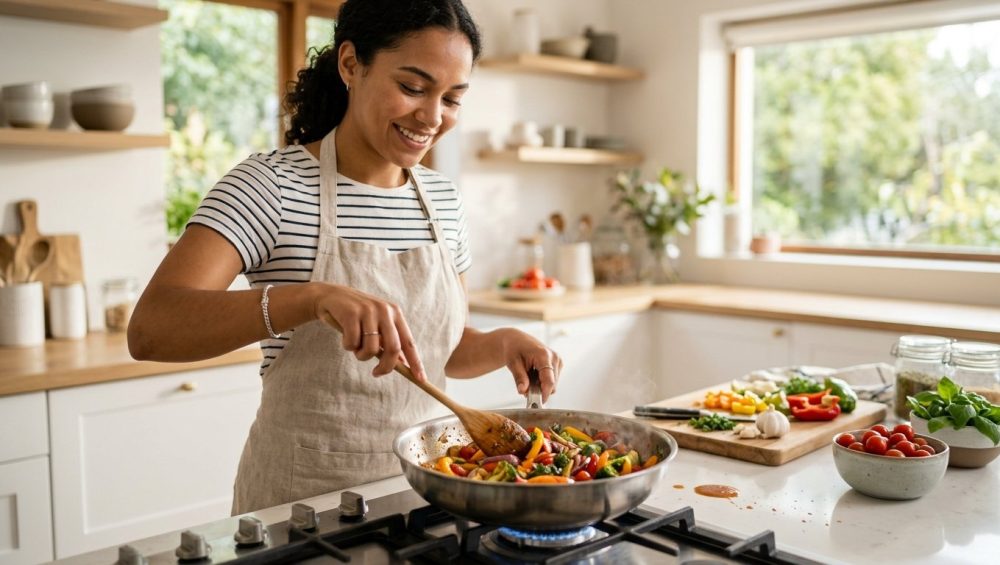
For the weekday home cook, time is money. The biggest mistake you can make is turning on the stove before you have finished chopping. If you are frantically mincing garlic while your onions are burning in the pan, you have already lost the game. Before you even touch a dial on the stove, chop all your vegetables, measure out your spices into a little bowl, and have your liquids ready. When the cooking starts, you should be calmly combining ingredients like a maestro conducting an orchestra, not running around the kitchen looking for the soy sauce while the smoke alarm shrieks. Clean your cutting board and knives while the food simmers. “Clean mind, clean bench, clean food”.
Sauce Sorrows: Broken Emulsions, Lumps, and Watery Messes
Sauces are the liquid gold that elevates a mediocre Tuesday night chicken breast into a culinary masterpiece. But they are also fickle, scientifically volatile concoctions that love to betray beginners.
Rescuing a Broken Emulsion (Mayo, Hollandaise, Vinaigrette)
An emulsion is a magical suspension of two liquids that violently hate each other—usually oil and water (or vinegar/lemon juice). When you make mayonnaise or hollandaise, you are forcing fat droplets to suspend themselves in water with the help of an emulsifier (like the lecithin found in egg yolks or mustard).
When an emulsion “breaks,” the oil and water separate, leaving you with a greasy, curdled, weeping mess. This usually happens because you added the oil too fast, or the temperature got too high (in the case of hollandaise).
The Fix: Do not throw it away! To rescue a broken emulsion, you just need to start a new, stable base. In a clean bowl, add a teaspoon of water (or a fresh egg yolk, or a dab of mustard). Whisking vigorously, slowly drizzle your broken sauce into the new base, drop by drop. The new emulsifier will grab onto the broken fats and weave them back together, restoring the smooth, creamy texture.
Banish the Lumpy Gravy
You tried to make gravy for Thanksgiving, and now it looks like a bowl of beige porridge with dumplings in it. Lumps happen when starches (like flour or cornstarch) hit hot liquid before they are dispersed. The outside of the starch clumps gelatinize instantly, creating a waterproof seal around dry, raw flour on the inside.
The Fix: If the lumps are already there, stop whisking—you are just exhausting yourself. Pour the gravy through a fine-mesh sieve to catch the lumps, or hit it with an immersion blender until it is violently forced into submission.
The Prevention: Next time, make a proper roux (cooking equal parts fat and flour together before slowly whisking in warm liquid) or make a slurry (whisking cornstarch into cold water until completely smooth before pouring it into a hot liquid). Starches need to be separated by fat or cold water before they hit the heat.
Thickening a Watery Disaster
Your pan sauce is supposed to coat the back of a spoon, but it currently has the viscosity of tap water.
The Fix: You have a few options.
- Reduction: The most flavorful method. Just let it boil. The water evaporates, concentrating the flavors and naturally thickening the sauce.
- Beurre Manié: The French secret weapon. Knead equal parts softened butter and flour together with your fingers to form a paste. Whisk small pea-sized lumps of this paste into your simmering sauce. The fat coats the flour, preventing lumps, and thickens the sauce with a luxurious, glossy finish.
Pantry Panics and Produce Purgatory
A significant portion of kitchen frustration comes from managing inventory. Food waste is expensive, and realizing you lack a crucial ingredient midway through a recipe is infuriating.
Reviving Stale Spices
Spices do not technically spoil or become dangerous to eat, but their essential oils degrade over time. If you open a jar of cumin that you bought during the Obama administration, it is going to taste like dusty sawdust.
The Fix: If your spices are a bit past their prime, you can wake them up through a process called “blooming.” Heat a little bit of oil or butter in a pan over medium heat, and add your dry spices. Toast them for 30 to 60 seconds until they become incredibly fragrant. The heat reactivates whatever essential oils are left, infusing the cooking fat with deep, robust flavor. (Note: This does not work for delicate dried herbs like parsley or basil, which will just burn. It works wonders for hard spices like cumin, coriander, paprika, and cinnamon).
Shocking Wilted Veggies Back to Life
You bought a beautiful bunch of celery, carrots, or leafy greens, left them in the crisper drawer for a week, and now they are limp and bendy. They haven’t rotted; they have just lost their turgor pressure (the water inside their cell walls).
The Fix: Trim the ends off the vegetables and submerge them in a bowl of ice water for 30 minutes. Through the magic of osmosis, the cells will drink the water back up, restoring their crisp, crunchy texture. Dry them thoroughly before cooking.
Baking Blunders: When Science Refuses to Cooperate
Cooking is an art; baking is an exact, unforgiving science. You can freestyle a soup, but if you freestyle a cake batter, you will end up with a dense, inedible brick.
The Tyranny of Measuring Cups
If you want to stop failing at baking, you need to throw your dry measuring cups in the trash and buy a $15 digital kitchen scale.
Measuring flour by volume (in a cup) is inherently flawed. Depending on how tightly you pack the flour, a “cup” can weigh anywhere from 100 grams to 150 grams. If a recipe calls for three cups of flour and you scoop heavily, you have accidentally added almost an entire extra cup of flour to your batter. No wonder your cookies taste like sand. Weighing your ingredients in grams guarantees 100% accuracy every single time.
The Room Temperature Rule
When a baking recipe tells you to use “room temperature” butter, eggs, and milk, it is not making a casual suggestion. It is a strict chemical requirement.
Baking batters are emulsions (there’s that word again). You are trying to trap air into a mixture of fat and water. If you try to cream cold, hard butter with sugar, it won’t aerate. If you add cold eggs to perfectly creamed room-temperature butter, the butter will instantly seize up and curdle.
The Fix: Take your dairy out of the fridge an hour before baking. If you forget, place cold eggs in a bowl of warm (not hot) water for 10 minutes. For butter, cut it into small cubes; it will soften on the counter in about 15 minutes. Never microwave butter to soften it—you will melt it, destroying the structure needed to trap air.
Time is Money: Weekday Survival Tactics
Let’s pivot back to reality. On a Saturday, you can spend three hours making a perfectly clarified consommé. On a Wednesday, you have exactly 45 minutes to get dinner on the table before you collapse onto the couch. The meal delivery industry and culinary forecasters have noted that for 2025, the overarching trend in home cooking is “Low Effort, High Reward”. Consumers are firmly rejecting complex, multi-hour pandemic-era recipes in favor of ultra-convenient, 5-ingredient meals, sheet pan dinners, and value-driven cooking.
Batching and Sheet Pan Supremacy
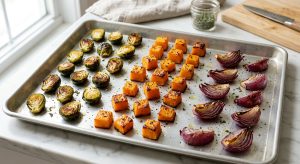
To survive the weekday grind without reverting to takeout, you must embrace the sheet pan. Toss proteins and hearty vegetables (like broccoli, sweet potatoes, or Brussels sprouts) in olive oil, salt, pepper, and a dash of acid. Spread them evenly on a heavy-duty baking sheet (do not crowd them!) and roast at 400°F (200°C). You get beautifully caramelized food with exactly one pan to wash.
Furthermore, cook once, eat thrice. If you are boiling rice or quinoa, make a massive batch. It keeps in the fridge for days and can be repurposed into fried rice, grain bowls, or soup thickeners. If you are roasting a chicken, roast two. Shred the second one for tacos or chicken salad the next day.
Embracing the “Semi-Homemade” Philosophy
There is absolutely no shame in utilizing high-quality store-bought shortcuts to save your sanity. The 2025 food trends highlight a massive demand for pre-prepped ingredients and premium condiments. Buy the pre-washed spinach. Buy the high-quality jarred curry paste. Buy the pre-minced garlic if you must (though my soul hurts a little saying that). Use these shortcuts to build a fast, flavorful foundation, and then elevate them with fresh herbs, a squeeze of citrus, or a drizzle of good olive oil at the very end. You are the executive chef of your kitchen; you are allowed to outsource the prep work.
Conclusion: Pour a Glass of Wine and Keep Cooking
The path to becoming a confident home cook is paved with burnt toast, broken sauces, and at least one spectacularly ruined Thanksgiving turkey. Do not let the failures intimidate you. Every mistake you make in the kitchen is just a data point, a lesson in culinary physics that makes you sharper, faster, and more intuitive for the next meal.
You have the tools. You know how to balance salt with acid, how to respect the heat of your pans, and why you need to immediately discard that peeling, toxic non-stick skillet. You know that recipes are roadmaps, but your palate is the ultimate judge.
So, stop apologizing for your food. Stop stressing over perfection. Turn up the music, pour yourself a generous glass of wine, keep your knives sharp, and get back to the stove. You’ve got this.