Listen to me. I know exactly why you are here. You have stood over a hot stove, whisking until your forearm cramped, praying to the culinary gods, only to watch your beautiful, buttery hollandaise violently split into a greasy, curdled puddle of absolute despair. You probably blamed yourself. You probably threw it in the sink, cursed the entire concept of French cuisine, and ordered takeout.
Take a deep breath and pour yourself a glass of wine, because I am about to absolve you of your kitchen guilt. Your sauce didn’t break because you lack talent; it broke because you were relying on hope and a whisk instead of modern culinary science.
As home cooks, we are constantly fed the lie that achieving restaurant-quality textures requires years of classical training or a brigade of line cooks. It doesn’t. It requires an understanding of basic fluid dynamics, a digital scale, and a little white powder called xanthan gum. Today, we are stripping away the pretentious chef-speak and diving deep into the rheological properties of modern hydrocolloids. We are going to bulletproof your sauces, stabilize your vinaigrettes, and ensure you never cry over a broken emulsion again.
The Heartbreak of a Broken Emulsion (And Why You’re Not to Blame)
To fix a broken sauce, you first have to understand the enemy: syneresis. In the culinary world, syneresis is the extraction or expulsion of a liquid from a gel or colloidal suspension. In plain English? It is the moment your perfectly smooth sauce decides it hates being together and aggressively separates into a layer of oil and a layer of watery sludge.
An emulsion is inherently unstable. You are forcing two things that despise each other—oil and water—to coexist in a tight space. In a classic emulsion, like mayonnaise or hollandaise, we use the lecithin found in egg yolks as an emulsifier to bridge the gap between the fat droplets and the water. But lecithin is delicate. If the temperature fluctuates too wildly, or if the ratio of fat to liquid tips even slightly out of balance, the interfacial tension between the droplets breaks down. The fat droplets collide, coalesce, and boom—your sauce is ruined.
For decades, the traditional advice for fixing this was simply to whisk harder, add a splash of boiling water, or frantically beat in another egg yolk. These are temporary, anxiety-inducing band-aids. They do not address the underlying physical instability of the sauce. If you want to permanently conquer your rookie kitchen mistakes, you need to stop relying on blind luck and start manipulating the viscosity of your continuous phase.
Enter Xanthan Gum: The Culinary Duct Tape
If there is one modernist ingredient you need in your pantry, it is xanthan gum (often labeled as E415 in Europe). Despite the scientific-sounding name, it is entirely natural. Xanthan gum is a high-molecular-weight polysaccharide produced through the microbial fermentation of sugars by a bacterium called Xanthomonas campestris.
Here is the secret that most generic recipes fail to explain: xanthan gum is not actually an emulsifier. It does not chemically bind oil and water together the way egg yolks or mustard do. Instead, it is a highly efficient hydrocolloid and rheology modifier. When you introduce xanthan gum to a liquid, it vigorously binds with the water molecules, creating a microscopic, three-dimensional gel network.
By thickening the continuous aqueous phase of your sauce, xanthan gum physically traps the suspended oil droplets in place. It essentially paralyzes them. If the oil droplets cannot move, they cannot collide; if they cannot collide, they cannot coalesce and break the sauce. This is how you prevent emulsion breakage with absolute certainty. It acts as the ultimate culinary duct tape, holding your delicate mixtures together through sheer physical force.
The Science of Pseudoplasticity (Why It Pours Like a Dream)
You might be thinking, “If xanthan gum traps the oil droplets by turning the water into a gel, won’t my sauce turn into a stiff, unappetizing block of jelly?”
This brings us to the absolute magic of xanthan gum: pseudoplasticity, also known as shear-thinning behavior.
In fluid dynamics, most liquids are Newtonian—their viscosity remains constant regardless of how much force you apply to them. Water is water, whether it is sitting in a glass or being sprayed from a hose. Xanthan gum solutions, however, are highly non-Newtonian. They follow the Herschel-Bulkley model of fluid behavior, meaning their apparent viscosity decreases dramatically when subjected to shear stress (like whisking, pouring, or chewing), but they instantly recover their thick, gel-like structure the millisecond the stress is removed.
This is the holy grail for a home cook who wants to achieve restaurant-level plating. When a xanthan-stabilized sauce is resting on a plate, it exhibits a high yield stress. It sits tall, proud, and perfectly cohesive without weeping water onto the plate. But the moment a diner drags a piece of steak through it, or the moment it hits their palate, the mechanical shear force causes the sauce to instantly thin out. It coats the tongue with a luxurious, silky mouthfeel, releasing its flavors perfectly before instantly thickening back up. Understanding this principle is the key to unlocking kitchen creativity and transforming a watery weekday pan sauce into a masterpiece.
The Golden Ratio: Precision Dosing for Perfect Textures
If you take only one thing away from this masterclass, let it be this: throw away your measuring spoons. Volume measurements are the enemy of hydrocolloids. A “teaspoon” of xanthan gum can vary wildly in actual mass depending on the brand, the humidity in your kitchen, and how tightly it is packed.
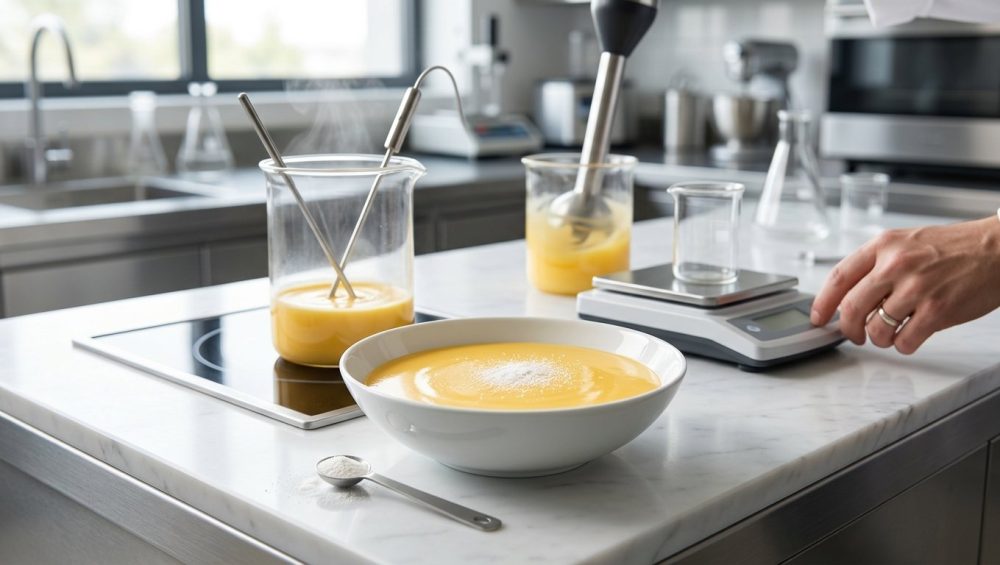
To use xanthan gum correctly, you must scale it by weight as a percentage of your total liquid mass. You need a precision jeweler’s scale that measures in 0.01-gram increments. They cost less than twenty dollars, and they are non-negotiable if you are serious about mastering modern recipes.
The golden rule for stabilizing culinary emulsions with xanthan gum is to stay within the 0.1% to 0.25% ratio by total weight. Let’s break down exactly what these percentages achieve:
- 0.1% by Weight (The Invisible Shield): At 0.1%, xanthan gum provides a subtle, almost imperceptible stabilization. It will not noticeably thicken the liquid, but it will keep a light vinaigrette from separating on the salad bar. If you have 500 grams of total vinaigrette, you need exactly 0.5 grams of xanthan gum.
- 0.15% to 0.2% by Weight (The Classic Mother Sauce): This is the sweet spot for warm, fat-heavy emulsions like Hollandaise, Béarnaise, or beurre blanc. At this ratio, the sauce gains a luxurious, velvety viscosity that clings beautifully to food without feeling heavy or artificial.
- 0.25% by Weight (The Heavy Suspension): At a quarter of a percent, you are entering the territory of fluid gels and heavy suspensions. This ratio is ideal if you want to suspend heavy particles—like minced herbs or cracked peppercorns—evenly throughout a sauce without them sinking to the bottom.
Do not exceed 0.25% for a standard emulsion unless you are intentionally making a thick puree. Pushing past 0.5% will result in a sauce that has the texture of unpleasant mucus. Precision is everything.
Shear Force: Why Your Whisk Isn’t Cutting It
Knowing the golden ratio is useless if you cannot properly hydrate the gum. Xanthan gum is notoriously hydrophilic; it loves water so much that the moment it touches a liquid, the exterior of the powder particle instantly swells and forms a waterproof gel coating around the dry core. This creates stubborn, un-dissolvable lumps affectionately known in the industry as “fish eyes.”
You cannot casually whisk xanthan gum into a bowl of water. It requires extreme mechanical shear force to disperse the particles evenly before they have a chance to clump. You need a high-speed blender or a powerful immersion blender.
And this brings me to my absolute strictest rule: the “no-go” policy on toxic kitchen gear. I have zero patience for home cooks who spend top dollar on premium grass-fed butter, organic eggs, and high-end hydrocolloids, only to blend their hot sauces in cheap, degrading plastic pitchers that leach microplastics and endocrine disruptors directly into their food. I am equally horrified by people who heat delicate emulsions in scratched, peeling Teflon pans from a decade ago. Stop poisoning your food.
If you are applying high-shear blending to a hot liquid, you must use a heavy-duty glass blender jar, a fully-clad stainless steel pot, or a high-quality stainless steel immersion blender. Actively banishing toxic kitchen gear from your home is the first step toward cooking like a true professional. Invest in durable, non-reactive equipment; these are the only beginner kitchen tools you actually need to achieve safe, stunning results.
Thermal Control: The Temperature Thresholds of Emulsion Stability
Unlike traditional starches (like flour or cornstarch) which require boiling temperatures to gelatinize and thicken, xanthan gum is entirely temperature-independent for hydration. It will thicken ice-cold water just as effectively as it thickens boiling stock. Furthermore, its viscosity remains incredibly stable across extreme temperature fluctuations, meaning a xanthan-stabilized sauce can be frozen, thawed, and reheated without losing its structural integrity.
However, just because xanthan gum can hydrate at any temperature doesn’t mean all temperatures are optimal for your specific sauce. Through extensive culinary testing, a brilliant thermal sweet spot has been identified: xanthan gum disperses and hydrates with absolute perfection around 125°F (52°C). At this precise temperature, the liquid is warm enough to increase molecular mobility, allowing the gum to dissolve seamlessly without clumping, but it is well below the danger zone where delicate proteins begin to cook.
If you are making an egg-yolk-based emulsion like hollandaise, thermal control is the difference between a Michelin-star sauce and scrambled eggs. Egg yolks begin to coagulate and harden at 150°F (65°C). Conversely, the clarified butter in your sauce will begin to congeal and solidify if the temperature drops below 96°F (35°C).
This leaves you with a highly specific thermal window. Modernist chefs have determined that the absolute perfect holding temperature for a finished hollandaise is exactly 140°F (60°C). At 140°F, the butter remains fluid, the egg proteins remain relaxed, and the xanthan gum matrix holds the entire suspension in a state of flawless, suspended animation. By utilizing precise induction burners or sous-vide water baths to hold your sauce at exactly 140°F, you are effectively demystifying modern recipes and eliminating the frantic, last-minute whisking that ruins so many dinner parties.
The Cold Dispersion Technique
If you are making a cold emulsion (like a vinaigrette or a vegan mayonnaise) and you do not want to heat the liquid to 125°F, you must use a dispersion agent to prevent clumping.
Because xanthan gum only hydrates in water, you can safely mix the dry powder into a pure fat (like olive oil or neutral oil) without it clumping. Create a “slurry” by thoroughly mixing your 0.15% xanthan gum into a tablespoon of your recipe’s oil. Once the powder particles are coated in oil, you can pour the slurry directly into your aqueous phase while blending. The oil acts as a physical barrier, delaying hydration just long enough for the blender blades to disperse the gum evenly throughout the liquid. Alternatively, you can dry-blend the xanthan gum thoroughly with a small amount of sugar or salt before adding it to the liquid, which achieves the same delayed-hydration effect.
The Hot Emulsion Protocol
When stabilizing a warm sauce like a beurre blanc or a pan gravy, dispersion is slightly easier, but thermal shock must be avoided. Do not dump cold xanthan powder directly into a boiling reduction. Instead, temper the gum. Remove a small ladle of your warm (but not boiling) liquid, use an immersion blender to vigorously hydrate the xanthan gum into that small batch, and then whisk that stabilized “master gel” back into the main pot. This ensures a perfectly smooth, lump-free integration every single time.
Step-by-Step Masterclass: Rescuing and Bulletproofing Your Sauces
Let’s put the science into practice. Imagine it is Sunday morning. You are hosting a brunch, and you want to make a bulletproof hollandaise that you can hold for two hours without it breaking. We are going to use the 0.2% ratio and precise thermal control.
- Calculate the Mass: Weigh your egg yolks, water (or lemon juice/vinegar reduction), and melted butter. Let’s say your total mass comes to 400 grams.
- Calculate the Gum: 0.2% of 400 grams is 0.8 grams. Weigh exactly 0.8 grams of xanthan gum using your precision scale.
- The Dispersion: To ensure flawless integration, mix that 0.8 grams of xanthan gum into a small spoonful of your melted (but not hot) butter to create an oil slurry.
- The Emulsification: In a tall, stainless steel blending cup (no cheap plastic!), combine your egg yolks and your acid reduction. Submerge your high-quality immersion blender.
- The Hydration: Turn the blender on high. Slowly stream in your melted butter (which should be sitting around 130°F). Once the emulsion forms, drop in your xanthan-butter slurry.
- The Shear: Blend on high for exactly 60 seconds. Do not skimp on this. The xanthan needs time and shear force to fully hydrate and build its three-dimensional network.
- The Hold: Transfer the finished, stabilized hollandaise to a clean stainless steel thermos or a container sitting in a 140°F (60°C) water bath.
You have just created a mathematically perfect sauce. It will not break. It will not weep. You can leave it in that 140°F bath for hours while you poach eggs and socialize with your guests. This is how you save ruined meals before they even happen. You are no longer cooking with anxiety; you are cooking with control.
Troubleshooting Common Rheological Disasters
Even with a digital scale and a solid understanding of fluid dynamics, things can occasionally go sideways. If your sauce isn’t behaving, do not panic. Analyze the rheology and correct the error.
The “Snot” Effect (Overdosing):
If your sauce has developed a slimy, stringy, mucus-like texture, you have overdosed the hydrocolloid. You likely used a volume measurement instead of a scale, or your math was wrong. You pushed past the 0.25% threshold. To fix this, you must increase the volume of the continuous phase. Blend in more water, stock, or acid to dilute the concentration of the xanthan network until the sauce returns to a fluid state.
The “Gritty” Effect (Improper Dispersion):
If your sauce feels grainy on the tongue, or if you see tiny translucent lumps floating in the liquid, the xanthan gum hydrated too quickly and formed “fish eyes”. You failed to use a dispersion agent (like oil or sugar) and you lacked sufficient shear force. You can attempt to blast it with an immersion blender on its highest setting for two minutes, but if the lumps have fully sealed themselves, you will need to pass the sauce through a fine-mesh chinois sieve to remove them.
The “Still Broken” Effect (Thermal Shock):
If you scaled perfectly to 0.2%, blended aggressively, and your hollandaise still split, you violated the thermal threshold. You either let the sauce drop below 96°F (causing the butter to crystallize and break the network) or you heated it past 150°F (causing the egg yolk proteins to tightly curdle and squeeze out the fat). Xanthan gum is powerful, but it cannot reverse the physical coagulation of scrambled eggs. Toss it, learn from it, and watch your thermometer next time. Avoiding these pitfalls is how you fix the common beginner cooking mistakes that plague weekend chefs.
Elevating the Weekend Culinary Project
Cooking should not be a source of stress. During the week, we use clever shortcuts to get dinner on the table. But the weekend? The weekend is when we slow down, pour the wine, and embrace the absolute art of the kitchen.
By mastering the rheological properties of xanthan gum and respecting precise thermal thresholds, you are freeing yourself from the tyranny of fragile recipes. You can pre-make a complex, herb-infused vinaigrette on a Friday, knowing the xanthan matrix will keep the oil and vinegar in perfect, un-separated harmony until your dinner party on Saturday. You can whip up a flawless, stabilized Béarnaise hours before your guests arrive, holding it safely at 140°F while you focus entirely on searing your steaks to a perfect medium-rare.
You don’t need a culinary degree to cook like an expert. You just need to ditch the toxic pans, buy a digital scale, and let the science do the heavy lifting. Now get back in the kitchen, turn on the blender, and show those sauces exactly who is in charge.