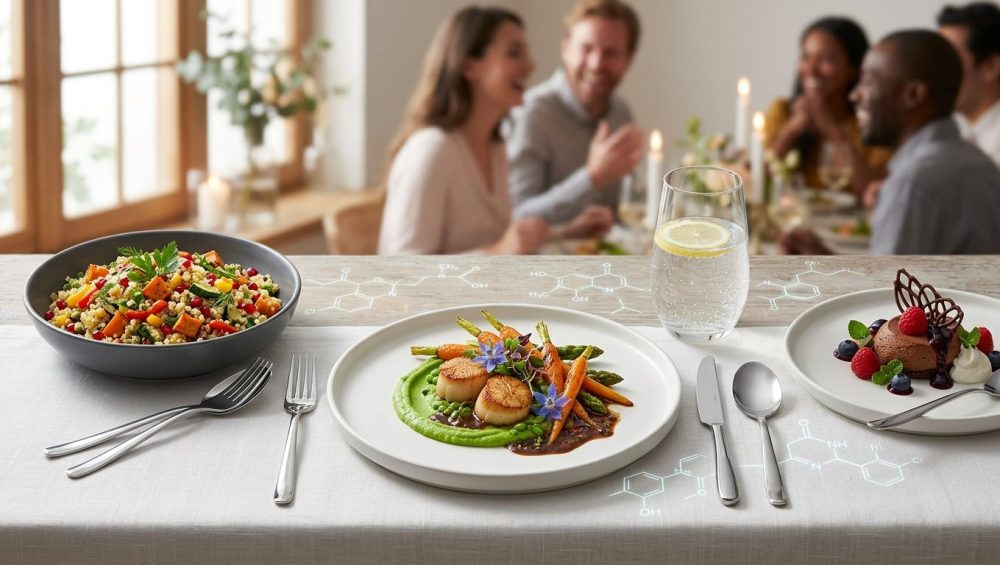
You have invited six people over for a weekend dinner. One is strictly vegan, another has celiac disease, your cousin suddenly decided they are highly sensitive to nightshades, and the rest just want a spectacular meal without feeling like they are participating in a clinical dietary trial. Welcome to the modern dinner party minefield.
If you are currently hyperventilating into a paper bag at the thought of cooking for this crowd, I need you to stop right now. I am here to tell you that you can pull this off, and you can do it with absolute perfection. You do not need a pretentious culinary degree, and you certainly do not need to exhaust yourself by cooking four entirely separate, disjointed meals. What you actually need is a rigorous crash course in the empirical science of food. When you understand the molecular building blocks of flavor and the thermodynamic principles of structural integrity, you can manipulate them to your advantage.
We are going to dive incredibly deep into molecular flavor pairing, hydrocolloid structuring, and kitchen material safety. This is not just a survival guide; it is an exhaustive blueprint for learning how to throw a flawless dinner party without losing your mind or compromising on taste. I firmly believe that the true secret to unlocking kitchen creativity lies in mastering the underlying chemistry of your ingredients. Once you know the rules, you can break them beautifully.
The Chemical Reality of Molecular Flavor Pairing
Let us cut the pretentious chef-speak right out of the equation. “Molecular flavor pairing” sounds like something a guy with tweezers and a superiority complex charges you $400 to experience. But in reality, it is simply the study of shared volatile compounds. When you smell your food—which accounts for roughly 80% of what your brain perceives as “flavor”—your olfactory receptors are detecting thousands of microscopic, volatile chemical compounds evaporating off the plate [5].
Decoding Volatile Compounds and Jaccard Similarity Scores
Food scientists and computational gastronomy researchers have spent the last decade mapping the molecular structures of our ingredients [12]. Using advanced machine learning models to analyze over 30,000 food science papers, researchers have developed “Jaccard similarity scores” for ingredients [11]. The Jaccard score measures the exact mathematical overlap of volatile compounds between two distinct foods [11].
For instance, almonds and hazelnuts score a massive 0.493 on the Jaccard index because they share near-identical benzaldehyde and linalool profiles [11]. That is an intuitive pairing. But what happens when you look at the data for things that do not seem culinarily related? Chocolate and blue cheese share over 70 aromatic compounds, predominantly consisting of complex ketones and lactones [4, 5]. Raspberry and cinnamon share an enormous amount of terpene and ester compounds, which is why a dash of cinnamon makes a berry compote taste inexplicably vibrant [11].
When you are designing an inclusive, allergen-free menu, you cannot rely on the old, tired crutches of butter, heavy cream, and wheat flour to carry your flavors. You have to be infinitely smarter. You have to build a flavor matrix based on chemical resonance. Demystifying modern recipes means understanding that if you remove a dairy-based lactone (because your guest is vegan or lactose intolerant), you must replace it with a plant-based ingredient that shares that exact volatile profile to trick the brain into experiencing the same richness.
For example, roasted parsnips and vanilla share significant volatile compounds [4]. If you are trying to create a dairy-free puree, combining roasted parsnips with a drop of pure vanilla extract and a neutral fat will taste astonishingly rich and creamy to your guests, completely bypassing the need for heavy cream.
Contrast vs. Complementation in the Olfactory System
It is crucial to note that high molecular similarity means ingredients will amplify each other, but cooking also requires dynamic tension [11]. The human palate craves contrast—acid cutting through fat, bitterness balancing sweetness [5]. Sweet and sour is the absolute model of complementary pairing [5]. When you design an allergen-free dish, you must map out both your resonant compounds (the shared volatiles that build the base) and your contrasting elements (the acids and textures that keep the palate awake).
The Mathematics of Umami Synergy
If there is one glaring flaw that ruins most vegan or allergen-free meals, it is the distinct lack of savory depth. Meat, aged cheeses, and butter are absolutely packed with umami. When you strip them away from a menu, your food can easily taste flat, watery, and uninspired. But science has a brilliant hack for this, and it is called umami synergy.
Glutamates, Inosinates, and Guanylates
Umami is primarily triggered by the amino acid glutamate, which is found abundantly in kombu (kelp), ripe tomatoes, nutritional yeast, asparagus, and soy sauce [2]. However, our taste receptors also respond to ribonucleotides, specifically inosinate (found in dried fish and meats) and guanylate (found in dried mushrooms like shiitake) [2, 8].
Here is where the mathematical magic happens: when you combine a glutamate with a guanylate, the flavor does not just add up sequentially; it multiplies exponentially. Rigorous sensory evaluation research shows that a precise 1:1 ratio of glutamate to inosinate or guanylate increases the perceived umami intensity by up to 7 to 8 times compared to tasting either compound in total isolation [8]. This is not a subtle boost; it is an explosion of savory depth [2].
Engineering the Ultimate Allergen-Free Broth
How does this translate to your kitchen on a Saturday afternoon? If you are making a plant-based broth for a risotto, do not just boil some carrots, celery, and onions and call it a day. That is a culinary crime. You need to engineer a synergistic reaction.
You must combine a high-glutamate ingredient, such as deeply roasted tomato paste or fermented miso, with a high-guanylate ingredient, like dried shiitake mushrooms or porcini powder [8, 16]. Furthermore, subjecting these ingredients to high heat initiates the Maillard reaction—a chemical reaction between amino acids and reducing sugars that produces hundreds of entirely new, complex flavor compounds [16]. This combination creates a profound, meaty, savory backbone that will make your carnivorous guests beg for the recipe. Understanding this specific chemical equation is the ultimate secret to transforming your daily cooking into a masterclass of flavor.
Architecting Structural Integrity in Gluten-Free and Vegan Matrices
Now we must address the nightmare of texture. If you have ever tried to bake a gluten-free, vegan bread or cake and ended up with a dense, crumbly hockey puck that tastes like sand, you have experienced a catastrophic structural matrix failure.
Gluten is a highly elastic, complex protein network that traps carbon dioxide gas bubbles during fermentation and provides chewiness and structure. Eggs provide emulsification (via lecithin) and structural setting (via protein coagulation). When you remove both wheat and eggs for an allergen-free gathering, you are essentially trying to build a skyscraper without any steel framing or concrete.
The Science of Hydrocolloids
This is where hydrocolloids become your best friend. A hydrocolloid is a hydrophilic (water-loving) long-chain polymer that forms a viscous gel when hydrated [7]. You probably know them by their commercial names: xanthan gum, guar gum, agar-agar, or hydroxypropyl methylcellulose (HPMC). And before you panic about “chemicals” in your food, understand that these are naturally derived complex carbohydrates that happen to possess incredible rheological properties [7]. Mastering these powders is the absolute best way to fix your rookie kitchen woes and elevate your baking.
Recent food science studies have proven that relying on a single hydrocolloid in gluten-free baking is a fundamental error [3, 9]. If you only use HPMC, it acts as a rigid skeleton, but the resulting crumb structure is fragile and lacks resilience [7, 9]. However, when you combine HPMC with a secondary hydrocolloid like xanthan gum or polyglutamic acid (PGA), a synergistic structural network is formed [3, 7, 9].
Thermogelation and the Baking Process
HPMC has a fascinating, highly unique property called thermogelation. Unlike most gels (like gelatin or agar) that melt when heated and set when cooled, HPMC does the exact opposite. It forms a firm gel network upon heating [9]. In a gluten-free dough, as the bread enters the hot oven, the HPMC instantly gels, creating a rigid structure that traps the expanding gas bubbles just like gluten would [7, 9]. As the bread cools, the HPMC softens, leaving behind a perfectly porous, airy crumb structure [9].
In practical terms, if you are making a gluten-free focaccia, a scientifically optimized blend of 2% HPMC and 1% xanthan gum (by baker’s percentage relative to the flour weight) will drastically increase the viscoelasticity of the dough [14]. The xanthan gum provides the dough with sheer-thinning elasticity during mixing, while the HPMC provides the thermal structure during baking [7, 9]. Stocking up on a variety of these specific hydrocolloids should absolutely be at the top of your list of beginner cooking essentials if you plan on hosting diverse dietary needs with any regularity.
Stabilizing Vegan Emulsions
Emulsions—like mayonnaise, hollandaise, or creamy vinaigrettes—are simply a forced mixture of two liquids that chemically repel each other (usually oil and water). In traditional cooking, egg yolks provide the amphiphilic molecules (lecithin) needed to coat the microscopic oil droplets and keep them suspended in the water phase.
In a vegan and egg-allergy-friendly environment, we must turn to sunflower lecithin or aquafaba. Aquafaba is the viscous liquid leftover from cooking chickpeas. It is incredibly rich in saponins and dissolved plant proteins that mimic the emulsifying properties of egg whites. When whipped, it stabilizes foams beautifully. However, because aquafaba lacks the fat and structural density of egg yolks, an emulsion made purely of oil and aquafaba will eventually break or split at room temperature. By adding just 0.1% xanthan gum to your plant-based emulsion, you dramatically increase the continuous phase viscosity, creating a highly stable, sheer-thinning sauce that will hold perfectly throughout your entire dinner party.
The Absolute “No-Go” Zone: Toxic Gear and Cross-Contamination
I am going to get on my soapbox now, and I refuse to apologize for it. You can source the finest, most scientifically optimized, organic ingredients in the world, but if you cook them in cheap, scratched, toxic cookware, you are ruining your food, destroying your flavor profiles, and potentially harming your guests.
I have zero patience for mystery metals, warping aluminum, and peeling non-stick coatings. If your Teflon pan is flaking black specks into your food, throw it in the trash immediately. When we talk about allergen-free cooking and mindful gatherings, material safety is not just about avoiding PFAS or “forever chemicals” (though the severe health risks associated with them are reason enough). It is about preventing microscopic cross-contamination at a metallurgical level.
The 316-Grade Stainless Steel Mandate
Most standard stainless steel cookware sold to home consumers is 304-grade (frequently labeled as 18/8 or 18/10, referring to its chromium and nickel percentages). 304-grade is perfectly fine for boiling pasta or making basic soups. However, 304 stainless steel is highly susceptible to pitting corrosion when exposed to aggressive high-acid or high-salt environments [1, 6, 13].
Remember that highly concentrated, mathematically perfect umami broth we discussed earlier? It is incredibly acidic (from the tomatoes) and highly saline (from the miso and soy). Over time, simmering these aggressive liquids in 304-grade steel can cause the metal to develop microscopic pits and crevices [6]. These invisible pits are an absolute nightmare for allergen control. Proteins—like gluten strands, casein, or trace nut residues—can become deeply trapped in these microscopic crevices [10]. They can survive standard hand-washing and even dishwasher cycles, only to leach out into your next meal, potentially triggering a severe reaction in a highly sensitive guest.
This is exactly why I strictly advocate for 316-grade stainless steel for serious home cooks who care about safety. 316-grade (often called marine-grade) contains an addition of 2-3% molybdenum [6, 13]. This specific metallurgical addition drastically enhances the alloy’s resistance to pitting and crevice corrosion, especially in harsh saline and acidic conditions [6, 13]. It is the exact same ultra-pure alloy mandated for use in pharmaceutical manufacturing and biotech processing because it guarantees a non-porous, perfectly hygienic surface [6].
Cooking with 316-grade ensures that when you wash the pan, it is actually, microscopically clean. No hidden allergens. No heavy metal leaching. No compromised flavors. Taking this step and upgrading your baseline equipment is a crucial part of banishing toxic kitchen gear from your life forever.
Verified Lead-Free Ceramics and Serving Ware
The exact same stringent safety rules must apply to your serving ware. Many cheap, imported, or artisanal ceramics use glazes that contain lead or cadmium to achieve bright, glossy colors or to lower the firing temperature of the kiln. When these plates and bowls are exposed to hot, acidic foods (like a tomato-based umami sauce or a citrus vinaigrette), those heavy metals can leach directly into the meal. You must actively audit your dinnerware and insist on verified, third-party tested lead-free ceramics.
Furthermore, high-quality, dense ceramics offer vastly superior thermal retention. When you are hosting a mindful gathering, you want the food to stay at the optimal serving temperature without needing to constantly run back to the kitchen to reheat it. Reheating degrades the delicate hydrocolloid structures we worked so hard to build and destroys volatile flavor compounds. By optimizing thermal mass in your heavy ceramic serving vessels, you ensure that your scientifically perfected dishes remain texturally sound and aromatically vibrant from the first bite to the last.
Cross-Utilization Techniques to Eliminate Prep Bottlenecks
Let us talk about kitchen strategy and execution. Weekday cooking requires ruthless, cutthroat efficiency, but weekend dinner parties require strategic, general-level orchestration. The single biggest mistake home cooks make is designing a menu with five separate dishes that require five completely different, non-overlapping prep processes. This results in a kitchen that looks like a disaster zone and a host who is sweating profusely into the salad while ignoring their guests.
If you truly want to master the art of effortless hosting, you must employ molecular cross-utilization. This means creating a single, highly complex foundational flavor component and utilizing it in multiple ways across the menu, altering its final expression through temperature manipulation, textural contrast, or complementary pairings.
The Master Umami Base Blueprint
Let us apply everything we have learned into a practical workflow. You spend one hour in the morning roasting a massive tray of cremini mushrooms, ripe tomatoes, garlic, and kombu, then blending them into a concentrated, high-glutamate, high-guanylate paste. This is your Master Umami Base. Here is how you deploy it across a cohesive, allergen-free menu:
- The Appetizer (Aeration & Contrast): You take three tablespoons of the Master Umami Base, thin it slightly with aquafaba, add a dash of sunflower lecithin and olive oil, and whip it in a food processor until it becomes an airy, savory mousse. You pipe this onto crisp, gluten-free HPMC-stabilized crostini and top it with a highly acidic pickled shallot. The acid contrasts the rich umami perfectly.
- The Main Course (Hydration & Depth): You use a large portion of the exact same paste as the foundational flavor bomb in a rich, slow-braised lentil and root vegetable stew. The paste dissolves into the cooking liquid, fortifying the entire dish with a meaty depth that requires absolutely no animal products.
- The Side Dish (Dehydration & Concentration): You spread a thin layer of the paste onto a silicone mat and dehydrate it in a low oven until it becomes brittle. You grind it into a fine powder and dust it heavily over crispy roasted potatoes right as they come out of the oven, creating an intense, savory flavor spike.
You have prepped exactly one complex component, but because you understand how to manipulate its physical state (aeration, hydration, dehydration), you have created three entirely distinct sensory experiences. This completely eliminates prep bottlenecks.
Thermodynamic Holding Strategies
Finally, the ultimate secret to a stress-free gathering is thermodynamic holding. When you use advanced hydrocolloids like xanthan gum and HPMC, your sauces and doughs are exponentially more stable under heat stress than traditional flour-roux or egg-thickened recipes [3, 7].
A traditional egg-yolk hollandaise will curdle and turn into scrambled eggs if held above 150°F, and it will break and separate if it cools down too much. However, a plant-based emulsion stabilized with aquafaba and sheer-thinning xanthan gum can be held in a thermal carafe at 140°F (60°C) for several hours without ever breaking, splitting, or degrading in quality.
By leveraging the thermal stability of these scientific ingredients, you can finish all of your active cooking an hour before your guests even arrive. You transfer your sauces to insulated, non-reactive 316-grade steel thermoses, hold your braises in high-thermal-mass ceramics, and simply plate everything flawlessly on demand while enjoying a glass of wine with your friends.
The Sassy Sous-Chef’s Final Word
Hosting a highly inclusive, allergen-free dinner party does not have to be a terrifying ordeal characterized by bland, crumbly food and constant cross-contamination anxiety. By embracing the actual, empirical science of cooking—understanding molecular flavor pairing, utilizing the structural magic of hydrocolloids, and strictly enforcing a non-toxic, high-grade equipment policy in your kitchen—you elevate yourself from a stressed-out, frantic cook to a culinary architect.
You do not need a Michelin star or a laboratory to cook like this. You just need to respect the chemical reality of your ingredients, ditch the cheap, scratched pans, and trust the science. When you do, you create a seamless environment where every single guest, regardless of their complex dietary restrictions, feels entirely safe, accommodated, and psychologically comfortable. And ultimately, that is what creating simple meals for mindful moments is all about. Now go pour yourself a large glass of wine, order some xanthan gum, and get to work.