Listen up, weekend warriors and weekday survivors. Physics does not care about your impatience. We have all been there at some point. It is 6:30 PM on a Tuesday, you are starving, and you crank the stovetop burner to absolute maximum because you want your dinner on the table right this second. Five minutes later, you hear a sharp, terrifying, metallic ping echoing from the kitchen. You look down, and your beautiful, expensive multiclad stainless steel skillet now wobbles on the flat glass cooktop like a drunk penguin. Congratulations, you have just committed pan murder.
As a home cook who learned the hard way—by setting off the smoke detector and warping more than a few cheap pans in my early days—I am here to tell you that professional-level results are absolutely achievable in your standard home kitchen. But to get there, you need to understand the tools you are working with. I have a strict, zero-tolerance policy for cheap, peeling, mystery-metal cookware. If you want to banish toxic kitchen gear from your life, you need to invest in high-quality multiclad stainless steel. However, investing in professional-grade equipment means you must learn how to operate it without destroying it. Today, we are taking a brutally honest, scientifically rigorous deep dive into the metallurgical dynamics of thermal shock. We are going to explore exactly why pans deform, the temperature differentials that cause it, and the non-negotiable cooling protocols you must follow to protect your culinary investments.
The Physics of Pan Murder: What Exactly Is Thermal Shock?
Before we can prevent the destruction of our cookware, we need to understand the crime scene. Thermal shock is a specific type of mechanical failure caused by a sudden, extreme, and localized change in temperature. When you expose a solid material to a rapid temperature shift—whether hot to cold, or cold to hot—different parts of that material expand or contract at drastically different rates. This creates immense internal tension across the structure of the metal.
The Anatomy of Multiclad Cookware
To comprehend why a pan warps under stress, you must first understand how a high-quality pan is physically constructed. We do not use flimsy, single-ply aluminum pans in this house, and we certainly do not use toxic, easily scratched PTFE non-stick pans that start off-gassing dangerous chemicals at 500°F. We use multiclad stainless steel.
A proper multiclad (often referred to as tri-ply, five-ply, or seven-ply) pan is a marvel of modern culinary engineering. It typically features an interior cooking surface of 18/10 food-grade stainless steel, prized for its non-reactive nature, resistance to acidic foods, and sheer durability. The exterior is usually 18/0 stainless steel, which contains less nickel, making it highly magnetic and therefore compatible with modern induction cooktops. Sandwiched tightly between these steel layers is a core of highly conductive metal—usually aluminum or copper.
Stainless steel is incredibly durable, but it has abysmal thermal conductivity, clocking in at roughly 15 W/m·K. Aluminum (around 237 W/m·K) and copper (around 401 W/m·K) act as thermal highways, pulling heat from the burner and distributing it evenly across the cooking surface. If you want to understand the sheer conductive power of these core metals, exploring the properties of copper cookware will give you a profound appreciation for thermal dynamics. But combining these different metals is exactly what makes the pan vulnerable to shock.
The Coefficient of Thermal Expansion (CTE) Explained
Here is where the physics lesson gets real. Every metal has a Coefficient of Thermal Expansion (CTE), which is a metric that measures exactly how much the material expands as its temperature rises. The CTE of stainless steel is approximately 16 µm/m·°C. The CTE of aluminum, however, is significantly higher—around 23 µm/m·°C.
When you place a multiclad pan on a heat source, the aluminum core wants to expand significantly faster and wider than the rigid stainless steel locking it in place. Manufacturers use immense pressure to roll-bond these metals together, creating a unified structure that can easily handle this internal tug-of-war under normal, gradual cooking conditions. But when you subject the pan to abusive, rapid temperature changes, the varying expansion rates generate catastrophic shear stress at the bonding interfaces. The expanding metal has to go somewhere, and if it cannot expand outward uniformly, it buckles.
Why Your Pan Looks Like a Pringle: The Mechanics of Deformation
So, you cranked the heat too high, or you threw a hot pan into a cold sink. The metal warped. But what actually happened on a microscopic, molecular level?
Temporary vs. Permanent Plastic Deformation
Metals have inherent elasticity. When heated gently and evenly, the crystalline structure of the steel and aluminum expands. If you remove the heat and let the pan cool slowly, the metals contract back to their exact original state. This is known as elastic deformation. The pan temporarily changes shape on a microscopic level, but it returns to baseline. Treating your tools with this kind of respect is a fundamental concept that every kitchen survival guide should emphasize.
However, every metal has a specific threshold known as the “yield point.” If the thermal stress exceeds the material’s yield strength, the crystalline lattice physically tears and realigns. The metal is pushed past the point of no return. This is called plastic deformation, and in the culinary world, we call it “permanent warping.” Once a pan undergoes plastic deformation, it will never be perfectly flat again. It will spin endlessly on your flat-top stove, heat unevenly, and cause your cooking oils to pool miserably around the edges.
The Role of Temperature Differentials (ΔT)
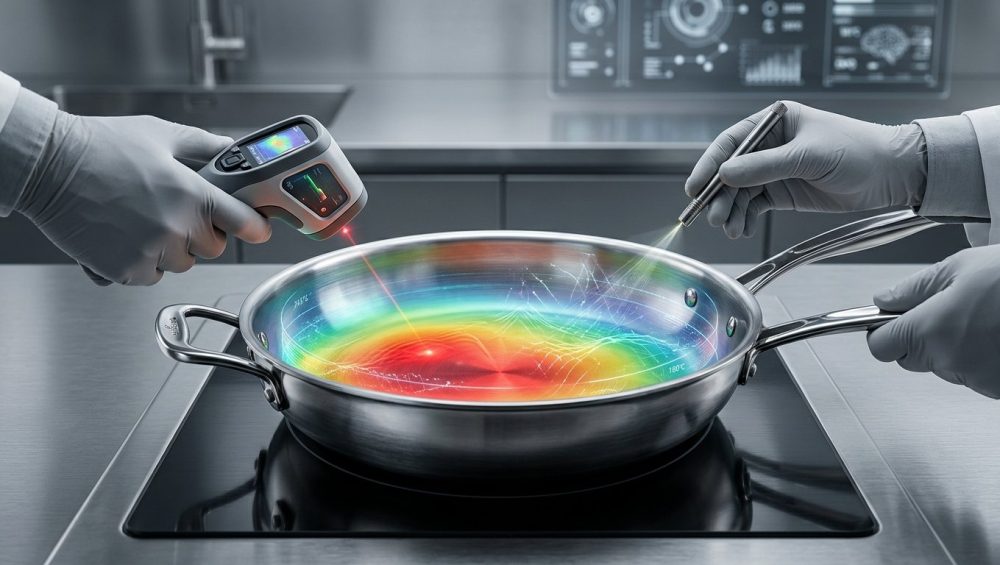
The most critical factor in thermal shock is the temperature differential, often denoted in physics as ΔT. Warping does not usually happen just because a pan gets incredibly hot; it happens because one localized part of the pan gets incredibly hot while another part remains completely cold.
Imagine placing a massive 12-inch skillet on a tiny 6-inch gas burner and instantly cranking the flame to maximum. The center of the pan rapidly heats to 400°F, while the outer edges are still sitting at a cool 75°F. The center tries to expand violently, but the cold, rigid outer ring acts like a vise, restricting that expansion. The center has nowhere to go but up or down, resulting in a bowed cooking surface. If you want to stop burning your dinner, you have to stop creating massive temperature differentials that lead to severe hot spots and warped metal.
The Induction Cooktop Danger Zone
Let us talk about the elephant in the modern kitchen: the induction cooktop. I absolutely love induction. It is highly efficient, boils water faster than gas, and keeps the ambient temperature of the kitchen perfectly cool. But induction is an absolute menace to poorly constructed cookware.
The Brute Force of Magnetic Heating
Unlike gas or standard electric coils, which heat the air and the bottom of the pan via conduction and convection, induction uses alternating magnetic fields to induce eddy currents directly inside the magnetic steel base of the pan. The pan itself becomes the heat source.
A high-quality commercial or heavy-duty residential induction hob can dump upwards of 5400 watts of power directly into the base of a pan in an instant. Because the heat generation is localized entirely in the magnetic exterior layer, the temperature can skyrocket from room temperature to over 500°F in mere milliseconds.
Why “Boost” Mode is a Cookware Killer
Induction ranges usually feature a “Power” or “Boost” mode, designed specifically for rapidly boiling large pots of water. Using this function on an empty skillet is a guaranteed death sentence for the pan. The base of the pan heats so violently and rapidly that the walls of the pan—which are not in direct contact with the magnetic field—remain completely cold. The resulting thermal shock exerts massive torque on the pan’s structure.
If you are using cheap, thin stainless steel or a pan with a poorly bonded disk bottom, the metal will buckle instantly, creating a permanent warp known as “crowning”. This is why learning to manage your induction settings is a massive step in fixing rookie kitchen mistakes. Heavy-duty, thick multiclad construction is your only defense against the brute force of induction heat, as the thicker thermal mass slows down the rate of heating and absorbs the shock.
The Metallurgy of the Core: Aluminum vs. Copper vs. Graphite
Let us dig deeper into the actual conductive engines of your cookware. The stainless steel exterior is just the armor; the core is the engine. Understanding these materials helps explain why some pans survive thermal shock while others perish.
Aluminum: This is the most common core material in high-quality multiclad pans, and for good reason. It is lightweight, relatively inexpensive, and boasts a thermal conductivity of roughly 237 W/m·K. It responds quickly to temperature changes, making it highly agile on the stovetop. However, because its Coefficient of Thermal Expansion is so high (23 µm/m·°C), it is the most susceptible to internal stress if heated too rapidly.
Copper: The undisputed king of traditional thermal conductivity, copper clocks in at a staggering 401 W/m·K. It heats up almost instantly and cools down just as fast, giving the cook unparalleled, razor-sharp control over the cooking temperature. Its CTE is around 16.5 µm/m·°C, which is incredibly close to the 16 µm/m·°C of stainless steel. Because their expansion rates are so perfectly matched, copper-core multiclad pans are inherently more resistant to the internal shear stresses of thermal shock than aluminum-core pans. The downside? They are heavy, astronomically expensive, and often require specialized care.
Graphite: In recent years, high-end manufacturers have begun experimenting with pyrolytic graphite cores. Graphite has a thermal conductivity that can actually exceed copper, while weighing a fraction of the amount. The modern engineering required to solid-state bond perforated graphite plates between layers of stainless steel is mind-boggling. While these pans are cutting-edge and highly resistant to deformation, they remain a niche luxury item. For the vast majority of us, a thick, well-constructed aluminum or copper core is the gold standard.
The Sin of the Cold Water Plunge (And Other Common Kitchen Crimes)
We have covered heating, but cooling is where most home cooks commit their worst culinary crimes. I know you are tired after cooking. I know you just want to eat. But throwing a screaming hot pan into the sink is unacceptable.
The Post-Cook Cooling Protocol
The absolute fastest way to permanently warp a piece of metal is to take it from a 400°F burner and plunge it directly under a 60°F stream of tap water. This violent, instantaneous contraction forces the metal to shrink so rapidly that the internal layers literally fight against each other.
The post-cook cooling protocol is non-negotiable: when you finish cooking, remove the pan from the heat source and set it on a cool burner or a wire rack. Let it sit there until it is warm to the touch—not hot, just warm. Only then is it safe to introduce water for cleaning. Your impatience is not worth destroying a $200 piece of equipment.
Deglazing vs. Drowning: A Crucial Distinction
You might be thinking, “But wait, what about deglazing? I pour wine into a hot pan all the time to make pan sauces!” This is a fair point, but there is a massive physical distinction between deglazing and drowning.
When you sear a piece of meat and utilize the Leidenfrost effect to get that perfect crust, you are left with delicious browned bits (fond) stuck to the bottom. Deglazing involves adding a small amount of room-temperature liquid (like wine or broth) to the hot pan. Because the volume of liquid is small, the thermal energy of the pan is rapidly absorbed by the liquid as it undergoes a phase change (turning into steam). The pan cools down slightly, but not fast enough to cause catastrophic thermal shock.
Drowning, on the other hand, is when you take a hot pan and dump a massive volume of ice-cold liquid into it all at once. The sheer thermal mass of the cold liquid overwhelms the metal, causing an instant, violent temperature drop that leads to warping. Always deglaze with moderate amounts of room-temperature liquids.
The “Mystery Metal” Warning: Why Cheap Pans Fail Faster
I firmly believe that anyone can cook like an expert without a culinary degree, but you cannot do it with garbage tools. I despise cheap, toxic kitchenware. Peeling non-stick coatings, thin aluminum pans that warp on day two, and “mystery metal” discount bins are the enemies of good cooking.
Delamination: The Silent Killer of Clad Cookware
Warping is bad, but delamination is fatal. Delamination occurs when the immense shear stress caused by thermal shock literally rips the bonded layers of metal apart. You will usually see this as a bubble forming on the cooking surface, or the bottom disk of a cheaper pan physically peeling away from the main body.
This happens most frequently when cheap pans are subjected to high-power electric coils or induction hobs. The thermal expansion mismatch between the low-grade steel and the thin aluminum core causes the adhesive or roll-bonded bond to fail. Once a pan delaminates, it is completely useless. It will harbor bacteria, heat with massive dead zones, and potentially leach core metals into your food. If you want to properly master the Maillard reaction, you need a pan with a perfectly intact, highly conductive core that delivers even, consistent heat.
The Chemical and Thermal Assault of Dishwashers
Let us talk about the dishwasher. Many manufacturers claim their multiclad stainless steel pans are “dishwasher safe.” This is a technicality that I highly advise you to ignore.
Dishwashers subject your cookware to a double assault of chemical aggression and thermal shock. Modern dishwasher detergents are highly alkaline, often boasting a pH between 10 and 12. While high-quality 18/10 stainless steel can generally withstand this, the exposed edges of a multiclad pan cannot. If your pan does not have fully sealed edges, the alkaline detergent will slowly eat away at the exposed aluminum core, causing micro-pitting.
Combine this chemical attack with the dishwasher’s high-temperature drying cycle (which can reach 160°F) and the rapid cooling when the door is opened, and you are subjecting the metal to unnecessary thermal cycling stress. Hand wash your good pans with warm water, a non-abrasive sponge, and a little Bar Keepers Friend. It takes two minutes and adds decades to the lifespan of the pan.
Actionable Protocols to Mitigate Thermal Shock
We have established the physics, the risks, and the crimes. Now, let us focus on the solutions. Because on a busy weeknight, time is money. We need efficiency, but we refuse to sacrifice our equipment to get it. Here are the rigorous, data-backed methods to protect your pans.
Preheating: The Slow and Steady Rule
The golden rule of thermal management is gradual temperature transition. You must allow the metal layers to expand together at a controlled rate.
- Start Dry and Low: Place your clean, dry skillet on the burner. Turn the heat to low or medium-low. Never start on high.
- Give it Time: Allow the pan to heat gently for 2 to 3 minutes. This allows the aluminum core to distribute the thermal energy all the way out to the rim of the pan, minimizing the ΔT (temperature differential) between the center and the edges.
- The Water Drop Test: To check if the pan is ready for searing, drop a single bead of water into the center. If it fizzles and evaporates instantly, the pan is too cold. If it forms a perfect mercury-like bead that glides effortlessly across the surface without evaporating, you have reached the optimal searing temperature (around 375°F to 400°F).
- Add Oil and Cook: Only after the pan is properly preheated should you add your cooking fat.
This protocol takes an extra 90 seconds, but it guarantees perfectly even heat distribution, prevents sticking, and ensures you can turn out a perfectly pan-seared salmon every single time without warping your skillet.
Matching Burner Size to Pan Diameter
This is a remarkably common oversight. If you put a 12-inch skillet on a 6-inch burner, you are asking for trouble. The heat source is concentrating all of its thermal energy into the dead center of the pan. The center expands, the edges remain rigid, and the pan bows.
Always match the diameter of the burner to the diameter of the pan base as closely as possible. If you must use a larger pan on a smaller burner, you absolutely must preheat the pan on a low setting for an extended period to allow the conductive core to move the heat to the edges before you turn the temperature up.
Safe Deglazing Temperatures and Liquid Volumes
When it is time to make a pan sauce, follow the rule of moderation. Remove the pan from the direct high heat for just a moment to let the ambient temperature drop slightly. Pour your room-temperature wine or broth in a slow, steady stream rather than dumping it all at once. Whisk continuously. This allows the pan to shed its thermal energy efficiently without suffering a catastrophic shock.
Advanced Thermal Management for Weekend Perfectionists
During the week, we survive through clever shortcuts and strict adherence to the rules. But on the weekends, we have the time to be absolute perfectionists.
Managing Heat Retention and Carryover Cooking
High-quality multiclad stainless steel has incredible thermal mass. This means it takes a while to heat up, but it also takes a while to cool down. Once you bring a heavy pan up to temperature, it will hold that heat aggressively.
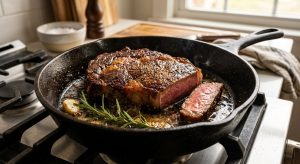
Weekend culinary hobbyists can use this to their advantage. If you are searing a thick steak, you do not need to keep the burner on high the entire time. Once the initial crust is formed, you can lower the heat significantly. The thermal mass of the pan will continue to deliver a steady, even sear without scorching the fond or stressing the metal. Understanding how to coast on retained heat is a fantastic way to cure your cooking anxiety, as it gives you a larger margin of error and keeps you from constantly fiddling with the dials.
The Sheet Pan Exception: Elasticity in the Oven
While we are primarily discussing stovetop skillets and saucepans, we must briefly mention the humble aluminum sheet pan. If you have ever roasted vegetables at 450°F, you have undoubtedly heard that terrifying, shotgun-loud bang from inside the oven.
This is thermal shock in its most dramatic acoustic form. A thin aluminum sheet pan, especially one loaded unevenly with cold food, experiences massive temperature differentials across its large surface area. The exposed corners heat up and expand rapidly, while the center, insulated by the food, remains cool. The tension builds until the metal violently buckles, popping one corner up into the air.
Here is the good news: unlike a multiclad stovetop skillet, a standard aluminum sheet pan is often experiencing elastic deformation, not plastic deformation. Because it is a single ply of relatively soft metal without the rigid constraint of a stainless steel jacket, it has more flexibility. Once you remove the sheet pan from the oven and allow it to cool to room temperature, it will almost always snap back into its perfectly flat, original shape.
The Flatness Test and Assessing Damage
How do you know if you have already committed pan murder? The flatness test is simple.
Take your cool, clean pan and place it on a perfectly flat surface, like a granite countertop or a glass-top stove. Press down firmly on the edges of the pan. If it rocks, wobbles, or spins, it has warped.
For a more precise measurement, take a metal straightedge (like a high-quality ruler) and lay it across the interior base of the pan. Hold it up to the light. If you see light peeking through the center, the pan has bowed outward (a convex warp). If you see light at the edges but the ruler touches the center, the pan has crowned (a concave warp).
Can You Un-Warp a Pan? (Spoiler: Probably Not)
I see the questions on forums all the time: “Can I just hit my warped pan with a rubber mallet to flatten it back out?”
The brutal, honest answer is no. Remember our discussion on plastic deformation? Once the crystalline structure of the metal has yielded and stretched, there is excess material. You cannot simply hammer it back into its original footprint. Attempting to beat a multiclad pan back into shape will only introduce microscopic fractures into the steel, further compromising its integrity and vastly increasing the risk of delamination.
If your pan is severely warped, it is time to retire it. Keep it around for roasting vegetables in the oven (where a flat bottom does not matter as much), but remove it from your stovetop rotation. It will only bring you unevenly cooked food and endless frustration.
The Final Verdict: Protect Your Culinary Investments
Cooking is an art, but it is governed entirely by the laws of physics and chemistry. You do not need a culinary degree or a Michelin star to understand these concepts; you just need a basic respect for thermodynamics and a desire not to flush hundreds of dollars down the drain.
By understanding the Coefficient of Thermal Expansion, respecting the sheer power of your stovetop (especially if you use induction), and strictly adhering to safe preheating and cooling protocols, you can ensure that your high-quality multiclad cookware lasts a lifetime.
Throw out the cheap, peeling, toxic mystery metal. Invest in heavy, durable, safe equipment. Treat that equipment with the respect it deserves, and it will reward you with perfectly seared steaks, flawlessly emulsified pan sauces, and a lifetime of reliable service. When you stop fighting your tools and start working with them, you truly unlock your kitchen creativity. Now, go preheat your pan—slowly—and make something amazing.