Listen, I love you, but we need to have a serious intervention about your potato salad. You are putting in the effort, chopping the celery, whisking the dressing, and trying to create a beautiful, restaurant-quality side dish. Yet, somehow, you keep ending up with a bowl of crumbly, waterlogged mush that looks more like a chunky puree than a proper salad. You are essentially serving your guests cold, mayonnaise-drenched mashed potatoes, and we both know it.
If you are committed to ditching takeout and elevating your weekend culinary projects, it is time to stop accepting mediocre results. You do not need a culinary degree to fix this. You do not need expensive, single-use gadgets. You just need to understand a tiny bit of basic kitchen chemistry.
The secret to perfectly intact, tender, flawlessly cubed potatoes that hold their shape against the most aggressive tossing is already sitting in your pantry. It is vinegar. By adding a simple splash of acid to your boiling water, you fundamentally alter the cellular breakdown of the potato.
Welcome to your definitive, no-nonsense masterclass on the science of boiling potatoes. Grab a glass of wine, take notes, and let’s fix your food.
The Anatomy of a Potato Disaster: Why Spuds Turn to Mush
To understand why your potato salad is failing, we have to look at what is actually happening inside the cooking pot. Cooking is not magic; it is applied thermal chemistry.
A raw potato is primarily composed of water, starch granules, and a rigid network of plant cells. These cells are glued together by a complex carbohydrate called pectin. Think of pectin as the mortar holding the cellular bricks of the potato together. When you drop potatoes into a pot of water and turn on the heat, two critical chemical reactions occur simultaneously:
First, as the water temperature surpasses 60°C (140°F), the starch granules inside the potato cells begin to violently absorb water. They swell up, expanding like tiny water balloons. This process, known as starch gelatinization, is what transforms a rock-hard, raw tuber into something soft, fluffy, and edible.
Second, as the temperature continues to climb, the pectin “mortar” begins to dissolve. Research shows that the calcium-bound pectin holding potato cells together starts to break down around 82°C (180°F) and fully degrades once the water exceeds 95°C (203°F).
Here is where the disaster strikes. If you boil the potatoes for even two minutes too long, the pectin completely dissolves. The swollen starch cells lose their structural binding and physically separate from one another. The outer edges of your potato cubes slough off into the water, and the remaining core becomes a spongy, waterlogged mess. You set out to make a beautiful salad and end up with a bowl of gluey mashed potatoes.
Unlike boiling an egg—where heat denatures proteins and causes them to tightly coagulate into a hard, solid structure—boiling a potato is an exercise in controlled structural degradation. Your goal is to cook the starch without completely melting the pectin.
The Magic of Acid: How Vinegar Saves the Day
This brings us to the ultimate restaurant shortcut: acidifying your cooking water.
For those of you used to surviving kitchen disasters, this chemical reaction is your new best friend. Pectin and hemicellulose (another structural carbohydrate in the potato’s cell walls) are highly sensitive to the pH level of their environment. In a neutral or alkaline environment—like plain tap water—pectin breaks down rapidly when heated.
However, when you introduce an acid like vinegar to the boiling water, you dramatically lower the pH. In an acidic environment (specifically dropping the pH below 5.0), the breakdown of pectin is significantly inhibited. The acid effectively reinforces the cellular “mortar,” preventing it from dissolving into the water.
When you boil potato cubes in vinegar water, the acid creates a microscopic, firm crust on the exterior of the potato. This protective barrier locks the cells together, allowing the heat to penetrate the center of the potato and gelatinize the starches without the exterior turning to mush. The potato becomes perfectly tender on the inside, while the outside retains sharp, distinct, beautifully defined edges.
The Golden Ratio of Acid to Water
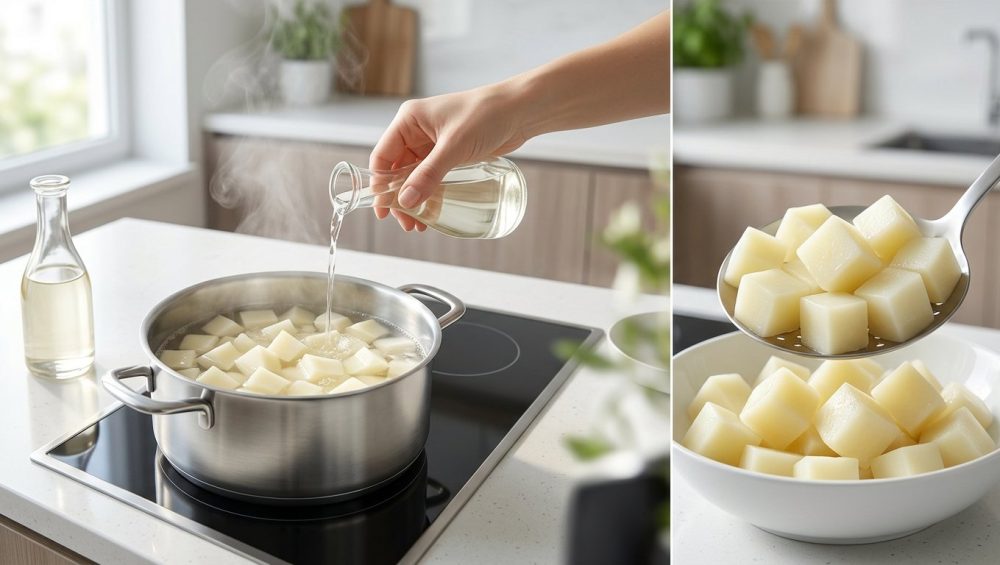
You do not need to empty a whole bottle of vinegar into your stockpot. The goal is to alter the pH, not to pickle the potatoes. The foolproof ratio is 1 tablespoon of vinegar for every 4 cups (1 quart) of water.
Which Vinegar Should You Use?
Keep it simple. Standard distilled white vinegar, apple cider vinegar, or white wine vinegar are all perfect for this application. Avoid dark, syrupy acids like balsamic vinegar, which will dye your potatoes an unappetizing shade of muddy brown and impart a heavy, overwhelming flavor.
Will the potatoes taste like vinegar? Barely. The acid leaves a very faint, bright tang on the exterior of the potato, which actually enhances the flavor profile of a potato salad. After all, most potato salad dressings rely heavily on vinegar, mustard, and pickles anyway.
Selecting Your Spuds: Waxy vs. Starchy
You cannot build a sturdy house out of cheap materials, and you cannot make a flawless potato salad with the wrong type of potato. Even the vinegar trick cannot completely save a potato that was biologically destined to fall apart.
Potatoes generally fall into two categories: starchy and waxy.
Starchy Potatoes (The Enemy of Potato Salad)
Russet potatoes and Idaho potatoes are incredibly high in starch and low in moisture. Because their starch granules are so large, they swell massively when cooked, creating a light, fluffy, mealy texture. This makes them absolute royalty for baking, frying, or mashing. However, if you boil peeled Russet cubes, they will absorb water like a sponge and disintegrate, regardless of how much vinegar you use. Leave the Russets out of your salad.
Waxy Potatoes (The Champions of the Salad Bowl)
Waxy potatoes—such as Red Bliss, Charlotte, New Potatoes, and Fingerlings—have a lower starch content and a higher moisture content. Their cells are smaller and more tightly packed, meaning they naturally hold their shape much better during the boiling process.
The Middle Ground: All-Purpose Potatoes
Yukon Golds sit right in the middle of the spectrum. They offer a buttery, creamy texture while retaining enough structural integrity to survive a boiling water bath. They are an acceptable choice for potato salad if you prefer a slightly softer bite.
The Verdict: For the absolute best, restaurant-quality potato salad, buy waxy red or yellow potatoes. While you don’t necessarily need a digital kitchen scale to weigh every tuber, uniform sizing is critical. When you combine a high-quality waxy potato with the acidic vinegar boiling method, you create an indestructible, perfectly textured foundation for your dish.
The Masterclass Method: Step-by-Step to Flawless Boiling
Knowing the science is only half the battle; execution is everything. If you want to cook like a pro in your home kitchen, you must abandon sloppy weeknight habits and embrace precision. Here is the exact, step-by-step method for boiling potatoes that will never let you down.
Step 1: The Uniform Dice
Peel your potatoes (or leave the skins on for a rustic texture, provided you scrub them thoroughly). Cut them into perfectly uniform, 3/4-inch to 1-inch cubes. If you have massive chunks mixed with tiny slivers, the small pieces will turn to mush before the large pieces are even cooked. Consistency is non-negotiable.
Step 2: The Cold Water Start
The non-negotiable first step is starting in cold water so the centers and edges heat at the exact same rate. Never drop raw potatoes into a pot of already-boiling water. If you do, the exterior of the potato will instantly overcook and turn to mush while the interior remains raw and crunchy. Place your uniform potato cubes into a large, heavy-bottomed pot and cover them with at least two inches of cold tap water.
Step 3: Seasoning the Bath
Your boiling water is your only opportunity to season the actual interior flesh of the potato. Add kosher salt until the water tastes like the sea. Then, add your vinegar. Remember the ratio: 1 tablespoon of vinegar per quart of water. Stir gently to distribute.
Step 4: The Gentle Simmer
Place the pot over medium-high heat and bring it to a boil. The moment the water reaches a boil, immediately reduce the heat to maintain a gentle simmer (around 90°C to 94°C). A violent, rolling, 100°C boil will physically smash the potatoes against each other and the sides of the pot, destroying their delicate edges. Treat them gently.
Step 5: The Fork Test
Set a timer for 10 minutes, but trust your senses over the clock. Test a potato chunk by piercing it with a fork or a paring knife. It should slide in with zero resistance. Thanks to the vinegar, the outside will still look perfectly sharp and intact, so you must physically test the center for doneness.
Step 6: The Sheet Pan Evaporation
Once tender, drain the potatoes immediately. Do not leave them sitting in the hot water, or they will continue to cook. Spread the hot, drained potatoes out in a single layer on a large baking sheet. This allows the residual steam to evaporate rapidly. If you dump them into a deep bowl while hot, the steam gets trapped, turning the bottom layer of potatoes soggy.
The “No-Go” Rule: Why Your Cooking Gear Matters
As your culinary cheerleader and harshest critic, I am a relentless advocate for banishing toxic kitchen gear from your home. The vinegar trick is pure magic, but it comes with a strict equipment warning: Do not boil acidic water in cheap, reactive cookware.
When you heat an acid (like vinegar) in a reactive metal pot—such as untreated aluminum or unlined copper—a chemical reaction occurs. The acid slowly dissolves the metal, leaching it directly into your cooking water. Not only will this give your potatoes a highly unpleasant, tinny, metallic taste, but it can also turn your beautiful yellow spuds a dismal shade of gray.
Furthermore, you should absolutely never boil anything in a cheap, lightweight non-stick pot that has a scratched or peeling Teflon coating. Subjecting degraded non-stick coatings to high heat and acidic liquids is a brilliant way to ingest toxic forever chemicals (PFAS) and microplastics. I have zero patience for gear that poisons your food.
The Safe Alternatives
For boiling potatoes with vinegar, you must use non-reactive cookware.
- Multi-Clad Stainless Steel: A heavy-bottomed, fully clad stainless steel stockpot is the gold standard of the home kitchen. A high-quality stainless steel pot (which you can easily master using the water drop test) is completely non-reactive, distributes heat flawlessly, and will last long enough to be inherited by your grandchildren.
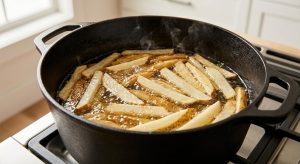
- Enameled Cast Iron: A high-quality enameled Dutch oven features a glass-particulate coating baked over cast iron. The enamel is entirely non-reactive to acid, making it a completely safe and highly effective vessel for the vinegar-boiling method.
Invest in safe, durable gear. Your health, and your potato salad, depend on it.
Flavor Building: Dressing the Potatoes
Now that you have perfectly boiled, structurally sound potato cubes resting on your sheet pan, you face the next hurdle: dressing them. Dressing ice-cold potatoes is one of the seven rookie kitchen mistakes that will leave your side dish tasting completely bland.
The Science of Starch Retrogradation
As potatoes cool down, a process called starch retrogradation occurs. The gelatinized starches begin to re-crystallize and firm up. Once a potato is completely cold, its cellular structure tightens, making it incredibly resistant to absorbing outside flavors. If you wait until the potatoes have been in the fridge for two hours before adding your dressing, the flavor will simply slide off the exterior.
The Two-Step Dressing Method
To maximize flavor without ruining the texture of your salad, you must dress the potatoes in two distinct stages.
Stage 1: The Acid Wash (While Hot)
While the potatoes are still warm on the sheet pan (about 5 minutes after draining), splash them with a highly acidic liquid. This could be a light vinaigrette, a splash of apple cider vinegar, or—my personal favorite—a few tablespoons of leftover dill pickle brine. Because the starches are still relaxed and expanded from the heat, they will drink up this acidic liquid like a sponge, seasoning the potato all the way through to its core.
Stage 2: The Emulsion (While Cold)
If you are making a creamy, mayonnaise-based potato salad, you must wait until the potatoes are completely cool to room temperature before adding the mayo. Mayonnaise is an emulsion of oil and egg yolks. If you fold mayonnaise into steaming hot potatoes, the heat will break the emulsion. The oil will separate from the egg, leaving you with a greasy, weeping, oily slick at the bottom of your bowl.
Soak them in acid while hot, coat them in creaminess while cold.
The State of the Spud: Why We Are Obsessed with Potato Salad
If you think mastering potato salad is a trivial pursuit, the economic data suggests otherwise. Potato salad is big business, and our modern reliance on convenience foods is actively changing how we eat.
According to recent 2025 consumer data, Americans are eating a staggering amount of potatoes. In the calendar year 2025 alone, U.S. retail sales of fresh potatoes reached $19.9 billion, translating to over 15.3 billion pounds of fresh spuds sold. Interestingly, consumer buying habits are shifting toward smaller, specialty packs. Sales of 1-to-2 pound bags grew by 6.3%, and specialty varieties—like medley (+8.8%), purple (+8.1%), and yellow potatoes (+6.6%)—saw massive spikes in popularity. This proves that home cooks are moving away from giant 10-pound sacks of bland russets and actively seeking out high-quality, waxy, colorful potatoes perfect for salads.
Simultaneously, the commercial refrigerated potato salad market is exploding. Valued at $1.49 billion in 2024, the market is projected to reach an incredible $2.26 billion by 2033. Why? Because contemporary consumers are exhausted. Market research indicates that 62% of North American households now purchase at least one ready-to-eat side dish every single month. People are buying tubs of mass-produced, preservative-laden potato salad from the deli counter because they believe making it from scratch takes too much time, or they are terrified of ending up with mushy potatoes.
Having a reliable, fail-proof method for batch-cooking sides is a brilliant way to eliminate kitchen chaos during busy weekdays. By mastering the vinegar trick, you can bypass the overpriced, artificially flavored deli tubs and create a superior, professional-grade dish in your own kitchen for a fraction of the cost. Time is money, but quality is paramount.
Troubleshooting Common Potato Salad Sins
Even with the vinegar trick in your arsenal, there are a few other pitfalls that can ruin your weekend barbecue contribution. Let’s quickly troubleshoot the most common amateur errors.
1. Under-Salting the Water
I mentioned this earlier, but it bears repeating. Potatoes are dense, starchy sponges that desperately need sodium to taste like anything. If you boil them in plain, unsalted water, no amount of dressing you add later will save them. They will taste flat and boring. Salt the water aggressively.
2. Adding Raw, Harsh Onions
Raw red or white onions provide a fantastic crunch, but their sharp, sulfuric bite can easily overpower the delicate flavor of the potatoes. To fix this, finely dice your onions and soak them in a small bowl of cold water (or a splash of vinegar) for 10 minutes before adding them to the salad. This simple step leaches out the harsh sulfur compounds, leaving you with a sweet, crisp onion that plays nicely with the other ingredients.
3. Over-Mixing the Salad
You went through all the trouble of buying waxy potatoes, adding vinegar to the water, and cooling them on a sheet pan to preserve their shape. Do not ruin all that hard work by aggressively stirring the salad like you are mixing concrete. When you add your dressing, use a large silicone spatula to gently fold the ingredients together. Scoop from the bottom and fold over the top. Treat the potatoes with respect.
4. Skipping the Fresh Herbs
A heavy, mayonnaise-based potato salad can feel incredibly rich and cloying after a few bites. You need fresh, green herbs to cut through the fat and brighten the palate. Fresh dill, chives, flat-leaf parsley, or even a hint of tarragon will elevate your potato salad from a heavy side dish to a vibrant culinary centerpiece.
Conclusion: Reclaiming the Home Kitchen
Cooking does not have to be a stressful, chaotic chore. You do not need to rely on the deli counter, and you certainly do not need to settle for mushy, waterlogged side dishes. By understanding the simple chemistry of pectin and acid, you have unlocked the ability to control the exact texture of your food.
Whether you are meal-prepping for the workweek or hosting a meaningful dinner party for your friends, the vinegar trick guarantees flawless, restaurant-quality potatoes every single time. Start with cold water, salt it like the sea, add a tablespoon of vinegar per quart, simmer gently, and dress them smartly.
Throw out your toxic peeling pots, stop buying the wrong types of potatoes, and go make a salad you can actually be proud of. You’ve got this. Now, if you’ll excuse me, my wine glass is empty, and I have a kitchen to clean.