Pour yourself a glass of wine, grab a sturdy cutting board, and let’s have a little heart-to-heart about the most heartbreaking tragedy that can strike a home kitchen. You have spent hours meticulously roasting a beautiful chicken, you have whisked together a pan gravy that could make a grown adult weep tears of joy, and you finally sit down to serve the ultimate comfort food side dish: mashed potatoes. But as you drag your serving spoon through the bowl, a cold sweat breaks out on the back of your neck. The mixture does not dollop. It stretches. It pulls. It clings to the spoon with the terrifying, elastic tenacity of fresh wallpaper paste.
Congratulations, my friend. You have accidentally manufactured a bowl of edible glue.
Look, I get it. We have all been there. When I was first learning to navigate the culinary world, I genuinely thought that pureeing boiled potatoes in a high-speed blender or a food processor was a brilliant, time-saving shortcut. Spoiler alert: it absolutely was not. It was one of those classic, fundamental mistakes ruining your dinners before you even have the chance to plate them.
The good news? You do not need a degree from Le Cordon Bleu to fix this issue, nor do you need to resign yourself to a lifetime of mediocre side dishes. You just need a rudimentary understanding of plant biology, a little bit of respect for starch thermodynamics, and the absolute refusal to use the wrong kitchen tools. Professional-level results are completely achievable in your standard home kitchen, provided you stop treating your ingredients like they owe you money.
Today, we are going to meticulously dissect the science of mashed potatoes. We will explore the botanical architecture of the potato, the thermodynamic process of starch gelatinization, and the catastrophic cellular rupture that occurs when you introduce high-shear mechanical force to a delicate tuber. We will also talk about why banishing toxic kitchen gear is absolutely mandatory if you want to cook safely and efficiently. Buckle up, because we are leaving no stone unturned in the pursuit of the perfect, cloud-like mash.
The Anatomy of a Potato: It Is Not Just a Generic Starch Blob
To truly understand why your mashed potatoes are turning into a sticky, gummy mess, you first have to understand what a potato actually is. Home cooks often treat potatoes as monolithic blocks of generic carbohydrate, interchangeable and devoid of complexity. But at a microscopic level, they are incredibly complex botanical structures.
A potato is a tuber, which is essentially a swollen, highly specialized underground stem designed by nature to store energy for the plant. This energy is stored in the form of microscopic starch granules, which are tightly packed inside individual, rigid plant cells. These individual cells are held together by a biological mortar made of pectin—the exact same complex carbohydrate that makes fruit jams and jellies set.
When we talk about the “starch” inside a potato, we are actually talking about two very different, highly specific polysaccharide polymers: amylose and amylopectin. Understanding the difference between these two molecules is the absolute key to mastering potato texture.
Amylose: The Straight-Laced Structurist
Amylose is a linear, straight-chain molecule. Because of its uniform, unbranched shape, amylose molecules can pack tightly together in a neat, organized fashion. When heated in the presence of water, amylose forms rigid, firm, and stable gels. High-starch potatoes contain a significant amount of amylose—typically around 20% to 25% of their total starch content. This high amylose ratio is exactly what allows them to bake up with a fluffy, dry, and highly porous interior that flakes apart beautifully under a fork.
Amylopectin: The Branched Troublemaker
Amylopectin, on the other hand, is a highly branched, bushy, chaotic molecule. It does not pack tightly at all. Instead, when it interacts with hot water, it produces a viscous, sticky, and intensely creamy texture. If you have ever wondered why a cheese sauce turns grainy or gummy when you use the wrong type of thickener, you are witnessing the power of branched starches behaving badly. In potatoes, a high concentration of amylopectin (which is found abundantly in waxy varieties) means the potato will hold its physical shape when boiled, but it will rapidly turn into a dense, gummy paste if you try to mash it.
When you mash a potato, your singular goal is to separate the individual plant cells from one another without actually breaking the delicate cell walls open. You want the cells to remain completely intact, acting like microscopic, fluffy balloons of cooked starch. If you break those balloons, the amylose and amylopectin spill out into the surrounding liquid, bind fiercely with the water, and instantly create an adhesive, glue-like matrix.
The Cultivar Conundrum: Setting Yourself Up for Failure at the Grocery Store
Most home cooks immediately blame their technique when their potatoes fail. They think they used the wrong temperature of milk, or they stirred the pot three times too many. While technique certainly matters, the single most critical factor in achieving perfectly aerated mashed potatoes is botanical selection. Not all potatoes are created equal, and grabbing whatever generic sack of spuds happens to be on sale at the supermarket is a surefire way to sabotage your meal.
Waxy Potatoes: The Absolute Enemy of the Mash
Waxy potatoes—such as Red Bliss, New Potatoes, and Fingerlings—have a very low starch content (hovering around 13% to 15%) and a disproportionately high moisture content. Their cellular architecture is dense, and their pectin bonds are exceptionally strong. This means that when you boil them, they hold their shape beautifully. They are fantastic for rustic potato salads, hearty stews, and high-heat roasting.
However, if you attempt to mash them, their stubborn cells will fiercely resist breaking apart. To get them smooth, you have to apply excessive mechanical force, which inevitably and violently ruptures the cells, releasing what little starch they have into a watery, gluey puddle. Just do not do it. Mashing a red potato and expecting a fluffy cloud is a fool’s errand.
Starchy Potatoes: The Fluffy Standard
High-starch, low-moisture cultivars like the Russet Burbank (often labeled as Idaho or baking potatoes) are the undisputed kings of the mash. Boasting a massive starch content of up to 22.7%, Russets have a dry, mealy texture. As they cook, their cells swell massively and naturally begin to separate from one another, creating a highly porous, open crumb that absorbs butter and heavy cream like a dry sponge. Because their cells separate so easily and willingly, they require very little physical manipulation to achieve a smooth texture, drastically reducing the risk of catastrophic cellular rupture.
Medium-Starch Potatoes: The Buttery Compromise
Yukon Golds fall right in the middle of the spectrum. They have a medium starch content (around 16% to 18%) and slightly lower moisture than waxy varieties, but they naturally contain higher sugar levels, which translates to a rich, inherently buttery flavor. While they do not mash up quite as fluffy and cloud-like as a pure Russet, they yield an incredibly creamy, luxurious texture and possess a slightly more forgiving cellular structure than waxy potatoes.
The Sassy Sous-Chef’s Golden Ratio
If you want to absolutely blow the minds of your dinner guests and truly embrace the art of the home kitchen, the scientifically optimal approach is a 60:40 blend of Russet to Yukon Gold. Laboratory culinary tests have shown that this specific botanical ratio delivers 98% of the voluminous fluffiness of a pure Russet mash, while simultaneously increasing the perceived richness and buttery mouthfeel by a staggering 32% thanks to the Yukon Golds. It is the ultimate culinary flex.
The Physics of Gelatinization: What Actually Happens in the Pot
Before we can even talk about mashing, we need to talk about boiling. The way you apply thermal energy to a potato fundamentally alters its chemical structure. This thermodynamic process is called starch gelatinization, and if you mess it up, your side dish is doomed before it ever leaves the stove.
Starch granules inside the raw potato are tightly coiled, crystalline, and relatively dry. As the potato heats up in water, these microscopic granules begin to absorb moisture and swell. Between 60°C and 70°C (140°F to 158°F), the hydrogen bonds holding the starch polymers together begin to weaken and break down. The granules swell to many times their original size, absorbing massive amounts of water and becoming incredibly fragile.
The Cold Water Rule
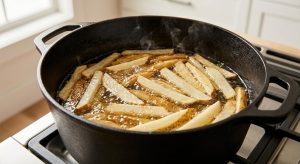
You must always, without exception, start your potatoes in cold, aggressively salted water. If you drop raw potato chunks into a pot of rapidly boiling water, the exterior of the potato will rapidly overcook, gelatinize, and disintegrate before the dense interior even reaches the necessary gelatinization temperature. By the time the center is finally tender, the outside is a waterlogged, mushy, ruined disaster. Starting in cold water ensures that the temperature rises gently and evenly throughout the entire piece of potato, allowing the pectin bonds to dissolve uniformly.
The Danger of Overcooking
There is a very fine, unforgiving line between “fork-tender” and “cellular devastation.” If you boil the potatoes for too long, the starch granules absorb so much water that they physically burst open while still submerged in the pot. When this happens, the gluey starch is released directly into the boiling water, and your potatoes become irreparably waterlogged. You want to cook them just until a sharp paring knife slides into the flesh with zero resistance, and not a single minute longer.
The Mandatory Drying Phase
Once drained, your potatoes are still carrying excess surface moisture. If you mash them immediately, that residual water will dilute your dairy and create a watery, sad, unappetizing consistency. Return the drained potatoes to the hot, empty pot and set it over low heat for about two to three minutes. Gently toss them until the surface moisture completely evaporates and the potatoes look chalky, dry, and slightly cracked. This step is non-negotiable if you want fluffy results.
The Cellular Rupture Crisis: Why Your Food Processor is the Ultimate Enemy
Now we arrive at the main event: the actual mashing. This is where culinary dreams are made, and where they are violently, brutally destroyed.
Let’s review our primary goal: We want to separate the swollen, cooked potato cells from one another to create a smooth texture, without breaking the delicate cell walls.
Enter the food processor.
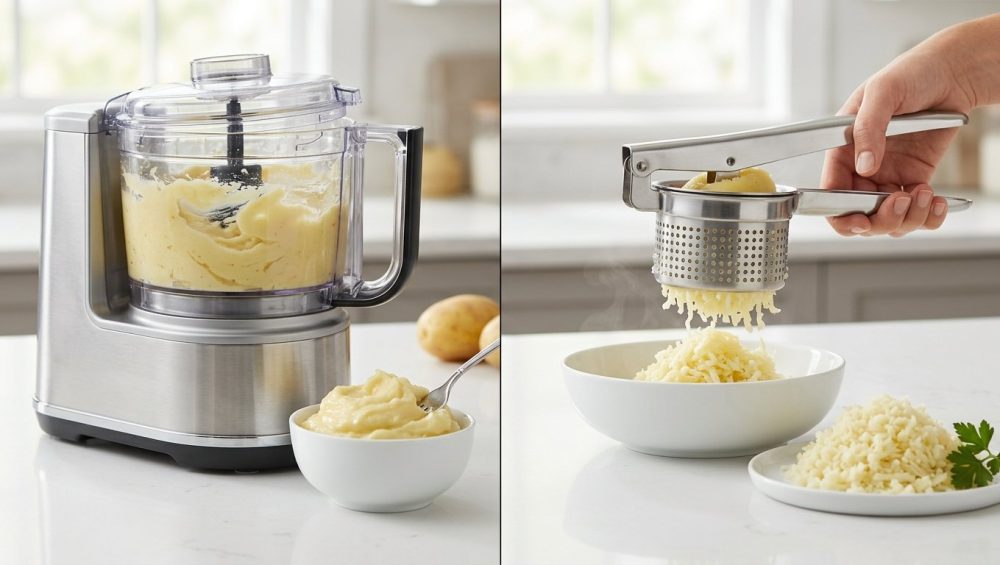
A food processor operates using a high-speed, razor-sharp steel blade that spins at thousands of revolutions per minute. When you drop hot, cooked potatoes into a food processor, that blade aggressively and mercilessly shears through the potato flesh. It does not gently separate the cells; it violently slices them wide open.
In a matter of mere seconds, millions upon millions of fragile potato cells are ruptured. The tightly contained amylose and amylopectin molecules flood out into the bowl. Because these molecules are long, highly branched, and desperate to bond, they immediately begin to tangle and link up with one another, forming an immense, sticky web. You have essentially created a complex carbohydrate polymer. You have made literal glue.
The exact same rule applies to immersion blenders and standard countertop blenders. High-shear mechanical action is the absolute, sworn enemy of the potato. Even a standard handheld electric mixer is a massive risk. If you whip the potatoes for just thirty seconds too long, the friction and force will tear the cell walls apart, leaving you with a shiny, gummy, cohesive mass that pulls away from the sides of the bowl like melted mozzarella cheese.
The “No-Go” Gear: Banishing Toxic Tools and Choosing the Right Arsenal
If there is one thing I have absolutely zero patience for in this world, it is cheap, toxic, poorly manufactured kitchen equipment. We need to have a serious conversation about the tools you are using to mash your food.
Far too many home cooks are out there using flimsy, bending plastic potato mashers or metal mashers coated in cheap, mystery non-stick materials. When you press down on hot, steaming potatoes with a low-quality coated masher, the intense friction and heat cause that cheap coating to degrade and flake off. Soon, you are looking at your cookware wondering why your pans are losing their slip, while simultaneously realizing that microscopic flakes of toxic Teflon or cheap synthetic polymers are ending up directly in your Thanksgiving side dishes.
Worse yet, inferior plastic tools can harbor dangerous bacteria, warp under pressure, or leach endocrine-disrupting chemicals into your hot food. Have you ever noticed that your silicone spatulas taste like soap? That is because cheap, filler-laden silicone absorbs harsh dishwasher detergents and transfers them directly into your meals. The exact same principle goes for cheap plastic mashers. Throw them in the garbage immediately.
If you are serious about building a highly functional, safe, and durable minimalist kitchen setup, you need to invest in high-quality, heavy-gauge, food-safe stainless steel.
The Holy Trinity of Potato Tools
1. The Potato Ricer:
This is the undisputed, heavyweight champion of mashed potatoes. A potato ricer looks like a giant, heavy-duty garlic press. You place the cooked potato chunks into the hopper and squeeze the handles together, extruding the potato through small perforated holes. Because the potato is being gently pushed and extruded rather than sliced or whipped, the cells remain completely intact. The result is a shower of incredibly fine, fluffy, aerated potato strands that require absolutely zero additional mashing. As an incredible time-saving bonus, if you use a ricer, you do not even need to peel your potatoes beforehand; the skin miraculously stays behind in the hopper.
2. The Food Mill:
A beloved staple in professional French kitchens, the food mill operates on a similar gentle extrusion principle to the ricer but uses a hand crank to sweep the potatoes over a perforated stainless steel plate. It gently crushes and extrudes the flesh while holding back the tough skins. It is highly efficient for processing massive batches and yields a spectacularly smooth, velvety texture without causing any cellular damage.
3. The Stainless Steel Hand Masher:
If you prefer a slightly more rustic, chunky texture, a heavy-duty, uncoated stainless steel hand masher is perfectly acceptable. It requires a bit of elbow grease, but because the mashing motion is vertical and relatively slow, it minimizes the shearing force applied to the delicate cells. Just remember the golden rule: mash only until the potatoes are broken down, and then immediately stop. Do not continuously pound them into oblivion just because you enjoy the arm workout.
The Fat Buffer: The Scientific Sequence of Dairy
Once your potatoes are perfectly riced or gently mashed, you must add your dairy. But the sequence in which you add your ingredients is not a matter of preference; it is a matter of strict culinary science.
Do not, under any circumstances, pour milk or cream into your potatoes before you add the butter.
When you add melted fat (butter) to the hot, riced potatoes first, the lipid molecules immediately coat the exterior of the individual potato cells. This protective fat layer acts as a lubricating buffer. It physically prevents the starch molecules from swelling any further and stops them from linking together to form those dreaded gummy chains. Once the cells are safely and luxuriously coated in butter, you can gently fold in your liquid (milk, heavy cream, or buttermilk) to achieve the exact desired consistency.
Furthermore, your dairy must be warm. If you pour freezing cold milk straight from the fridge into hot, steaming potatoes, the sudden drop in temperature causes the starch cells to seize, contract, and harden, resulting in a dense, heavy, and thoroughly unpleasant texture. Heat your butter and cream in a small saucepan until they are gently simmering, and fold them into the potatoes using a gentle, sweeping motion with a sturdy wooden spoon.
The Weeknight Cheat Sheet: Maximum Efficiency, Zero Glue
I firmly believe that time is money during the week. While I love a long, meditative cooking session on a Sunday afternoon, a Tuesday night at 6:30 PM is an entirely different battlefield. But prioritizing efficiency does not mean you have to sacrifice quality.
If you are exhausted from a long day at the office and just want to stop eating mushy veggies and sad, gluey side dishes, here is the ultimate time-saving workflow that bypasses the tedious steps without compromising the chemistry:
- Skip the Peeling: Wash your Yukon Golds thoroughly, cut them into uniform two-inch chunks, and boil them with the skins completely on.
- The Ricer Shortcut: Drain the potatoes, dry them in the hot pot for sixty seconds, and immediately run them through a heavy-duty stainless steel potato ricer. The ricer will catch the skins for you in the hopper. You just saved yourself ten minutes of tedious, frustrating peeling.
- The Microwave Hack: Instead of dirtying another saucepan to heat your milk and butter, combine them in a glass measuring cup and microwave them in thirty-second bursts until steaming hot.
- Fold and Serve: Pour the hot dairy over the riced potatoes, gently fold four or five times until just incorporated, season aggressively with kosher salt and white pepper, and serve immediately.
You can execute flawless, restaurant-quality mashed potatoes in exactly the time it takes the potatoes to boil, with minimal cleanup and absolutely zero stress.
How to Save a Ruined, Gluey Batch (Because You Didn’t Listen)
Let’s say you are reading this article a little too late. You already took a high-speed hand mixer to your Russets, or you tossed them into the food processor because you were rushing, and now you are staring down a bowl of shiny, elastic spackle.
First, take a deep breath. Surviving kitchen disasters is a necessary rite of passage for every home cook. We have all ruined a side dish.
Second, you must accept the harsh scientific reality: You cannot un-rupture a cell. Once the amylose and amylopectin have been violently released and linked together, no amount of stirring, adding milk, or praying to the culinary gods will make the potatoes fluffy again. If you try to thin them out with more liquid, you will just end up with a thinner, soupier glue.
However, you can pivot. You can transform your mistake into an entirely different, deliberate dish.
Pivot 1: Pommes Aligot
If your potatoes are stretchy and gummy, lean into the stretch. Pommes Aligot is a luxurious, decadent French dish that is essentially a cross between mashed potatoes and cheese fondue. Place your gluey potatoes in a pot over very low heat. Vigorously fold in a massive amount of shredded melting cheese—traditionally Tomme de Laguiole, but a mix of Gruyère and low-moisture mozzarella works brilliantly. Add a dollop of crème fraîche and a generous spoonful of roasted garlic puree. The melted cheese binds with the overworked starch, creating a deliberately elastic, rich, and stringy side dish that feels incredibly gourmet and intentional.
Pivot 2: The Potato Casserole
If the texture is too dense to serve on its own, change the structural format entirely. Spread the pasty potatoes into a heavily buttered baking dish. Drizzle the top generously with melted butter, a splash of heavy cream, and a thick layer of sharp cheddar cheese and toasted panko breadcrumbs. Bake it at 400°F (200°C) until the top is deeply golden brown and bubbling. The intense heat of the oven will dry out some of the excess moisture, and the crispy, crunchy topping will completely distract from the denser texture underneath. (Just a quick note: if you are using cheap, thin metal pans where your baking sheets keep warping in the oven, you are going to have an unevenly baked casserole. Invest in heavy aluminized steel.)
Pivot 3: The Silky Velouté
If you have completely pulverized the potatoes into a liquid paste, thin them out on purpose and call it soup. Transfer the gluey mash to a large saucepan and vigorously whisk in hot chicken or vegetable stock, a splash of heavy cream, and a pat of butter until you achieve the consistency of a thick, luxurious soup. Pass the entire mixture through a fine-mesh sieve to remove any remaining lumps or un-pureed skins. You now have a rich, silky potato velouté. Garnish it with crispy bacon bits, freshly chopped chives, and a drizzle of high-quality extra virgin olive oil. No one has to know it was originally supposed to be a side dish.
Conclusion: Respect the Spud
At the end of the day, cooking is just applied chemistry and physics. When you take the time to understand how your raw ingredients react to heat, friction, and moisture, you gain total, unwavering control over the final outcome in your kitchen.
Mashed potatoes are not a dish that requires brute force or high-tech machinery. They require a gentle touch, the right botanical cultivar, a healthy dose of dairy fat, and the absolute refusal to use high-shear tools like food processors or blenders. Treat your starch cells with the respect they deserve, banish the cheap plastic tools from your kitchen drawers, and remember that it is just as easy to make a flawless, cloud-like puree as it is to make a bowl of wallpaper paste.
Now get out of here, go buy yourself a heavy-duty stainless steel potato ricer, and show those tubers who is actually the boss of the kitchen. Happy cooking!