Let’s get one thing straight right out of the gate: your friends do not care if you can perfectly brunoise a carrot. If they do, you need new friends, not better knife skills.
Look, I get it. The idea of inviting people into your home to consume food you prepared with your own two hands can be absolutely terrifying. You are staring into the abyss of your refrigerator, hyperventilating over the idea that your apartment isn’t aesthetically pleasing enough, and convinced that everyone will secretly judge your inability to perfectly sear a scallop. We have all been conditioned by social media to believe that hosting a dinner party requires a sprawling, pristine kitchen, an encyclopedic knowledge of French culinary techniques, and a tablescape that belongs in a glossy magazine.
I am here to tell you that is complete and utter nonsense. I have set off my smoke detector enough times to know that panic is the enemy of good food. You do not need a culinary degree to make mind-blowing meals, and you certainly do not need to be a professional chef to create an unforgettable evening. During the week, I am a ruthless pragmatist—I use every shortcut and time-saving hack in the book because time is money. But the weekend? The weekend is when we slow down. The weekend is for pouring a glass of wine, turning on a great playlist, and creating something beautiful for the people we actually tolerate enough to invite into our homes.
This masterclass is your definitive, no-nonsense roadmap to pulling off a spectacular dinner party when you barely know your way around a cutting board. We are going to dismantle the pretentious menus, throw out the toxic cookware, and focus on what actually matters.
The Psychology of the Dinner Party (And Why We Desperately Need Them)
Before we even talk about grocery lists or oven temperatures, we need to address why you are doing this in the first place. We are living in an era where it is infinitely easier to order a gourmet meal from a glowing rectangle in our pockets than it is to look another human being in the eye. But convenience has come at a staggering cost.
We are currently in the midst of a devastating loneliness epidemic. In 2023, the World Happiness Report revealed a heartbreaking statistic: roughly 1 in 4 American adults now eat all of their daily meals completely alone, representing a massive 53% increase since 2003. The health implications of this isolation are terrifying. The U.S. Surgeon General has warned that lacking social connection can increase the risk of premature death by up to 26%, equating the physical health impact to smoking up to 15 cigarettes a day.
But there is a rebellion brewing. If you have spent any time online recently, you might have noticed a massive cultural shift driven by Gen Z and Millennials: the “hostingcore” trend. People are actively rejecting the isolation of modern life and bringing back the old-school dinner party. In fact, Pinterest recently reported an absolutely mind-boggling 6000% increase in searches for “dinner party” trends. This generation is ditching crowded, overpriced bars in favor of intimate, candlelit gatherings at home.
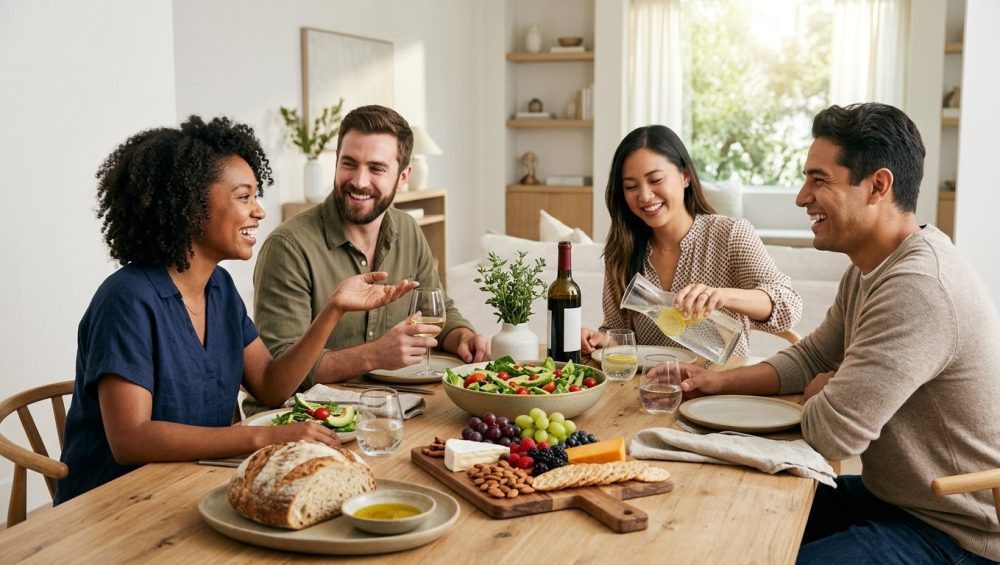
Why? Because we desperately want to connect. An American Heart Association survey found that 84% of adults actively wish they could share meals with loved ones more often. People do not want to come over to judge your culinary prowess; they want to come over because they want to feel seen, heard, and valued. If you are interested in the deeper philosophy behind this cultural shift, hosting mindful gatherings is all about shifting your focus from performance to genuine presence. Your dinner party is merely a vehicle for human connection. The food is just the beautiful, delicious excuse to get everyone around the same table.
Dismantling the Pretentious Menu (What to Actually Serve)
The number one reason people have a miserable time hosting is that they overcomplicate the menu. A recent poll by The Independent found that a brave (and foolish) 41% of people attempt to cook a completely unfamiliar recipe for the first time on the night of their dinner party. Guess what? Only 10% of those people claim it was a success.
Do not be a statistic. Your dinner party is not the time to experiment with making your own puff pastry or attempting a soufflé. You do not need to decode pretentious recipe jargon just to feed your friends. Instead, you need a bulletproof strategy.
Strategy 1: Assembly Over Cooking
If turning on the stove induces a panic attack, your best friend is the “Assembly Menu.” You can host a phenomenal, luxurious dinner party where the only “cooking” you do is slicing and arranging. Think of a massive, sprawling Mediterranean mezze board. Buy the absolute highest quality ingredients you can afford: artisanal cheeses, cured meats, marcona almonds, fresh figs, honeycomb, high-end olives, and freshly baked artisanal bread from a local bakery.
You arrange this beautifully on a massive wooden board, scatter some fresh rosemary sprigs around it, and open a few bottles of good wine. It feels incredibly opulent, it encourages communal eating and conversation, and there is zero risk of burning anything.
Strategy 2: The One-Pot Wonder
If you want to serve a hot meal, you should lean into simple meals for mindful moments that require minimal active cooking time. Braising is the culinary equivalent of a cheat code. It sounds incredibly fancy—something a French chef with a towering white hat would do—but in reality, it just means cooking something low and slow in a pool of flavorful liquid until it surrenders.
Take a tough, inexpensive cut of meat like a chuck roast or short ribs. Sear it in a heavy pot until it is aggressively browned, throw in some chopped onions and carrots, pour in a bottle of wine that you’d actually drink, and shove the whole heavy pot into the oven for three or four hours. What happens next is pure alchemy. The meat becomes meltingly tender, and the wine and meat juices reduce into a rich, glossy sauce. The best part? It is entirely hands-off. While the oven does 95% of the work, you are free to clean the kitchen, take a shower, and actually enjoy a glass of that wine.
Strategy 3: The Interactive Station
People love to customize their food. Setting up an interactive DIY food station takes the pressure off you as the host and turns dinner into a fun activity. A high-end taco bar is a perfect example. You can make a massive batch of carnitas in a slow cooker (again, practically zero effort), and spend your time preparing vibrant, fresh toppings: pickled red onions, crumbled cotija cheese, fresh cilantro, lime wedges, and a great homemade salsa. Guests build their own plates, which means dietary restrictions are easily accommodated, and you aren’t stuck plating individual portions like a frantic line cook.
The “No-Go” Rule on Toxic Gear (My Absolute Dealbreakers)
This is where I get incredibly serious. I have absolutely zero patience for cheap, peeling, toxic kitchenware. If you are still cooking your meals in a scratched non-stick pan that you bought at a discount store for fifteen bucks, I am personally begging you to throw it in the trash. Right now. Go ahead, I’ll wait.
We are currently living through a massive, overdue reckoning regarding PFAS—the “forever chemicals” used to make those pans so magically slippery. These synthetic compounds are essentially indestructible, meaning they do not break down in the environment or in the human body. They have been linked to a horrifying laundry list of health issues, including liver damage, thyroid disease, weakened immune responses, and cancer.
The situation is so dire that state governments are finally stepping in to protect consumers. On January 1, 2025, Minnesota’s Amara’s Law officially went into effect, making it the very first state in the nation to enact a comprehensive ban on the sale of nonstick cookware coated with intentionally added PFAS. Not to be outdone, California lawmakers just passed Senate Bill 682 in September 2025, which will aggressively phase out PFAS in cookware by 2030.
If the government is actively banning the material your skillet is made of, you probably shouldn’t be using it to sear a steak for your friends. Part of mastering the art of the kitchen is knowing that your equipment directly impacts your health and the quality of your food. So, what do you use instead?
Enameled Cast Iron
This is the holy grail of weekend cooking. A high-quality enameled cast iron Dutch oven (like a Le Creuset or Staub) is an investment piece that will literally outlive you. It retains heat beautifully, it is entirely non-toxic, and it goes seamlessly from the stovetop to the oven to the center of your dining table.
Carbon Steel
If you want the slick properties of a non-stick pan without the chemical cocktail, carbon steel is your best friend. It is what professional kitchens use. It requires a little bit of maintenance (you have to season it, much like raw cast iron), but once it builds up a natural patina, it is incredibly slick, highly durable, and completely safe.
High-Quality Stainless Steel
When you are building your collection of beginner cooking essentials, a heavy-bottomed, fully clad stainless steel skillet is non-negotiable. It is indestructible, it creates a beautiful sear on meats, and the fond (the browned bits left at the bottom of the pan) is the foundation for incredible pan sauces.
Setting the Scene (Because Vibes Cover Up Burnt Edges)
You could serve your guests lukewarm takeout pizza, but if the atmosphere is immaculate, they will still talk about what a fabulous time they had. The “vibe” of your dinner party is arguably more important than the menu. You are creating a sensory experience, and you need to curate it intentionally.
Lighting: Ban the “Big Light”
I cannot stress this enough: turn off your overhead lighting. Nothing kills the mood of a dinner party faster than the sterile, interrogation-room glare of recessed ceiling lights. You want your space to feel warm, intimate, and inviting. Rely entirely on secondary lighting sources. Turn on your floor lamps, drape some warm-toned fairy lights, and absolutely cover your dining space in taper candles and tea lights. Everyone looks better, feels more relaxed, and talks more openly in dim, warm light.
The Soundscape
A silent room is an awkward room. The moment your first guest walks through the door, music should already be playing. Curate a playlist that matches the mood of the evening. Start with something upbeat but unobtrusive—like instrumental jazz, lo-fi beats, or vintage soul—while people are arriving and having cocktails. As the night progresses and the wine flows, you can transition the music to match the rising energy of the room. Keep the volume at a level where people can easily hear each other without shouting.
Clutter Management
You do not need to live in a sprawling, multi-million dollar mansion to host a great party. But you do need to manage your mess. There are plenty of visual tricks to make your kitchen feel brighter and more spacious before guests arrive, and the most effective one is simply clearing your countertops. Stash your mail, hide your blender, and put away the dish rack. Maintaining a permanently organized kitchen means you aren’t frantically shoving dirty spatulas into a drawer when the doorbell rings. Clean your bathroom, light a mildly scented candle in there, and make sure there is plenty of toilet paper.
The Master Timeline (How to Not Sweat Through Your Shirt)
The difference between a host who is relaxed and charming, and a host who is sweating profusely and snapping at their partner, is a timeline. If you want to master the art of effortless hosting, you need to spread the work out over several days. Do not leave everything for Saturday afternoon.
3 Days Out: The Logistics
This is when you finalize your menu and do your major grocery shopping. Check your pantry to ensure you have the hidden essentials: olive oil, kosher salt, black peppercorns, butter, and enough toilet paper. Buy your wine and liquor now so you aren’t making a frantic run to the store hours before the party.
2 Days Out: The Deep Clean
Do not clean your house on the day of the party. You will exhaust yourself before anyone even arrives. Vacuum the floors, wipe down the bathroom, and clean the kitchen counters two days in advance. From this point on, you are just doing light maintenance.
1 Day Out: The Prep Work
This is the secret weapon of the stress-free host. Look at your menu and identify everything that can be done in advance. Wash and dry your salad greens. Chop your onions and garlic and store them in airtight containers. If you are making a braise or a stew, make it today! Almost all slow-cooked meats taste significantly better on the second day after the flavors have had time to meld in the fridge.
The Day Of: The Execution
Because you did your prep work yesterday, today is a breeze.
- Morning: Set the table. Arrange the flowers, set out the plates, polish the wine glasses, and place the candles. Doing this early gives you a psychological win and makes the house look immediately festive.
- Afternoon: Finish any active cooking. If you made your braise yesterday, simply put it in a low oven to gently reheat.
- 1 Hour Before: Stop working. Empty the dishwasher (so you have a place to put dirty plates later), take a shower, put on an outfit that makes you feel great, dim the lights, turn on the playlist, and pour yourself a glass of wine. When the doorbell rings, you will be holding a drink and smiling, rather than frantically chopping parsley.
Troubleshooting Rookie Mistakes on the Fly
Despite your best efforts, things will occasionally go sideways. Hosting is a live performance, and unpredictability is part of the thrill. A poll by The Independent revealed that 76% of hosts feel immense pressure to ensure guests have a good time, and 64% feel actively stressed when guests don’t arrive on time.
While fixing the seven rookie kitchen mistakes takes practice and repetition, you can handle immediate, night-of disasters with a little finesse and a good attitude. The true secret to surviving kitchen disasters is not letting your guests see you panic.
Scenario A: The Guests Are Late
Someone is always late. If you timed a delicate, pan-seared piece of fish to finish exactly at 7:30 PM and your best friend texts you at 7:28 PM saying they are “just leaving,” you are going to experience a rage so pure it could power a small city. This is exactly why we do not serve temperamental, minute-specific food at dinner parties. If you followed my advice and made a braised short rib or a baked lasagna, you simply turn the oven down to 200°F (93°C), cover the dish with foil, and let it hang out. It will not ruin the food. Pour the guests who did arrive on time another drink and direct them to the charcuterie board.
Scenario B: You Ruined the Main Course
The same poll noted that 30% of hosts admit to cooking a dish that completely failed, and 14% have straight-up burnt something to a crisp. If you pull your main course out of the oven and it resembles a smoking charcoal briquette, do not panic. Do not cry in the bathroom. You pivot. You laugh it off, you playfully announce that the chef has been fired, and you immediately order a mountain of high-quality pizzas, Thai food, or sushi. You plate the takeout on your nice ceramic dishes, light the candles, and keep the wine flowing. Your guests will think it is hilarious, and it will become a legendary story. The night is only ruined if your vibe is ruined.
Scenario C: You Run Out of Drinks
This is the one actual emergency you want to avoid. Always buy 30% more alcohol and non-alcoholic beverages than you think you will need. Unopened bottles of wine do not go bad, and extra sparkling water is always useful. However, if you do run dry, do not make a big deal out of it. Simply pull out the coffee or tea, serve dessert, and naturally transition the evening to its winding-down phase.
The Final Course
Hosting a dinner party when you barely know how to cook is not an act of culinary mastery; it is an act of bravery and love. It is about pushing past the deeply ingrained fear of imperfection and opening your doors anyway.
Your friends do not care about the slightly overcooked asparagus or the fact that your dining chairs don’t perfectly match. They care that you made the effort. They care that in a world that is increasingly isolated, digital, and lonely, you created a warm, safe space for them to sit down, share a meal, and just be human for a few hours.
So, put down your phone. Throw away that toxic, peeling Teflon pan. Buy some good cheese, light a few candles, and invite someone over this weekend. You’ve got this.