Picture this: It is 6:30 PM on a Tuesday. You are exhausted from back-to-back meetings, you are running on caffeine and sheer willpower, and you have exactly thirty-five minutes to get a respectable dinner on the table. You decided to treat yourself, so you stopped at the seafood counter and dropped twenty dollars on a gorgeous, center-cut fillet of wild-caught halibut. You heat up some oil, gently lay the fish in the pan, and wait for that promised golden crust. But when you go to flip it, disaster strikes. The fish has bonded to the metal with the strength of industrial superglue. You panic, you scrape, and suddenly your beautiful, expensive fillet has disintegrated into a tragic mound of shredded cat food.
If this sounds like a scene from your own personal kitchen nightmare, pour yourself a glass of wine and take a deep breath. You are not alone, and more importantly, you are not a bad cook. You are simply fighting a losing battle against molecular chemistry. When you are rushing to make a weeknight meal, time is money, and you do not have the luxury of perfectly tempering proteins or babying a temperamental pan. You need a foolproof, scientifically backed shortcut that works every single time.
I have zero patience for pretentious, overly complicated chef-speak, so I am going to give it to you straight: the secret to achieving a flawless, restaurant-quality crust on delicate seafood does not require a culinary degree, nor does it require a two-hundred-dollar specialty pan. The magic ingredient is already sitting in the door of your refrigerator. It is mayonnaise.
Yes, you read that correctly. A thin layer of everyday, store-bought mayonnaise is the ultimate culinary hack for preventing your food from sticking, tearing, and ruining your evening. Today, we are going deep into the food science, the thermodynamics, and the brutal reality of kitchen gear to explain exactly why this works. By the time we are done, you will never watch your fillets always fall apart in a hot skillet ever again.
The Biological Tragedy: Why Fish Flesh is So Unforgiving
To understand the cure, you have to understand the disease. Why is fish so notoriously difficult to cook compared to a steak or a pork chop? The answer lies in the biological structure of marine life.
Unlike land animals, which have to fight gravity and support heavy bone structures, fish live in a buoyant environment. As a result, their muscle structure is entirely different. Fish flesh is composed of short muscle fibers called myotomes, which are held together by thin, fragile sheets of connective tissue known as myocommata. In a cow or a pig, connective tissue is tough and requires hours of slow braising to break down into gelatin. In a fish, the myocommata begins to melt and break down at incredibly low temperatures—often around 120°F to 130°F (49°C to 54°C).
This is why perfectly cooked fish is beautifully flaky; the connective tissue has dissolved, allowing the myotomes to separate easily. However, this exact same biological trait is what makes it a nightmare to sear. As soon as the fish hits a hot pan, that structural integrity vanishes.
But the real villain of the story is a protein called myosin. Fish muscle is packed with myosin, and when this protein is exposed to high heat, it denatures and coagulates rapidly. If the fish is in direct contact with a hot metal surface, the myosin proteins will actually form strong chemical bonds—specifically Van der Waals forces and covalent bonds—with the microscopic pores and imperfections in the metal. The proteins fuse to the pan. Because the connective tissue holding the fish together is so weak, the bond between the fish and the pan is literally stronger than the bond holding the fish itself together. When you try to force a spatula underneath, the flesh tears, leaving the browned crust cemented to your stainless steel pan.
Furthermore, fish contains a massive amount of water. When you add a wet fillet to a hot pan with a splash of plain cooking oil, the water rapidly evaporates into steam. This steam barrier pushes the oil away, leaving dry patches of bare protein to make direct contact with the searing hot metal. Plain oil simply lacks the viscosity to cling to the wet surface of the fish, meaning it pools in the edges of the pan while your expensive halibut welds itself to the center.
The Chemistry of the Cure: Deconstructing the Mayonnaise Emulsion
If plain cooking oil runs away from the moisture and leaves the fish unprotected, we need a fat source that actively wants to stick to the protein. Enter mayonnaise.
To the untrained eye, mayonnaise is just a sandwich spread. To a culinary scientist, mayonnaise is a marvel of chemistry. It is a stable emulsion—a microscopic suspension of oil droplets dispersed within water, held together by an emulsifying agent. In the case of traditional mayonnaise, the oil is typically soybean or canola, the water comes from a splash of vinegar or lemon juice, and the crucial emulsifier is egg yolk.
Egg yolks are rich in a phospholipid called lecithin. Lecithin molecules are amphiphilic, meaning they have a split personality. One end of the molecule is hydrophilic (it loves water) and the other end is lipophilic (it loves fat). When you vigorously whisk oil into egg yolks and acid, the lecithin molecules coat the tiny droplets of oil, preventing them from coalescing back together.
This emulsion is the exact reason why mayonnaise is the ultimate tool for a perfectly seared fish. When you brush mayonnaise onto a raw fillet, it does not bead up and roll off like plain oil. The hydrophilic ends of the emulsion actively cling to the inherent moisture on the surface of the fish, while the thick, viscous texture ensures an even, impenetrable barrier of fat.
When this mayonnaise-coated fillet hits the hot pan, something beautiful happens. The heat causes the emulsion to break. The water evaporates, and the oil is released exactly where it is needed most—right at the microscopic contact point between the delicate fish proteins and the hot metal. The oil acts as a perfect thermal buffer, preventing the myosin from chemically bonding to the pan.
The Maillard Reaction: A Microscopic Look at Flavor
Preventing the fish from sticking is only half the battle; we also want a gorgeous, deeply flavorful crust. This brings us to the holy grail of culinary science: the Maillard reaction.
Discovered in 1912 by French chemist Louis Camille Maillard, this complex chemical reaction occurs when amino acids (from proteins) and reducing sugars are subjected to high heat. Typically occurring between 280°F and 330°F (140°C to 165°C), the Maillard reaction produces hundreds of unique, aromatic flavor compounds called melanoidins, which are responsible for the savory, roasted, umami-rich flavor of seared meats, toasted bread, and roasted coffee.
Here is where the mayonnaise trick goes from a clever anti-stick hack to a flavor-building superpower. Plain cooking oil can only brown food thermally—it conducts heat to the surface of the food until the food’s own proteins and sugars undergo the Maillard reaction. Mayonnaise, however, contains its own proteins (from the egg yolks) and its own sugars (from the eggs and occasionally added sugar or lemon juice).
This means that when you sear a mayo-coated piece of fish, the mayonnaise browns chemically on its own, in addition to conducting heat to the fish. Renowned food science author J. Kenji López-Alt has extensively documented this phenomenon, noting that the egg proteins in the mayonnaise caramelize and undergo the Maillard reaction beautifully, creating a complex, golden-brown crust at an accelerated rate. You get a thicker, crispier, more flavorful exterior than you could ever achieve with oil alone, and you get it faster—which is absolutely vital for delicate fish that overcooks in a matter of minutes.
The 2026 Cookware Reality Check: Banishing the Toxic Teflon
Now, I know exactly what some of you are thinking. “Why bother with all this science when I can just use my non-stick pan?”
Let’s get one thing straight: I absolutely despise cheap, toxic kitchenware. If you are still cooking on a scratched, peeling, mystery-metal pan that you bought at a discount store five years ago, you are making one of the most dangerous rookie kitchen mistakes possible.
The traditional “non-stick” coating is made of polytetrafluoroethylene (PTFE), commonly known by the brand name Teflon. PTFE belongs to a massive class of synthetic chemicals known as PFAS (per- and polyfluoroalkyl substances), notoriously dubbed “forever chemicals” because they do not break down in the environment or in the human body.
As of 2026, the regulatory landscape has finally caught up to the science. We are witnessing the death of the toxic non-stick pan. Minnesota led the charge by banning the sale of cookware containing intentionally added PFAS effective January 1, 2025. As of January 1, 2026, Colorado, Maine, Connecticut, and Vermont have enforced identical bans, making it literally illegal to sell these toxic PTFE-coated pans in those states. The European Union is currently finalizing a universal PFAS restriction targeted for 2027.
Why the sudden legislative panic? Because when PTFE is heated beyond safe temperatures (which can happen in just a few minutes on a standard gas stove), the coating begins to thermally degrade, releasing invisible, toxic chemical byproducts into the air and into your food. Studies have linked chronic PFAS exposure to hormonal disruption, weakened immune responses, and an increased risk of certain cancers, including kidney and testicular cancer. Furthermore, when the coating gets scratched—which inevitably happens—you end up ingesting physical flakes of this toxic kitchen gear.
You do not need a chemical crutch to cook fish. You need proper technique. By mastering the mayonnaise method, you can confidently cook the most delicate seafood on safe, professional-grade, heirloom-quality materials like fully clad stainless steel, carbon steel, or cast iron. Throw out that warped, peeling non-stick pan. Stop ruining your nonstick pans with aerosol sprays that polymerize into sticky residue, and graduate to real cookware.
The Foolproof Masterclass: Searing Seafood with Scientific Precision
We have covered the biology, the chemistry, and the equipment. Now, let us execute. This is your step-by-step masterclass for flawlessly searing fish on a weeknight, using the mayonnaise emulsion method.
Phase 1: Moisture Eradication
The greatest enemy of the Maillard reaction is water. If the surface of your fish is wet, the thermal energy of the pan will be entirely wasted on converting that liquid water into steam. Steam maxes out at 212°F (100°C), which is far below the 280°F required for browning.
Remove your fish from the fridge about 15 minutes before cooking to take the chill off. Place the fillets on a cutting board and aggressively pat them dry with heavy-duty paper towels. Do not just dab them; press firmly to extract surface moisture. The flesh should look matte, not glossy. Season the fish generously with kosher salt and freshly ground black pepper.
Phase 2: The Emulsion Application
Using a silicone basting brush or the back of a spoon, apply a thin, even layer of full-fat mayonnaise to the presentation side of the fish (the side that will hit the pan first). You do not need to glob it on like you are making potato salad; you are looking for a translucent, even glaze. It should be just enough to coat the flesh entirely without dripping down the sides.
Do not use low-fat or fat-free mayonnaise. Those products are pumped full of modified cornstarches, gums, and excess water to mimic the texture of fat. They will not provide the necessary lipid barrier, and their high water content will cause the fish to steam. Stick to the real deal: oil, egg, and acid.
Phase 3: Thermodynamic Pan Preparation
Place a high-quality, heavy-bottomed stainless steel or carbon steel skillet on the stove over medium-high heat. Do not add any oil to the pan. You must let the dry metal heat up thoroughly.
To know exactly when the pan is ready, utilize the water drop test. Flick a few drops of water from your fingertips into the pan. If the water sizzles and evaporates instantly, the pan is too cold. Wait another minute. If the water drops instantly bead up into perfect little spheres that glide and dance across the surface of the metal like mercury, you have achieved the Leidenfrost effect.
The Leidenfrost effect occurs when the metal is so hot that the bottom of the water drop instantly vaporizes, creating a microscopic cushion of steam that levitates the rest of the droplet. This physical phenomenon is the absolute key to stick-free searing. When the pan reaches this state, it is primed and ready.
Phase 4: The Searing Window
Gently lay the mayonnaise-coated side of the fish down into the hot, dry pan. Always lay the fish away from you, so if any microscopic pockets of moisture pop, the steam and fat splatter away from your face.
The moment the fish hits the pan, do absolutely nothing. Do not nudge it. Do not shake the pan. Do not try to peek underneath. Step back and let the chemistry happen. The mayonnaise emulsion is breaking down, releasing its oil to lubricate the metal while the egg proteins begin to undergo the Maillard reaction.
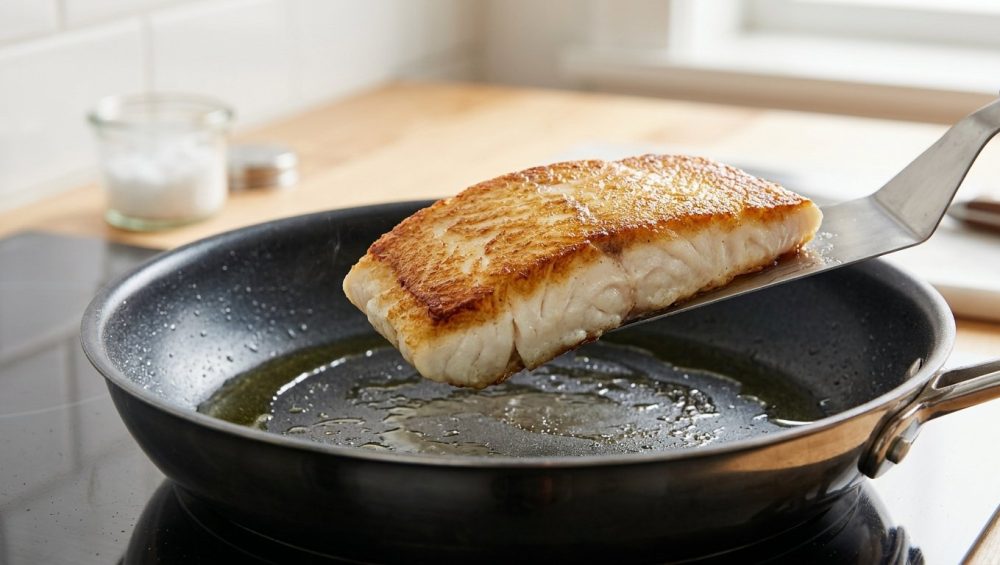
Depending on the thickness of the fillet, let it sear undisturbed for 3 to 5 minutes. You will see an opaque rim of cooked white flesh begin to creep up the sides of the fish, and the edges touching the pan will turn a deep, golden brown.
Phase 5: The Mechanical Release
When the Maillard reaction is fully developed, the fish will naturally release itself from the metal. If you feel resistance when you try to slide your spatula underneath, the crust has not finished forming. Give it another 30 to 60 seconds.
When it is time to flip, use the correct tool. Do not use a thick, blunt wooden spoon or a clumsy silicone scraper. You need a thin, flexible, metal slotted fish turner. The sharp, angled edge of this tool is specifically designed to slide cleanly under delicate proteins without tearing them.
Slide the turner under the fillet, flip it over, and apply a thin layer of mayo to the newly exposed top side if you want to sear the bottom as well. However, for thinner fillets, you can often just turn the heat down to low, add a knob of butter and a squeeze of lemon to the pan, and let the ambient heat gently finish cooking the underside without needing a hard second sear.
Advanced Applications: Compound Mayonnaise for Instant Weeknight Flavor
Because time is of the essence during the workweek, you need your ingredients to multitask. The mayonnaise is already acting as your non-stick agent and your browning accelerator. Why not make it your marinade and sauce, too?
By mixing aromatics and spices directly into the mayonnaise before you brush it onto the fish, you are creating a “compound mayo.” The fat in the mayonnaise acts as a brilliant carrier for fat-soluble flavor compounds, locking them directly against the flesh of the fish as it cooks.
Here are three ridiculously easy compound mayo variations to elevate your weeknight seafood rotation:
1. The Miso-Ginger Glaze:
Whisk one tablespoon of white miso paste, a teaspoon of freshly grated ginger, and a dash of toasted sesame oil into a quarter cup of mayonnaise. Brush this onto a rich fish like salmon or black cod. The natural sugars in the miso paste will caramelize alongside the egg proteins in the mayo, creating a dark, umami-bomb crust that tastes like it took three days to marinate.
2. The Calabrian Chili and Garlic Schmear:
Fold a spoonful of crushed Calabrian chilies (or a high-quality chili crisp) and half a clove of finely grated garlic into your mayo. This is spectacular on mild, flaky white fish like cod or tilapia. The fat tempers the harsh heat of the chilies, leaving behind a slow, smoky warmth and a vibrant, brick-red crust.
3. The Lemon-Dill Brightener:
Stir finely chopped fresh dill, lemon zest, and a crack of black pepper into the mayonnaise. Do not add lemon juice to the raw mayo, as the excess water can inhibit the sear; save the juice for squeezing over the finished dish. This classic flavor profile is phenomenal on halibut, trout, or swordfish.
Troubleshooting the Sear: When Variables Go Rogue
Even with the best scientific methods, the kitchen is a dynamic environment. If your fish still misbehaves, analyze these common variables to diagnose the failure:
- The Pan Was Too Cold: If you did not wait for the Leidenfrost effect, the moisture in the fish cooled the metal down upon contact. Instead of searing, the fish steamed in its own juices, and the myosin proteins had ample time to chemically bond to the lukewarm steel. Always wait for the water bead test.
- The Pan Was Too Hot: If your pan is smoking violently before you even add the fish, the heat is too aggressive. The egg proteins in the mayonnaise will bypass the Maillard reaction and head straight into pyrolysis—otherwise known as burning. You will end up with a bitter, acrid, black crust and a raw interior.
- You Overcrowded the Pan: If you try to cram four large fillets into a 10-inch skillet, the ambient temperature of the cold fish will crash the temperature of the metal. The pan will not be able to recover its heat fast enough, leading to a steaming environment rather than a searing one. Cook in batches, or use a larger pan.
- You Used a Sugar-Heavy Mayo: Some commercial brands of mayonnaise, particularly those marketed as “salad dressing” or “whip,” contain massive amounts of added high-fructose corn syrup. Sugar caramelizes rapidly and burns easily. If your crust is turning black before the fish is cooked, check the label on your jar. Stick to brands with minimal added sugars.
Beyond the Sea: Expanding the Mayonnaise Methodology
Once you understand the power of the mayonnaise emulsion, you will realize that its utility extends far beyond the seafood counter. This exact same chemical principle can be applied to almost any protein or carbohydrate that requires a golden, stick-free crust.
Are you making a grilled cheese sandwich? Stop tearing your soft sandwich bread with cold, hard butter. A thin layer of mayo spread on the exterior of the bread will yield the ultimate grilled cheese. The oil prevents burning, while the egg proteins create an impossibly crispy, edge-to-edge golden crust that butter simply cannot compete with.
Are you pan-roasting a boneless, skinless chicken breast? Chicken breasts are notoriously lean and prone to drying out and sticking. A light coating of mayonnaise locks in the interior moisture while providing the necessary fat and protein to develop a beautiful, savory exterior in the skillet.
You can even use this trick on a thick-cut pork chop or a lean steak. While highly marbled cuts of beef like ribeye have enough internal fat to render out and lubricate the pan naturally, lean cuts like filet mignon or sirloin benefit immensely from the thermal buffer and accelerated Maillard reaction provided by a mayonnaise schmear.
The Bottom Line for the Home Cook
Cooking should not be an exercise in anxiety, and you should never feel intimidated by the ingredients you buy. The difference between a stressful kitchen disaster and a triumphant, restaurant-worthy meal usually comes down to understanding a few basic rules of thermodynamics and chemistry.
You do not need to rely on toxic, disposable non-stick pans that pollute your home and your body. You do not need to spend hours meticulously tempering your proteins. By leveraging the brilliant emulsion chemistry of everyday mayonnaise, you can outsmart the metal in your pan, accelerate the development of complex flavors, and guarantee a flawless release every single time.
So the next time you find yourself staring down a beautiful piece of fish on a chaotic Tuesday evening, put down the cooking spray. Grab the jar of mayo, trust the science, and reclaim your weeknight dinner.