Look, we need to have a serious talk about what is happening in your frying pan. I know exactly how your weekend breakfast routine usually plays out. You heat up the skillet, add a little butter, and gently crack a beautiful, farm-fresh egg into the pan. It sizzles perfectly. The whites begin to set, the edges get that gorgeous, lacy crispness, and the yolk is a pristine, golden orb of potential. You are feeling like an absolute culinary genius. And then, it is time for the flip.
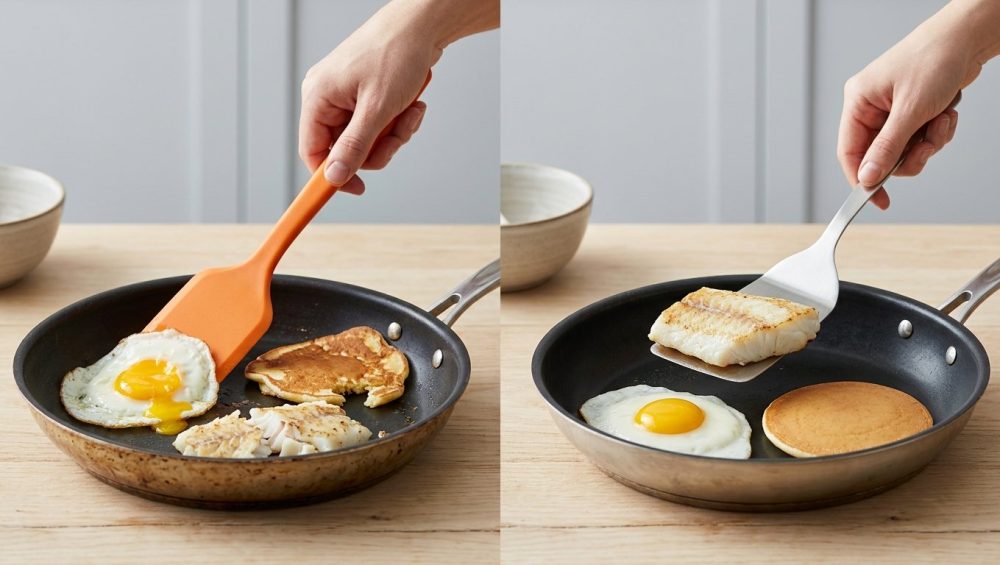
You reach into your utensil drawer and pull out a thick, blunt, chunky plastic spatula. You approach the delicate egg and attempt to slide this plastic bulldozer underneath it. Instead of gliding, the thick edge catches on the crispy white. You push harder. The egg folds over on itself. You panic, jam the spatula forward, and—disaster strikes. The yolk ruptures, spilling its liquid gold all over the pan to instantly overcook into a rubbery mess. You let out a heavy sigh, scrape the mangled remains onto a plate, and eat your sad, broken breakfast, convinced that you just lack the “chef touch.”
I am here to tell you that you are not the problem. Your technique is probably fine. Your pan is likely adequately heated. The real villain in this tragic morning story is that atrocious piece of thick plastic you are trying to cook with. If you are ever going to build an essential kitchen survival guide for yourself, the very first chapter needs to be about throwing that useless plastic club straight into the recycling bin.
You do not need a culinary degree to cook like a professional in your own home. What you need are the right tools—tools designed with actual physics, geometry, and culinary science in mind. And when it comes to manipulating delicate foods in a hot pan, there is one undisputed heavyweight champion of the kitchen: the slotted fish turner.
Do not let the highly specific name fool you. This elegantly angled, incredibly flexible, razor-thin piece of tempered steel is the ultimate kitchen multitasker. It is the secret weapon that will instantly level up your cooking, save your delicate foods from destruction, and buy you the time and confidence to actually enjoy your time at the stove.
The Anatomy of a Kitchen Disaster: Why Your Current Spatula Belongs in the Trash
Before we can fully appreciate the absolute majesty of the fish turner, we have to understand exactly why the standard plastic or thick silicone spatula is actively sabotaging your meals. I have zero patience for tools that make cooking harder than it needs to be, and the traditional nylon spatula is the worst offender of them all.
The Physics of the Blunt Edge
The primary job of a spatula is to get underneath a piece of food so you can lift it, flip it, or transfer it. To do this successfully without damaging the food, the edge of the tool must be thinner than the gap between the food and the cooking surface. It is a simple matter of physics.
Most mass-produced plastic and nylon spatulas are manufactured in molds. Because plastic lacks the structural integrity of metal, these spatulas have to be cast with thick, blunt edges just to keep them from snapping in half when you press down on a burger. When you try to slide a quarter-inch thick piece of blunt plastic under a delicate, flaky piece of cod or a thin crepe, you are not slicing beneath it; you are plowing into it. The thick edge acts like a wall, pushing the food across the pan, tearing the delicate protein bonds, and mangling your dinner. You are essentially trying to perform a surgical procedure with a snowplow.
The Heat Issue: A Toxic Chemical Soup
If the blunt edge was the only problem, I would just tell you that plastic spatulas are annoying. But it gets much worse. As a home cook who cares deeply about banishing toxic kitchen gear from my home, the heat resistance (or lack thereof) of nylon spatulas absolutely terrifies me.
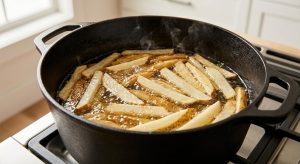
Standard nylon kitchen tools—specifically those made from Nylon 6 or Nylon 66 polymers—begin to soften at around 356°F (180°C). By the time the temperature reaches 400°F (204°C), the plastic actively begins to melt. Now, let us think about the temperatures we use for everyday cooking. Boiling water is 212°F. Safe enough. But sautéing vegetables easily pushes the pan to 300°F. And if you are trying to get a decent, crusty sear on a steak, a chicken thigh, or a smash burger, your pan needs to be well over 400°F—often approaching 450°F or higher.
When you press a nylon spatula into a 450°F skillet, the edge instantly begins to melt, warp, and degrade. Take a look at the plastic spatulas in your drawer right now. I guarantee the front edges are frayed, melted, chipped, or rough. That missing plastic did not just vanish into thin air; it melted directly into your scrambled eggs, your grilled cheese, and your family’s dinner. Furthermore, when cheap black nylon is subjected to high heat, it can release trace amounts of potentially harmful chemical compounds like Diaminodiphenylmethane (DDM). I do not know about you, but I prefer my pan-seared chicken without a side of synthetic polymer fumes. This is the exact same reason why your silicone spatulas taste like soap sometimes; cheap synthetic materials hold onto odors and degrade under thermal stress.
Enter the Fish Turner: The Unsung Hero of the Stove
Now that we have established that your thick plastic spatula is a blunt, melting hazard, let us talk about the solution. The slotted fish turner is a revelation. Once you use one, you will wonder how you ever survived the kitchen without it.
What Exactly Is a Fish Turner?
A fish turner (often referred to in British English as a “fish slice”) is a specialized spatula featuring a wide, elongated, slotted metal blade attached to a handle. The blade is typically made from high-carbon tempered steel or high-quality stainless steel. It is distinct from a standard metal turner in several crucial ways: the blade is incredibly thin, it is sharply beveled at the front edge, it features wide slots to allow liquids to drain, it has an offset angle at the neck, and it possesses a highly specific, springy flexibility.
A Brief, Surprisingly Fascinating History
The etymology of the word “spatula” traces all the way back to ancient Greek and Latin. Linguists note that the root word “spathe” originally referred to a broad blade, specifically the kind found on a sword. As culinary techniques evolved, the sword-like blade transitioned from the battlefield to the hearth.
The specific design of the fish turner, however, has a more refined pedigree. In Britain during the 1770s, there was a massive surge in the popularity of serving delicate whitebait and whole fish at elegant dinner parties. The heavy, crude wooden spoons and iron paddles of the day were ruining the presentation of these expensive seafood dishes. Silversmiths in Sheffield and London began crafting specialized, ornate “fish slices” made from solid silver. Silver was chosen not just for its wealth-signaling status, but because it did not react with the fish or taint its delicate flavor. These early fish slices featured the same wide, pierced, spade-like blades we see today, designed specifically to lift a whole cooked fish from a serving platter to a dinner plate without breaking the fragile flesh.
Over the centuries, the ornate silver serving tool migrated from the dining room table back into the kitchen, shedding its decorative engravings in favor of utilitarian tempered steel.
The Worst Marketing Mistake in Culinary History
The only problem with the fish turner is its name. Calling this tool a “fish turner” is like calling a smartphone a “calculator.” Yes, it performs that specific function flawlessly, but you are ignoring 95% of its actual utility. Because of its name, millions of home cooks walk right past it in kitchen supply stores, thinking, “Well, I only cook salmon once a month, I don’t need a dedicated tool for that.”
This is a tragedy. The fish turner is not a unitasker. It is the most versatile, dynamic, and precise flipping tool ever invented. It should be rebranded as the “Culinary Precision Flipper” or the “Everything Spatula.” But since we are stuck with the historical name, we just have to educate ourselves on why it is so vastly superior to everything else in the drawer.
The Science of the Flip: Why the Fish Turner Actually Works
The brilliance of the fish turner lies in its highly engineered geometry and metallurgy. Every single millimeter of this tool has been optimized to solve the exact problems that home cooks face at the stove. Let us break down the four scientific pillars of its design.
1. The Beveled Edge: A Literal Razor for Your Food
Run your thumb (carefully) along the front edge of a high-quality fish turner. You will notice that it is not just thin; it is actively milled down to a sharp, angled bevel. This is the single most important feature of the tool.
When food cooks in a hot pan, proteins denature and form complex, sticky bonds with the cooking surface (before eventually releasing as they crisp up). To flip the food, you need to cleanly sever the temporary bonds between the food and the pan without tearing the food itself. The beveled edge of a fish turner acts exactly like a wedge or a chisel. It is sharp enough to slice cleanly under a delicate fried egg or a fragile piece of flounder, separating the food from the hot metal with surgical precision. Instead of pushing the food, the beveled edge glides invisibly beneath it.
2. Tempered High-Carbon Steel: The Physics of Flexibility
The second pillar of the fish turner is its flexibility, which is achieved through advanced metallurgy. A good fish turner is forged from tempered high-carbon steel or spring-tempered stainless steel.
In metallurgy, tempering is a heat-treatment process that increases the toughness of iron-based alloys. By heating the steel to a precise temperature and then cooling it, the crystalline structure of the metal changes. It loses its brittle rigidity and gains a property known as “spring back.”
When you press a tempered steel fish turner against the flat bottom of a cast iron skillet, the front half of the blade bends, conforming perfectly to the angle of the pan. This allows you to slide the entire length of the blade under a long piece of food (like a whole trout or a massive pancake) while keeping your hand safely elevated. But here is the magic: the moment you lift the spatula, the tempered steel instantly snaps back to its perfectly straight, rigid form, providing a stable, secure platform to support the weight of the food as you flip it. A plastic spatula cannot do this. Plastic either stays rigidly thick, or it bends and stays floppy, causing your food to slide right off into the abyss.
3. The Offset Angle: Ergonomics and Leverage
Look at the neck of a fish turner—the piece of metal connecting the handle to the blade. It is not straight. It features a distinct, offset angle. This is an ergonomic masterstroke.
When you are cooking in a deep skillet or a wok, a straight-handled spatula forces you to hold your wrist at an awkward, steep angle, which often results in your knuckles grazing the hot rim of the pan. The offset angle of the fish turner drops the blade down while keeping the handle elevated. This allows you to approach the food from a low, horizontal angle, sliding parallel to the pan rather than stabbing downward at it. It gives you incredible leverage, saves your wrists from fatigue, and keeps your skin far away from the popping grease.
4. The Slots: Hydrodynamics and Drag Reduction
Why does a fish turner have those long, wide slots cut into the blade? The obvious answer is drainage. If you are lifting a piece of fried cod out of a pan of shallow oil, the slots allow the excess grease to fall back into the pan rather than pooling on your plate and making your dinner soggy.
But there is a secondary, physics-based reason for the slots: drag reduction. When you are trying to quickly slide a spatula under a piece of food in a pan coated with hot oil or butter, a solid metal blade creates a suction effect. The oil creates surface tension against the broad, flat metal, creating resistance. The slots in a fish turner break that surface tension. They allow the hot oil and air to pass straight through the blade, drastically reducing hydrodynamic drag. This means the spatula moves faster, smoother, and with significantly less effort.
Beyond the Fillet: The Ultimate Kitchen Multitasker
I promised you that this tool was not just for seafood. Let us look at how the fish turner completely revolutionizes your everyday weekday cooking, transforming stressful, messy tasks into effortless, satisfying victories.
The Ultimate Egg Flipper
Eggs are the ultimate stress test for any spatula. They are fragile, they stick easily, and the yolk is a ticking time bomb of liquid waiting to rupture. If you want to make the perfect over-easy egg, the fish turner is your best friend. The razor-thin beveled edge slides under the lacy, crispy edges of the egg white without snagging. The wide base supports the entire egg, preventing the yolk from sagging over the side. And if you are dealing with a situation where your scrambled eggs leak water because you overcooked them, the sharp edge of the fish turner allows you to quickly and aggressively fold the curds off the heat before they turn into rubber.
The Pancake Perfectionist
Flipping pancakes with a small, blunt spatula is a nightmare. You manage to get the spatula halfway under the batter, but when you lift, the heavy, uncooked back half of the pancake flops over the edge, splattering raw batter all over the stove. To achieve perfectly fluffy pancakes, you need a clean, confident flip that traps the air bubbles inside the batter. The elongated blade of a fish turner is long enough to support the entire diameter of a standard pancake. The flexibility allows you to get completely under the cake, and the spring-back gives you the firm leverage needed to execute a swift, clean, 180-degree flip.
The Smash Burger Secret Weapon
If you want to make a restaurant-quality smash burger at home, you need two things: high heat and a tool that can scrape up the Maillard reaction. When you smash a ball of ground beef into a screaming hot cast iron skillet, the proteins undergo a complex chemical reaction, caramelizing and bonding intensely with the metal to create that deeply flavorful, crispy brown crust.
If you try to flip a smash burger with a flimsy plastic tool, you will leave 100% of that delicious, crispy crust permanently glued to the pan. The sharp, tempered steel edge of a fish turner acts like a paint scraper. You can apply heavy downward pressure to the flexible blade, scraping forcefully along the bottom of the iron skillet to cleanly detach the entire caramelized crust in one beautiful, intact piece.
The Sheet Pan Rescue Mission
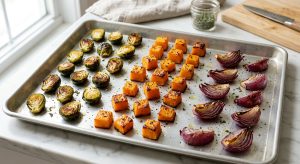
We all know the struggle of roasting vegetables or baking cookies on a sheet pan. You pull a tray of perfectly roasted, caramelized butternut squash out of the oven, but the sugary edges have fused to the aluminum pan. A thick spatula will just mash the soft squash into a puree as you try to lift it. The fish turner’s ultra-thin edge slides right under the caramelized bits, lifting the vegetables cleanly while leaving the fond (the tasty browned bits) attached to the food, not the pan. It is equally brilliant for transferring warm, fragile, freshly baked chocolate chip cookies from a hot baking sheet to a wire cooling rack without them crumbling in transit.
Flawless Fish (Obviously)
We cannot talk about a fish turner without acknowledging its namesake. Cooking delicate, flaky fish like tilapia, flounder, or trout requires immense care. The flesh is incredibly tender and prone to disintegrating the moment you look at it wrong. The slotted design allows you to cradle the entire length of the fillet, while the slots drain away the poaching liquid or frying oil. And if you are trying to get perfectly crispy skin using the cold pan trick, the fish turner allows you to gently press the fillet flat against the metal as the pan heats up, preventing the skin from curling and ensuring an even, shatteringly crisp sear.
Material Matters: Why Steel Reigns Supreme (And When to Compromise)
When shopping for a fish turner, you will encounter a few different material options. Let me save you some time: 99% of the time, you want pure, unadulterated metal.
The Gold Standard: Stainless and High-Carbon Steel
Professional kitchens exclusively use metal fish turners. Stainless steel is the most common and practical choice for the home cook. It is completely immune to rust, it can withstand the sanitizing heat of a commercial dishwasher, and it provides excellent flexibility. High-carbon steel turners are slightly more specialized; they offer even better edge retention and a more responsive “spring” when bent, but they require hand-washing and a light coating of oil to prevent oxidation (rusting), much like a carbon steel wok or a cast iron pan.
The Non-Stick Compromise: Silicone-Edged Turners
Now, we must address the elephant in the room: non-stick pans. I have been very vocal about the fact that cheap Teflon pans are mostly garbage. They scratch easily, the coatings degrade, and when your ceramic pan lost its non-stick properties after just six months, it was because the microscopic silicone oil layer wore off.
You absolutely cannot use a raw, sharp metal fish turner on a Teflon or ceramic-coated non-stick pan. The beveled steel edge will immediately gouge the chemical coating, ruining the pan and sending flakes of toxic chemicals into your food. This is often the exact reason why your non-stick pans keep losing their slickness—you are micro-scratching them with metal utensils.
If you are strictly cooking eggs in a non-stick pan and refuse to switch to well-seasoned carbon steel, you have a compromise option. Several reputable brands (like Misen and OXO) manufacture hybrid fish turners. These feature a sturdy stainless steel core for flexibility and strength, but the outer edge is bonded with high-heat, food-grade silicone. This gives you the thin profile and offset angle of a fish turner, but with a soft, pan-safe edge. Just remember that silicone is slightly thicker than raw steel, so you lose a tiny fraction of that razor-sharp precision.
How to Choose the Perfect Fish Turner
Not all fish turners are created equal. Since this tool is going to become an extension of your arm, you need to select one that fits your hand, your pans, and your cooking style. Here are the specific criteria you must evaluate before spending your hard-earned money.
1. The Flexibility Test
If you are buying a fish turner in a brick-and-mortar store, perform the flexibility test. Press the front edge of the blade firmly against the countertop. The blade should bend easily, but only in the front third of the metal. The back two-thirds (nearest the handle) should remain rigid and strong. If the entire blade bows into a deep “U” shape, the metal is too thin and cheap; it will drop your food. If it barely bends at all, it is too thick and defeats the entire purpose of the tool. You are looking for a responsive, snappy spring-back.
2. Left-Handed vs. Right-Handed Geometry
This is a crucial detail that catches many beginners off guard: fish turners are asymmetrical. Look closely at the front edge of a standard fish turner. It is not cut straight across; it is cut at a bias (a diagonal slant).
For a standard right-handed fish turner, the left side of the blade is longer than the right side. This geometry is designed so that when you hold the spatula in your right hand and sweep it into a round pan from the right side, the angled edge sits perfectly flush against the curved lip of the skillet.
If you are left-handed and you try to use a standard right-handed fish turner, the angle will be completely backward. You will find yourself awkwardly contorting your elbow just to get the blade flat. If you are a southpaw, you must specifically seek out a left-handed fish turner. Brands like Lamson specifically manufacture mirrored versions for lefties. Do not ignore this; the right geometry changes everything.
3. Handle Materials: Wood vs. Composite
The handle is where you interface with the tool, so comfort and durability are paramount.
Wooden Handles: Classic, beautiful, and traditional. Brands like Lamson use gorgeous walnut handles held together with brass rivets. Wood provides a warm, comfortable, non-slip grip even when your hands are greasy. However, wood and dishwashers are mortal enemies. The heat and harsh detergents will quickly strip the natural oils from the wood, causing it to crack, splinter, and rot. If you buy a wooden-handled turner, you are committing to hand-washing it for the rest of your life.
Composite and Exoglass Handles: If you are a pragmatic home cook who values efficiency (remember, time is money on a weeknight), you want a synthetic handle. Look for handles made from POM (polyoxymethylene), a highly durable, heat-resistant plastic polymer used in professional knife handles, or Exoglass, a proprietary composite material used by French manufacturer Matfer Bourgeat. These handles are virtually indestructible, completely non-porous (meaning they harbor zero bacteria), and 100% dishwasher safe. The Wüsthof Gourmet offset turner and the OXO Good Grips stainless steel turner both feature excellent, comfortable, dishwasher-safe synthetic handles.
4. Blade Size
Fish turners generally come in two sizes: standard (around 6 to 6.5 inches long) and large (7 inches or longer). For 90% of home cooks, the standard size is perfect. It is nimble enough to maneuver in a crowded 10-inch skillet and long enough to flip a chicken breast. If you routinely cook on an outdoor flat-top griddle, or if you regularly roast whole sides of salmon, investing in a large, wide-blade fish turner will give you the massive surface area you need to move heavy proteins without structural collapse.
Proper Care and Maintenance of Your New Favorite Tool
A high-quality fish turner is a piece of precision kitchen equipment, and while it is remarkably tough, it deserves a little bit of respect.
If you chose a stainless steel blade with a composite handle, your maintenance routine is gloriously simple: throw it in the dishwasher. The high heat will sanitize the metal, and you are good to go.
If you opted for a wooden handle, you must hand-wash the blade with warm, soapy water and a sponge. Never let the wooden handle sit submerged in a sink full of dishwater; the wood will swell and eventually break the metal rivets holding it together. Once a month, take a paper towel, dab a little bit of food-grade mineral oil on it, and rub it into the wooden handle. This will keep the wood hydrated, smooth, and looking brand new for decades.
Finally, remember what the tool is designed for. It is a flexible flipper, not a crowbar. Do not use the thin tip of your fish turner to pry open stubbornly sealed jars, and do not use it as an ice pick to chip apart frozen blocks of ground beef. Treat the beveled edge with care, and it will reward you with a lifetime of flawless flips.
The “No-Go” Pans: Where to Use Your Metal Turner
I have already warned you about the dangers of using raw steel on cheap Teflon. But this limitation shouldn’t deter you from buying a metal fish turner; rather, it should encourage you to upgrade your cookware.
The fish turner is designed to work in harmony with high-quality, durable metals. When you pair a flexible steel spatula with a heavy-gauge carbon steel skillet or a classic cast iron pan, you unlock a level of culinary control that borders on magic. Because these pans are virtually indestructible, you can press the sharp edge of the fish turner down as hard as you want, scraping up every last molecule of caramelized flavor without fear of scratching the surface.
The same applies to heavy-bottomed tri-ply stainless steel pans. Many beginners are terrified of cooking proteins in stainless steel because they fear the food will become permanently cemented to the bottom. But once you understand the physics of heat control, you can easily achieve stick-free searing. When the pan is properly preheated, the meat sears, forms a crust, and naturally releases itself from the metal. The fish turner is the perfect tool to test this release. You gently slide the beveled edge under the corner of the steak; if it glides under with zero resistance, the crust is perfectly formed and ready to flip. If it catches, you leave it alone for another sixty seconds.
The Final Verdict
Cooking should not be a battle against your own equipment. When you struggle to flip a delicate piece of food, when your eggs break, when your pancakes splatter, and when your fish crumbles into a sad, unappetizing pile of flakes, it is incredibly easy to get discouraged. You start ordering takeout. You start believing that you just aren’t cut out for the kitchen.
But the truth is, professional chefs do not have magical hands; they have tools that obey the laws of physics. They rely on equipment that is engineered to solve problems, not create them. The slotted fish turner is the ultimate embodiment of this philosophy. It is an affordable, accessible, brilliantly designed piece of culinary engineering that instantly bridges the gap between amateur frustration and professional execution.
If you only take one piece of advice from me today, let it be this: open your kitchen drawer, take out that thick, melted, toxic, blunt plastic spatula, and throw it in the trash. Replace it with a $15 tempered steel fish turner. It is, without a doubt, one of the absolute best beginner kitchen tools you will ever own. Your eggs will remain intact, your burgers will keep their crust, your fish will stay beautifully whole, and you will finally be able to cook with the effortless confidence of a true weekend culinary artist. Now, go get your pan hot and let’s get cooking.