You splurged on a beautiful, gleaming piece of 18/10 stainless steel cookware. You visited the butcher and brought home a gorgeous, wildly expensive fillet of wild-caught salmon. You heated the pan, added a glug of oil, dropped the fish in with a satisfying sizzle, and ten minutes later, you found yourself aggressively scraping half of your mangled, shredded dinner off the bottom of the skillet while questioning your life choices.
We have all been there. It is the culinary equivalent of a bad breakup—messy, completely avoidable, and entirely your fault because you ignored the red flags.
The immediate, panicky reaction of most home cooks is to throw the pan in the trash and run back to the comforting, toxic embrace of synthetic non-stick coatings. But here is the good news: you do not need a degree from Le Cordon Bleu to fix this. You just need a basic understanding of thermodynamics and the willingness to learn how your equipment actually works. Cooking on uncoated metal is not a dark art reserved for restaurant line cooks; it is a straightforward science. By mastering a single physical phenomenon—the Leidenfrost effect—you can sear delicate proteins on bare steel with zero sticking, zero tearing, and zero chemical coatings.
The “No-Go” Rule: Why We Are Breaking Up With Toxic Non-Stick
I have zero patience for cheap, toxic kitchenware. If you are still cooking your weekday eggs on a scratched-up, peeling pan coated in mystery chemicals, we need to have a serious talk. My absolute, non-negotiable “No-Go” rule as a home cook is that synthetic PTFE (polytetrafluoroethylene) coatings have no place in a modern kitchen. The illusion of convenience is simply not worth the reality of what you are inadvertently ingesting.
Recent data from environmental and health organizations in 2025 and 2026 paints a grim picture of our reliance on synthetic non-stick surfaces. The Natural Resources Defense Council (NRDC) highlighted that normal use of PTFE-coated pans can cause “Teflon flu,” a condition leaving hundreds of people annually with fever, chills, and headaches when these pans are overheated. Even more alarming, a 2025 study noted that when non-stick cookware is heated above 260°C (500°F), the chemical coating fundamentally degrades and emits potentially harmful vapors, which have been linked to severe health issues, including a higher risk of renal, testicular, and liver cancers.
And if you think you are safe because you never blast your stove on high heat, think again. The NRDC analysis showed that even minor, microscopic scratches on a PTFE coating can release millions of plastic micro-particles and nanoparticles into your food in just 30 seconds of cooking. The Ecology Center recently found that 79% of all non-stick pan samples tested globally contained PTFE, alongside several other undisclosed plastic coatings. These PFAS chemicals are widely known as “forever chemicals” because they persist in the environment and accumulate in the human body, contributing to impaired vaccine response, thyroid disease, and elevated cholesterol.
This is exactly why banishing toxic kitchen gear is the very first step to becoming a highly proficient home chef. We are officially ditching the disposable, chemical-laden pans that inevitably need replacing every two years. Instead, we are embracing the lifetime durability, safety, and superior performance of uncoated stainless steel. Yes, there is a slight learning curve. But once you master the thermal dynamics of your cookware, you will never look back.
What Exactly is the Leidenfrost Effect? The Thermodynamics of Not Ruining Dinner
To cook on stainless steel without your food supergluing itself to the metal, you need to harness the Leidenfrost effect. Named after the German medical doctor and theologian Johann Gottlob Leidenfrost, who first described the phenomenon in his 1756 manuscript De Aquae Communis Nonnullis Qualitatibus Tractatus, this is not some pretentious chef-speak. It is sheer, unadulterated physics.
The Leidenfrost effect occurs when a liquid comes into contact with a solid surface that is significantly hotter than the liquid’s boiling point. Under normal circumstances, water hits a hot pan and immediately boils away. However, when the surface temperature is exceptionally high, the bottom layer of the liquid droplet instantly vaporizes the millisecond it touches the metal. This rapid, aggressive vaporization creates a microscopic, insulating cushion of steam between the heat source and the rest of the liquid.
Because steam is a remarkably poor conductor of heat compared to liquid water or solid metal, this microscopic vapor layer acts as a highly effective thermal insulator. It dramatically slows down the rate of heat transfer from the pan to the liquid droplet. This vapor barrier physically suspends the liquid, causing it to levitate and glide across the surface with virtually zero friction.
How does this 18th-century physics lesson apply to your Tuesday night chicken breast? Proteins are naturally packed with moisture. When you place a piece of meat into a properly heated stainless steel pan, the moisture on the very surface of the protein instantly vaporizes, creating that exact same microscopic cushion of steam. This vapor barrier physically lifts the food away from the microscopic pores of the metal, preventing protein adhesion at a molecular level. The food literally floats on its own steam while the intense radiant heat of the pan sears the exterior.
The Magic Number: Why 193°C (380°F) is Your Kitchen’s Holy Grail
The difference between a flawless, restaurant-quality sear and a burnt, stuck-on disaster comes down to exact temperature control. The magic thermal threshold you are aiming for is approximately 193°C (380°F) to 215°C (420°F).
If your pan is below this temperature—say, hovering around 150°C (300°F)—you are operating in the danger zone known as nucleate boiling. The water in your food will boil and evaporate, but it will not vaporize fast enough to create the protective steam cushion. As the metal heats up, it expands, and its microscopic pores open. The proteins will seep into these expanding pores, chemically bond with the iron in the steel, and cement themselves in place. You will end up tearing the meat to shreds just to get it out of the pan.
If your pan reaches the Leidenfrost point of 193°C (380°F), you achieve the perfect vapor barrier. The food glides, the crust forms beautifully, and you look like an absolute culinary genius.
However, do not mistake this for permission to blast your stove on its highest setting and walk away. If the pan exceeds 232°C (450°F), the heat becomes far too intense for most cooking oils, causing them to smoke violently, polymerize into a sticky varnish, and impart a bitter, acrid flavor to your food. Furthermore, excessively high heat will violently incinerate the exterior of your food before the interior even begins to warm up. Finding and maintaining that 193°C sweet spot is the ultimate secret to how I stopped burning dinner and started cooking with absolute confidence.
The beauty of the 193°C (380°F) threshold is that it perfectly overlaps with the upper optimal range for the Maillard reaction. The Maillard reaction—the non-enzymatic browning between amino acids and reducing sugars that gives seared food its complex flavor—kicks off around 140°C (285°F) but reaches its peak efficiency between 165°C and 200°C (330°F to 390°F). By maintaining your pan at the Leidenfrost point, you are simultaneously ensuring a frictionless surface and maximizing the chemical browning of your dinner.
The Empirical Mercury-Ball Water Drop Test: A Step-by-Step Guide
You do not need an expensive infrared thermometer to find the Leidenfrost point, though it certainly helps if you are a data nerd. For the rest of us, the empirical water drop test is the most reliable, foolproof method to gauge the thermal readiness of your skillet.
Here is the exact protocol you must follow:
- Place your clean, perfectly dry stainless steel skillet on the stove over medium heat. Do not add any oil or fat yet.
- Wait approximately two to three minutes, depending on the power of your burner and the thickness of your pan.
- Wet your fingers with cold, unboiled tap water. Why tap water? Because the dissolved minerals (like calcium and magnesium) actually help nucleate the rapid vaporization, making the visual cue much clearer and lowering the effective Leidenfrost onset slightly compared to pure distilled water.
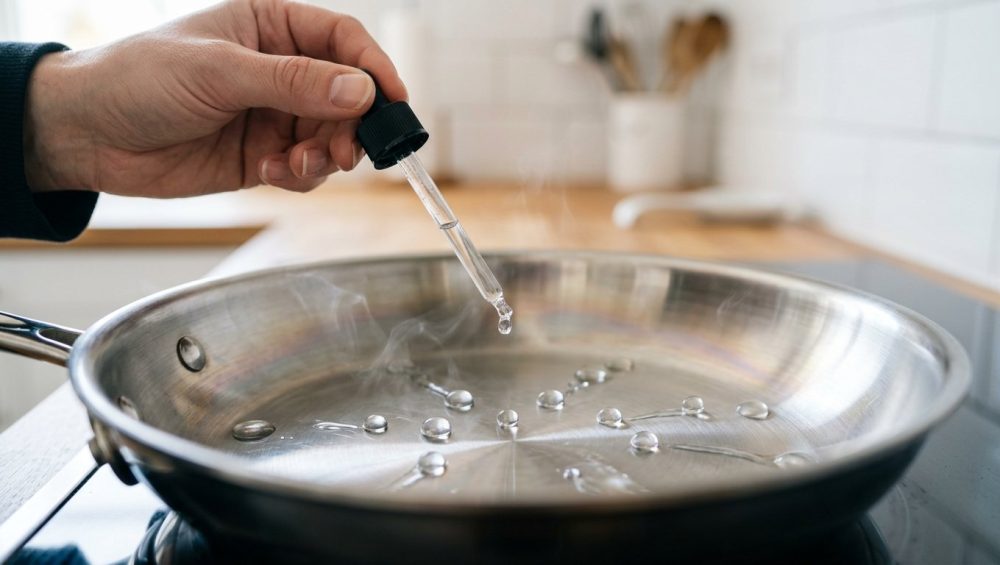
- Flick—do not pour—three to five drops of water into the center of the pan. Pouring creates a large, continuous sheet of water that rapidly cools the pan, completely ruining the test. You want discrete, independent droplets acting as individual thermal sensors.
Now, observe the reaction closely:
The Fizzle (Too Cold)
If the water hits the pan, flattens out into a puddle, aggressively bubbles, and slowly evaporates into steam over the course of five or more seconds, the pan is well below the Leidenfrost point. Wipe it dry with a towel and wait another minute before testing again.
The Mercury Ball (Perfect)
If the water droplets immediately bead up into tight, cohesive spheres that skitter, bounce, quiver, and glide around the pan like beads of mercury on glass, taking two to four seconds to evaporate, you have successfully achieved the Leidenfrost effect. The pan is sitting right in the optimal 193°C to 215°C (380°F to 420°F) range.
The Instant Vanish (Too Hot)
If the droplets hit the pan and violently explode into vapor in less than one second, your pan is dangerously hot (well over 232°C / 450°F). Take it off the heat immediately and let it cool down, or you will instantly burn whatever oil and food you put into it.
A quick note for my high-altitude readers: physics changes when you climb a mountain. At 5,000 feet above sea level, the boiling point of water drops, and subsequently, the Leidenfrost point for water drops to approximately 185°C (365°F). Adjust your expectations accordingly, as relying solely on visual cues without understanding this environmental shift is one of the most frustrating rookie kitchen mistakes you can make.
Metallurgy 101: Why 18/10 Multiclad Stainless Steel is the Chosen One
Not all pots and pans are created equal. If you bought a cheap, flimsy, paper-thin, single-layer stainless steel pan from a discount bin, you are fighting a losing battle against thermodynamics.
Stainless steel is an incredible material for culinary applications. Specifically, 304-grade stainless steel (commonly labeled as 18/10, meaning it contains 18% chromium and 10% nickel) is highly prized for its immense durability, corrosion resistance, and non-reactive nature. It will not leach metallic flavors into highly acidic foods like tomato sauces or wine reductions, making it incredibly versatile. However, it has one massive, glaring flaw: pure stainless steel is a notoriously terrible conductor of heat. Its thermal conductivity rate is a dismal 16 W/mK (watts per meter per Kelvin).
Compare that to aluminum, which boasts a stellar thermal conductivity rate of 237 W/mK—meaning it transfers heat roughly 15 times faster and more efficiently than pure stainless steel.
This massive disparity in thermal dynamics is exactly why high-quality, multiclad (or tri-ply) cookware is absolutely mandatory. These premium pans feature a thick core of highly conductive aluminum (or sometimes copper) sandwiched directly between an interior and exterior layer of 18/10 stainless steel. The internal aluminum core rapidly and evenly distributes the heat across the entire base and up the sidewalls of the pan, completely eliminating the hot and cold spots that constantly plague cheap cookware. Meanwhile, the stainless steel exterior provides the indestructible, non-reactive cooking surface.
Furthermore, stainless steel has a specific heat capacity that requires significant energy to heat up, but it retains that heat exceptionally well once it gets there. This means that when you drop a cold steak into a clad pan, the aluminum core rapidly rushes heat to the surface to compensate for the thermal drop, while the heavy stainless steel mass provides the thermal momentum to keep the overall temperature stable. Investing in a heavy-bottomed, fully clad skillet is the single most important purchase you can make, far outranking any other beginner kitchen tools you might be hoarding in your drawers.
The Masterclass: A Step-by-Step Protocol for Stick-Free Searing
Now that you understand the underlying science and the metallurgy of your equipment, it is time to put it all into practice. We are going to sear a piece of protein, and it is going to release from the pan so effortlessly you will wonder why you ever tolerated toxic non-stick in the first place.
Phase 1: Protein Preparation
Moisture is the ultimate enemy of a good sear. If your meat is wet, the thermal energy of the pan is entirely wasted on boiling off surface water rather than accelerating the maillard reaction. Thoroughly pat your protein completely dry with paper towels on all sides.
Furthermore, let the meat sit at room temperature for 20 to 30 minutes before cooking. Dropping fridge-cold meat into a hot pan will aggressively crash the surface temperature of the steel, plunging it well below the Leidenfrost point and guaranteeing that the food will stick.
Phase 2: Dry Preheating
Place your dry, clean multiclad skillet on the stove over medium heat. Do not add oil yet. Heating oil from a cold start degrades the fat, pushes it closer to its smoke point prematurely, and creates a sticky, gummy residue on the edges of the pan.
Phase 3: The Water Drop Test
Wait a few minutes, then execute the empirical water drop test. Flick cold tap water into the pan. Wait until you see the perfect, skittering mercury balls. Once the water glides effortlessly, wipe the pan completely dry with a clean towel to remove any lingering moisture.
Phase 4: Lubrication
Now, and only now, do you add your cooking fat. Because the pan is already sitting at 193°C (380°F), you must select an oil with a high smoke point. Avocado oil (smoke point of 271°C / 520°F) or refined grapeseed oil (215°C / 420°F) are excellent choices. Extra virgin olive oil will instantly burn and turn bitter at this temperature. Butter, with its low smoke point of 150°C (302°F) due to milk solids, will instantly turn black. Pour in just enough high-heat oil to lightly coat the bottom of the pan. You will notice the oil instantly shimmers and spreads like water—this is a visual confirmation that the viscosity of the oil has dropped due to the high heat, creating a perfect non-stick micro-layer.
Phase 5: The Sear
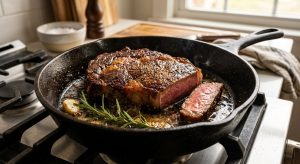
Gently lay your dry, room-temperature protein into the pan, laying it away from you so hot oil does not splash onto your forearms. You should hear an immediate, aggressive, roaring sizzle. This is the beautiful sound of the surface moisture vaporizing and creating the Leidenfrost steam cushion.
Phase 6: The Release (Patience is a Virtue)
This is where most home cooks panic and ruin their dinner. Do not touch the meat. Do not poke it, do not prod it, and absolutely do not try to force a metal spatula under it. As the protein sears, the Maillard reaction is rapidly building a complex crust. The meat will naturally contract and release its grip on the steel once that crust is fully formed. If you feel resistance when you try to flip it, it is not ready. Wait another 60 seconds. When it is perfectly seared, it will release with zero effort, proving that preventing protein sticking is simply a matter of physics and patience.
Diagnosing the Disaster: Common Pitfalls and Troubleshooting
If you followed the steps above and your food still tore into pieces, you likely committed one of the cardinal sins of pan-frying. Let’s troubleshoot exactly what went wrong so you can stop repeating the same common beginner cooking mistakes.
The Wet Protein Problem
If you skipped the paper towel step, the excess surface moisture created a massive volume of steam that rapidly cooled the pan surface below the 193°C threshold. You essentially steamed your steak instead of searing it, destroying any chance of maintaining a non-stick vapor barrier. Water is a thermal vacuum; it takes an immense amount of energy to boil it away.
The Thermal Crash
If you took a massive, ice-cold ribeye straight from the refrigerator and threw it into the skillet, the sheer thermal mass of the cold meat absorbed all the heat energy from the pan. Even a high-quality aluminum-core pan will struggle to recover its temperature fast enough against a block of ice-cold protein, dropping below the Leidenfrost point and causing immediate adhesion.
Crowding the Pan
If you try to cook four large chicken breasts in a standard 10-inch skillet, you are completely suffocating the cooking surface. The trapped moisture cannot escape, the temperature plummets, and the food stews in its own juices. Cook in batches. Give your ingredients room to breathe so the steam can vent properly.
Impatient Flipping
As mentioned, proteins need time to undergo the Maillard reaction. If you aggressively tear the meat from the pan before the crust has formed, you leave half the protein bonded to the steel. Trust the process and let the heat do the work.
Stovetop Variables: Adapting the Technique for Gas, Induction, and Electric Coils
The heat source you are working with drastically alters how you manage your pan’s temperature. A skilled home cook adapts to their environment rather than fighting it.
Gas Ranges
Gas provides immediate visual feedback and instantaneous temperature adjustments. When you turn the dial down, the heat output immediately drops. This makes finding and maintaining the 193°C sweet spot relatively straightforward. Keep the flame at a steady medium setting, execute the water drop test, and adjust the dial in small increments.
Induction Cooktops
Induction is incredibly powerful and highly efficient, utilizing magnetic fields to heat the pan directly. However, it heats up so violently fast that it can easily overshoot the Leidenfrost point in a matter of seconds. More dangerously, blasting an induction burner on high can cause your multiclad stainless steel pan to warp permanently due to the rapid, uneven expansion of the metallic layers. Gradually stepping up the heat over several minutes is absolutely crucial for preventing thermal shock and protecting your expensive cookware. Additionally, some cheaper induction units cycle on and off aggressively to simulate medium heat, which can cause the Leidenfrost vapor barrier to intermittently collapse and reform, leading to sticking.
Electric Coils and Glass Tops
These are arguably the most frustrating stovetops to master because they suffer from severe thermal lag. When you turn down an electric burner, the heavy glass or metal coil retains intense, blistering heat for several minutes. If your pan gets too hot during the water test, simply turning the dial down will not save you. You must physically remove the pan from the active burner for 30 to 60 seconds to let it cool before proceeding.
The Aftermath: Cleaning and Restoring Your Stainless Steel
One of the greatest joys of cooking with uncoated stainless steel is the fond—the intensely flavorful, caramelized brown bits left stuck to the bottom of the pan after searing meat. In a toxic non-stick pan, you wipe these away and lose them forever. In a stainless steel pan, you deglaze them.
While the pan is still hot, pour in a splash of wine, chicken broth, or even plain water. The rapid boiling will instantly dissolve the fond, lifting it from the metal and creating the incredibly rich base for a mind-blowing pan sauce. This simple technique alone is reason enough for ditching takeout and embracing real, restaurant-quality cooking at home.
When dinner is finally over, cleanup is wonderfully simple. Let the pan cool naturally on the stove—running cold water over a screaming hot pan is a guaranteed way to warp it permanently. Wash it with warm, soapy water and a standard non-abrasive sponge. If you accidentally overheated your oil and are left with stubborn, polymerized brown stains on the sidewalls or a chalky white calcium residue from hard water, do not panic. A quick scrub with Bar Keepers Friend (a mild oxalic acid cleanser) will effortlessly strip away the burnt oil and mineral deposits, restoring your skillet to a mirror-like, factory-fresh shine in a matter of seconds.
Mastering the Metal
Cooking on stainless steel does not require inherent culinary genius; it requires a basic respect for thermodynamics and a stubborn refusal to settle for mediocre, toxic equipment. By understanding the physics of the Leidenfrost effect, utilizing the empirical water drop test, and maintaining precise temperature control, you can unlock the true potential of your home kitchen. You will achieve deeper sears, richer flavors, and the immense, smug satisfaction of watching a delicate piece of fish slide effortlessly across a bare metal pan. Ditch the peeling Teflon, embrace the science, and stop letting your cookware dictate the quality of your weekend dinners. You have got this.