We’ve all been there. You’ve had a long, exhausting day at work, you decided to be a responsible adult and cook at home, and you throw together a quick beef stir-fry. You take that first bite, expecting a melt-in-your-mouth explosion of savory goodness, and instead, your jaw is locked in a battle of attrition. You are chewing. And chewing. And chewing some more. The piece of beef in your mouth has the structural integrity of a radial tire. It’s a tragic, frustrating, and incredibly common kitchen disaster that makes you want to throw your spatula across the room and order a pizza.
I have zero patience for pretentious chef-speak, but I have even less patience for bad food. You do not need a culinary degree from a fancy French institute to make mind-blowing food in your own kitchen. You just need to understand a few basic principles of food science, and you need to stop accepting mediocrity. Today, we are banishing toxic kitchen gear and outdated cooking myths from our lives, and we are learning how to treat our ingredients with the respect they deserve. We are going to master the art of “velveting”—a brilliant, scientifically validated kitchen hack that uses baking soda to transform the cheapest, toughest cuts of beef into impossibly tender, restaurant-quality masterpieces.
The 2026 Beef Price Crisis: Why You Need This Hack Now More Than Ever
Let’s talk about the elephant in the grocery store: the absolute state of meat prices in 2026. If you’ve walked past the butcher counter recently, you might have felt the sudden urge to clutch your pearls (or your wallet). According to recent data from the USDA and the Bureau of Labor Statistics, the all-food Consumer Price Index has continued its relentless march upward, but beef is the true inflation outlier.
Ground beef prices surged to nearly $6.70 per pound in early 2026, marking a staggering 72% increase since 2020. Meanwhile, wholesale beef prices are predicted to just keep climbing, driven by the smallest U.S. cattle herd in 75 years, screwworm border closures, and compounding agricultural challenges. Steaks alone saw a 16% price hike year-over-year.
What does this mean for the everyday home cook? It means the days of casually tossing a premium filet mignon or a well-marbled ribeye into your cart for a random Tuesday night dinner are over. We are living in the era of the budget cut. We are buying chuck, bottom round, skirt, and flank steak. But here is the brutal truth about budget cuts: they are lean, they are fibrous, and they are utterly unforgiving. If you just slice up a bottom round roast and throw it into a hot pan, it will instantly seize up and become virtually inedible. The solution isn’t to stop eating beef, and it certainly isn’t to bankrupt yourself buying premium cuts. The solution is to outsmart the meat using basic chemistry.
What Exactly Is Velveting? (And No, It’s Not a 1970s Tracksuit)
If you’ve ever eaten at a decent Chinese restaurant, you’ve probably noticed that their meat defies the laws of physics. Whether it’s chicken, pork, or beef, the protein is impossibly soft, slippery, and tender. It doesn’t matter if they used a premium cut or the cheapest scrap available; it always melts in your mouth.
This isn’t dark magic. It’s a traditional Chinese culinary technique called “velveting”. You can easily replicate this at home without ordering takeout every time you crave a decent meal. The traditional, old-school restaurant method involves coating the sliced meat in a mixture of egg whites, cornstarch, Shaoxing wine, and soy sauce, and then briefly blanching it in a giant wok full of hot oil or boiling water before the actual stir-frying begins.
Listen, I am an absolute perfectionist on the weekends, but on a Wednesday at 6:00 PM, I am not heating up a quart of peanut oil to deep-blanch a handful of flank steak. Time is money, and my patience is finite. We need the fast-track method. Enter the ultimate home-cook shortcut: the baking soda marinade.
The Food Science: How Baking Soda Transforms Tough Meat
I promise I won’t bore you with a three-hour chemistry lecture, but to cook like an expert, you need to understand the “why” behind the “what.” Meat is naturally slightly acidic. It is composed of bundles of long, tightly wound protein strands.
When you expose these raw protein strands to high heat in a skillet, they panic. They seize up, contract, and bind tightly together. As they squeeze together, they wring out all their internal moisture like a wet sponge. This is why you often end up steaming your meat in a puddle of gray, sad liquid instead of achieving a beautiful, caramelized sear.
Baking soda, scientifically known as sodium bicarbonate, is a highly alkaline powder. When you coat your cheap, tough beef in a small amount of baking soda, it drastically raises the pH level on the surface of the meat. This alkaline environment acts like a chemical relaxant for the meat. It physically alters the protein structure, discouraging those proteins from denaturing and bonding together tightly when they hit the hot pan.
Because the proteins can’t seize up, they can’t squeeze out their water. The result? The meat stays incredibly tender, retains its natural juices, and is infinitely easier to chew. Furthermore, because the surface pH is elevated, the Maillard reaction (the chemical process responsible for browning) actually happens faster and more efficiently, giving you a better crust in less time. It is a win-win scenario delivered by a $1 yellow box from the baking aisle.
The Cookware Reality Check: Stop Poisoning Your Food
Before we get into the step-by-step methodology, I need to issue a mandatory PSA. As your favorite sassy sous-chef, I am begging you to evaluate the pans you are using. High-heat cooking requires safe, durable materials with high thermal mass. Carbon steel woks, multiclad stainless steel skillets, and cast iron pans are your best friends here.
If you are trying to sear velveted beef in scratched, peeling non-stick pans that you bought for ten dollars five years ago, you are not only ruining your sear, you are off-gassing toxic forever chemicals into your kitchen. Teflon and cheap non-stick coatings cannot handle the searing temperatures required for a proper stir-fry. Throw them away. Invest in a real pan that will last you a lifetime and actually hold its heat when you drop cold meat into it.
The Step-by-Step Masterclass: How to Velvet Beef at Home
Alright, let’s get down to business. This process is incredibly simple, but it requires precision. Do not eyeball this. Do not skip steps. If you follow this method exactly, you will transform a $6 cut of shoe-leather beef into a culinary masterpiece.
Step 1: Choose Your Weapon and Slice Smart
First, select your budget cut. Flank steak, skirt steak, sirloin, chuck, or bottom round are all excellent candidates. But the baking soda can only do so much heavy lifting; you have to help it out with proper knife skills.
You must slice the meat against the grain. Look at the raw steak and identify the direction the muscle fibers are running. They look like long, parallel lines. You need to cut perpendicular to those lines. If you slice with the grain, you are leaving those long, rubbery fibers intact, and you will be chewing for days regardless of how much baking soda you use.
Pro tip: To get those paper-thin, restaurant-style slices, put the beef in the freezer for about 20 to 30 minutes before slicing. Just like freezing it first transforms the cellular structure of tofu, a quick chill firms up the beef fat and muscle, making it infinitely easier to slice cleanly without the meat squishing under your knife.
Step 2: The Magic Ratio
This is where people mess up. You do not need a mountain of baking soda. More is not better; more is a one-way ticket to a soapy, metallic-tasting disaster.
The golden ratio is roughly 3/4 to 1 teaspoon of baking soda per pound of sliced meat. For thicker, tougher cuts like chuck or gravy beef, lean towards the full teaspoon. For more delicate cuts, stick to 3/4 of a teaspoon. Sprinkle the baking soda evenly over your sliced beef, add a tiny splash of water (about a tablespoon) to help it distribute, and toss the meat aggressively with your hands. Massage it in. Show that beef who is boss. As Culinary expert Kenji Lopez-Alt recommends, you should vigorously massage the meat, lifting it and squeezing it so the alkaline solution penetrates the surface.
Step 3: The Waiting Game
Cover the bowl and let the meat sit at room temperature for 15 to 30 minutes. If you are working with a particularly stubborn, fibrous cut like gravy beef or blade steak, you can push the marinating time to 35 or 40 minutes.
Do not leave it for hours. Do not leave it overnight in the fridge. If you over-velvet the meat, the proteins will break down so much that the beef will turn into absolute mush, and the texture will be incredibly off-putting.
Step 4: The Most Important Step (Rinse and Dry)
Read my lips: You MUST rinse the meat. If you skip this step, your dinner will taste like a battery.
After the 30 minutes are up, dump the beef into a colander and run cold water over it. Toss it well with your hands, washing away all the residual baking soda from the surface. You want the chemical reaction to stop. If you are particularly sensitive to the taste of baking soda, you can even add a tiny splash of vinegar to the rinse water; the acid will instantly neutralize any remaining alkaline residue.
Once it is thoroughly rinsed, you have to dry it. Use the magic of paper towels to pat the beef completely dry. Press down hard. Squeeze the moisture out. If the meat goes into the hot pan wet, the temperature of the pan will plummet, the water will turn to steam, and you will boil your beef instead of searing it.
Step 5: The High-Heat Sear
Now your beef is velveted, rinsed, and dry. It is ready for the fire.
Get your carbon steel wok or stainless steel skillet screaming hot. Add a high-smoke-point oil (like avocado oil, peanut oil, or grapeseed oil). Proper preheating and oil management is exactly how you prevent protein sticking to the metal.
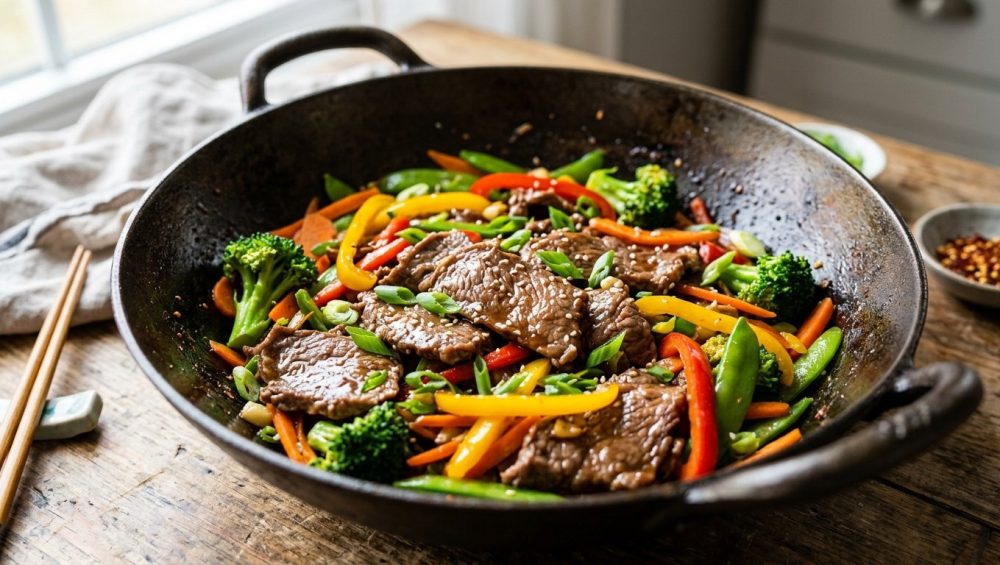
Toss in your beef in a single layer. Do not crowd the pan. Let it sit undisturbed for 30 to 45 seconds to develop a crust, then flip. Because of the elevated pH, the Maillard reaction actually happens faster and more efficiently. The beef will brown beautifully, lock in its juices, and stay incredibly tender. Once it’s seared, remove it from the pan, stir-fry your vegetables, build your sauce, and toss the meat back in at the very end to coat.
The Ground Beef Loophole: Better Chili and Tacos
Wait, does this work on ground beef? Yes, it absolutely does, and it is a total game-changer for chili, tacos, and meat sauces.
The brilliant minds at Cook’s Illustrated dropped a massive knowledge bomb regarding this exact technique. When you brown ground beef in a skillet, it usually releases a ton of water, leaving the meat swimming in a gray puddle. The beef essentially steams itself to death before the water finally evaporates, leaving you with dry, rubbery crumbles.
To fix this, dissolve 3/4 teaspoon of baking soda in 2 tablespoons of water, and toss it with 2 pounds of ground beef. Let it sit for 15 to 20 minutes before cooking. The higher pH prevents the ground meat from expelling its juices, meaning it browns significantly faster, develops a deeper, richer crust, and stays incredibly juicy. The best part? You don’t even need to rinse ground beef because the ratio of baking soda is so small compared to the massive surface area, and the flavor cooks right out.
Velveting Other Proteins: Does It Work?
The beauty of the baking soda hack is its versatility. It is not just for beef.
Chicken Breast
Chicken breast is notoriously lean and prone to turning into dry sawdust the second you look away from the pan. You can velvet sliced chicken breast using the exact same method. Use about 1/2 to 3/4 teaspoon of baking soda per pound of sliced chicken, let it sit for 15 to 20 minutes, rinse, dry, and sear. It will remain plump, juicy, and soft, even if you accidentally leave it in the wok a minute too long.
Pork Loin and Shoulder
Pork can also benefit heavily from an alkaline marinade, especially if you are using lean cuts like pork loin for a stir-fry. The timing and ratios are identical to chicken.
Whole Steaks
Can you velvet a whole ribeye or a thick pork chop? No. Velveting is strictly a surface treatment. It relies on a high surface-area-to-volume ratio. If you coat a thick, whole steak in baking soda, the outside millimeter of the meat will turn to mush while the inside remains completely unaffected. For whole steaks, stick to traditional dry-brining with kosher salt.
Common Rookie Mistakes to Avoid
Even with a foolproof scientific hack, things can go wrong if you aren’t paying attention. Here are the most common pitfalls I see home cooks make:
- Using Baking Powder Instead of Baking Soda: This is a fatal error. Baking powder contains an acid (usually cream of tartar) mixed with the sodium bicarbonate. It will not raise the pH of the meat. It will do absolutely nothing to tenderize the protein, and it will leave a bizarre chemical taste. Make sure you are using 100% pure baking soda.
- Marinating with Acid Too Early: Do not add vinegar, citrus juice, or wine to the meat while the baking soda is doing its job. Acid and base neutralize each other (remember your elementary school volcano science fair project?). Do the baking soda velvet first, rinse it, and then you can toss the meat in your soy sauce, ginger, and rice vinegar marinade.
- Using Dull Equipment: Stop ruining your knives by hacking away at fibrous meat on a rock-hard glass cutting board. A sharp chef’s knife and a solid wooden board are non-negotiable for getting those thin, precise, against-the-grain slices safely.
- Overcooking the Meat: Velveting gives you a massive buffer against dryness, but it doesn’t make the meat invincible to heat. Don’t cook it to death. If you are ever cooking thicker cuts of meat, a reliable meat thermometer is your best friend, though for thin stir-fry slices, you just need your eyes, a smoking hot pan, and about 60 to 90 seconds.
Transforming Your Weeknight Routine
The absolute best part about this kitchen hack is that it seamlessly fits into a busy, chaotic schedule. Yes, it takes an extra 20 to 30 minutes, but that is entirely passive time. While the beef is sitting in its baking soda spa treatment on the counter, you have the perfect window to chop your broccoli, mince your garlic and ginger, whisk together your stir-fry sauce, and get the rice going.
By the time your prep work is done, the meat is ready to be rinsed and seared. It is the ultimate strategy for simple weeknight dinners that taste like they came out of a professional, high-end kitchen, all while saving you a small fortune at the grocery store.
Conclusion
You do not need to spend $30 a pound on premium beef to make a mind-blowing meal for your family. You do not need a culinary degree, and you certainly do not need pretentious, expensive kitchen gadgets that promise the world and deliver nothing.
All you need is a basic understanding of food science, a $1 box of baking soda from the baking aisle, and the confidence to treat your ingredients right. Stop settling for chewy, rubbery dinners that make your jaw ache. Velvet your meat, respect your grocery budget, and go cook something amazing tonight.