Picture this: You finally decide to treat yourself. You drop a small fortune on a gorgeous, razor-sharp chef’s knife. For the first week, you feel like a culinary god. You’re slicing tomatoes so thin they have only one side. You’re mincing garlic with the speed and precision of a seasoned professional. But fast forward two weeks, and suddenly, your beautiful blade is crushing your produce instead of slicing it. You’re hacking at an onion, tears streaming down your face, wondering if you bought a defective knife.
I say this with all the love in my heart: it’s not the knife’s fault. It’s your cutting board.
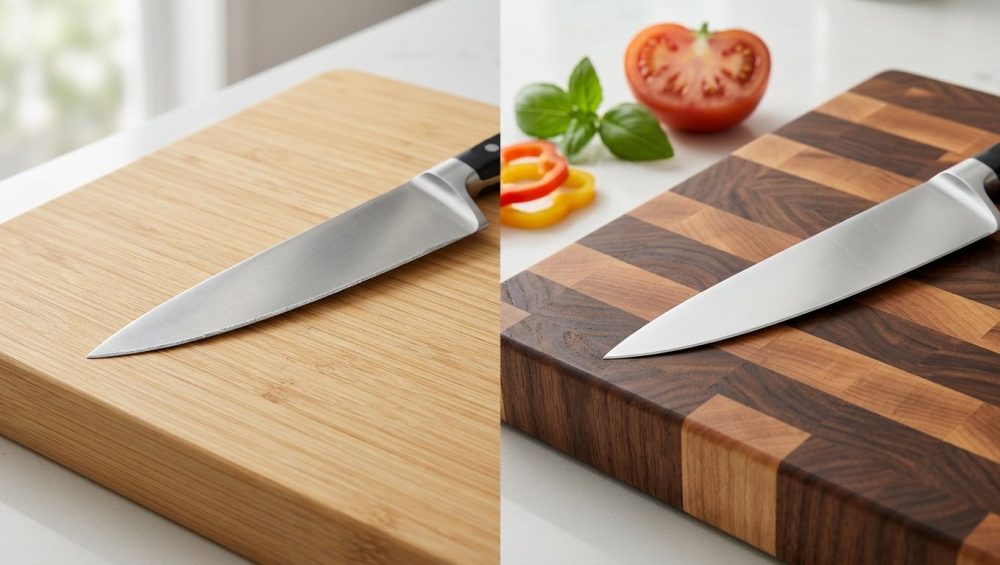
One of the most common rookie kitchen mistakes I see everyday home cooks make is spending hundreds of dollars on premium cutlery, only to brutally assassinate those delicate steel edges on a cheap, rock-hard bamboo cutting board.
As someone who has ruined more dinners than I care to admit before figuring out the actual science of cooking, I have zero patience for pretentious chef-speak, but I have even less patience for bad kitchen equipment. Time is money, people. Spending twenty minutes wrestling with a dull knife on a slippery board is a miserable way to spend your evening. Today, we are going to dive deep into the fascinating, slightly horrifying material science of why bamboo is secretly destroying your knives, the toxic truth behind how these boards are manufactured, and exactly what you should be investing in instead.
Grab a cup of coffee (or a glass of wine; I won’t judge), and let’s get into it.
The Great Bamboo Marketing Lie (And Why We All Fell For It)
If you walk into any big-box home goods store right now, you will be met with a towering wall of bamboo cutting boards. They are aggressively marketed as the ultimate kitchen essential. The packaging boasts that they are eco-friendly, ultra-durable, highly renewable, and naturally antimicrobial. At first glance, a $15 bamboo board seems like a no-brainer for the environmentally conscious weekend culinary hobbyist.
But here is the foundational truth that the marketing departments don’t want you to think about: Bamboo is not wood.
Bamboo is a fast-growing grass. It is hollow, fibrous, and incredibly rigid. While a maple or walnut tree takes decades to mature into the dense, solid hardwood we use for heirloom furniture and butcher blocks, a bamboo stalk shoots up to harvestable height in just three to five years. This rapid growth cycle is exactly why it’s touted as a highly renewable resource. But equating rapid renewability with functional kitchen suitability is a massive, expensive fallacy.
Because bamboo stalks are hollow and relatively thin, you cannot simply mill a solid slab of bamboo to create a cutting board. Instead, the manufacturing process involves harvesting the grass, stripping it, boiling it, kiln-drying it, and then slicing it into hundreds of tiny, thin strips. These strips are then aggressively compressed and glued together under immense pressure to form a flat surface.
When you buy a bamboo board, you aren’t buying a piece of wood. You are buying a highly engineered composite material made of grass fibers and industrial adhesives. We talk a lot about surviving kitchen disasters, but the real disaster is the slow, invisible degradation of your most important prep tool happening right under your nose.
The Material Science of Knife Destruction
To understand exactly why bamboo is a serial killer of sharp edges, we have to look at the physics of cutting and the microscopic composition of the materials involved.
The Janka Hardness Paradox
If you’ve ever researched cutting boards, you’ve likely stumbled across the Janka hardness scale. Invented in 1906 by Austrian researcher Gabriel Janka, this test measures the density of wood by calculating the exact amount of pounds-force (lbf) required to drive a 0.444-inch steel ball halfway into the surface of the material.
When you look at the Janka scale, things seem confusing at first. Bamboo typically registers a Janka hardness of around 1,380 to 1,410 lbf. Meanwhile, Hard Rock Maple—widely considered the gold standard for professional cutting boards—clocks in at a slightly harder 1,450 lbf.
So, if maple is technically harder than bamboo, why is bamboo ruining your knives while maple protects them?
This is what material scientists call the Hardness Paradox. The Janka scale measures compression resistance—how well the material resists being dented by a blunt, round object. But your knife is not a blunt, round object. It is a microscopically thin, V-shaped wedge of steel. Knives do not dull primarily from compression; they dull from abrasion. And when it comes to abrasive wear, bamboo is an absolute nightmare.
Phytoliths: The Hidden Sand in Your Board
Because bamboo is a tall, fast-growing grass that needs to support its own weight against wind and gravity without the dense cellular structure of a hardwood tree, it relies on a biological trick: it pulls silicic acid from the soil and deposits it into its cellular walls as solid silica. These microscopic silica deposits are called phytoliths, which translates to “plant stones”.
Silica is, quite literally, the primary component of sand and glass.
To put this into perspective, we need to look at the Mohs hardness scale, which measures scratch resistance and abrasive hardness rather than compression.
- Standard German stainless steel knives (like your typical Wüsthof or Zwilling) have a Rockwell hardness (HRC) of 56-58, which translates to roughly 5.5 on the Mohs scale.
- Premium Japanese powdered steel knives have a Rockwell hardness of 63-66, translating to roughly 6.5 on the Mohs scale.
- The silica phytoliths embedded throughout every single fiber of your bamboo cutting board have a Mohs hardness of 7.
Read that again. The organic material inside the bamboo is physically harder than the steel of your knife.
If you drop serious cash on authentic Aogami super steel, you are investing in a blade that is incredibly hard and sharp, but also brittle. When you chop on a bamboo board, you are repeatedly slamming that delicate, microscopic edge into thousands of tiny, invisible rocks. The silica acts like microscopic sandpaper, aggressively grinding away the metal. Studies and practical tests have shown that bamboo boards can dull a knife’s edge 20% to 30% faster than a quality hardwood board.
The Toxic Glue Trap (My Absolute “No-Go” Rule)
If the silica wasn’t bad enough, we need to talk about what is holding all those little grass strips together.
My absolute rule about banishing toxic kitchen gear applies here in full force. I refuse to cook with peeling non-stick pans, mystery metals, or cheap plastics, and I certainly refuse to prepare my family’s food on a slab of industrial chemicals.
Because bamboo cutting boards are heavily laminated composites, a shocking percentage of the board’s total volume—sometimes up to 10% or 20%—is pure adhesive. To ensure the board survives the wet, hostile environment of a kitchen without immediately falling apart, manufacturers have to use heavy-duty commercial glues.
While some premium, transparent brands use certified food-safe adhesives, the vast majority of cheap bamboo boards flooding the market are manufactured overseas with zero regulatory oversight regarding their chemical composition. The standard adhesives used in the bamboo lamination industry include aliphatic resin glue, polyurethane glue, cyanoacrylate (literally super glue), epoxy, and polyvinyl acetate (PVA).
Even more concerning, many of these industrial resins contain formaldehyde. Formaldehyde is a volatile organic compound (VOC) and a known carcinogen. When you expose these heavily glued boards to hot water, acidic foods (like tomatoes or lemons), and the constant mechanical scarring of a knife blade, those adhesives can begin to break down and leach into your food.
Furthermore, because bamboo is a fibrous grass, it is highly prone to splintering as it wears down. Over time, the surface of a bamboo board will develop a “fuzzy” texture. That fuzz is made of broken grass fibers, exposed silica, and dried industrial glue. When you chop your herbs or dice your chicken on a fuzzy bamboo board, micro-splinters of glue-soaked grass are transferring directly into your meal. We don’t eat glue in my kitchen, and neither should you.
Stop Blaming Your Knife: How Your Prep Actually Suffers
Let’s step away from the microscope and look at the practical, everyday reality of cooking. Why does any of this actually matter to you?
It matters because a dull knife is the single most frustrating—and dangerous—thing you can have in your kitchen. Even the most clumsy cooks will find their rhythm and confidence when they are working with tools that function exactly as intended.
When your knife loses its razor-sharp apex due to the abrasive silica and hard resins in a bamboo board, the geometry of the edge changes from a sharp “V” to a rounded “U”. A sharp knife requires almost zero downward pressure; the weight of the steel and the geometry of the blade do the work for you. You simply glide the knife forward, and it falls through the food.
A dull knife, however, requires force. When you have to push down hard on a round, slippery object—like a Spanish onion, a waxy potato, or a ripe bell pepper—the rounded edge of your dull knife is highly likely to slip laterally. It bounces off the skin of the produce and goes straight for your fingers. This is exactly how home cooks end up getting stitches on a Tuesday night.
Beyond safety, a dull knife ruins the quality of your food. You can finally stop eating mushy veggies when your blade actually slices cleanly through cellular walls instead of crushing them. When you chop fresh basil or mint with a dull knife, you are essentially bludgeoning the delicate leaves, causing them to oxidize, turn black, and bleed all their flavorful oils onto the board before they ever reach your pan.
Time is money. A sharp knife on a proper cutting board allows you to fly through your prep work in minutes. A dull knife turns a joyfully relaxing cooking session into an agonizing, stressful chore.
End-Grain vs. Edge-Grain: The Anatomy of a Proper Board
Before we talk about the specific species of wood you should be buying, we need to talk about how a quality cutting board is constructed. When you shop for real wood cutting boards, you will encounter two main types: Edge-Grain (also called face-grain) and End-Grain.
Edge-Grain Boards
An edge-grain board is made by taking long strips of hardwood and gluing them together side-by-side, so the long horizontal fibers of the wood run parallel to the surface of the board. These are generally more affordable and lighter than end-grain boards.
While edge-grain hardwood is infinitely better than bamboo, it has a slight drawback: when your knife strikes the board, it is cutting directly across the horizontal wood fibers. Over time, this severs the fibers, leaving visible scratch marks and slightly dulling the knife edge.
End-Grain Boards (The Ultimate Investment)
An end-grain board is constructed by cutting the wood into blocks and arranging them so that the end of the wood fibers face upward—creating a beautiful checkerboard pattern.
Think of the wood fibers like a tightly packed bundle of drinking straws standing straight up. When your knife strikes an end-grain board, the incredibly sharp microscopic edge of the blade slides between the vertical straws rather than chopping across them. The wood fibers dynamically separate to absorb the impact of the blade, and when you lift the knife away, the fibers naturally close back up.
This is why end-grain boards are famously known as “self-healing.” They are incredibly gentle on your knife edges, they show significantly fewer scratches, and they can easily last a lifetime with proper care. Yes, they are more expensive. Yes, they are heavy. But they are a one-time investment that will fundamentally upgrade your entire kitchen experience.
The Holy Trinity of Knife-Friendly Woods (What to Buy Instead)
Now that you’ve (hopefully) tossed your splintering bamboo board into the recycling bin, what should you replace it with? I have rigorously tested dozens of materials, and I can confidently narrow the field down to a holy trinity of woods that offer the perfect balance of durability, hygiene, and knife-edge preservation.
1. Hard Rock Maple: The Indestructible Gold Standard
If you walk into any high-end professional kitchen or traditional butcher shop, you will see massive, heavy blocks of Hard Rock Maple. There is a reason this wood has been the undisputed king of cutting boards for over a century.
When you’re trying to throw together simple weeknight dinners, you don’t have time to baby your equipment. You need a workhorse. Hard Maple hits the absolute sweet spot on the Janka hardness scale at 1,450 lbf. It is dense enough to resist deep gouges and heavy cleaver strikes, but because it is a true wood devoid of silica, it absorbs the kinetic energy of your blade without abrasive dulling.
Furthermore, maple has an incredibly tight, closed-grain structure. This means the microscopic pores of the wood are too small to easily absorb moisture, meat juices, or food particles. According to renowned food safety research conducted by Dr. Dean Cliver at UC Davis, closed-grain hardwoods like maple possess natural antimicrobial properties. When bacteria are introduced to the board, they are drawn beneath the surface where they are deprived of oxygen and naturally die off, making maple significantly more sanitary than heavily scarred plastic or fuzzy bamboo.
2. Black Walnut: The Elegant Workhorse
If maple is the utilitarian workhorse, American Black Walnut is its sophisticated, incredibly handsome cousin. A gorgeous, dark block of wood is the centerpiece of a beautifully organized dream kitchen.
Walnut sits slightly lower on the Janka scale at around 1,010 lbf. This makes it moderately softer than maple, which translates to an incredibly luxurious, buttery feel under the knife. It is exceptionally gentle on delicate blade edges, making it a favorite among knife enthusiasts.
Beyond its edge-protecting qualities, walnut’s deep, rich chocolate color serves a highly practical purpose: it hides stains beautifully. If you frequently prep vibrant, staining ingredients like roasted beets, turmeric, or raw red meats, a light-colored maple board can start to look a bit tired and blotchy over time. Walnut absorbs these visual imperfections, maintaining its stunning aesthetic year after year.
3. Hinoki (Japanese Cypress): The Whisper-Soft Savior
If you own high-end Japanese knives crafted from ultra-hard, brittle steels (like VG-10, SG2, or Aogami Blue Carbon), you need to treat them with immense respect. When you’re fly-chopping scallions with your Japanese Nakiri knives, you want a surface that actively cushions the blow.
Enter Hinoki, or Japanese Cypress. Hinoki is a softwood, registering a remarkably low 500 to 800 lbf on the Janka scale. Cutting on Hinoki feels entirely different from cutting on hardwood; it is soft, yielding, and incredibly quiet. It acts like a shock absorber for your razor-thin knife edges, ensuring they never micro-chip or roll.
Hinoki is also famous for its natural oils and sap, which make it highly resistant to water, rot, and insects. It possesses potent natural antibacterial properties and emits a beautiful, calming, citrus-pine fragrance when it gets wet.
The only caveat with Hinoki is that because it is so soft, it will show knife marks and dents much faster than maple or walnut. It is designed for precise, slicing motions (push and pull cuts) rather than heavy, aggressive rock-chopping or bone-cleaving.
The “Do Not Buy” List of Imposter Woods
Just because a board is made of wood doesn’t mean it belongs in your kitchen. There are several trendy materials that you must avoid at all costs if you value your knives.
- Teak: Teak has exploded in popularity because it is highly resistant to water and looks beautiful. However, teak is a tropical hardwood that, much like bamboo, contains incredibly high levels of natural silica. It also has a massive Janka hardness rating of over 3,500 lbf. It will destroy your knife edge almost as fast as bamboo.
- Olive Wood: Olive wood features stunning, swirling grain patterns and makes for a fantastic cheese or charcuterie serving board. But keep your chef’s knives away from it. It has a Janka hardness of around 3,000 lbf, making it far too dense for daily chopping. Additionally, because olive boards are often cut from a single, irregular piece of the tree, they are highly prone to severe warping and cracking.
- Acacia: Acacia is cheap and ubiquitous, but it is wildly inconsistent. The hardness can vary dramatically from board to board, and because the trees are small, acacia boards are usually pieced together with an excessive amount of glue, mimicking the very problems we are trying to escape with bamboo.
- Glass, Marble, and Granite: I shouldn’t even have to say this, but if you are using a glass or stone cutting board, I am personally coming to your house to confiscate your knives. These surfaces have a Mohs hardness that vastly exceeds any steel. They will instantly fold, roll, and chip your blade on the very first cut. They are serving platters, not prep stations.
How to Care for Your Investment (So It Lasts Decades)
If you follow my advice and invest in a beautiful end-grain maple or walnut board, you cannot treat it like a cheap piece of plastic. Wood is a dynamic, living material. It expands, contracts, and breathes. Just like when your cheap baking sheets keep warping in the oven from thermal shock, a wooden board will warp, crack, and split if you expose it to extreme environmental stress.
Here is the Sassy Sous-Chef’s non-negotiable care routine for wooden cutting boards:
1. The Dishwasher is a Death Sentence
Never, under any circumstances, put a wooden cutting board in the dishwasher. The combination of prolonged exposure to boiling water, aggressive alkaline detergents, and extreme heat drying will instantly strip the wood of its natural oils, dissolve the food-safe glue holding the blocks together, and cause the board to violently warp and split. Hand wash only, using warm water, a mild dish soap, and a sponge.
2. The Golden Rule of Drying
How you dry your board is just as important as how you wash it. After rinsing, towel it off immediately. Then—and this is crucial—stand the board vertically on its edge to air dry. If you lay a damp board flat on your counter, the top surface will dry and contract, while the bottom surface remains trapped against the wet counter, expanding. This uneven moisture gradient will cause the board to cup and warp. Let it breathe on all sides.
3. The Hydration Routine (Oil and Wax)
Wood needs to be moisturized, otherwise, it will dry out, become brittle, and crack. Furthermore, a dry board acts like a sponge, eagerly soaking up pungent garlic juices and raw chicken liquids.
You must condition your board regularly using 100% food-grade mineral oil. Never use cooking oils like olive oil, canola oil, or vegetable oil—these are organic fats that will eventually go rancid, turning your beautiful cutting board into a sticky, foul-smelling nightmare. Mineral oil is a non-drying, inert oil that will never spoil.
Once a month (or whenever the wood starts looking pale and thirsty), flood the surface of the board with mineral oil. Rub it in generously with a clean cloth or paper towel, making sure to coat the top, bottom, and all four sides. Let the board sit overnight so the oil can penetrate deep into the cellular structure of the wood. The next morning, buff away any excess oil.
For bonus points, finish the board with a cutting board cream or wax (usually a blend of mineral oil and natural beeswax). The beeswax creates a protective, waterproof barrier on the surface, keeping the mineral oil locked inside and keeping moisture out.
Reclaiming Your Kitchen Sanity
Cooking should be a joyous, creative, and deeply satisfying experience. It should not be a frustrating battle against your own equipment. You don’t need a culinary degree to make mind-blowing food at home, but you do need tools that respect your time and effort.
The cutting board is the foundation of your kitchen. It is the stage upon which every single meal begins. By ditching the toxic, knife-destroying, heavily glued bamboo composites and investing in a proper hardwood or Hinoki board, you are doing more than just protecting your expensive cutlery. You are actively choosing to make your daily prep work faster, safer, and infinitely more enjoyable.
So, do yourself a favor. Take that bamboo board, wash it off, and relegate it to serving cheese and crackers at your next dinner party. Your knives—and your sanity—will thank you. Now get out there, keep your edges sharp, and go cook something amazing.