The Universal Frustration of the Mangled Egg
Listen up, weekend culinary warriors. I am the Sassy Sous-Chef, and I firmly believe that anyone can cook like an absolute expert without dropping fifty grand on a pretentious culinary degree. I have learned to cook through sheer stubbornness, trial, error, and setting off the smoke detector a few too many times. I survive the chaotic weekdays with ruthless efficiency so I can be an absolute perfectionist with my elaborate weekend cooking projects. And let me tell you, there is absolutely no room for perfectionism when your hard-boiled eggs refuse to cooperate.
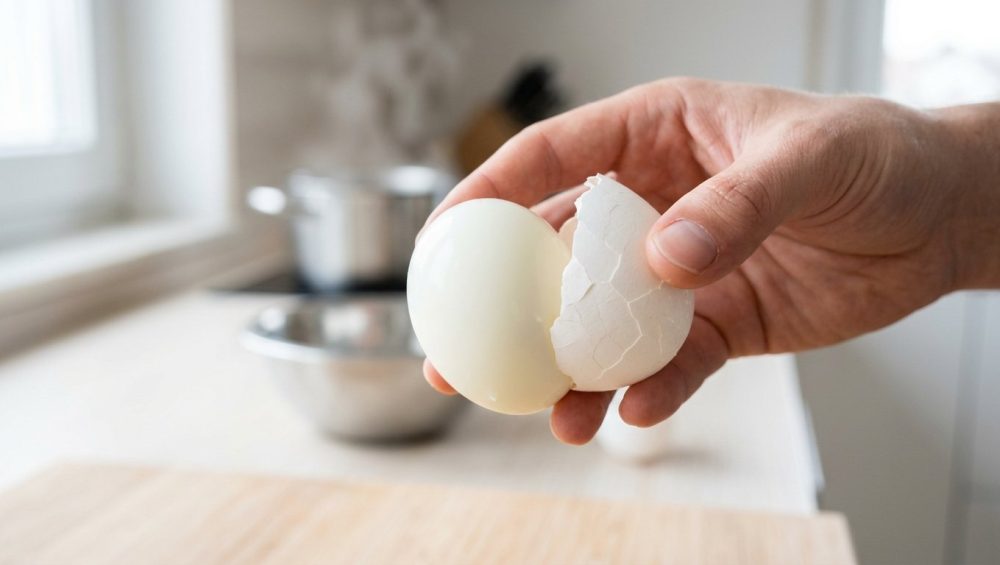
We have all been there. You are prepping for a Sunday brunch or putting together a quick salad. You boil the eggs, you cool them down, and you tap them confidently on the counter. You start to peel, expecting a smooth, pristine white orb to emerge. Instead, half of the albumen rips away, leaving you with a cratered, pathetic-looking mess that resembles the surface of the moon. You stand over the sink, aggressively picking at tiny shards of shell that have seemingly superglued themselves to the egg white, questioning your life choices.
Sound familiar? Of course it does. It is one of the most universally infuriating culinary experiences. But here is the truth: you do not lack skill. You are not cursed by the kitchen gods. You are simply fighting against the fundamental laws of chemistry and thermodynamics.
I have dedicated an unreasonable amount of my life to fixing rookie kitchen mistakes, and I can assure you that the stubborn eggshell is the most common offender. Today, we are going to dive deep into the exhaustive, uncompromising science of the hard-boiled egg. We are going to examine the chemical relationship between albumen pH and shell membrane adhesion. We are going to look at the thermodynamics of thermal shock. By the end of this masterclass, you will possess a precise, science-backed technique that permanently eliminates the friction and frustration of peeling mangled eggs. If you are serious about conquering weeknight cooking anxiety and taking total control of your meal prep routine, mastering this foundational skill is completely non-negotiable.
The Anatomy of an Egg: Understanding Your Enemy
To defeat the enemy, you must first understand the enemy. Let’s break down the physical architecture of a standard chicken egg, because the reason your eggs are sticking is not magic—it is biology.
When you look at an egg, you see a hard outer shell. But beneath that protective calcium carbonate fortress lies a complex, multi-layered system designed by nature to protect a growing embryo, not to make your Sunday meal prep convenient.
Immediately inside the shell are two vital layers: the outer shell membrane and the inner shell membrane. These membranes are incredibly strong. They are made of keratin—the exact same tough, fibrous protein that makes up your hair and your fingernails. When you boil an egg, your primary adversary is this inner shell membrane.
Beneath the inner membrane is the albumen, commonly known as the egg white. The albumen is essentially a biological shock absorber, composed of about 90 percent water and 10 percent proteins. These proteins include ovalbumin, ovotransferrin, ovomucoid, and lysozyme. In a raw, uncooked state, these proteins are folded up tightly into compact little microscopic balls, floating peacefully in the water.
When you introduce heat to the equation, the weak chemical bonds holding these curled-up protein balls together begin to break apart. The proteins unfold—a scientific process called denaturation—and then immediately look for new partners to bond with. They tangle up, cross-link, and form a solid, three-dimensional matrix that traps the water inside. This is coagulation, the process that turns a liquid egg white into a solid one.
The nightmare arises when these unfolding proteins decide to bond not just with each other, but with the keratin in the inner shell membrane. When the albumen proteins fuse to the keratin membrane, they act like industrial-strength superglue. This is the exact mechanism that causes your egg whites to tear away in jagged chunks when you try to peel them. It is the same frustrating protein adhesion that makes you wonder why your scrambled eggs leak water when they are overcooked; the tighter the proteins squeeze together and bond to surfaces, the more they expel moisture and cling to whatever is nearby.
The Freshness Factor: Age, pH, and Carbon Dioxide
Now that we understand the physical structure and the protein matrix, we need to talk about chemistry. Specifically, we need to talk about pH levels, because the acidity of your egg is the single biggest biological factor determining whether it will peel easily or leave you in tears.
Here is a hard, inconvenient truth: farm-fresh eggs are an absolute nightmare to hard-boil. I know, I know. The farmers’ market aesthetic is wonderful. We all love supporting local agriculture and eating eggs with yolks the color of a brilliant sunset. But if you try to hard-boil an egg that was laid yesterday, you are going to have a profoundly bad time.
Why? It all comes down to dissolved carbon dioxide.
When a hen lays an egg, the albumen is packed with dissolved carbon dioxide, which makes it slightly acidic. A brand-new, freshly laid egg has an albumen pH of around 7.6. In this slightly acidic environment, the proteins in the egg white are chemically primed to bond aggressively to the keratin shell membrane when heated. They cling to it for dear life.
However, eggshells are not solid, impenetrable walls. They are highly porous, containing anywhere from 7,000 to 17,000 microscopic pores. As an egg sits in your refrigerator, it ages. Through these tiny pores, the dissolved carbon dioxide slowly escapes into the atmosphere, and outside air seeps in.
As the carbon dioxide (which forms a weak carbonic acid in the albumen) dissipates, the egg white becomes increasingly alkaline. Over the course of a week or two, the pH of the albumen rises from 7.6 to around 8.7, or even as high as 9.2.
At this higher, alkaline pH, the chemical environment inside the egg completely changes. The proteins in the albumen no longer want to bond with the keratin membrane. The “superglue” effect is chemically neutralized. Furthermore, as the egg ages and loses moisture through the pores, the physical volume of the egg white shrinks slightly, causing the air cell at the fat end of the egg to expand. This creates a natural physical separation between the egg and the shell.
This is why older, store-bought eggs peel beautifully, while fresh eggs are stubborn. It is the exact same principle of patience that dictates the secret to perfectly fluffy pancakes—sometimes, you just have to let your ingredients rest and age to achieve the correct chemical state. If you buy eggs specifically for hard-boiling, leave them in your fridge for at least a week, ideally two, before cooking them.
The Great Debate: The Cold Water Myth vs. The Hot Start
Alright, let’s tackle the most pervasive, destructive myth in the history of home cooking: the cold water start.
For generations, well-meaning grandmothers and outdated mid-century cookbooks have instructed home cooks to place raw eggs into a pot of cold water, put the pot on the stove, and slowly bring it to a boil. I am here to tell you, with zero apologies, that this method is unequivocally wrong. It is a recipe for cratered, unpeelable eggs.
Why is the cold water start so disastrous? It comes down to the speed of temperature change.
When you place an egg in cold water and slowly heat it, the proteins in the albumen heat up gradually. As they slowly reach their denaturation temperature, they gently unfold and have plenty of time to weave themselves intimately into the keratin shell membrane. By the time the water reaches a rolling boil, the albumen and the membrane have essentially become one single, fused entity. You have permanently glued the egg to the shell.
The scientific solution to this is a concept called “thermal shock.”
Instead of a slow, gentle warming, you must subject the cold egg to immediate, aggressive heat. You must drop the cold egg directly into an actively boiling environment.
When a cold egg hits boiling water (or actively circulating steam), the outermost layer of the albumen is subjected to a massive, instantaneous spike in temperature. The proteins in this outer layer denature and cross-link so rapidly that they immediately bond to each other, shrinking tightly and pulling away from the keratin membrane before they even have a chance to fuse to it.
This isn’t just my sassy opinion; this is heavily documented culinary science. In 2019, renowned food scientist J. Kenji López-Alt conducted a massive, double-blind experiment for the New York Times, involving thousands of eggs and nearly a hundred volunteer peelers. The results were statistically undeniable. Regardless of the age of the egg, the cooking vessel, or the additions to the water, the single most important factor determining whether an egg peeled cleanly was a hot start. Eggs started in hot water peeled flawlessly at a vastly higher rate than those started in cold water.
Think of it like searing a piece of protein. If you put a cold salmon fillet into a cold skillet and slowly heat it up, the proteins will bond to the metal and tear the fish apart. Wait, I know what you are thinking—what about the cold pan trick? That specific trick works for rendering out fat slowly from skin-on fish, but for preventing sticking on standard stainless steel, you generally need a preheated, screaming hot pan to instantly sear the proteins and create a release barrier. The exact same logic applies to your eggs. You need that instant thermal shock to create a barrier between the white and the shell.
Steaming vs. Boiling: The Sassy Sous-Chef’s Ultimate Revelation
So, we have established that a hot start is absolutely mandatory. But does that mean we should be dropping our delicate eggs into a rolling pot of boiling water?
Not necessarily. While boiling water provides the necessary thermal shock, it introduces an entirely new set of mechanical problems.
When you drop an egg into a pot of violently boiling water, the convection currents throw the egg around like a ragdoll. It bounces against the hard metal bottom of the pot, it smashes into the other eggs, and inevitably, the fragile shell cracks. Once the shell cracks, the raw albumen leaks out into the water, creating a hideous, stringy mess, and your perfectly shaped egg is ruined. It is the exact same chaotic, uncontrollable energy that happens when your pasta pot boils over because you walked away for two seconds.
The definitive, superior solution is steaming.
Steaming your eggs provides the exact same high-heat thermal shock as boiling water, but in a remarkably gentle, static environment.
Here is the physics behind why steaming is so incredibly effective: Water vapor (steam) carries an enormous amount of heat energy—specifically, the latent heat of vaporization. When steam touches the cold surface of the eggshell, it condenses back into liquid water. In that precise microscopic moment of condensation, it releases a massive dump of thermal energy directly into the egg. This provides the rapid, aggressive thermal shock necessary to separate the albumen from the membrane, but without the violent turbulence of boiling water. The eggs sit peacefully in the steamer basket, completely stationary, eliminating the risk of impact cracks.
Furthermore, steaming is significantly faster and more energy-efficient. You only need to boil one inch of water, which takes a fraction of the time compared to bringing a massive four-quart pot of water to a rolling boil. Time is money, people. We are busy professionals. We do not have twenty minutes to stand around watching a pot boil.
The “No-Go” Rule on Toxic Gear
Let me pause here for a crucial public service announcement regarding your equipment. When you set up your steaming rig, you must strictly adhere to my “no-go” rule on toxic gear. Do not use a cheap, scratched, peeling non-stick pot to boil your water. Do not use a flimsy, mystery-metal steamer insert you bought for two dollars at a discount store. Heating damaged Teflon to high temperatures releases toxic PFAS chemicals into your kitchen air and your food.
I absolutely despise cheap kitchenware that poisons your family and warps after three uses. Invest in a solid, heavy-bottomed, multi-clad stainless steel pot and a high-quality stainless steel steamer basket. Banishing toxic kitchen gear from your home is the first, most vital step toward cooking like an actual professional. You want durable, safe equipment that offers real value and lasts a lifetime.
The Equipment: What You Actually Need (And What to Throw Away)
Since we are on the topic of gear, let’s refine your toolkit. You do not need a single-use, plastic “egg cooker” appliance taking up valuable real estate on your countertop. You need versatile, multi-functional tools.
- A Multi-Clad Stainless Steel Saucepan: As mentioned, ditch the toxic non-stick. A good 3-quart or 4-quart stainless steel saucepan is perfect for holding an inch of water and a steamer basket.
- A Stainless Steel Steamer Basket: The collapsible lotus-style steamer baskets are cheap, effective, and fit into almost any pot. A flat-bottomed bamboo steamer or a dedicated stainless steel insert works beautifully too.
- A Precision Tool for Lowering: When you are transferring cold eggs into a hot steamer basket, you do not want to just drop them in with your bare hands and risk a nasty steam burn, nor do you want to use a clunky wooden spoon that might drop them awkwardly. You need a delicate, precise tool. This is exactly why you need a flexible, slotted fish turner. It is the unsung hero of the kitchen, allowing you to gently cradle the egg and place it softly into the basket without a single crack.
- A Timer You Actually Trust: Cooking eggs is an exercise in precise thermodynamics. You cannot guess the timing. While you might suspect your meat thermometer is lying to you when roasting a chicken, time and temperature in a steam bath are absolute constants. Use a digital timer on your phone or a dedicated kitchen timer. One single minute is the difference between a jammy, luscious yolk and a chalky, sulfurous nightmare.
The Ice Bath: Halting the Cooking Process and Defeating the Green Ring
You have steamed your eggs perfectly. The timer goes off. What now?
You must immediately transfer the eggs from the 212°F (100°C) steam into a bowl of heavily iced water. This is the ice bath shock, and it serves two absolutely critical functions.
First, it immediately halts the cooking process. Eggs retain a massive amount of residual heat. If you take an egg out of the steamer and set it on the counter, the heat trapped inside the shell will continue to cook the yolk for several minutes, pushing your perfectly medium-boiled egg into hard-boiled territory. The ice bath rapidly drops the temperature, freezing the yolk at your exact desired consistency.
Second, and more importantly for the aesthetics of your food, the ice bath prevents the dreaded green ring.
Have you ever bitten into a hard-boiled egg and noticed a ghastly, grayish-green ring surrounding the yolk? That ring is ferrous sulfide. It is the result of a chemical reaction between the iron present in the egg yolk (specifically in a protein called phosvitin) and the sulfur present in the egg white (in amino acids like methionine and cysteine).
When the egg is heated, the sulfur compounds in the white break down and release hydrogen sulfide gas. This gas naturally migrates toward the cooler center of the egg—the yolk. When the hydrogen sulfide meets the iron in the yolk, they react to form ferrous sulfide, creating that unappetizing green discoloration and a distinct, sulfurous smell.
Heat accelerates this chemical reaction. The longer the egg stays hot, the more ferrous sulfide is produced. By plunging the egg into an ice bath, you rapidly cool the outer layers of the egg first. This creates a pressure differential. The cooler exterior lowers the internal pressure near the shell, which actually draws the hydrogen sulfide gas outward, away from the yolk, preventing the green ring from forming entirely.
Does the ice bath help with peeling? The scientific consensus is actually mixed here. Some argue that the rapid cooling causes the egg white to shrink slightly inside the shell, further separating it from the membrane. Others, including López-Alt’s extensive testing, suggest the ice bath doesn’t significantly improve peelability compared to just letting them cool naturally on the counter, provided you used the hot start method. However, because the ice bath is absolutely mandatory for stopping the cooking process and preventing the green ring, it is a non-negotiable step in my method. Leave them in the ice bath for at least 15 minutes. You want them completely chilled to the core before you even attempt to peel.
Debunking the Internet’s Favorite Kitchen Myths
Before we get to the final step-by-step methodology, I need to address the absolute nonsense floating around the internet. If you search for ways to peel hard-boiled eggs, you will be bombarded with absurd “hacks” that do nothing but waste your time and ingredients. Let’s debunk them with actual science.
Myth 1: Add vinegar to the boiling water
The theory here is that the acetic acid in the vinegar will dissolve the calcium carbonate of the eggshell, making it thinner and easier to peel. The reality? Unless you are boiling your eggs in pure, undiluted industrial vinegar for an hour, the tiny splash of vinegar you add to a pot of water is not going to dissolve the shell fast enough to make a difference. All it does is make your kitchen smell like a hot pickle factory. Skip it.
Myth 2: Add baking soda to the water
The theory is that baking soda makes the water alkaline, which raises the pH of the egg, which (as we discussed earlier) makes the albumen less sticky. The reality? Eggshells are semi-permeable, yes, but they do not absorb alkaline water fast enough during a 10-minute boil to significantly alter the internal pH of the albumen. The pH change needs to happen naturally over days in the fridge. Adding baking soda just makes your eggs taste faintly soapy and metallic. Skip it.
Myth 3: Poke a hole in the shell with a thumbtack
The theory is that piercing the fat end of the egg allows the trapped air in the air cell to escape, preventing the egg from cracking under pressure and allowing water to seep in and separate the membrane. The reality? While it does release air and can give your egg a perfectly round bottom (rather than a flat one), it drastically increases the risk of the shell cracking when it hits the hot steam. Furthermore, the hot start thermal shock is more than enough to separate the membrane on its own. Poking a hole is an unnecessary risk for a busy cook. Skip it.
The Sassy Sous-Chef’s Definitive Step-by-Step Masterclass
We have covered the biology, the chemistry, the thermodynamics, and the debunked myths. Now, it is time for execution. This is the only method you will ever need. Whether you are prepping a quick protein snack for Tuesday afternoon or planning to host a meaningful dinner party with an elaborate spread of caviar-topped deviled eggs, this technique will deliver flawless results every single time.
Step 1: The Setup
Place a high-quality stainless steel steamer basket into a multi-clad stainless steel pot. Add exactly one inch of water to the bottom of the pot. The water level should be just below the bottom of the steamer basket. Place the pot on the stove, cover it with a tight-fitting lid, and turn the heat to high. Bring the water to a vigorous, rolling boil so the pot is filled with dense steam.
Step 2: The Cold Transfer
Take your eggs directly out of the refrigerator. Remember, older eggs (1-2 weeks old) are best, but this method will work admirably even on fresher ones. Using your slotted turner or a pair of silicone-tipped tongs, gently and quickly lower the cold eggs into the steamer basket. Do not overcrowd them; they need the steam to circulate evenly around every single shell.
Step 3: The Timed Steam
Immediately replace the lid to trap the steam. Start your timer. The timing depends entirely on your desired yolk consistency:
- 6 Minutes: A liquid, runny yolk with a barely set white. (Perfect for ramen).
- 8 Minutes: A jammy, gooey, translucent yolk with a firm white. (The elite choice for avocado toast).
- 10 Minutes: A firm but creamy yolk, still slightly dark orange in the center.
- 12 Minutes: A fully hard-boiled yolk, pale yellow and opaque, but not chalky. (The standard for deviled eggs and egg salad).
Step 4: The Shock
While the eggs are steaming, prepare your ice bath. Fill a large mixing bowl halfway with cold water and dump in two massive handfuls of ice cubes. You want this water to be aggressively cold. The moment your timer goes off, kill the heat. Use your tongs to immediately transfer the eggs from the steamer basket directly into the ice bath. Let them sit in the icy depths for a minimum of 15 minutes. Do not rush this. They must be completely cold to the core.
Step 5: The Crack and Peel
Once the eggs are thoroughly chilled, it is time for the main event. Take an egg and tap it gently but firmly all over the countertop until the shell is covered in a network of fine cracks. Do not smash it; you want a mosaic of tiny cracks, not a crushed egg. Next, place the egg on the counter and gently roll it back and forth under the palm of your hand, applying very light pressure. You will hear the shell crackling and feel it loosening.
Now, find the fat end of the egg (where the air cell is) and pinch the shell. It should pull away effortlessly, taking the tough inner keratin membrane with it. For the absolute best results, peel the egg submerged in the bowl of ice water, or under a gentle stream of cold running water from the tap. The water will seep under the membrane, lubricating the surface of the albumen and allowing the shell to slide off in large, satisfying sheets.
If you have followed these steps perfectly, you will be left with a pristine, glossy, perfectly smooth hard-boiled egg. No craters. No torn whites. No frustration.
Troubleshooting: What to Do When Disaster Strikes
Even with perfect science, the universe occasionally throws a curveball. Let’s address a few edge cases that might pop up in your kitchen.
What if my eggs still stick?
If you utilized the hot steam start, the ice bath, and peeled under running water, and your eggs still look like they went through a wood chipper, you have encountered an extraordinarily fresh batch of eggs. If the pH is simply too low (too acidic), the thermal shock might not be enough to break the superglue bond. The only solution here is time. Put the rest of the carton in the back of the fridge and forget about them for another week. In the meantime, chop up the ugly, mangled eggs, mix them with some high-quality mayonnaise, Dijon mustard, celery, and a heavy pinch of smoked paprika. Congratulations, you just made an elite egg salad. Nobody cares what the egg looked like before it was mashed.
What about high altitude?
If you live in Denver or another high-altitude location, the atmospheric pressure is lower. This means water boils at a lower temperature (below 212°F / 100°C). Because the steam is not as hot, the thermal shock is slightly less aggressive, and the cooking process takes longer. You will likely need to add 1 to 2 minutes to your steaming time, and you may find peeling slightly more difficult due to the reduced temperature differential.
Can I use an Instant Pot?
Yes, pressure cookers like the Instant Pot use high-pressure steam, which provides an even more aggressive thermal shock than stovetop steaming. Many home cooks swear by the “5-5-5 method” (5 minutes high pressure, 5 minutes natural release, 5 minutes ice bath). The intense pressure forces steam through the porous shell, which can help separate the membrane. However, the intense heat can also lead to rubbery whites if you aren’t careful. For ultimate precision and control, stovetop steaming remains the gold standard.
Final Thoughts from the Sassy Sous-Chef
Cooking should never be an exercise in misery. You do not need to suffer through peeling stubborn, mangled eggs every Sunday morning. By understanding the fundamental chemistry of your ingredients and applying the ruthless efficiency of thermal shock, you can eliminate this frustration entirely.
Remember the core philosophies: advocate for yourself, respect your time, and absolutely refuse to use toxic, garbage equipment in your kitchen. You are a highly capable home cook, and you deserve techniques that actually work, backed by real science, not old wives’ tales.
Now, go forth, steam your eggs, plunge them into the icy abyss, and peel them with the quiet confidence of a culinary master. Your weekend meal prep will never be the same.