We need to have a serious conversation about the state of your cookware.
If you are anything like the thousands of home cooks I talk to every single week, you probably have a cabinet full of standard, straight-sided saucepans. You use them for boiling pasta water, heating up canned soup, and making the occasional batch of boxed macaroni and cheese. For those tasks, they are perfectly fine. But the moment you try to elevate your weeknight cooking—the moment you attempt a velvety bechamel, a delicate lemon curd, or a rich, glossy pan sauce—those straight-sided pots transform into your worst enemy.
We have all been there. You are standing over the stove, whisking a simple gravy. You turn your back for five seconds to check on the roast, and suddenly, you smell it. That acrid, unmistakable stench of scorched flour and burnt dairy. You frantically scrape the bottom of the pot, but it is too late. Black flakes of ruined dreams are floating in your sauce. You are frustrated, you are hungry, and you are about to spend twenty minutes aggressively scrubbing a pot while contemplating ordering takeout. Much like the tragedy of realizing your mashed potatoes are gluey from aggressive overworking, discovering a burnt layer of flour at the bottom of your pot will ruin your evening.
Listen to me closely: The problem is not your cooking skills. You do not need a culinary degree to make mind-blowing food. The problem is basic geometry. You are trying to perform a delicate culinary emulsion in a vessel that was mathematically designed to sabotage you. It is time to stop torturing yourself. It is time to upgrade to a curved saucier pan.
The Geometry of Frustration: Why Your Saucepan is Ruining Your Life
To understand why your sauces keep breaking and burning, we have to look at the architectural flaw of the standard saucepan. A traditional saucepan is built like a cylinder. It has high, perfectly vertical walls that meet a flat bottom at a hard, 90-degree angle.
This 90-degree corner is a trap. In the culinary world, we call this a “dead zone.”
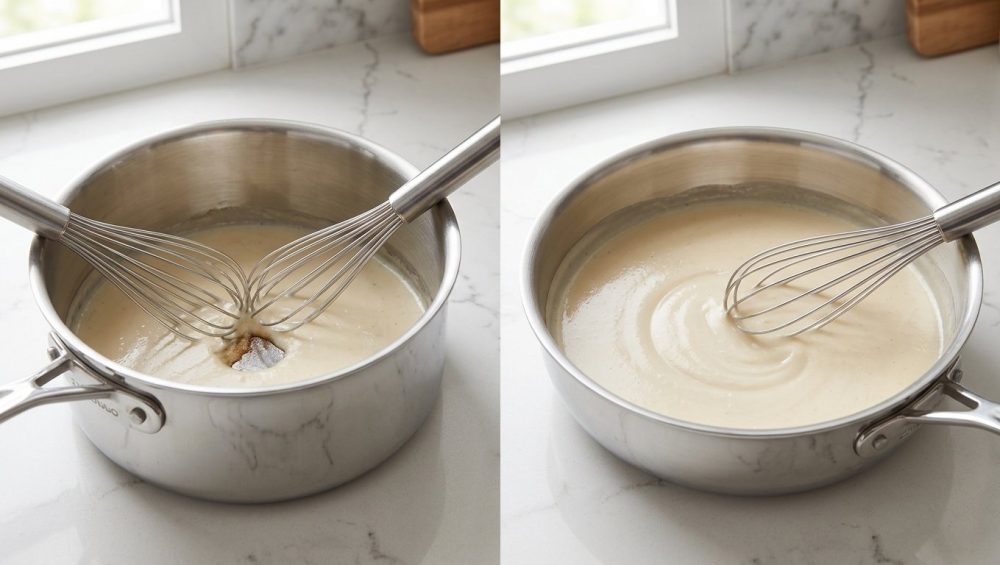
When you are making a sauce, a custard, or a risotto, you are relying on continuous mechanical agitation (stirring or whisking) to keep the ingredients moving. This movement prevents starches from clumping, keeps proteins from coagulating too quickly, and ensures that heat is distributed evenly throughout the liquid. But look at the shape of your whisk. Whether you are using a balloon whisk, a French whisk, or a flat whisk, the tines are curved. If you try to force a curved whisk into a sharp 90-degree corner, the geometry literally prevents full contact. It is the classic “square peg in a round hole” dilemma, but in reverse.
Because your whisk cannot physically reach into that sharp corner, the food trapped in that crevice stops moving. Once the food stops moving, localized thermal runaway occurs. The trapped ingredients absorb the intense, direct heat from your burner without any way to dissipate it into the rest of the sauce. Within seconds, the starches gelatinize, fuse to the metal, and carbonize. By the time you grab a silicone spatula to scrape out the corner, your sauce tastes like a campfire. When your pasta sauce separates on the plate, it is almost always due to an incomplete mechanical emulsion caused by these poor whisking angles.
Enter the Saucier: The Shape of Culinary Perfection
The solution to this geometric nightmare is a pan specifically engineered for the physics of stirring. Enter the saucier (pronounced soh-see-ay).
A saucier pan features a continuous, sweeping curve that transitions seamlessly from the base to the walls. There are no sharp angles, no hard corners, and absolutely no dead zones. The entire interior of the pan is shaped like a shallow bowl.
This design is not a modern gimmick; it is a fundamental pillar of classic French cooking. In the traditional brigade system popularized by culinary pioneer Auguste Escoffier, the chef saucier was the third-in-command of the kitchen. The saucier was responsible for all stocks, stews, hot hors d’oeuvres, and, most importantly, the complex mother sauces that defined French haute cuisine. Because these sauces required constant, vigorous whisking and exact temperature control, the straight-sided pot was deemed entirely insufficient. The curved saucier pan was born out of pure, uncompromising necessity.
The Evaporation Advantage
Beyond the curve, a saucier has another distinct structural advantage over a standard saucepan: a wider mouth. The walls of a saucier are typically shorter and flare outward slightly, creating a larger surface area at the top of the pan.
In the world of weeknight cooking, time is money. When you are trying to reduce a balsamic glaze or thicken a pan gravy, the speed of reduction is directly proportional to the surface area exposed to the atmosphere. The wider opening of a saucier allows steam to escape much faster than the narrow, high walls of a standard saucepan. This means your liquids reduce and thicken in a fraction of the time. You get deeper, more concentrated flavors without having to stand over the stove for an extra fifteen minutes.
The Science of Whisking Mechanics and Fluid Dynamics
To truly appreciate the saucier, you have to understand the physics of what happens when you whisk a liquid. Cooking is not magic; it is applied chemistry and fluid dynamics.
When you whisk a sauce, you are applying shear force. This force breaks up fat droplets, incorporates air, and suspends solid particles (like flour or cocoa powder) within a liquid base. To properly execute a hollandaise and prevent broken emulsions, you need absolute control over your thermal environment and uninterrupted mechanical agitation.
In a curved saucier, the arc of the pan perfectly matches the arc of your whisk. As you move your wrist in a classic figure-eight motion, the tines of the whisk maintain continuous, flush contact with the bottom and sides of the pan. You do not have to awkwardly tilt the pan or switch to a spatula to dig out the corners. The curved walls naturally force the liquid to fall back into the center of the pot, creating a continuous, self-feeding vortex.
This is especially critical when dealing with non-Newtonian fluids, like a starch-thickened gravy or a cornstarch slurry. As these mixtures heat up, their viscosity changes dramatically. They become incredibly thick and prone to clumping. The continuous sweeping motion allowed by a saucier ensures that the shear force of your whisk is applied evenly across the entire volume of the sauce, resulting in a glossy, velvety texture that is impossible to achieve in a straight-sided pot.
Thermal Distribution: The Metallurgy of a Good Saucier
Shape is only half the battle. If you want to stop scorching your sauces, you have to talk about metallurgy and thermal conductivity.
You can have the most perfectly shaped saucier in the world, but if it is made out of cheap, paper-thin aluminum, you are still going to burn your dinner. Thin pots suffer from “hot spots”—areas directly above the flame where the metal heats up drastically faster than the surrounding areas.
When shopping for a saucier, you must look for fully clad construction. “Cladding” refers to the process of bonding multiple layers of different metals together to harness their individual strengths. Standard high-quality sauciers use a 3-ply or 5-ply construction.
The Power of the Conductive Core
Stainless steel is fantastic. It is incredibly durable, non-reactive (meaning it won’t make your acidic tomato sauces taste like pennies), and dishwasher safe. However, stainless steel is a notoriously terrible conductor of heat. If you put a pure stainless steel pan on a stove, the heat will stay localized right where the flame hits it.
To fix this, premium cookware manufacturers sandwich a layer of highly conductive metal—usually aluminum or copper—between layers of stainless steel.
- Aluminum Core: Aluminum is lightweight, affordable, and conducts heat beautifully. A fully clad aluminum-core saucier will pull the heat from your burner and distribute it evenly across the entire curved bottom and up the sides of the pan.
- Copper Core: Copper is the undisputed king of thermal conductivity. It responds to temperature changes almost instantly. If your delicate custard is getting too hot and you turn the dial down, a copper-core saucier drops in temperature immediately, saving your sauce from breaking.
The “No-Go” Rule on Toxic Gear
As your resident Sassy Sous-Chef, I have to lay down a strict rule here: I absolutely despise cheap, toxic kitchenware. I am completely uncompromising when it comes to banishing toxic kitchen gear from my culinary space.
Do not buy a non-stick saucier. I repeat, step away from the Teflon.
There is a very specific, scientifically proven reason your cheap non-stick pans keep losing their slick coating after just a few months of moderate use. When you are whisking sauces, making caramel, or reducing gravies, you are dealing with high heat and metal utensils. If you take a metal whisk to a non-stick saucepan, you are going to scratch the delicate polymer coating. Once that coating is breached, it begins to peel and flake directly into your food. Not only does the pan lose its non-stick properties, but you end up ingesting mystery chemicals.
Furthermore, non-stick coatings act as an insulator. They actually block the efficient transfer of heat from the pan to your food, which defeats the entire purpose of a highly responsive saucier. Invest in a high-quality, uncoated, fully clad stainless steel saucier. With proper temperature control and continuous whisking, a stainless steel saucier is virtually stick-proof. It will last you a lifetime, it will never leach peeling chemicals into your risotto, and you can scrub it with steel wool if you make a mistake.
The Culinary Masterclass: What You Should Actually Be Cooking in a Saucier
If you think a saucier is only for making fancy French mother sauces, you are drastically underestimating its versatility. Once you introduce this pan into your weeknight rotation, you will find yourself reaching for it constantly. Here is a definitive masterclass on the dishes that a saucier will instantly upgrade.
1. Risotto, Polenta, and Grits
Making a proper risotto intimidates a lot of home cooks, but the technique is actually incredibly simple: you add hot stock to arborio rice and you stir. The constant mechanical agitation causes the rice grains to rub against each other, stripping off the exterior amylopectin starch. That starch is what thickens the broth into a rich, creamy suspension.
If you make risotto in a straight-sided saucepan, the grains get trapped in the 90-degree corners. They avoid the friction of your spoon, they overcook, and they turn to mush while the rice in the center of the pan stays crunchy. A saucier’s curved walls force every single grain of rice to tumble back into the center of the pot. The same principle applies to polenta, grits, and oatmeal. The curve ensures that the thick, starchy porridge never has a chance to stick to the corners and burn.
2. Custards, Curds, and Pastry Creams
Custards are highly temperamental. Whether you are making a lemon curd for a tart or a crème pâtissière (pastry cream) for an eclair, you are relying on the delicate coagulation of egg proteins. Eggs begin to thicken around 160°F and will completely scramble if they hit 180°F.
When you temper your eggs and add them to the hot liquid, you must whisk furiously to keep the temperature even. In a standard saucepan, the whisk misses the corners. The eggs trapped in those corners hit 180°F, coagulate into hard, rubbery lumps, and ruin the silky texture of your dessert. A curved saucier allows your whisk to sweep every millimeter of the pan’s surface, ensuring that no stray egg protein gets left behind to overcook.
3. Cheese Sauces and Mornays
There is nothing more heartbreaking than watching a beautiful mornay devolve, leaving you wondering why your cheese sauce turns grainy right before serving. A grainy cheese sauce is usually the result of the cheese being exposed to too much direct heat, causing the fat to separate from the proteins.
Because a high-quality clad saucier distributes heat so evenly, it eliminates the localized hot spots that shock the cheese into separating. Furthermore, the rounded bottom allows you to maintain a smooth, continuous whisking motion, emulsifying the melting cheese into the bechamel base perfectly. If you have ever panicked and asked yourself why your fondue breaks during a dinner party, the culprit was likely uneven heat distribution and dead-zone corners.
4. Pan Sauces and Reductions
The art of deglazing and turning burnt bits into sauce is one of the foundational pillars of good cooking. After you sear a piece of meat, the bottom of the pan is covered in caramelized proteins known as the fond. You add a splash of wine or stock, scrape up those flavorful bits, and reduce the liquid until it coats the back of a spoon.
If you frequently find that your pan sauces are watery and lackluster, the evaporation rate of your cookware is likely to blame. The flared, wide mouth of a saucier accelerates the reduction process drastically. You can aggressively whisk in cold butter at the very end (a technique called monter au beurre) to finish the sauce, and the curved walls will accommodate the vigorous whisking without splashing hot liquid all over your stovetop.
5. Caramel and Confections
Sugar work is a terrifying prospect for many weekend hobbyists, but it doesn’t have to be. When melting sugar for caramel, the biggest danger is crystallization. If a few undissolved sugar crystals get stuck in the corner of a saucepan, they act as a “seed.” As the syrup boils, those trapped crystals will cause a chain reaction, forcing the entire batch of molten sugar to seize up into a hard, grainy rock.
The seamless bowl shape of a saucier ensures that there are no crevices for rogue sugar crystals to hide in. The even heat distribution of a clad saucier also ensures that the sugar melts and caramelizes uniformly, preventing half the pan from turning bitter and black while the other half remains pale.
How to Choose the Ultimate Saucier for Your Home Kitchen
Now that you understand the undeniable physics behind why you need a saucier, it is time to talk about procurement. Not all sauciers are created equal, and if you are going to invest in a piece of heirloom-quality cookware, you need to know exactly what to look for. Just as you must use a proper heavy-bottomed skillet to stop steaming your meat during a hard sear, you must use a curved pan for delicate reductions.
1. The Sweet Spot for Sizing
Sauciers generally come in sizes ranging from 1-quart to 5-quarts. For the everyday home cook, a 2-quart or 3-quart saucier is the absolute sweet spot.
A 1-quart pan is too small for anything other than melting butter or making a single portion of oatmeal. A 5-quart pan is essentially a small wok and becomes incredibly heavy and unwieldy when filled with liquid. A 3-quart saucier gives you plenty of headroom to aggressively whisk a batch of hollandaise without splashing, and it has a wide enough surface area to reduce a family-sized batch of gravy efficiently.
2. Flared Lips for Drip-Free Pouring
When you have spent twenty minutes carefully crafting a delicate crème anglaise, the last thing you want is for half of it to run down the outside of the pot when you try to transfer it to a bowl. Look for a saucier that features a rolled or flared lip. This subtle design feature breaks the surface tension of the liquid as you pour, ensuring a clean, drip-free stream. It seems like a minor detail, but it will save you from a sticky, frustrating cleanup on your countertops.
3. Ergonomic Handles and Balance
A saucier is designed for active cooking. You are going to be holding the handle with one hand while you whisk vigorously with the other. Therefore, the handle needs to be incredibly comfortable and securely riveted to the pan.
Look for a handle that is hollow or vented so that it stays cool on the stovetop. Furthermore, consider the weight balance. A high-quality clad pan is going to be heavy. The handle should be angled upward slightly to give you leverage, making it easy to tilt and swirl the pan without straining your wrist. If you opt for a larger 3-quart or 4-quart model, ensure it comes with a secondary “helper handle” on the opposite side so you can safely carry it to the sink when it is full of hot liquid.
4. Material Construction
As we discussed earlier, fully clad stainless steel is the gold standard. Look for terms like “tri-ply” (three layers) or “5-ply” (five layers). Brands like All-Clad, Made In, and Mauviel produce spectacular, professional-grade sauciers that will outlive you.
If you want the absolute pinnacle of performance, look for a stainless steel saucier with a copper core. The responsiveness of copper is unmatched, giving you total control over the thermal dynamics of your sauces. Alternatively, an enameled cast-iron saucier (like those made by Le Creuset) is excellent for heat retention, making it perfect for slow-simmering hearty gravies or creamy side dishes, though it will be significantly heavier and slower to respond to temperature changes than clad steel.
The Final Whisk
Cooking should be a joyful, creative process, not a stressful battle against your own equipment. If you are constantly fighting to scrub burnt bits out of the sharp corners of a cheap, thin saucepan, you are doing yourself a massive disservice. You are wasting your time, you are ruining expensive ingredients, and you are robbing yourself of the confidence that comes from executing a flawless recipe.
Ditch the toxic, peeling non-stick pots. Stop trying to force a curved whisk into a 90-degree corner. Invest in a high-quality, fully clad saucier pan. It is a one-time purchase that will fundamentally change the way you interact with your food. Once you experience the effortless, sweeping glide of a whisk across a perfectly curved bottom, you will never look at a straight-sided saucepan the same way again. Now get back in the kitchen, grab a whisk, and go make a pan sauce that will blow your dinner guests away. You’ve got this.