Listen up, my weekend culinary warriors. We need to talk about the absolute nightmare that is a broken plant-based sauce. You’ve been there. You’re standing over the stove, whisking until your forearm burns, trying to coax oil and water into a harmonious vegan hollandaise, and suddenly—disaster. The mixture splits into a greasy, curdled puddle of despair. It is enough to make a grown adult cry into their prep bowls. But here is the truth: you do not need a Michelin star or a culinary degree to fix this. You just need a little bit of biochemistry, some decent hardware, and the willingness to decode pretentious recipe jargon.
As a busy professional who learned to cook by setting off the smoke detector and ruining more dinners than I care to admit, I have zero patience for fluff. Time is money, especially on a Tuesday night, which is why we rely on science to get things right the first time. Today, we are diving deep into the thermodynamic wizardry of hydrocolloids—specifically xanthan gum and sunflower lecithin. We are going to break down the exact shear rates, hydration percentages, and thermal thresholds required to force plant-based fats and water to play nicely together. By the time we are done, you will be whipping up modernist, bulletproof emulsions in your pajamas.
The Thermodynamics of Emulsions: Why Plant-Based Sauces Split
Let us get one thing straight: oil and water hate each other. They are the culinary equivalent of two bitter exes forced to sit at the same dinner table. If you want to eliminate kitchen chaos, you have to understand the fundamental physics of why sauces break in the first place.
The Hydrophobic vs. Hydrophilic Battle
From a strict physiochemical perspective, an emulsion is a thermodynamically unstable system. You are taking a dispersed phase (like oil) and forcing it into a continuous phase (like water or vinegar). Because oil is hydrophobic (water-fearing) and water is hydrophilic (water-loving), the system naturally wants to separate to lower its overall surface energy. The droplets of oil will constantly seek each other out, colliding and coalescing until they form a distinct, separated layer. This is called Ostwald ripening, and it is the enemy of your creamy vegan pasta sauce.
To prevent this, we have to lower the interfacial tension between the two liquids. We need a mediator. We need an emulsifier—a molecule with a split personality. One end of the molecule is hydrophilic (attracted to water), and the other end is lipophilic (attracted to oil). When introduced into the system, these molecules coat the dispersed oil droplets, preventing them from coalescing and keeping them suspended in the aqueous phase.
Why Egg Yolks Were the Old Reliable (and Why We’re Moving On)
In traditional French culinary technique, the egg yolk is the undisputed king of emulsions. Egg yolks are packed with a natural phospholipid called lecithin, alongside a complex matrix of lipoproteins that effortlessly bind butter and lemon juice into a glossy hollandaise. But we are in the modern era of plant-based cooking. Whether you are cooking for vegan friends, dealing with an egg allergy, or just pushing your own culinary boundaries, removing the egg yolk removes your biological safety net.
Vegan sauces lack that inherent lipoprotein complex. If you try to simply whisk olive oil into aquafaba (chickpea brine) without understanding the underlying chemistry, you are playing Russian roulette with your dinner. You need to replace the mechanical and chemical functions of the egg yolk with highly specific plant-based alternatives. This is where hydrocolloids step onto the stage.
Enter the Hydrocolloids: Your Kitchen’s Biochemical Bodyguards
Hydrocolloids sound like something out of a sci-fi movie, but they are simply long-chain polymers (polysaccharides or proteins) that disperse in water to modify its rheology—meaning they change how the liquid flows. They are the secret weapons of modernist cuisine, and they belong in your pantry right next to the salt and pepper.
Xanthan Gum: The Shear-Thinning Sorcerer
If I had to choose one powder to save my life in the kitchen, it would be xanthan gum. Produced by the fermentation of glucose or sucrose by the bacterium Xanthomonas campestris, this stuff is pure magic. It is not an emulsifier in the traditional sense; it is a stabilizer and a thickener. It works by dramatically increasing the viscosity of the continuous aqueous phase, physically trapping the oil droplets in a microscopic gel network so they cannot move around and coalesce.
But here is where the science gets incredibly specific. You cannot just dump xanthan gum into a blender and hope for the best. The hydration ratios must be exact. Empirical data shows that at very low concentrations (below 0.15% weight-by-volume), xanthan gum can actually cause your emulsion to break through a phenomenon known as depletion flocculation. The unattached polymer chains force the oil droplets together, accelerating the split.
However, once you cross that critical threshold of 0.15%, the magic happens. A concentration of 0.25% to 0.3% w/v is the absolute sweet spot for stabilizing oil-in-water (O/W) emulsions. At this ratio, xanthan gum forms a robust, shear-thinning network. “Shear-thinning” means the sauce becomes fluid when agitated (like when you pour or chew it) but instantly thickens and locks the emulsion in place when at rest.
Furthermore, xanthan gum is practically invincible. While basic starches turn to glue and break down under heat, xanthan gum exhibits remarkable thermal stability. It maintains its structural integrity at temperatures up to 80°C to 100°C (176°F to 212°F). Even when subjected to 120°C for short bursts, its viscosity only drops by a negligible 3%. This makes it the ultimate tool for warm sauces where precise temperature control is usually a high-stress balancing act. It is also completely unfazed by highly acidic environments, remaining perfectly stable across a pH range of 3 to 11. Your lemon juice and vinegar do not stand a chance against it.
Sunflower Lecithin: The Amphiphilic Anchor
While xanthan gum thickens the water to trap the oil, we still need a true emulsifier to coat the oil droplets and lower the interfacial tension. Enter sunflower lecithin. Unlike soy lecithin, which is often heavily processed and genetically modified, sunflower lecithin is extracted using cold-press techniques. It is a complex mixture of phospholipids, primarily phosphatidylcholine, which acts as our amphiphilic anchor.
When formulating with sunflower lecithin, you must understand its Hydrophilic-Lipophilic Balance (HLB) value. The HLB scale runs from 0 to 20 and dictates whether an emulsifier is better suited for water-in-oil (W/O) or oil-in-water (O/W) emulsions. Sunflower lecithin has an HLB value of approximately 4. Traditionally, an HLB of 4 is considered ideal for water-in-oil emulsions (like butter or margarine). However, when combined with a high-shear mechanical environment and a co-stabilizer like xanthan gum, sunflower lecithin becomes an incredibly potent O/W emulsifier, particularly in formulas that hover around a 50/50 oil-to-water ratio.
For the home cook, liquid sunflower lecithin is vastly superior to the powdered granules. The liquid form contains up to 35% triglycerides, making it infinitely easier to disperse into your oil phase. Typical usage rates range from 0.5% to 5% of the total formula weight. If you are serious about upgrading your culinary arsenal, ditch the basic beginner kitchen tools and invest in a precision gram scale to measure these percentages accurately. Eyeballing hydrocolloids is a guaranteed ticket to a ruined meal.
The Golden Ratios: Precise Hydration and Formulation Metrics
Theory is great, but we are here to cook. Let us translate these thermodynamic principles into actionable, empirical formulas that you can execute in your own kitchen without needing a PhD in food science. You can invest in all the aesthetic kitchen upgrades in the world, but if your vegan mayo looks like curdled milk, your dinner party is going to be a disaster.
Formulating a Bulletproof Plant-Based Mayonnaise
Traditional mayonnaise is an oil-in-water emulsion that contains a massive amount of dispersed oil—often up to 70% or 80%. To replicate this without egg yolks, we need to create a highly stable aqueous base that can handle the sheer volume of lipid droplets being forced into it.
Here is the data-backed golden ratio for a foolproof plant-based mayo:
- Aqueous Phase: 30% of total weight (e.g., aquafaba, water, vinegar, lemon juice, Dijon mustard).
- Lipid Phase: 70% of total weight (e.g., neutral sunflower or grapeseed oil).
- Sunflower Lecithin (Liquid): 1.2% to 1.5% of the total formula weight.
- Xanthan Gum: 0.25% to 0.28% of the total formula weight.
The Methodology:
- Disperse the liquid sunflower lecithin directly into your oil phase. Because lecithin is lipophilic, it incorporates seamlessly into the fat.
- Hydrate the xanthan gum in your aqueous phase. Crucial step: Do not just dump the powder in, or it will instantly form impenetrable, lumpy “fish eyes.” Either vigorously blend the water while slowly dusting the xanthan gum over the vortex, or pre-mix the xanthan gum with a tiny amount of liquid glycerin or oil to separate the polymer chains before hitting the water.
- Once the aqueous phase is fully hydrated and thickened (it should look like a loose gel), turn your high-shear blender on medium-high.
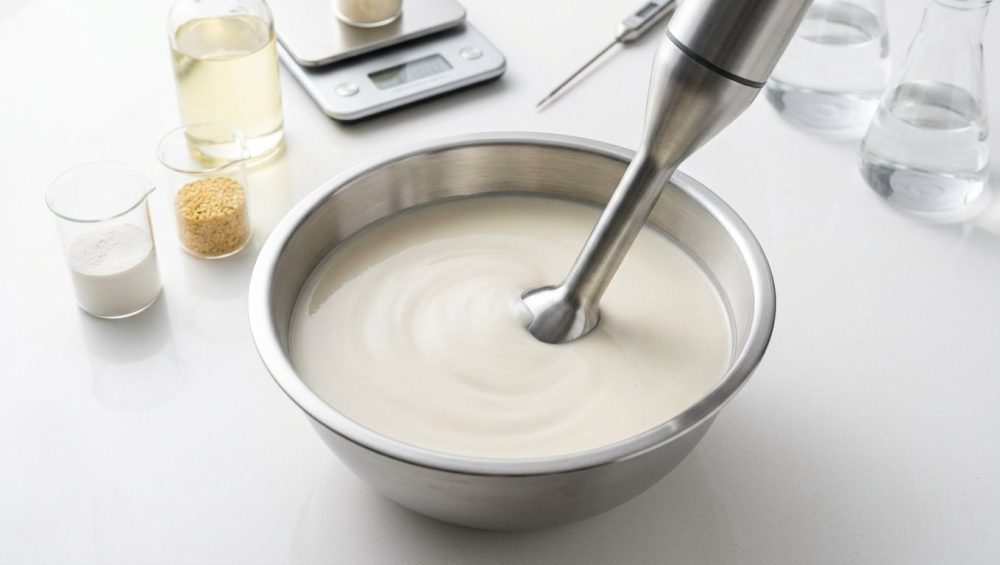
- Slowly—and I mean painfully slowly—drizzle the lecithin-infused oil into the vortex. The mechanical shear will rip the oil into microscopic droplets, while the lecithin coats them and the xanthan gum locks them into suspension.
Formulating a Stable Vegan Hollandaise
Hollandaise is notoriously finicky because it introduces thermal dynamics into the equation. You are dealing with melted fat (usually vegan butter or refined coconut oil) that must remain warm enough to flow, but not so hot that it breaks the emulsion.
For a vegan hollandaise, we drop the oil concentration to around 50% to 60%. Because sunflower lecithin excels at 50/50 ratios, it is the perfect candidate here.
- Aqueous Phase: 45% (water, lemon juice, white wine reduction).
- Lipid Phase: 55% (melted vegan butter, kept at 55°C / 130°F).
- Sunflower Lecithin: 2.0% of total weight.
- Xanthan Gum: 0.2% of total weight.
The xanthan gum here is non-negotiable. Because vegan butter lacks the complex proteins of dairy butter, the emulsion is highly susceptible to splitting when held warm. By incorporating 0.2% xanthan gum, you create a thermal shield. You can hold this sauce in a thermos for hours, mastering your food holding strategies without the terrifying anxiety of the sauce separating right before plating.
Thermal Thresholds: When Heat Destroys Your Hard Work
Let us talk about kinetic energy. When you heat an emulsion, you are pumping kinetic energy into the system. The water molecules and oil droplets start vibrating and moving at higher velocities. If the kinetic energy exceeds the activation energy of your emulsifier’s protective barrier, the droplets will smash through the lecithin coating, collide, and coalesce. The emulsion breaks.
This is why traditional egg-based sauces split if they get too hot—the egg proteins coagulate and squeeze the water out, ruining the suspension. Plant-based sauces using xanthan and lecithin are vastly superior in this regard. As we established earlier, xanthan gum maintains its viscosity up to 100°C. However, the oil phase and the lecithin have their own limits. If you boil a lecithin-stabilized emulsion vigorously, the violent mechanical action of the boiling water bubbles will physically tear the emulsion apart, regardless of the temperature stability of the gum.
When executing advanced food staging techniques, keep your plant-based warm sauces held between 50°C and 65°C (122°F – 149°F). This is warm enough to serve, perfectly safe for the hydrocolloids, and well below the kinetic threshold of emulsion failure.
High-Shear Blending: The Mechanical Catalyst for Emulsion Stability
You can have the most mathematically perfect ratio of hydrocolloids in the world, but if you do not apply enough mechanical force to the system, your sauce is going to fail. Emulsions require energy to form. We need to physically rip the oil into microscopic droplets.
The Physics of Shear Rates and Droplet Size
In commercial food manufacturing, engineers use massive rotor-stator homogenizers to achieve droplet sizes of 2 to 5 microns. A micron is one-millionth of a meter. At this microscopic size, the droplets are so small that gravity essentially stops affecting them, rendering the emulsion indefinitely stable against creaming or separation.
To achieve a 2 to 5 micron droplet size in a home kitchen, you need high shear. Empirical studies on food emulsions indicate that optimal droplet size reduction occurs at rotational speeds of around 14,500 RPM. If you go too low, the droplets remain large and will eventually coalesce. Interestingly, if you go excessively high (above 20,500 RPM for prolonged periods), the intense friction generates so much localized heat that it can actually denature certain plant proteins or cause the molecules to aggregate, counter-intuitively ruining the emulsion.
Therefore, you need a blender that can hit that 14,500 to 18,000 RPM sweet spot and sustain it long enough to process the sauce (usually 60 to 90 seconds) without overheating the motor or the food.
The “No-Go” Rule: Ditching Toxic Blenders
This brings me to my absolute favorite topic, and by favorite, I mean the thing that enrages me the most: cheap, toxic kitchenware. I am invoking my strict “No-Go” rule right here and now. If you are trying to make a highly acidic, high-shear emulsion like a vegan mayonnaise in a $20 plastic blender you bought at a discount store, you are making a massive mistake.
When you run a cheap blender at high speeds, the immense friction and cavitation forces slowly degrade the cheap polycarbonate pitcher. Microplastics begin to shed directly into your food. Furthermore, the mystery-metal blades in bargain blenders are highly susceptible to corrosion. When you introduce acidic ingredients like lemon juice or vinegar into a scratched, cheap metal housing, heavy metals can leach into your pristine plant-based sauce. It is disgusting, it is dangerous, and I will not tolerate it. We are banishing toxic kitchen gear from our lives permanently. Throw that peeling, degrading plastic trash in the bin immediately.
Safe, High-Performance Gear Recommendations
If you want to cook like an expert, you need equipment that respects your ingredients. You do not need commercial machinery, but you do need a high-performance, culinary-grade blender.
Look for blenders featuring pitchers made from thick, thermal-shock-resistant borosilicate glass or high-grade, BPA-free Eastman Tritan copolyester. The blade assembly must be constructed from laser-cut, hardened culinary stainless steel. You actually do not want razor-sharp blades for emulsions; you want slightly blunt, thick blades that rely on brute-force RPMs to create a powerful vortex and intense cavitation.
Brands like Vitamix or high-end Blendtec models are the gold standard for home cooks. They easily achieve the 14,500+ RPM required to hit that 2-micron droplet size, and their materials are rigorously tested for safety and non-toxicity under high heat and high acidity. Yes, they are an investment. But considering how much time and money you will save by never throwing away a split, ruined batch of expensive ingredients ever again, they pay for themselves.
Troubleshooting the Split: Rescuing Broken Emulsions
Okay, let us be real. Even with the best science and the best gear, mistakes happen. Maybe you poured the oil too fast. Maybe your vegan butter was too hot. Suddenly, your gorgeous, glossy sauce turns into a weeping, separated mess. Do not panic, and do not throw it away. Emulsion breakage is just a thermodynamic state, and what chemistry breaks, chemistry can fix. If you want to survive the kitchen without losing your mind, you need to know how to execute a rescue operation.
Temperature Shock and How to Reverse It
Sometimes, an emulsion breaks because of a phase inversion caused by a sudden temperature shock. If you are making a warm vegan hollandaise and you accidentally stream in cold oil, the localized temperature drop causes the saturated fats to crystallize and solidify unevenly, breaking the network.
To fix a cold-shocked emulsion, add exactly one tablespoon of boiling water to a clean blender pitcher. Turn the blender on medium speed, and slowly drizzle the broken, separated sauce into the hot water. The sudden burst of thermal energy melts the crystallized fats, while the mechanical shear re-establishes the emulsion.
Conversely, if your sauce broke because it got too hot (kinetic energy overload), add one tablespoon of ice water to the clean blender pitcher and slowly stream the broken sauce into it. The rapid cooling lowers the kinetic energy of the system, allowing the lecithin to re-anchor itself to the oil droplets.
The Hydration Rescue Method
If temperature wasn’t the issue, the problem was almost certainly your hydration ratio or your shear rate. You probably overwhelmed the aqueous phase with too much oil too quickly. To fix this, we use the Hydration Rescue Method. This is one of the most brilliant ways to save ruined meals.
- Leave the broken sauce in a separate bowl.
- In your clean blender, create a new, miniature continuous phase. Add 2 tablespoons of water or aquafaba, and a microscopic pinch (about 0.05 grams) of xanthan gum.
- Blend this new mixture until the xanthan gum is fully hydrated and forms a thick, stable gel.
- With the blender running on high shear (aiming for that 14,500 RPM mark), slowly—drop by agonizing drop—stream the broken sauce into the new hydrocolloid base.
Because you are introducing the un-emulsified oil into a highly stable, heavily thickened aqueous environment, the high shear will easily rip the large oil slicks back down into microscopic droplets, permanently locking them into place. Your sauce will be slightly thicker than originally intended, but it will be glossy, stable, and perfectly delicious.
Conclusion: Mastering Modernist Cuisine in Your Pajamas
Cooking is not magic, and it is certainly not reserved for people in crisp white chef coats yelling in a commercial kitchen. It is just applied physics and chemistry mixed with a little bit of patience. By understanding the thermodynamic battle between oil and water, and by leveraging the incredible biochemical power of hydrocolloids like xanthan gum and sunflower lecithin, you have completely eliminated the guesswork from your plant-based sauces.
You now possess the empirical data to formulate precise hydration ratios. You understand the critical importance of high-shear blending to achieve microscopic droplet sizes. And most importantly, you know exactly how to troubleshoot and rescue a sauce if things go sideways.
So, this weekend, leave the stress behind. Grab your digital scale, fire up your high-performance, non-toxic blender, and show that vegan hollandaise exactly who is boss. You have got the science on your side, and there is absolutely nothing you cannot conquer in that kitchen. Now, pour yourself a glass of wine and get to blending.