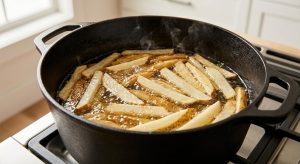
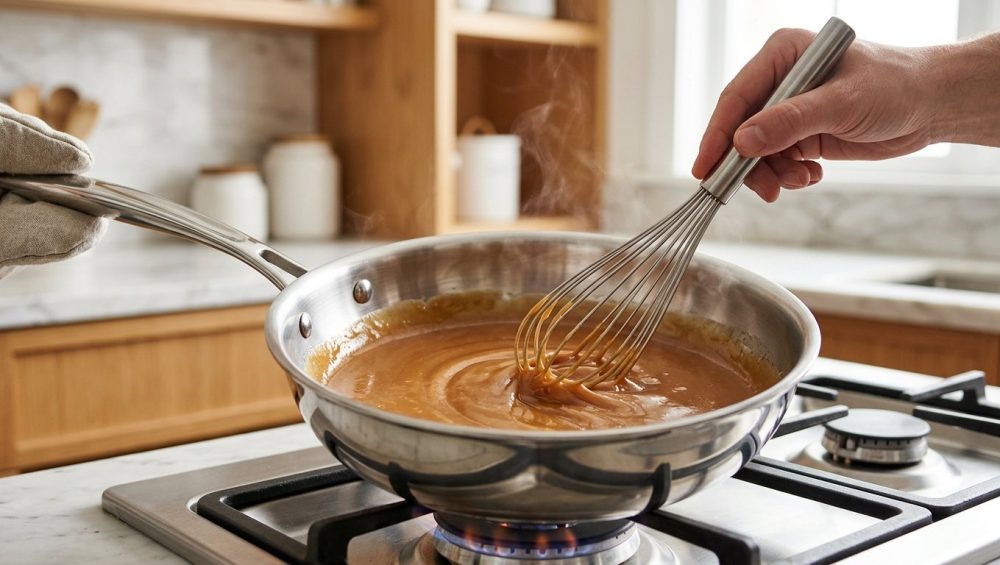
Listen, I love you, but if you are still trying to make a delicate hollandaise or a velvety caramel in that thin, battered, 90-degree saucepan you bought in a panic during your college years, we need to have a serious talk. You are making your life infinitely harder than it needs to be. I get it. When you are just starting out, navigating the endless sea of beginner kitchen tools can feel like trying to read a foreign language. But here is the brutal truth: sometimes, it is not your lack of culinary school training that is ruining your dinner. Sometimes, it is literally the physical shape of your cookware.
I firmly believe that absolutely anyone can cook like an expert and make mind-blowing food without a culinary degree. However, you cannot out-cook bad physics. If you constantly find yourself scraping burnt bits of flour off the bottom edges of your pots, or crying over a broken, greasy cheese sauce on a Tuesday night, you are experiencing a hardware failure, not a software failure. Today, we are going to dive deep into the thermodynamics, fluid dynamics, and geometry of stovetop cooking. We are going to permanently solve your scorching issues by introducing you to the greatest kitchen upgrade you probably do not own yet.
The Anatomy of a Kitchen Disaster: Why Your Sauces Keep Breaking
We have all been there. You are standing over the stove, aggressively whisking a roux for macaroni and cheese. You look away for five seconds to yell at your dog for eating a dropped onion peel, and boom—your sauce is ruined. The edges are scorched, the center is a lumpy mess, and if you have ever wondered why your cheese sauce gets grainy despite your frantic stirring, you are about to find out.
Sauce-making is essentially a high-wire act of temperature control and continuous agitation. Whether you are creating an emulsion (like a hollandaise), gelatinizing starches (like a gravy), or carefully depolymerizing sucrose (like a caramel), you are relying on even heat distribution to trigger chemical reactions at a steady pace. When a sauce breaks, turns lumpy, or scorches, it is almost always because a localized area of the liquid exceeded the target temperature, causing proteins to tightly coagulate, starches to clump, or sugars to burn.
The problem is that most home cooks blame themselves for these failures. They assume they didn’t whisk fast enough, or they had the burner set too high. While burner control is certainly part of the equation, the actual culprit is usually the vessel holding the food. You are fighting a losing battle against a poorly designed piece of metal that actively encourages heat to pool in the exact places your whisk cannot reach.
The Culprit Hiding in Plain Sight: The 90-Degree Saucepan
Take a walk into your kitchen and pull out your standard saucepan. Look at the interior profile. The walls go straight down and meet the base at a sharp, 90-degree right angle. This cylindrical design is fantastic for maximizing volumetric capacity on a crowded stovetop. It is great for boiling pasta water, simmering a massive batch of stock, or heating up a can of soup. But for delicate, reduction-heavy, or dairy-based tasks? That right angle is a geometric death trap.
The Physics of Stagnant Zones and Scorched Corners
To understand why your food burns in a saucepan, we have to talk about heat transfer. When you place a pot on a burner, conductive heat transfers from the stove into the bottom of the pan. From there, the heat must transfer to the liquid inside. In a perfectly fluid system, convection currents naturally push the hot liquid at the bottom up to the surface, while cooler liquid sinks to take its place.
However, fluid dynamics get incredibly messy when they hit a sharp 90-degree corner. The right angle creates a severe disruption in the convection flow, resulting in a “stagnant zone” or a “dead zone”. The viscosity of your sauce—especially thick sauces like béchamel or pastry cream—overcomes the kinetic energy of the convection current in that tight corner. Because the liquid in the corner stops moving, it absorbs continuous, direct conductive heat from the burner without cycling away to cool down. The temperature in this microscopic edge spikes dramatically higher than the rest of the pan, leading to instantaneous scorching.
The Whisking Geometry Problem
“But wait,” you say, “I whisk constantly!” Do you? Let’s look at your whisk. A standard balloon whisk has a bulbous, teardrop shape with a continuously curved profile. When you press a curved whisk into a sharp, 90-degree corner, the point of physical contact is infinitesimally small. It is a mathematical tangent. You physically cannot scrape a right angle with a curve.
Unless you are using a specialized flat roux whisk to violently scrape those edges, you are leaving a tiny ring of food untouched around the entire perimeter of the pan’s base. That untouched ring of dairy, flour, or sugar sits in the stagnant heat zone, burns, and then gets slowly incorporated into the rest of your sauce as brown, bitter flakes. You are working twice as hard to achieve a mediocre result because the geometry of your tools is fundamentally mismatched.
Enter the Saucier: The Greatest Pan You Probably Don’t Own
If you have ever audited an online cooking course, watched a professional chef construct an intricate reduction, or peeked into the back of a high-end restaurant kitchen, you have likely spotted a unique, bowl-shaped vessel nestled on the stovetops. To the untrained eye, it looks like a saucepan that went to a yoga retreat. But culinary insiders know this highly specialized tool by its proper French name: the saucier.
What Exactly is a Saucier?
A curved saucier pan (often referred to as a chef’s pan) is designed specifically to solve the geometric nightmares of the standard saucepan. Instead of straight walls and sharp corners, a saucier features a wide mouth and gracefully sloped, rounded sides that seamlessly transition into the base.
For decades, the saucier was regarded as an exclusive tool reserved for high-end European restaurant kitchens or dedicated pastry chefs. But as weeknight home cooks seek out more efficiency and less cleanup, this pan is rightfully claiming its spot as a mandatory household staple. A saucier replaces your medium saucepan for about 90 percent of daily cooking tasks, offering a level of forgiveness and precision that a straight-sided pot simply cannot match.
The Fluid Dynamics of a Curved Bottom
The genius of the saucier lies in its uninterrupted curvature. Because there are no sharp corners, there are no stagnant fluid zones. Convection currents can roll smoothly up the sloped sides, continuously cycling the liquid and maintaining an incredibly even temperature throughout the entire volume of the sauce.
More importantly, the curved radius of the saucier’s base perfectly mirrors the sweep of a standard whisk or a wooden spoon. When you stir a saucier, your utensil makes full, flush contact with the bottom and the sides simultaneously. There is nowhere for flour to hide. There is nowhere for sugar to stick. Every single millimeter of the pan’s interior is accessible, meaning you can keep the ingredients moving effortlessly. This eliminates localized scorching and guarantees a perfectly smooth, velvety texture every single time.
The Science of Heat Distribution and Evaporation
We know that the shape fixes the stirring problem, but a saucier offers several other massive thermodynamic advantages over a standard saucepan, specifically when it comes to time efficiency and heat management. Because time is money on a busy weekday, you need gear that works with you, not against you.
Wider Surface Area Equals Faster Reduction
Beyond the curve, a saucier typically has a wider mouth and slightly shorter walls than a saucepan of the same volume. This structural difference dramatically increases the surface area of the liquid exposed to the open air.
When you are making a pan sauce, a balsamic glaze, or reducing a stock, the goal is to evaporate water as quickly as possible to concentrate the flavors. Evaporation rates are directly proportional to surface area. A narrow, tall saucepan traps steam and slows down evaporation, forcing you to stand at the stove for twenty minutes waiting for your sauce to thicken. A saucier’s wide, flared opening allows steam to escape rapidly, cutting your reduction time in half. You get richer flavors in a fraction of the time, which is the ultimate weeknight cooking hack.
Eliminating Hot Spots with Proper Cladding
Shape is only half the battle; material construction is the other. You might have noticed that food sticks to your stainless steel when the heat is wildly uneven across the cooking surface. Cheap pans utilize a thin “disk bottom” where a small puck of aluminum is glued only to the base of the pot, leaving the side walls incredibly thin. This creates massive temperature differentials between the bottom of the pan and the sides, leading to burnt bases and raw edges.
A high-quality saucier utilizes fully clad construction. Cladding refers to the metallurgical fusion of different metals to construct a single, seamless piece of cookware. Premium sauciers feature 3-ply or 5-ply construction, where a highly conductive core of aluminum or copper is sandwiched entirely between layers of non-reactive stainless steel, extending all the way up the sloped sides to the rim. This continuous core acts as a thermal highway, pulling heat away from the direct center of the burner and wrapping it evenly around the entire curve of the pan. This is how you achieve absolute temperature control.
A Brutally Honest Warning: The Toxic Cookware Trap
I have a strict “no-go” rule when it comes to cheap, toxic kitchenware, and I need to address the elephant in the room. Many home cooks try to solve their sauce-scorching problems by buying cheap, non-stick aluminum saucepans. They figure that if the pan has a slippery coating, the corners won’t burn. This is a massive, dangerous mistake.
Why Cheap Non-Stick is Ruining Your Food (and Health)
I have zero patience for peeling non-stick coatings. First of all, you are actively ruining your nonstick pans with aerosol cooking sprays, which contain emulsifiers like soy lecithin that bake into the surface and permanently destroy the non-stick properties. But more importantly, traditional non-stick coatings (PTFE, commonly known as Teflon) are highly sensitive to heat.
When you are making caramel or searing a base for a sauce, temperatures can easily exceed the safe limits of cheap non-stick. PTFE breakdown begins at 464°F (240°C), at which point the coating degrades and releases toxic gases, including perfluoroisobutylene (PFIB). Furthermore, the global regulatory landscape is aggressively cracking down on these materials. In 2025 and 2026, PFAS-free cookware regulations expanded significantly. US states like California (under AB 1817), Maine, and Colorado have implemented strict bans on intentionally added PFAS in consumer products. Meanwhile, the European Union is on track for a universal restriction by 2027 that covers over 10,000 chemical compounds used in these coatings. When global governments are aggressively legislating a material out of existence, you should not be using it to whisk your family’s gravy.
The Only Materials You Should Actually Buy
If you are serious about banishing toxic kitchen gear from your home, you must invest in materials that are safe, durable, and thermally efficient. For a saucier, you have two primary options: fully clad stainless steel or lined copper.
Stainless steel is the ultimate workhorse. High-end brands utilize 18/10 stainless steel for the interior cooking surface, meaning it contains 18% chromium and 10% nickel. This specific metallurgical ratio ensures the pan is incredibly durable, highly resistant to corrosion, and completely non-reactive to acidic foods like tomatoes or wine.
If you want to step up to absolute professional-grade thermal dynamics, copper is the king. Copper boasts an extremely high thermal conductivity value of 385 W/(m/K), which is roughly twice that of aluminum. A copper saucier (lined with stainless steel or tin to prevent metal reactivity) responds to temperature changes almost instantaneously. If a delicate custard is about to overcook, pulling a copper saucier off the flame stops the cooking process immediately, whereas heavy cast iron would hold the heat and ruin the dish.
The Ultimate Saucier Masterclass: What to Cook in Your New Favorite Pan
Upgrading to a sloped saucier is not just about buying a new shiny object; it is about unlocking techniques that previously felt too intimidating. Let’s look at exactly how this pan transforms your most stressful culinary projects into effortless weekend victories.
Flawless Cheese Sauces and Béchamel
Béchamel—a simple mix of butter, flour, and milk—is the mother of all cheese sauces. The process starts by cooking a roux. In a 90-degree saucepan, the flour traps in the corners and burns, giving your milk a bitter, acrid taste. In a saucier, your whisk glides through the butter and flour, toasting it evenly. When you stream in the cold milk, the curved walls allow you to incorporate the liquid rapidly, preventing the starches from clumping into dumplings. The result is a glass-smooth base ready to accept massive handfuls of sharp cheddar without breaking or turning grainy.
Silky Custards, Puddings, and Lemon Curd
Egg-based sauces are notorious for scrambling on the stove. Custards require gentle, highly controlled heat to slowly denature the egg proteins without turning them into a breakfast omelet. The thick, fully clad bottom of a premium saucier diffuses the heat from the burner, preventing hot spots. The sloped sides allow you to continuously fold the delicate egg mixture with a silicone spatula, ensuring that not a single drop of the custard sits on the heat source for too long.
Risotto That Doesn’t Require Constant Babysitting
Risotto has a reputation for being a needy, high-maintenance dish that chains you to the stove for 45 minutes. The truth is, the friction of the rice grains rubbing against each other is what releases the starches to create that signature creamy texture. In a flat saucepan, rice gets trapped in the edges, forcing you to aggressively dig it out to prevent burning. The continuous curve of a saucier naturally folds the rice back into the center of the pot as you stir. The grains tumble over each other effortlessly, releasing starch uniformly while the wide mouth of the pan encourages the broth to evaporate at the perfect rate.
Perfect Caramel Without the Bitter Burn
Caramelization is often misunderstood as simply “melting sugar.” In reality, it is a highly complex cascade of endothermic and exothermic chemical reactions that begins precisely at 320°F (160°C). At this temperature, sucrose molecules depolymerize, dehydrate, and recombine into hundreds of distinct, volatile flavor compounds.
Because sugar is a terrible conductor of heat, it relies heavily on the pan to distribute the thermal energy. In a cheap saucepan, the sugar in the corner reaches 350°F and turns to black ash before the sugar in the center even begins to melt. Before you know it, your caramel crystallizes or burns into a bitter nightmare. A thick-bottomed saucier applies heat so evenly that the entire layer of sugar melts and caramelizes in unison, allowing you to pull it off the heat at the exact amber stage you desire.
Pan Sauces and Reductions
After you sear a steak or a chicken breast, the bottom of the pan is coated in a sticky layer of caramelized proteins known as fond. Deglazing this fond with wine or stock is the foundation of a brilliant pan sauce. However, it is infuriating when your pan sauces are watery because your pan was too tall and narrow to allow for proper evaporation. The flared walls of a saucier act like an exhaust system, rapidly venting steam and reducing your stock into a thick, glossy, lip-smacking glaze in a matter of minutes.
How to Choose the Perfect Saucier for Your Home Kitchen
If you are ready to banish the 90-degree saucepan to the donation bin, you need to know what to look for when shopping for a saucier. Not all curved pans are created equal, and since you are going to be using this piece of equipment for decades, you need to get the specifications right.
Size Matters: Finding the Sweet Spot
Sauciers generally come in sizes ranging from 1-quart to 5-quarts. For the average home cook, a 3-quart saucier is the absolute sweet spot. A 1-quart pan is too small for anything other than melting butter, and a 5-quart pan is so large that a small batch of sauce will spread too thin and evaporate before it can properly cook. A 3-quart capacity gives you enough volume to make a family-sized batch of risotto, boil a small portion of pasta, or reduce a quart of stock without risking a boil-over.
Handle Ergonomics and Weight Balance
Because a saucier is designed for dishes that require constant movement, you are going to be holding the handle quite a bit. Before you even do the water drop test to check the heat retention of the metal, you need to be able to comfortably lift the pan.
Look for a saucier with a solid, riveted stainless steel handle that is hollowed out or bifurcated near the base to disperse heat, keeping it cool to the touch on the stovetop. The handle should be relatively long to provide good leverage, as a fully clad 3-quart pan can be quite heavy when filled with liquid. If you are opting for a larger size, ensure it has a small “helper handle” on the opposite side so you can safely transfer a heavy pot of boiling liquid from the stove to the sink.
The Final Word: Stop Fighting Your Cookware
Cooking should be a joyful, creative release at the end of a long day, not a frustrating battle against poorly engineered metal. We put so much pressure on ourselves to perfectly execute recipes, often forgetting that the tools we use dictate the boundaries of our success.
The standard 90-degree saucepan is a relic of cheap manufacturing, designed to be stamped out of a factory line as quickly as possible with zero regard for the actual physics of cooking food. By upgrading to a fully clad, sloped saucier, you are instantly eliminating the stagnant heat zones, awkward whisking angles, and uneven evaporation rates that have been secretly sabotaging your meals for years.
You do not need a culinary degree to make a flawless béarnaise, a silky risotto, or a perfect caramel. You just need to respect the physics of the kitchen, ditch the toxic non-stick coatings, and let the graceful curve of a saucier do the heavy lifting for you. Now go pour yourself a glass of wine, get back in the kitchen, and show that cheese sauce who is boss.