Listen up, folks. We need to have a very serious, slightly nerdy, and brutally honest conversation about what you are currently cooking your food in. I spend my weekdays showing you how to shave fifteen minutes off a Tuesday night stir-fry so you can rescue a ruined dinner or just get to the couch faster. But when the weekend hits? That is when we play for keeps. That is when we pull out the big guns and embrace our inner perfectionists.
And by “big guns,” I absolutely do not mean that flimsy, peeling, scratch-and-dent non-stick pan you bought on clearance at a big-box store. You know the exact pan I am talking about. The one actively flaking mystery polymers into your morning eggs while off-gassing chemicals that probably require a hazmat team to clean up. We are banishing toxic kitchen gear from our lives, starting right now, and we are never looking back.
Instead, we are talking about the undisputed, heavyweight champion of the culinary world: authentic, traditional, tin-lined copper cookware.
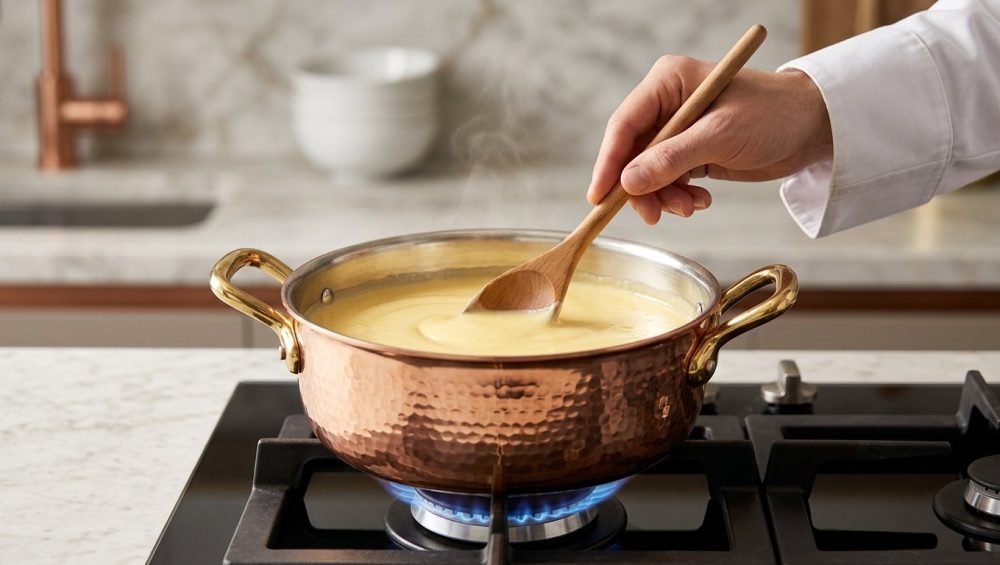
If you have ever tried to make a delicate hollandaise, a finicky beurre blanc, or a batch of temperamental caramel, you know the sheer, unadulterated panic of a hot spot. One second your sauce is glossy, emulsified, and perfect; the next, it is a scorched, broken mess, and you are staring into the abyss of your own culinary inadequacy. It is enough to make you throw in the towel and order takeout. But here is the secret the professionals know: it is not you. It is your pan. You are fighting a losing battle against terrible thermodynamics.
Welcome to the definitive, no-holds-barred masterclass on the thermal dynamics of tin-lined copper cookware. By the time we are done here, you will understand exactly why this heirloom-grade equipment is the ultimate hack for precise temperature control, how its metallurgy works on a subatomic level, and why those cheap clad impostors are laughing all the way to the bank. Grab a glass of wine. Let’s get into the science.
The Thermodynamics of Pure Copper: Why Heat Hates to Wait
Let’s get one thing straight right out of the gate: copper does not care about your schedule. It is the high-performance sports car of the kitchen. When you step on the gas, it moves. When you hit the brakes, it stops. In thermodynamic terms, we are talking about two critical concepts: thermal conductivity and specific heat capacity. If you want to elevate your cooking, you need to understand these numbers.
Thermal Conductivity vs. Heat Retention (The Science)
Every metal in your kitchen has a specific thermal conductivity, which is measured in Watts per meter-Kelvin (W/m·K). This metric tells us exactly how fast heat travels through the atomic lattice of the material. In metals, heat is primarily conducted by free electrons. Because copper has a uniquely highly mobile electron structure, it transfers kinetic thermal energy at a staggering rate.
Let’s look at the numbers, because numbers do not lie, unlike the marketing copy on your cheap frying pan:
- Pure Copper: ~385 to 401 W/m·K
- Aluminum: ~205 W/m·K
- Cast Iron: ~50 W/m·K
- Carbon Steel: ~45 W/m·K
- Stainless Steel: A pathetic 15 W/m·K
Yes, you read that correctly. Stainless steel is an absolutely abysmal conductor of heat. It is practically a thermal insulator. If you try to heat a cheap, thin stainless steel pan, the heat sits exactly where the burner flame touches it, creating aggressive, localized hot spots that will scorch your minced garlic before you even have time to blink.
Copper, on the other hand, is nearly twenty-five times more conductive than stainless steel. When you place a pure copper pan on a burner, the heat doesn’t just sit at the bottom; it instantly races up the sidewalls, wrapping your food in a completely uniform, 360-degree blanket of thermal energy.
But thermal conductivity is only half the story. We also have to talk about specific heat capacity, which is the amount of energy required to raise the temperature of 1 gram of the material by 1 degree Celsius (J/g°C).
- Water: 4.18 J/g°C (This is exactly why boiling a massive pot of pasta water feels like it takes an eternity)
- Aluminum: 0.90 J/g°C
- Cast Iron / Steel: ~0.45 J/g°C
- Copper: 0.39 J/g°C
Because copper has a remarkably low specific heat capacity combined with astronomical thermal conductivity, it is incredibly responsive. When you turn the flame down, the pan cools down almost instantly. There is virtually zero thermal lag time. This is the exact opposite of cast iron, which holds onto heat like a toddler refusing to give up a toy. Cast iron is fantastic for searing a thick ribeye, but if your crème anglaise is about to curdle, cast iron will betray you by continuing to pump heat into the sauce long after you’ve killed the flame. Copper will save your life by dropping its temperature the second you twist the stove knob.
The End of Hot Spots (And Scorched Béchamel)
Let’s translate these nerdy numbers into real-world cooking scenarios. When you are making a delicate sauce, the margins for error are microscopic. A béchamel can easily scorch on the bottom while the top is still cold if your pan has hot spots. You end up whisking frantically, praying you don’t incorporate burnt, bitter flakes into your pristine white sauce.
In a heavy copper pan, hot spots are physically impossible. The heat disperses so rapidly through the atomic lattice of the copper that the entire cooking surface reaches thermal equilibrium before the food even has a chance to realize what is happening. This means you can gently melt chocolate, reduce a delicate demi-glace, or hold a temperamental emulsion without ever needing to fuss with a cumbersome double boiler. It is the ultimate cheat code to cure cooking anxiety, allowing you to focus completely on flavor development rather than fighting your equipment.
The Magic of the Tin Lining: A Metallurgical Match Made in Culinary Heaven
Now, if you have been paying attention, you might be asking: “If copper is so thermodynamically amazing, why do we line it with anything at all? Why not just cook directly on the bare metal?”
Excellent question. Let’s talk about why bare copper is a terrible idea for most savory foods, and why traditional, hand-wiped tin is the greatest cooking surface known to humanity.
Why Not Bare Copper? (The Toxicity Factor)
Copper is a highly reactive transition metal. If you cook acidic foods—like tomatoes, wine, lemon juice, or vinegar—in a bare copper pan, the acid will trigger a chemical reaction that strips copper ions right into your food.
Consuming trace amounts of copper is fine (it is an essential trace mineral, after all), but consuming too much of it will lead to acute copper toxicity. Symptoms include severe nausea, vomiting, and a horrific metallic taste in your mouth that will absolutely ruin your carefully planned dinner party. Furthermore, if bare copper is left exposed to moisture and air, it can develop verdigris (copper acetate), a toxic blue-green rust that you absolutely do not want anywhere near your meticulously prepped ingredients.
The only time you should ever use an unlined copper pan is for whipping egg whites (the copper ions react with the conalbumin in the egg to stabilize the foam, creating massive volume) or for boiling pure sugar for jam and candy, where the high sugar content and lack of acid make it perfectly safe. For everything else, we need a protective barrier. Enter: pure tin.
The Non-Stick Superiority of Pure Tin (Take That, Teflon)
Tin (Sn on the periodic table) is a soft, silvery-white metal that is completely inert and non-reactive to food acids. But here is the real secret that the modern, mass-produced cookware industry desperately doesn’t want you to know: pure tin is naturally, beautifully non-stick.
Long before some lab coat invented toxic chemical coatings, French chefs were effortlessly frying delicate eggs and searing flaky fish in tin-lined copper. Tin possesses a unique, slippery crystalline structure that actively resists protein adhesion. If you use a little bit of butter or oil and understand basic temperature control, food simply glides across a tin surface. It is the ultimate non-toxic alternative, making it one of the absolute most critical beginner cooking essentials for anyone serious about upgrading their kitchen arsenal.
Unlike modern non-stick pans that emit highly toxic fumes if accidentally overheated and inevitably peel jagged chemical flakes into your scrambled eggs after a mere two years of use, tin is a natural earth element. It doesn’t flake off in synthetic shards. And when it eventually wears down after a decade of heavy, loving use, you don’t throw the pan into a landfill. You send it to a master tinsmith to be re-tinned, and it comes back looking and performing like it is brand new. That is true, multi-generational sustainability.
The Melting Point Myth: Dispelling Tin Paranoia
If you spend five minutes browsing online culinary forums, you will inevitably encounter someone aggressively panicking about the melting point of tin. Let’s set the record straight once and for all.
Yes, pure tin melts at roughly 450°F (232°C). If you place an empty tin-lined copper pan on a roaring, high-output 20,000 BTU gas burner and walk away to check your email, the tin will bubble, pool, and melt into a sad, silvery puddle. Congratulations, you just ruined a $400 piece of functional art.
But here is the brutal reality check: you should never be cooking at 450°F in a copper pan anyway. The entire point of copper’s insane thermal conductivity is that you can achieve professional, high-end results on low to medium heat. You do not need to blast it.
Furthermore, food contains water. Water boils at 212°F (100°C). As long as there is food, fat, or liquid in the pan, the fundamental thermodynamic principle of evaporative cooling ensures that the surface temperature of the pan cannot significantly exceed the boiling point of the moisture in the food. You can aggressively boil a hearty stew, simmer a delicate cream sauce, or even sauté moisture-rich vegetables without ever coming close to 450°F.
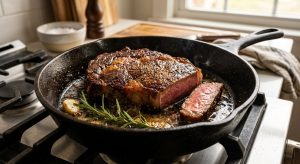
Even the Maillard reaction—the holy grail of browning, caramelization, and flavor development—begins rapidly around 285°F to 320°F (140°C to 160°C). You can achieve a gorgeous, golden-brown sear on a chicken breast or a piece of white fish well below the danger zone of the tin lining. If you want to blast a thick ribeye steak at 600°F to get a charred crust, use your heavy cast iron or focus on mastering the maillard reaction with your carbon steel skillet. But for the vast majority of your daily cooking, tin-lined copper is perfectly safe, vastly superior, and infinitely more precise.
Copper vs. The Clad Impostors: A Brutal Reality Check
Walk into any high-end kitchen supply store, and you will be immediately bombarded by shiny “tri-ply” and “copper-core” cookware promising the elite performance of copper with the rugged convenience of stainless steel. I am going to save you a lot of money and a lifetime of disappointment: most of it is brilliantly marketed garbage.
The Tri-Ply Deception
Tri-ply cookware typically consists of a thin layer of stainless steel on the inside, a core of aluminum, and another layer of stainless steel on the outside. It is durable, sure. It is technically dishwasher safe (though you should never, ever put good pans in the dishwasher). But it is not copper, and it does not perform like copper.
Aluminum has a thermal conductivity of ~205 W/m·K. That is roughly half the conductivity of pure copper. To get the exact same thermal performance and even heat distribution as a 2.5mm thick copper pan, you would mathematically need an aluminum pan that is a massive 5mm thick. Tri-ply pans are nowhere near that thick; they are usually around 2.5mm total, meaning the aluminum core is dangerously thin. They are sluggish to heat up, they are highly prone to warping under thermal shock, and they simply cannot offer the razor-sharp precision of pure copper. While you can certainly learn about preventing protein adhesion in stainless skillets through the Leidenfrost effect, you are still fundamentally fighting the metal’s inherent thermal limitations every time you turn on the stove.
Copper-Core Clad: Paying for the Look, Not the Performance
Then we have the notoriously overpriced “copper-core” pans. These are stainless steel pans with a microscopic, almost insulting sliver of copper hidden inside, or worse, a purely decorative copper ring stamped around the base just to trick you into paying a massive premium.
Let’s do the math. A famous, highly marketed brand’s “copper core” line contains a copper layer that is exactly 0.9mm thick. That is less than one single millimeter of copper, permanently sandwiched between layers of aluminum and highly insulating stainless steel. The stainless steel completely bottlenecks the thermal transfer. You are paying an exorbitant premium for a pan that performs only marginally better than standard aluminum tri-ply, while weighing an absolute ton and completely missing the point of why copper is magical in the first place. If you want copper, buy pure copper. Do not buy a stainless steel pan wearing a copper Halloween costume.
The Masterclass Menu: What to Cook in Your Copper
To truly appreciate the thermodynamics we’ve just obsessed over, you need to know what dishes actually require this level of precision.
The Art of the Emulsion
Hollandaise, béarnaise, and beurre blanc are the terrors of the culinary world. They require you to hold a delicate suspension of fat and water at exactly the right temperature. Too cold, and the butter congeals. Too hot, and the egg proteins scramble, breaking the sauce into a greasy, weeping mess. In a heavy copper saucier, the temperature remains so incredibly stable and uniform that the risk of breaking an emulsion drops to near zero.
Sugar Work and Confectionery
If you are making caramel, fudge, or fruit preserves, temperature control is the difference between a luscious dessert and a burnt, bitter disaster. Sugar burns in the blink of an eye. Unlined copper sugar pots are the industry standard for confectioners because the sides of the pot get just as hot as the bottom, preventing sugar crystals from clinging to the edges and causing the entire batch to crystallize and seize.
The Perfect Sauté
Sautéing is not frying. Sautéing means “to jump.” It requires high, even heat to quickly evaporate the moisture released by the food, allowing for rapid browning without steaming the ingredients. When you drop a cold piece of fish or a handful of mushrooms into a 2.5mm copper sauté pan, the immense thermal mass of the thick copper prevents the pan’s temperature from plummeting. The heat recovers instantly, ensuring a perfect, golden crust every single time.
The Exact Sourcing Criteria: How to Buy Authentic Heirloom Copper
If you are ready to make the investment and upgrade your culinary life, you need to know exactly what you are looking for. The market is absolutely flooded with cheap, decorative copper that belongs hanging on a rustic farmhouse wall, not sitting on a working stove. Here is your strict, non-negotiable buying guide.
Thickness Dictates Destiny (The 2.5mm Rule)
The single most important metric of any copper pan is its thickness. Thickness dictates thermal mass, which determines how evenly the pan will heat and how well it will hold a steady temperature when you add cold ingredients.
- Under 1.5mm: This is decorative junk or cheap table-service ware. It will warp the second it gets hot, it will dent if you look at it wrong, and it will aggressively scorch your food. Walk away immediately.
- 1.5mm to 2.0mm: This is acceptable for a small saucepan or a specialty crepe pan where you want hyper-responsiveness, but it completely lacks the thermal mass required for serious searing or large-batch cooking.
- 2.5mm to 3.0mm: This is the undisputed gold standard. This is the professional, heirloom-grade thickness that will outlive you, your children, and your grandchildren. It is undeniably heavy. It is a legitimate forearm workout to lift. But the thermal performance is unparalleled.
When shopping for reliable brands, look for vintage pieces from Mauviel, Matfer Bourgeat, E. Dehillerin, or modern artisan manufacturers like Brooklyn Copper Cookware. Always verify the exact millimeter thickness before handing over your credit card.
Handles and Rivets: Cast Iron vs. Brass
A heavy, 2.5mm thick copper pan needs a handle that can support its immense weight without snapping or bending.
- Cast Iron: The traditional, historical, and vastly superior choice. Cast iron is a remarkably poor conductor of heat, meaning the handle will stay relatively cool on the stovetop while the copper body of the pan gets blazing hot. It offers a secure, ergonomic grip.
- Brass: Brass looks incredibly pretty and shiny, but it conducts heat rapidly. A brass handle will get blisteringly hot during normal stovetop use, requiring you to use a thick towel or a silicone grip at all times. It is a purely aesthetic choice that severely sacrifices function.
- Rivets: Look for thick, sturdy, hammered copper rivets. There should be three massive rivets securing the handle to the pan body. If the handle is weakly welded on, or if the rivets look flimsy and small, leave it on the shelf.
Spotting Fakes, Thin Washes, and “Decorative” Junk
Beware of pans that are simply stainless steel or aluminum with a micro-thin “copper wash” electroplated onto the outside. These are designed purely for aesthetics and offer absolutely zero thermal benefits. You can usually spot them because they are suspiciously lightweight and incredibly cheap. Real copper is dense; a standard 10-inch, 2.5mm copper skillet will weigh upwards of 5 to 6 pounds.
Also, avoid pans with rolled lips. Authentic, thick copper is simply too dense and rigid to be rolled at the rim; it is cut straight and filed smooth. A rolled rim is a dead giveaway that the copper is paper-thin and practically useless for cooking.
Caring for Your Tin-Lined Masterpiece
Okay, you took the plunge. You bought a gorgeous, 2.5mm thick, hand-wiped, tin-lined copper pan. Now you have to protect your investment. Copper care is not difficult, but it requires you to respect the metallurgy and follow a few basic rules.
The Wooden and Silicone Utensil Mandate
Because tin is a relatively soft metal, you absolutely cannot use metal spatulas, metal whisks, or sharp metal spoons. A metal utensil will gouge right through the soft tin lining, exposing the bare, reactive copper underneath.
You must strictly use wooden spoons, bamboo spatulas, or high-quality heat-resistant silicone tools. This is a hard, non-negotiable rule. Consider it the perfect excuse to upgrade your utensil crock and take those simple steps to culinary artistry with the right tools in hand.
Cleaning Without Destruction
Throw away the steel wool immediately. Throw away the abrasive scouring pads. If you take a green Scotch-Brite pad to a tin lining, you will literally scrub the tin right off the pan in a matter of minutes.
Because tin is naturally non-stick, cleaning is remarkably easy. Let the pan cool completely on the stove (never run cold water into a hot copper pan, or you risk severe thermal shock and permanent warping). Fill it with warm, soapy water and let it soak for ten to fifteen minutes. Use a soft sponge or a gentle dishcloth to effortlessly wipe away the food. That is it.
As for the exterior, the copper will naturally oxidize and develop a dark, matte, brownish-red patina over time. Many serious cooks love the rustic, well-used look of a naturally tarnished pan. If you prefer the gleaming, mirror-polish look, simply make a quick paste of coarse salt and lemon juice (or use a high-quality commercial copper polish) and gently rub the exterior. It takes about thirty seconds to restore the brilliant, blinding shine.
The Inevitable Retinning Process (A Badge of Honor)
Over years of heavy use, the bright silver tin lining will naturally darken, turning a mottled, matte grey. This is perfectly normal oxidation and does not affect the safety or non-stick performance of the pan in any way. Do not try to scrub the grey away; you will only damage the lining.
Eventually, however, the tin will physically wear thin from friction. You will know it is time for a retinning when you can clearly see an area of bare copper peeking through the tin that is roughly the size of a US quarter (about 1 inch in diameter).
When this happens, do not panic. You haven’t broken the pan. You simply box it up and ship it to a professional, artisan tinsmith. They will chemically strip the old tin, melt fresh, pure tin at 500°F, and meticulously hand-wipe a brand-new, thick cooking surface into your pan using traditional flux and cotton wadding. It costs a fraction of the price of a new pan, and it completely resets the clock for another decade of flawless use. It is a beautiful, sustainable tradition that connects you to centuries of culinary history.
The Induction Conundrum: Why Copper Hates Magnets
We need to talk about modern stovetops. If you have an induction range, you have a problem. Induction works via magnetic fields generating electrical currents in ferromagnetic materials (like cast iron or magnetic stainless steel). Pure copper is entirely non-magnetic. If you place a 2.5mm pure copper pan on an induction burner, absolutely nothing will happen. The stove won’t even register that the pan is there.
Does this mean induction users are completely locked out of the copper game? Not necessarily, but the workarounds are frustrating. You can buy an induction interface disk—a heavy plate of magnetic steel that you place between the burner and the copper pan. The burner heats the steel disk, and the steel disk transfers heat to the copper via conduction. However, this completely ruins the hyper-responsiveness of the copper. You are introducing a massive thermal bottleneck. If you are serious about traditional copper, gas or traditional electric radiant coils are your absolute best friends.
Conclusion: Elevating Your Weekend Culinary Projects
Listen, I am not telling you to throw out every single pan in your kitchen and spend your entire life savings on a massive set of French copper. For a quick, aggressive Tuesday night stir-fry, grab your well-seasoned wok and focus on the polymerization in carbon steel. For boiling a giant pot of heavily salted pasta water, use whatever cheap, indestructible stainless steel pot you have lying around.
But when it is Sunday afternoon? When you are taking the time to craft a delicate, complex sauce, or when you are trying to eliminate bottlenecks at mindful gatherings by holding a beurre blanc at the absolute perfect temperature without it breaking? That is when you reach for the copper.
Tin-lined copper cookware is not just a passive tool; it is an active teacher. It forces you to pay close attention to heat management, to respect your raw ingredients, and to truly understand the physical science of cooking. It bridges the gap between chaotic amateur fumbling and precise, professional execution.
So stop settling for toxic, disposable, poorly engineered pans that fight you every step of the way. Invest in the unmatched thermodynamics of pure copper, respect the delicate, non-stick magic of the artisan tin lining, and watch as your kitchen transforms from a place of stress into a laboratory of absolute perfection. Now, go pour yourself that glass of wine, polish your new favorite pan, and let’s get cooking. You have a lot of incredible food to make, and you might even discover the beautiful art of food plating once your meals actually stop burning to the bottom of your skillet.