You’ve just spent three hours lovingly braising a short rib. It smells like a rustic Tuscan dream. The meat is practically melting off the bone, the sauce is rich and glossy, and you are ready to feast. But when you enthusiastically scoop it onto a plate, reality hits you like a wet towel. It looks like a tragic, brown pile of mush. You snap a quick photo for your friends, look at the screen, and immediately delete it. We’ve all been there.
The harsh truth of the culinary world is that we eat with our eyes first. If a dish looks like a chaotic, sloppy mess, your brain is already subconsciously lowering its expectations before the fork ever hits your mouth. But here is the good news: you do not need a culinary degree, a Michelin star, or a pretentious chef’s coat to make your food look spectacular. You just need a basic understanding of composition, a few reliable techniques, and a refusal to settle for mediocrity.
The goal here isn’t to make you feel inadequate; it’s about transforming your daily cooking from a basic survival chore into a genuinely artistic and fulfilling experience. I am going to walk you through exactly how to plate your food like a seasoned pro, using the same straightforward logic we apply to everything else in the kitchen.
The Science of Plating: Gastrophysics and Cross-Modal Perception
Before we start smearing purees on porcelain, we need to talk about the actual science of why plating matters. It’s not just about getting likes on social media or trying to look fancy. There is a fascinating, heavily researched scientific field known as “gastrophysics,” a term popularized by Oxford University experimental psychologist Professor Charles Spence. Gastrophysics explores how our senses—sight, sound, touch, and smell—interact to create our perception of flavor. If you’ve ever tried to decode pretentious recipe jargon, you might think plating is all art, but it is actually deeply rooted in biology and psychology.
Hacking the Brain with Plates and Shapes
Spence’s research on “cross-modal perception” proves that visual presentation literally alters the chemical perception of taste. In one famous 2012 study, Spence and his team served the exact same batch of strawberry mousse to two sets of participants. One group ate it off a round white plate, while the other ate it off a round black plate. The results were staggering. The participants who ate from the white plate rated the mousse as 9% to 13% sweeter, more flavorful, and overall more enjoyable than those who ate from the black plate. The plate has absolutely no taste, yet it fundamentally changed how the brain processed the dessert.
It doesn’t stop at color. The physical shape of your food and your dishware plays a massive role in how your palate anticipates flavor. Studies consistently show that over 90% of people associate round, curved shapes with sweetness, while sharp, angular shapes are subconsciously linked to bitter or sour flavors. If you are serving a tart lemon dessert, an angular presentation will actually enhance the perception of that sourness.
The Sonic Crunch and Cutlery Weight
Let’s talk about texture and touch. Spence conducted a groundbreaking “sonic chip” experiment where participants bit into potato chips while wearing headphones. When the researchers amplified the high-frequency sound of the crunch, participants rated the chips as 15% fresher and crispier.
Even the cutlery you use influences the meal. Research demonstrates that adding just 100 grams of weight to a diner’s fork or knife increases their willingness to pay for the meal, as the brain associates heavy, sturdy utensils with high-quality, premium experiences. So, the next time someone tells you that plating is just superficial nonsense, you can confidently tell them they are arguing with peer-reviewed science.
The Canvas: Choosing the Right Plates (And Dodging Toxic Garbage)
Think of your plate as a blank canvas. You wouldn’t paint a masterpiece on a dirty, flimsy piece of scrap paper, so why would you serve a beautiful meal on garbage dishware?
The Color Palette of Your Dishware
When choosing your canvas, white is the undisputed king of the culinary world for a reason. White provides the highest level of contrast for vibrant ingredients, allowing the natural colors of the food to pop without any visual distraction. It acts as a spotlight. Matte black is a fantastic secondary option, particularly for bright, neon-colored purees, vibrant greens, or stark white elements like a beautifully seared scallop. Avoid heavily patterned plates at all costs; they compete with the food for attention and make your meal look like it’s wearing camouflage.
The Non-Negotiable Rule on Toxic Kitchenware
Let’s address the elephant in the room: my absolute zero-tolerance policy for toxic kitchenware. I do not care how cute that vintage glazed plate looks at the thrift store, and I do not care how cheap that peeling non-stick pan was at the discount outlet. If you are cooking on mystery metals, scratching flaking Teflon into your sauces, or serving food on cheap, mass-produced ceramics loaded with lead or cadmium glazes, you are actively poisoning your household.
The foundation of a good meal is safety. Period. Invest in high-fired stoneware, pure porcelain, or tempered glass. When you are building your collection of beginner kitchen tools, prioritize materials that will outlast you, not cheap plastics that will melt into your food or reactive metals that leach chemicals into your acidic tomato sauces. A beautiful plate of food means absolutely nothing if it is laced with peeling synthetic polymers.
Size and Shape Matter
The size of your plate is critical. If your plate is too large, your portion will look stingy and sad, like a lonely island in a sea of porcelain. If your plate is too small, the food will look overcrowded, messy, and appetizing to absolutely no one. A standard 10-inch to 11-inch dinner plate with a wide rim is the sweet spot for main courses. The rim acts as a natural frame for the artwork inside it. Never plate food on the rim.
The Golden Rules of Culinary Composition
Now that we have a safe, appropriately sized canvas, we need to understand the basic geometry of making food look good. You don’t need a fine arts degree, but you do need to respect a few universal laws of composition.
The Rule of Thirds in the Kitchen
Imagine a tic-tac-toe grid overlaid on your plate. Instead of aggressively dumping a massive piece of meat directly in the dead center like a bullseye, try offsetting it slightly to one of the intersections of those grid lines. This subtle asymmetry creates visual interest and draws the eye naturally across the entire dish. It feels organic rather than rigidly forced.
The Magic of Odd Numbers
If you are plating individual items—like scallops, shrimp, meatballs, or ravioli—always plate them in odd numbers. Three scallops look infinitely more elegant than four. Five asparagus spears look better than six. While some gastrophysicists note that the “odd numbers rule” doesn’t necessarily change the literal taste of the food, it is a deeply ingrained aesthetic principle. Even numbers create perfect symmetry, which the human brain interprets as rigid, manufactured, and unnatural. Odd numbers create dynamic tension and a more relaxed, appetizing feel.
Embracing Negative Space
This is where most home cooks panic. They see an empty spot on the plate and feel a desperate, overwhelming urge to fill it with another scoop of rice or a random, uninspired sprig of curly parsley. Stop it. Negative space—the empty, untouched area of the plate—is just as important as the food itself. It allows the dish to breathe. It provides contrast. If you struggle with rookie kitchen mistakes, overcrowding the plate is almost certainly at the top of your list. Keep the rim of the plate spotlessly clean. The rim is the frame; the center is the art.
Escaping the Beige Trap: Color, Contrast, and Texture
Let’s talk about the dreaded “Brown Slop” syndrome. A shocking amount of delicious comfort food—stews, roasts, curries, casseroles—is overwhelmingly beige, brown, or yellow. While these dishes taste like a warm hug, they photograph like a disaster.
Defeating the “Brown Slop” Syndrome
To fix a monochromatic plate, you must consciously introduce color, contrast, and texture. If you are serving a rich, dark beef stew, do not just ladle it into a bowl and call it a day. Use your tongs to pull out the structural elements. Place the pieces of meat deliberately. Arrange the bright orange carrots around the meat. Spoon the glossy, reduced sauce over the top, and finish it with a vibrant pop of freshly chopped green parsley or a dollop of stark white crème fraîche.
Natural Vibrancy Over Artificial Dyes
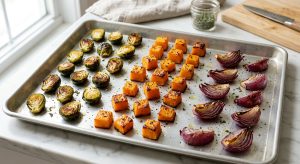
I am strictly against artificial food dyes. Nature provides all the neon you could ever need. Bright pink pickled red onions, vibrant emerald-green herb oils, ruby-red pomegranate seeds, or the stark, earthy purple of roasted beets can instantly rescue a boring plate. When you are demystifying modern recipes, you’ll notice they almost always call for an acidic, brightly colored garnish at the end. That isn’t an accident; it is a calculated aesthetic and flavor choice.
The Law of Textural Layering
A plate of soft mashed potatoes, soft braised beef, and soft cooked carrots is a textural nightmare. It feels like baby food. You need crunch. You need snap. You need something to break up the monotony. This is where toasted nuts, crispy fried shallots, a scattering of coarse flaky sea salt, or a bright, crunchy slaw comes into play. Remember the sonic chip experiment? That loud crunch literally makes the brain perceive the entire meal as fresher and more vibrant. Never serve a dish that is entirely one texture.
The No-Nonsense Plating Toolkit
I have zero patience for culinary bros who insist you need a $100 pair of titanium tweezers to place a single micro-cilantro leaf. You do not need a massive, cluttered drawer full of single-use gadgets to plate beautifully. In fact, most professional chefs rely on just a handful of cheap, durable tools.
The Squeeze Bottle
If you want to look like a pro, buy a $2 plastic squeeze bottle. It is the only way to get perfectly round dots of puree or a controlled, elegant drizzle of oil. Just make sure the nozzle is wide enough to let your sauce pass through without exploding under pressure and ruining your kitchen walls.
The Offset Spatula
This isn’t just for frosting cakes. A small offset spatula is the ultimate tool for smearing purees, lifting delicate pieces of fish without tearing the crispy skin, and smoothing out the edges of a molded base.
The Humble Spoon
You need two types of spoons: a large, sturdy serving spoon with a deep bowl for executing the perfect “swoosh,” and a smaller, tapered spoon for basting meats and saucing delicate plates.
Precision Tongs
You don’t necessarily need those massive, intimidating 12-inch culinary tweezers unless you really want to feel dramatic, but a good pair of precision tongs is non-negotiable. They allow you to place delicate microgreens, twist long pasta with absolute control, and handle hot proteins without piercing them and losing all their juices.
The Multi-Tasker
Do not underestimate the bench scraper. While it’s traditionally used for baking and dividing dough, it is an incredible tool for scooping up finely diced garnishes, transferring delicate ingredients to the plate in one piece, and keeping your cutting board perfectly clean between plating steps.
Masterclass Techniques: The Five Essential Moves
Let’s get into the actual physical movements. These are the five foundational techniques that will elevate your food from home-cooked to restaurant-quality.
The Perfect Swoosh
This is the quintessential modern plating technique. To execute a swoosh, your puree (whether it’s sweet potato, cauliflower, or parsnip) must be completely smooth. I mean meticulously smooth. Blend it thoroughly and pass it through a fine-mesh sieve. A lumpy puree makes a terrible swoosh. It should have the consistency of thick Greek yogurt.
Drop a generous dollop of the puree slightly off-center on the plate. Take the back of your large spoon, press it gently into the center of the dollop, and in one swift, confident, continuous motion, drag the spoon across the plate. Do not hesitate. Hesitation creates jagged edges. It is all in the flick of the wrist.
The Controlled Drizzle
When adding an infused oil or a balsamic reduction, do not just haphazardly squirt it over the top of the meat like you are applying ketchup to a hot dog. Use your squeeze bottle or a spoon to create a deliberate, sweeping arc over the dish, or place a few precise dots of oil in the negative space. Viscosity is key here. If the oil is too thin, it runs everywhere. If a reduction is too thick, it looks like tar.
The Pasta Twirl
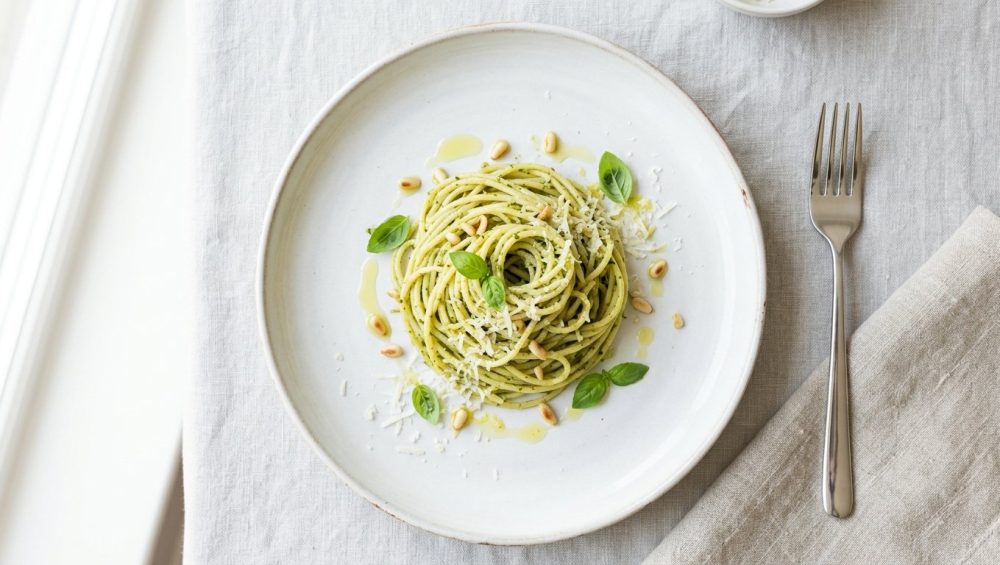
Serving pasta by dumping it from a pot onto a plate looks sloppy. To get that beautiful, towering restaurant look, grab a portion of long pasta (like spaghetti or linguine) with your tongs. Rest the tips of the tongs inside the bowl of a large ladle. Twirl the tongs continuously until the pasta forms a tight, neat nest. Carefully transfer the nest to the center of the plate and slide the tongs out. The starch and butter emulsion in your sauce will help the nest hold its towering shape.
The Elegant Shingle
When serving sliced meats—like a flank steak, a chicken breast, or a duck breast—do not just lay the slices flat on the plate. Cut the meat on a slight bias (angle) and “shingle” them by slightly overlapping each slice, like a fanned-out deck of cards. This exposes the perfect medium-rare interior while creating structural height. If you are learning how to make a classic pan-seared salmon and asparagus, you can shingle the asparagus spears underneath the fish to create a beautiful, elevated bed.
The Vertical Build
Flat food is boring food. Always try to build upward. Place your starch or puree at the bottom as an anchor, rest your structural vegetable on top of it, place your protein at the summit, and delicately rest your garnishes at the very peak. This creates a three-dimensional structure that catches the light, shows off every component, and looks infinitely more appetizing.
Weeknight Efficiency vs. Weekend Perfection
I am a realist. I know that on a Tuesday night after a grueling workday, you do not have the time or the patience to meticulously place edible flowers on your chicken breast with tweezers. My philosophy is that time is money during the week, but the weekends are for absolute perfection.
The Tuesday Night “Time is Money” Approach
On a weeknight, focus on the 30-second garnish. You can elevate a basic bowl of soup or a simple piece of fish instantly with a quick drizzle of high-quality extra virgin olive oil, a pinch of flaky sea salt, and a handful of roughly torn fresh herbs. It takes zero extra time, but it transforms the dish from dull to vibrant. Having a permanently organized kitchen ensures that these finishing touches—your good finishing salt, your infused oils, your fresh herbs—are always within arm’s reach when you are rushing to get dinner on the table.
The Saturday Night Deep Dive
The weekend is when you pour a glass of wine, turn on some music, and treat your kitchen like an art studio. This is the time to experiment with making vibrant green parsley oils, reducing a rich demi-glace until it perfectly coats the back of a spoon, and practicing your swooshes. When you host a relaxed dinner party, these are the meticulous, time-consuming techniques that will make your guests think you secretly went to culinary school.
Fixing Common Plating Disasters
Even the best home cooks mess up. Here is a brutally honest guide to fixing the most common plating disasters before they hit the dining room table.
The Puddle of Doom
You plated a beautiful piece of fish, but three minutes later, a watery, unappetizing puddle has formed around it, ruining your puree and making the dish look like soup. This happens when vegetables (like spinach or zucchini) or meats haven’t been properly drained or rested. Always rest your meat on a cutting board to let the juices redistribute, never on the plate. And always gently press watery vegetables in a clean kitchen towel or let them drain on a paper towel before they hit the porcelain.
The Messy Rim
You accidentally dropped a blob of sauce or a stray piece of rice on the pristine white rim of your plate. Do not try to wipe it with a dry paper towel; you will just smear the grease and make it worse. Dip a clean, lint-free towel or a folded paper towel in a tiny bit of hot water and white vinegar, and sharply wipe the rim clean. A dirty rim instantly shatters the illusion of a professional dish.
Inedible Forests
Stop garnishing your food with things that cannot be eaten. A massive, raw sprig of rosemary stabbed into the top of a pork chop is not a garnish; it is a choking hazard and a nuisance. If an ingredient is on the plate, it must serve a distinct flavor purpose and it must be entirely edible. If you want a rosemary flavor profile, chop it finely, toast it, or infuse it into an oil. Do not make your guests do yard work before they eat.
Conclusion: Eat Your Mistakes
Plating is an art form, but it is an incredibly accessible one. It requires no special genetics, no expensive culinary school tuition, and no pretentious attitude. It just requires a little bit of care, a respect for your ingredients, and the willingness to play with your food. The beauty of this skill is that even if you mess up a swoosh, accidentally break your puree, or your pasta nest falls over, the food still tastes fantastic.
The next time you cook, take an extra sixty seconds to think about the canvas, the colors, the textures, and the height of your dish. You will be shocked at how much better the food tastes when you put a little effort into the presentation. And if you are still feeling intimidated about inviting people over to taste your creations, don’t panic. Mastering the art of effortless hosting is just like mastering the art of plating: it’s all about preparation, confidence, and knowing how to hide your mistakes under a really good sauce. Now get out of here, go buy some microgreens, ditch those toxic peeling pans, and start making your dinners look as good as they taste.