Listen up, culinary weekend warriors. Grab a glass of wine, pull up a stool, and let’s talk about the giant, shiny, incredibly expensive elephant in the room: solid copper cookware. If you’ve spent any time drooling over the gleaming pot racks in high-end culinary boutiques, or watching professional chefs expertly flick their wrists over a roaring French top, you’ve probably asked yourself a very valid question. Is this stuff actually worth the hype, or is it just decorative kitchen jewelry for people who have too much disposable income and a weird fetish for polishing metal?
I am here to tell you that solid copper cookware is not just an aesthetic flex. It is a thermodynamic powerhouse. It is the absolute holy grail of precise temperature control. If you are tired of scorching your delicate reductions, splitting your butter sauces, and generally feeling like your stove has a personal vendetta against your dinners, it is time to understand why the professionals rely on this ancient metal. Don’t panic—you don’t need a PhD in metallurgy to cook a decent meal. I have zero patience for pretentious recipe jargon, but we do need to talk about the actual, verified physics of heat transfer. Because once you understand how heat moves on a molecular level, you will stop ruining your expensive ingredients and start cooking with absolute, undeniable authority.
The Physics of Heat Transfer: Why Copper Reigns Supreme
To understand why copper is the undisputed king of the stovetop, we have to look at the properties of copper cookware through the cold, hard lens of thermodynamics. Specifically, we need to examine two critical metrics that dictate how your food cooks: thermal conductivity and thermal diffusivity.
Thermal conductivity, measured in Watts per meter-Kelvin (W/m·K), is a material’s ability to transfer heat energy through itself. On an atomic level, copper possesses a single, highly mobile s-orbital electron. This creates a “sea of free electrons” within the metallic crystal lattice, allowing kinetic energy (heat) to travel through the metal with virtually zero resistance.
Let’s look at the raw data. At room temperature, pure copper boasts a staggering thermal conductivity of approximately 401 W/m·K. Now, let’s compare that to the other metals in your kitchen cabinets. Aluminum, the budget-friendly alternative, clocks in at around 237 W/m·K. Cast iron, the darling of rustic campfire cooking, lumbers behind at a sluggish 50 to 80 W/m·K. And stainless steel? Standard stainless steel is an abysmal conductor of heat, registering at an almost laughable 15 W/m·K.
What does this mean for your Tuesday night dinner? When you put a pure stainless steel pan on a burner, the heat just sits there, trapped directly above the flame. It creates massive, aggressive hot spots that will scorch the onions in the center of the pan while the ones on the outer edges remain completely raw. Copper, on the other hand, takes that thermal energy and instantly shoots it across the entire base and up the sidewalls of the pan. It wraps your food in a perfectly even blanket of heat, eliminating hot spots entirely.
The Molecular Dance: Thermal Diffusivity in Action
But thermal conductivity is only half the story. The real metric that matters when you are standing over a hot stove trying not to ruin a forty-dollar piece of fish is thermal diffusivity.
Thermal diffusivity is a complex equation that combines a material’s thermal conductivity, its density, and its specific heat capacity. In plain English, it measures how fast a material reacts to a temperature change.
Copper has exceptionally high thermal diffusivity. It acts like a highly sensitive, finely tuned sports car. You hit the gas (turn up the flame), and it accelerates instantly. You hit the brakes (turn off the flame), and it stops cooking immediately. Compare this to cast iron, which has terrible thermal diffusivity but massive thermal mass. Cast iron is like driving a freight train. It takes forever to get up to speed, but once it’s hot, good luck trying to stop it. If you are trying to make a delicate hollandaise in a heavy cast iron skillet, the residual heat trapped in the dense metal will scramble your eggs three minutes after you’ve turned the stove off. Copper obeys your commands the millisecond you issue them.
The Chemical Reality: Why Bare Copper is a Culinary Hazard
Now, before you rush out to buy a raw copper bowl to simmer your grandmother’s famous marinara sauce, we need to have a very serious talk about toxicity and food safety. I am a fierce, unrelenting advocate for banishing toxic kitchen gear, and that absolutely includes misusing traditional, reactive materials.
The FDA strictly prohibits the use of unlined copper for commercial food contact surfaces when the food has a pH below 6.0. Why? Because bare copper is highly chemically reactive. When acidic compounds—like tomatoes (pH 4.3), wine (pH 3.5), citrus juice, or vinegar (pH 2.5)—come into contact with bare copper, they catalyze rapid oxidation. The acid strips the copper oxide from the surface of the pan, dissolving trace amounts of copper ions directly into your food.
This is not just a flavor issue, though reducing a balsamic glaze in a bare copper skillet will result in a horrifying, metallic bitterness. It is a genuine health hazard. While the human body needs trace amounts of copper to function, chronic ingestion of copper above 10 mg per day can cause nausea, severe abdominal pain, vomiting, and extreme liver strain. The only thing bare copper should ever be used for in a modern kitchen is whipping egg whites (where the copper ions actually help stabilize the protein foam) or boiling pure sugar syrups for candy making, as sugar is non-reactive. For everything else, you need a barrier.
The Traditional Solution: The Metallurgy of Tin Linings
Because humans are exceptionally clever when it comes to eating well, we figured out centuries ago that we could get all the thermodynamic benefits of copper without the heavy metal poisoning by lining the inside of the pan with a non-reactive barrier. Historically, and still today in the finest high-end artisanal pans, that barrier is pure tin.
Tin is a fascinating, food-safe element. It bonds beautifully to copper, but it has one massive, intimidating quirk: its melting point is incredibly low. Pure tin melts at just 450°F (232°C).
This is the exact statistic where weekend culinary warriors usually panic. “You mean my pan will literally melt on the stove?!” Yes, it will, if you abuse it. One of the most classic beginner cooking mistakes is throwing an empty tin-lined copper pan onto a 15,000 BTU gas burner while you turn your back to chop onions. Do that, and the tin will blister, bubble, and smear across the base of the pan. You will be left with a very expensive repair bill and a bruised ego.
However, the chemistry of the pan offers a slight safety net. When tin is applied to copper, the two metals interact to form a microscopic copper-tin intermetallic layer (Cu6Sn5) that acts as an anchoring glue. This intermetallic layer actually boasts a significantly higher melting point of 779°F (415°C). This means that even if you slightly overheat the pan and the surface tin softens, it won’t just slide off the walls like water.
Furthermore, tin has an incredible secret weapon that modern chemical companies have spent billions trying to replicate: its crystalline structure is naturally, beautifully non-stick. Long before synthetic, peeling, toxic chemical coatings were invented, cooks relied heavily on pure tin for preventing protein adhesion when frying delicate eggs or searing flaky white fish. It is a brilliant, natural cooking surface that releases food effortlessly, provided you treat it with the respect it demands.
The Modern Compromise: Stainless Steel Cladding
If the mere idea of melting your pan’s lining gives you hives, modern metallurgy has a foolproof solution. In 1983, a brilliant industrial engineer named Paul Van Achter revolutionized the cookware industry by figuring out how to bond indestructible stainless steel directly to thick plates of solid copper.
Stainless steel (specifically 18/8 or 18/10 grade 304 stainless) is virtually bulletproof. It does not melt at cooking temperatures, it does not scratch easily, it requires zero maintenance, and it is completely non-reactive to highly acidic foods. But remember our thermal conductivity numbers from earlier? Stainless steel is a terrible conductor of heat.
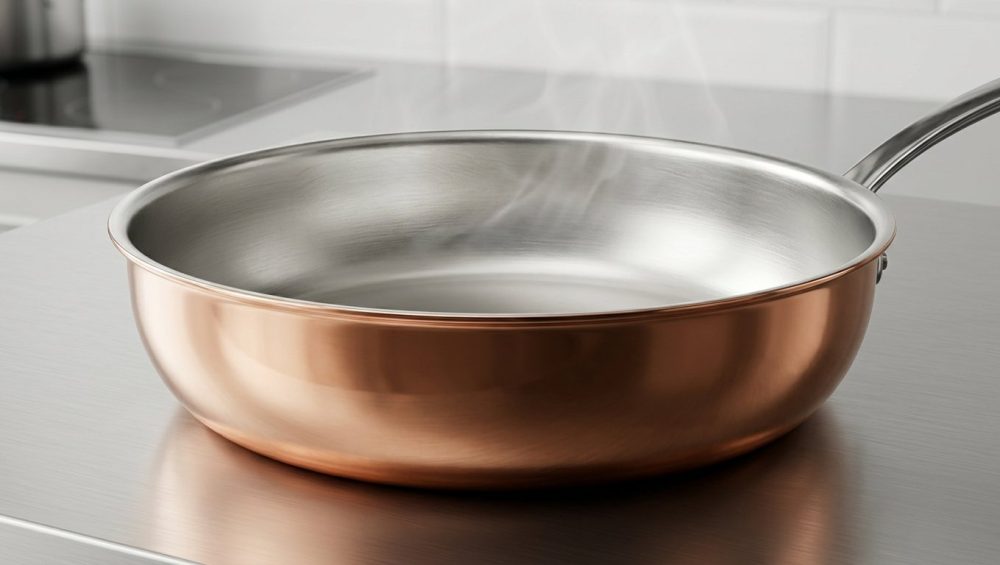
To solve this thermodynamic bottleneck, the stainless steel lining must be microscopically thin—typically around 0.2mm (200 microns). This is thick enough to completely protect your food from the reactive copper, but thin enough that it doesn’t significantly interfere with the copper’s rapid heat transfer.
The bonding process to create this bimetal is an absolute marvel of modern engineering. It requires massive, terrifying force—around 850 tonnes per square centimeter—to create a permanent, intercrystalline connection between the two vastly different metals. The result is a pan that gives you 90% of the thermal responsiveness of pure copper, with zero of the maintenance anxiety of tin.
However, because stainless steel expands and contracts at a different rate than copper, mitigating thermal shock is absolutely critical. Never, under any circumstances, throw a ripping hot bimetal copper pan directly into a sink full of cold water. The rapid temperature change will cause the metals to violently contract, permanently warping the base of your expensive pan into a useless, wobbly spinner.
Solving Culinary Pain Points: Emulsions and Reductions
Let’s talk about why you actually need this absurd level of thermal control in your home kitchen. The two biggest nightmares for ambitious home cooks are broken emulsions and scorched sugar reductions.
An emulsion—like a classic French beurre blanc, a delicate hollandaise, or a modern, stabilized plant-based sauce—is a fragile, microscopic suspension of fat droplets dispersed in water. It is held together by precise temperature management and mechanical shearing (whisking). The window for success is terrifyingly tiny. Egg yolks, the primary emulsifier in hollandaise, begin to coagulate between 149°F and 158°F. If the temperature of your pan gets even slightly too high, the proteins seize, the fat violently separates, and you are left with a greasy, broken, weeping mess of scrambled eggs and butter. If you are constantly struggling to prevent emulsion breakage, your sluggish, unresponsive cookware is almost certainly the culprit.
When you use a thick copper pan, you have absolute thermal supremacy. You can hold the sauce exactly at the ideal 140°F range. If it starts to get even a fraction of a degree too hot, you simply lift the pan off the burner. Because of copper’s high thermal diffusivity, the heat transfer stops instantly. There is no residual heat hiding in the heavy base to sabotage your sauce.
The exact same physics apply to reductions and delicate sugar work. When you are making a caramel, the difference between a perfect, nutty amber syrup and a bitter, smoking disaster is literally a matter of seconds. Copper’s rapid thermal conductivity ensures that the melting sugar heats perfectly evenly across the entire base of the pan, eliminating the localized hot spots that cause the edges to burn while the center remains crystallized.
Mastering Heat Application: Searing and Sautéing in Copper
Wait, can you actually sear a steak in a tin-lined copper pan if the tin melts at 450°F (232°C)? Yes, absolutely. But you have to understand the limits of the metal and the chemistry of your food.
You do not need a 600°F pan to get a gorgeous, crusty sear on a piece of meat. In fact, mastering the Maillard reaction—the complex chemical process between amino acids and reducing sugars that browns your meat and creates deep flavor—only requires sustained temperatures around 300°F to 350°F.
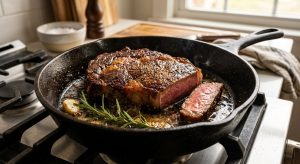
Tin-lined copper excels in this exact temperature range. The incredible thermal mass of a thick (2.5mm) solid copper pan means that when you drop a cold, thick ribeye into it, the pan’s surface temperature does not plummet. It holds completely steady, driving heat continuously and evenly into the meat. The moisture from the food actually cools the surface of the pan as it evaporates, keeping the metal well below the melting point of the tin, creating a perfect, golden-brown crust long before the pan ever gets close to a dangerous temperature.
The Sassy Sous-Chef’s Guide to Buying and Maintaining Copper
If you are going to invest in copper cookware, do it right. Do not buy cheap, paper-thin, decorative nonsense from a discount home goods store. You want a pan that is at least 1.5mm to 2.5mm thick. Anything thinner than 1.5mm is just shiny table service ware and will not give you a single one of the thermal benefits we just spent all this time discussing. A proper 2.5mm copper pan should feel heavy, substantial, and incredibly solid in your hand.
Maintenance is not the nightmare the internet makes it out to be. Yes, the exterior of the copper will naturally oxidize and develop a dark, cloudy patina over time due to heat exposure and oxygen. You can polish it every week with a commercial copper paste (or a mixture of lemon juice and fine salt) if you want it to look like a shiny new penny, or you can let it age gracefully. I personally prefer the patina—it shows that you actually cook, rather than just treating your kitchen like a museum exhibit.
For tin linings, the rules of engagement are simple and non-negotiable: no metal utensils, no abrasive scouring pads, and never, ever preheat the pan empty. Treat it gently, use wooden or silicone spatulas, wash it with warm soapy water and a soft sponge, and the lining will easily last for a decade before needing to be sent to a professional tinsmith for re-tinning.
Having reliable, high-performance gear that does exactly what you tell it to do is one of the best ways to cure weeknight cooking anxiety. When you know your pan is going to respond instantly to your burner adjustments, cooking stops being a stressful, chaotic battle against your equipment and becomes a genuinely enjoyable, creative craft.
Final Thoughts on the Copper Investment
Solid copper cookware is an investment in culinary precision. It forces you to pay attention, to understand heat, and to cook with intention. It is the ultimate tool for the home cook who wants to elevate their food without relying on cheap gimmicks, toxic coatings, or blind luck.
If you are serious about building a kitchen that works for you, and you want to stop fighting your stove, consider adding a thick, beautifully crafted copper saucepan or sauté pan to your arsenal. Treat it with respect, learn its thermodynamic quirks, and it might just become the most important, reliable piece in your essential kitchen survival guide. Now go pour yourself another glass of wine, get back in the kitchen, and show that hollandaise exactly who is boss.