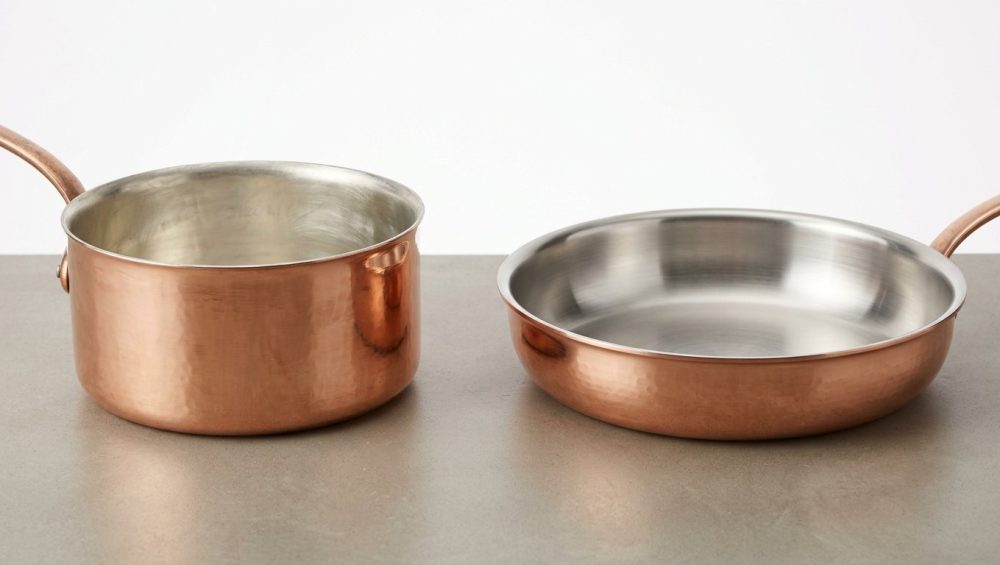
Listen up, culinary weekend warriors. If you have been relying on scratched-up, peeling non-stick pans that off-gas mystery chemicals into your scrambled eggs, it is officially time for an intervention. I have zero patience for cheap, disposable cookware that treats your daily meals like a hazardous waste experiment. As someone who firmly advocates for banishing toxic kitchen gear from the face of the earth, I am here to talk about the absolute, undisputed heavyweight champion of the stovetop: hand-forged copper.
Let’s get one thing straight right out of the gate: you do not need a culinary degree from Le Cordon Bleu to cook with copper. Yes, it looks intimidating hanging from a pot rack in a French chateau, and yes, it costs more than a standard kitchen appliance. But behind the pretentious chef-speak and the shiny exterior lies a simple, undeniable truth rooted in pure physics: copper makes cooking incredibly easy. It is the ultimate tool for the home cook who wants professional-level results without the guesswork.
Today, we are skipping the fluff and diving deep into the thermodynamic properties, the metallurgical realities, and the chemical dynamics of copper cookware. We are going to settle the great debate between traditional tin linings and modern stainless steel linings, and we are going to arm you with the empirical data you need to finally cook like an expert. Pour yourself a glass of wine, grab your notebook, and let’s get into the science.
The Thermodynamics of Copper: Why It Obliterates the Competition
To understand why copper is universally revered by professional chefs, we have to look at the cold, hard numbers. In the realm of thermodynamics, the performance of a cooking vessel is largely dictated by its thermal conductivity—the rate at which a material transfers heat from a source to your food. This is measured in Watts per meter-Kelvin (W/m·K).
Let’s look at the standard metals floating around your kitchen. Stainless steel, while durable, is a terrible conductor of heat, sitting at a miserable 15 to 16 W/m·K. Cast iron, the darling of rustic campfire cooking, clocks in at a sluggish 50 to 80 W/m·K. Pure aluminum is highly respectable at 237 W/m·K, which is why it is used as the core in most high-end clad pans.
But pure copper? Copper boasts a staggering thermal conductivity of 401 W/m·K. The only metal on the periodic table that beats it is pure silver at 429 W/m·K, and unless you have a billionaire’s budget, silver pans are likely out of the question.
Thermal Diffusivity: Agility in the Pan
Thermal conductivity is only half the story. We also have to account for thermal diffusivity, which measures how quickly a material reacts to changes in temperature. Because of its immense conductivity combined with its specific density, copper offers unparalleled responsiveness. This gives you precise temperature control that simply cannot be replicated by cast iron or aluminum.
When you turn up the flame under a copper saucepan, the heat spreads across the base and up the sidewalls almost instantly, eliminating the dreaded hot spots that scorch delicate ingredients. More importantly, when you turn the flame down or remove the pan from the heat entirely, the temperature drops immediately. When a delicate hollandaise sauce or a temperamental caramel is on the verge of breaking, removing a copper pan from the heat stops the cooking process almost instantaneously. This thermal agility is the ultimate cheat code for surviving kitchen disasters before they even happen.
Enthalpy and Thermal Mass
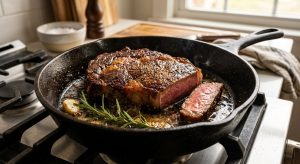
Copper also possesses an excellent balance of entropy (the property of heat transfer) and enthalpy (the property of heat retention, or thermal mass). A heavy, 2.5mm thick copper skillet holds a massive amount of internal thermal energy. When you drop a cold, thick-cut steak into a hot copper pan, the pan does not suffer a massive temperature drop the way a thin aluminum pan would. It recovers instantly, pumping heat into the meat to create a perfect crust.
Hand-Hammered vs. Machine-Spun: Is the Hammer Actually Better?
If you have ever shopped for high-end copper, you have likely noticed the gorgeous, dimpled texture on the exterior of certain pans. But is hand-hammering just an aesthetic flex, or does it actually serve a functional purpose?
In the earliest days of coppersmithing, all pans were “raised” by hand. An artisan would take a flat sheet of raw copper and beat it in concentric circles over an anvil, gradually shaping the metal into the walls of a pot. Today, with the advent of the Industrial Revolution, most commercial copper pans are spun on high-speed lathes. Spinning is incredibly efficient and produces pans with highly uniform thickness, but it lacks the structural benefits of a hammer.
Work Hardening and Grain Structure
When a master coppersmith takes a hammer to a sheet of copper, they are executing a complex metallurgical process known as work hardening (or severe plastic deformation). The mechanical impact of the hammer fundamentally alters the microscopic grain structure of the metal. The crystalline lattice shifts from a chaotic, relatively soft state into a tighter, sub-micron nanocrystalline structure.
This severe plastic deformation drastically increases the yield strength and rigidity of the metal, effectively preventing deformation or warping when the pan is subjected to the thermal shock of a cold deglazing liquid. A true hand-hammered pan is significantly tougher and more durable than a machine-spun pan of the exact same thickness.
Be warned, however: many modern manufacturers simply run machine-spun pans through an automated texturing press to mimic the dimpled look of a hammered pan. This purely cosmetic texturing does not replicate the deep, structural work-hardening effect of traditional hand-raising. If you want the true benefits of a hammered grain structure, you have to seek out authentic, artisan-crafted pieces.
The Lining Dilemma: Why Bare Copper Needs a Babysitter
For all of its thermodynamic glory, copper has one glaring flaw: it is a highly reactive heavy metal. If you simmer a highly acidic tomato sauce, a wine-heavy coq au vin, or a sharp lemon reduction in a bare copper pot, the acid will rapidly oxidize the copper, leaching it directly into your food.
While trace amounts of copper are an essential dietary mineral, a massive dose of oxidized copper will give your painstakingly crafted dinner a violently bitter, metallic taste. More importantly, frequent ingestion of foods cooked in highly reactive bare copper can lead to heavy metal toxicity.
For this reason, with the exception of specialized unlined bowls used exclusively for whipping egg whites (where the copper ions stabilize the protein foam) or making high-sugar jams, all copper cookware must be lined with a non-reactive barrier. This brings us to the ultimate debate in the culinary world: traditional tin versus modern stainless steel.
Traditional Tin Lining: The Slippery, Delicate Classic
For hundreds of years, the standard lining for copper cookware has been pure tin. Applying tin to copper—a technique known in Greece as ganoma or kalaysma—is a mesmerizing, old-world craft. The coppersmith heats the raw copper vessel, applies a chemical flux, melts pure tin ingots directly into the pan, and swiftly wipes the molten metal across the interior using a pad of cotton or fiberglass.
The Chemical and Thermal Profile of Tin
Tin is a magnificent material for cooking. It is completely inert, meaning it will never react with your acidic ingredients. When molten tin is wiped over hot copper, an incredible chemical reaction occurs. The pure tin bonds with the copper at a precise atomic ratio, forming highly stable intermetallic layers of Cu3Sn and Cu6Sn5. This means the tin doesn’t just sit on top of the copper like cheap Teflon; it chemically fuses to the vessel.
Furthermore, tin is naturally hydrophobic and incredibly slick. You do not need a synthetic, toxic polymer coating to prevent food sticking when you are working with a well-maintained tin lining. Eggs, delicate fish fillets, and crepes will practically levitate off the surface.
The Melting Point Danger Zone
However, there is a massive catch that terrifies most home cooks: pure tin has a remarkably low melting point of exactly 231.9°C (449.4°F).
If you put an empty tin-lined copper pan on a high-BTU gas burner and walk away to check your phone, the tin will reach its melting point in a matter of minutes. It will soften, bubble, and bead up, potentially ruining the smooth cooking surface. Because of this, if you are focused on mastering the Maillard reaction by aggressively searing a thick-cut steak at 500°F, you should be reaching for a heavy carbon steel skillet, not your heirloom tinned copper.
That being said, the fear of melting tin is often overblown. As long as there is food, liquid, or cooking fat in the pan, the surface temperature of the metal will rarely exceed the boiling point of the moisture in the food (212°F/100°C). The food acts as a thermal sink, absorbing the heat and keeping the tin safe.
The Beta to Rhombic Transition
New tin linings are bright, shiny, and mirror-like. But as you use the pan, you will notice the interior turning dull, matte, and slightly grey. Do not panic—you have not ruined your pan. Tin transitions from a shiny “beta” tetragonal crystal structure to a duller rhombic crystal structure when exposed to temperatures between 161°C and 202.8°C (321.8°F and 397°F). This change in appearance is completely normal and indicates that the tin is curing and becoming slightly more durable.
Because tin is a very soft metal, you must never use metal utensils, steel wool, or abrasive scouring pads on it. Stick to wooden spoons, silicone spatulas, and soft sponges.
Modern Stainless Steel Lining: The Indestructible Compromise
If the thought of melting your pan’s lining gives you heart palpitations, science has provided a modern miracle. For decades, manufacturers tried and failed to line copper with stainless steel. Copper is a highly ductile, soft metal that expands quickly when heated, while stainless steel is incredibly rigid and expands slowly. Early attempts to combine them resulted in pans that delaminated and tore themselves apart under thermal stress.
The Bimetallic Revolution
In 1983, a brilliant Belgian industrial engineer named Paul Van Achter, the founder of Falk Culinair, finally cracked the code. After three years of rigorous trial and error, Van Achter discovered that by adding specific heat resistors to the lamination process, he could heat the metals to a temperature that achieved the necessary ductility.
He then applied a mind-boggling 850 tonnes per square centimeter of pressure to press a thin sheet of stainless steel directly into a thick plate of copper. This immense pressure forced the two distinct metals to form a permanent, intercrystalline metallic connection. The bimetallic copper pan was born, and it revolutionized the high-end cookware industry overnight. Today, premium brands like Mauviel, Falk, and Made In utilize this exact bonding technology.
Debunking the Thermal Drag Myth
Purists often argue that adding stainless steel to copper ruins the pan’s thermal conductivity. Let’s look at the math. A standard, high-quality bimetallic pan features 2.3mm of pure copper bonded to a microscopic 0.2mm (200 microns) layer of austenitic 304 (18/8) stainless steel.
Because the stainless steel layer is so incredibly thin, its poor thermal conductivity (15 W/m·K) has almost zero practical impact on the pan’s overall performance. The 2.3mm copper engine drives the heat instantly, and the 0.2mm steel lining simply passes it through to the food.
If you are a busy professional who wants high-octane performance without the constant babysitting, this bimetallic construction is your holy grail. It completely eliminates weeknight cooking anxiety because you can sear at 800°F, deglaze with cold wine, aggressively scrape the fond with a metal whisk, and scrub the pan with heavy abrasives without a second thought. It is utterly indestructible.
The 2.5mm Sweet Spot and the Handle Hierarchy
When shopping for copper cookware, thickness is everything. Do not waste your money on cheap, 1.0mm decorative pans that belong on a wall rather than a stove.
For serious culinary work, 2.5mm is the industry gold standard. This thickness (usually 2.3mm copper and 0.2mm stainless) provides the perfect balance of rapid thermal response and heavy thermal mass. Some manufacturers offer 1.5mm or 2.0mm lines (such as the Mauviel M150 or M200 series) to save weight and reduce costs, but these thinner pans are more prone to scorching and lack the heat retention required for heavy searing.
A Note on Handles
The material of the handle drastically affects your cooking experience.
- Cast Iron: The traditional French choice. Cast iron handles are heavy, providing excellent counterbalance to the heavy copper body. Because cast iron is a poor conductor of heat, the handle stays relatively cool on the stovetop. However, they are prone to rusting if left wet.
- Brass/Bronze: Aesthetically stunning, but brass conducts heat very efficiently. A bronze handle will get blazing hot on the stove, requiring you to constantly use a side towel.
- Stainless Steel: The modern choice. Stainless steel handles will never rust, and their poor thermal conductivity means they stay cool during extended stovetop use.
Care, Maintenance, and the Economics of Retinning
Let’s address the elephant in the room: keeping copper looking pretty. When exposed to heat, oxygen, and the oils from your hands, raw copper will rapidly oxidize, developing a dark, mottled patina.
Polishing vs. Patina
You have two choices. You can spend your Sunday afternoons aggressively rubbing your pans with commercial copper polish (or a homemade paste of lemon juice and coarse salt) to maintain that blinding, mirror-like showroom shine. Or, you can do what actual working chefs do: absolutely nothing.
Embrace the tarnish. A dark, well-earned patina proves that the pan is actually being used to create incredible food, rather than just sitting on a shelf as a prop. If you are trying to escape a chaotic cooking routine, do yourself a massive favor and let the exterior of your copper age gracefully. Spend your time cooking, not polishing.
The Realities of Retinning
If you choose a stainless steel lining, your maintenance is zero. You wash it like a normal pan, and it will outlive you.
If you choose a tin lining, you must accept the economics of retinning. Over time, the soft tin will slowly wear thin from the friction of cooking and cleaning. Once the cumulative area of exposed raw copper at the base of the pan exceeds the size of a large coin, it is time to send the pan to a professional coppersmith to be retinned. For the average home cook, a high-quality tin lining will easily last 10 to 15 years before needing replacement. While retinning is an added expense, it makes the pan infinitely renewable. You can pass a tinned copper pan down for generations, having it wiped with fresh tin every decade to make it brand new again.
Verdict: Which Lining Wins for the Home Kitchen?
So, which path should you choose?
If you are a culinary romantic who loves the history of food, cooks delicate fish, relies on low-heat simmering, and treats your tools with meticulous care, traditional hand-hammered, tin-lined copper is a dream to cook with. Its non-stick properties and historical pedigree are unmatched.
If you are a pragmatic, high-volume home cook who wants the unrivaled thermal speed of copper but demands the rugged durability of a modern restaurant kitchen, bimetallic stainless-lined copper is the undisputed winner. It allows you to abuse the pan without consequence.
Even if you are currently building out your core collection of beginner kitchen tools, adding a single, high-quality 2.5mm copper saucepan or saucier to your arsenal will fundamentally change how you interact with heat. It will force you to become a more attentive, precise cook.
Cooking is not just about following a list of ingredients; it is about manipulating thermodynamics. By understanding the physics of your equipment and utilizing the unparalleled conductivity of copper, you are actively mastering the art of the kitchen. Ditch the toxic non-stick, respect the metal, and go make something incredible.