Look, I have burned enough caramel in my lifetime to single-handedly pave a small driveway. If you are anything like the average home cook, the mere thought of making spun sugar, English toffee, or a glossy, perfectly set fruit preserve sends a shiver of dread down your spine. We all love a good weekday shortcut to get dinner on the table efficiently, but when the weekend rolls around and it is time to tackle a serious pastry or confectionery project, shortcuts will only lead to scorched sugar, ruined ingredients, and bitter tears. You absolutely do not need a culinary degree to make mind-blowing confections in your own home, but you cannot cheat the laws of thermodynamics.
If you are still trying to melt sugar in that peeling, lightweight, mystery-metal skillet you bought at a big-box store five years ago, we need to have a serious talk about banishing toxic kitchen gear from your life. Not only are cheap, degrading non-stick coatings a chemical nightmare that have no place near your food, but they are also mathematically incapable of giving you the results you want when working with high temperatures. Sugar work requires absolute, uncompromising thermal precision.
Enter unlined copper cookware.
Now, before you roll your eyes and accuse me of pushing pretentious, high-maintenance chef-speak, let me stop you right there. I have zero patience for culinary elitism, and I despise kitchen tools that look pretty but offer no functional value. However, I have an immense amount of respect for objective metallurgical data. The use of bare, unlined copper for confectionery is not a stylistic choice; it is a scientifically backed, mathematically quantifiable necessity. Today, we are going to dive incredibly deep into the brutally honest physics and chemistry of why unlined copper vastly outperforms stainless steel for temperature-sensitive sugar work. Grab a cup of coffee and your reading glasses, because we are leaving no stone unturned.
The Agony of Sugar Crystallization (And Why Your Pan is to Blame)
Before we can appreciate the elegant solution that copper provides, we have to deeply understand the thermodynamic nightmare that is boiling sugar. Sucrose is a diva. When you set out to make caramel, fudge, or fruit preserves, you are essentially engaging in high-stakes organic chemistry in your kitchen.
The Fragile Phases of Sugar
When you dissolve granulated sugar (sucrose) in water and apply heat, the water begins to evaporate, and the concentration of the sugar syrup increases. As the concentration increases, the boiling point of the syrup rises. This is why pastry chefs obsess over specific temperature stages: the “thread” stage (around 230°F), the “soft ball” stage (235°F), the “hard crack” stage (300°F), and finally, the caramelization stage (320°F to 350°F).
At these elevated temperatures, the sugar syrup is in a highly volatile, supersaturated state. The sucrose molecules are desperately looking for an excuse to snap back together and form a solid crystal lattice. All it takes is one stray seed crystal clinging to the side of your pot, a sudden drop in temperature, or a localized “hot spot” on the bottom of your pan to trigger a catastrophic chain reaction. Within seconds, your smooth, glossy syrup seizes up into a grainy, cloudy, ruined mess. Stirring the pot at the wrong moment is one of those classic rookie kitchen mistakes that will instantly crystallize a batch, but often, the real culprit is the cookware itself.
Most home cooks attempt sugar work in standard multi-clad stainless steel pots. Stainless steel is a fantastic, durable material for boiling pasta or simmering a weekday soup, but when it comes to the rapid, razor-edge temperature shifts required for confectionery, it is a thermodynamic liability. To understand why your stainless steel pan is actively sabotaging your caramel, we have to look at the metallurgical math.
The Brutal Math: Thermal Conductivity of Copper vs. Stainless Steel
Thermal conductivity, denoted by the symbol k or λ, is the measure of a material’s inherent ability to conduct heat. It is quantified in Watts per meter-Kelvin (W/m·K). In simple terms, this metric tells us how efficiently heat energy moves through the crystalline atomic structure of the metal via free electrons.
Let us look at the raw data. The thermal conductivity of pure copper is approximately 400 W/m·K.
The thermal conductivity of standard austenitic stainless steel (the 300 series, like 304 or 316, which makes up 99% of home cookware) ranges between a pitiful 15 to 25 W/m·K.
Read those numbers again. Copper conducts heat roughly twenty to twenty-five times faster than stainless steel. When you are attempting to melt sugar, you need the heat from your stove’s burner to wrap around the base and sides of the pan with absolute uniformity. Because stainless steel has such a dismal thermal conductivity rate, the heat struggles to spread laterally across the bottom of the pan. Instead, it travels straight up from the burner, creating intense, localized hot spots directly above the flame or heating element.
If you have a hot spot in your sugar syrup, the sucrose in that specific area will reach the caramelization stage and begin to burn while the sugar just two inches away is still pale and undercooked. By the time the rest of the pan catches up, the sugar over the hot spot has turned into bitter, acrid carbon. Copper’s massive thermal conductivity ensures that the heat energy is instantly and evenly distributed across the entire surface area of the pan. When you demand precise temperature control for delicate spun sugar or a flawless mirror glaze, copper eliminates the thermal variance that causes localized scorching.
Specific Heat Capacity and the Physics of Rapid Cooling
Conductivity is only half of the thermodynamic story. The other crucial metric we must analyze is specific heat capacity.
Specific heat capacity (often denoted as C_p) measures the amount of heat energy—in Joules—required to raise the temperature of one kilogram of a substance by one degree Kelvin (J/kg·K). In the culinary world, we often refer to this concept casually as “thermal mass” or heat retention.
The specific heat capacity of pure copper is approximately 385 J/kg·K.
The specific heat capacity of austenitic stainless steel is significantly higher, hovering around 477 to 500 J/kg·K.
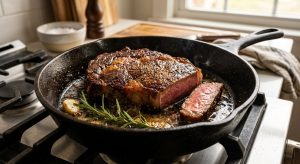
What does this mean for your weekend confectionery projects? It means that stainless steel acts like a thermal battery. It takes a massive amount of energy to heat it up, and once it is hot, it stubbornly holds onto that heat for a very long time. Cast iron is another prime example of a material with massive heat retention, which is why it is brilliant for searing a steak but absolutely disastrous for making caramel.
When your boiling sugar hits the critical hard crack stage (300°F) or the perfect amber caramel stage (320°F to 350°F), you have a window of mere seconds before it crosses the line into burnt, bitter territory. You must stop the cooking process instantaneously.
If you are using a stainless steel pan, turning off the burner or moving the pan to a cold grate does almost nothing. The stainless steel has absorbed so much thermal energy that it will continue to actively pump heat into your sugar syrup for minutes after it has been removed from the heat source. Your perfectly golden caramel will turn black while sitting on a cold counter because the pan itself is still cooking it.
Copper, conversely, has a lower specific heat capacity. It does not hoard heat. The absolute millisecond you remove a copper pan from the flame, the temperature of the metal begins to plummet, instantly halting the caramelization process. This hyper-responsive nature is the ultimate cure for cooking anxiety, because it means you are actually the one in control of the cooking process, not your cookware. The pan responds to your commands with zero lag time.
Thermal Diffusivity: The Real Metric That Matters
If you want to truly geek out and combine conductivity and specific heat capacity into one master metric, you look at thermal diffusivity. This is the holy grail of cookware physics.
Thermal diffusivity (denoted by the Greek letter α) measures the rate at which a temperature disturbance propagates through a material. It is calculated by dividing the thermal conductivity by the product of the material’s density and specific heat capacity (α = k / (ρ·C_p)). Essentially, it tells us how fast a pan reacts to a change in temperature.
The thermal diffusivity of copper is approximately 111 mm²/s (or 1.1 × 10⁻⁴ m²/s).
The thermal diffusivity of stainless steel is a microscopic 4 mm²/s (or 4 × 10⁻⁶ m²/s).
Let that sink in. Copper diffuses heat more than twenty-five times faster than stainless steel.
Trying to modulate the temperature of boiling sugar in a stainless steel pan is like trying to steer a massive, overloaded freight train. You can hit the brakes, but the sheer momentum is going to carry you forward for a mile before you actually stop. Cooking with copper is like driving a lightweight, finely tuned sports car. You tap the brakes, and you stop on a dime. When you are curating a collection of must-have tools for your kitchen, understanding thermal diffusivity is what separates the overpriced marketing gimmicks from the lifetime investments that actually elevate your food.
Why Unlined Copper? The Chemistry of Bare Metal
At this point, you might be thinking, “Okay, Sassy Sous-Chef, you have convinced me that copper is thermodynamically superior. But why does it have to be unlined bare copper? Why can’t I just use a copper pan lined with stainless steel or tin?”
This is where the physics lesson ends and the chemistry lesson begins.
The Problem with Linings in High-Heat Sugar Work
Historically, copper pots intended for savory cooking have always been lined with a non-reactive metal, traditionally tin. Tin is naturally non-stick and highly inert, but it has a fatal flaw: its melting point is incredibly low, right around 450°F (232°C).
When you are boiling sugar to the caramel stage (upwards of 350°F), you are operating dangerously close to the melting point of tin. If you leave an empty tin-lined pan on a high-BTU gas burner for even a minute before adding your sugar, the base of the pan can easily exceed 450°F, causing the tin lining to literally bubble, melt, and smear, permanently ruining the pan.
Modern manufacturers often line copper with a thin layer of stainless steel to solve the melting issue. However, as we just established with our brutal math, stainless steel is an insulator. Bonding a layer of stainless steel to the interior of a copper pan instantly degrades its thermal diffusivity. It is the equivalent of putting cheap, bald all-season tires on that finely tuned sports car. You lose the instantaneous temperature response that you paid all that money for.
The Chemical Magic of Copper Ions
Beyond the physical limitations of linings, bare copper provides a distinct, scientifically proven chemical advantage when working with sugar.
When sucrose is heated in the presence of water, it undergoes a process called sugar inversion, where the complex sucrose molecule breaks down into its simpler component monosaccharides: glucose and fructose. This inversion is critical because a mixture of glucose and fructose is highly resistant to crystallization.
Unlined copper acts as a chemical catalyst for this inversion process. The bare copper ions interact directly with the sugar molecules, accelerating the breakdown of sucrose into glucose and fructose. This microscopic chemical reaction acts as an invisible insurance policy against crystallization. The copper literally fights the sugar’s natural urge to seize up and turn grainy, preventing those infuriating kitchen disasters that force you to throw out a whole batch of expensive ingredients and start over.
Furthermore, when whipping egg whites for meringues or soufflés (another common use for unlined copper bowls), the copper ions bind with the conalbumin protein in the egg whites, creating a spectacularly stable foam that is nearly impossible to over-whip.
The “No-Go” Rule: Is Bare Copper Actually Toxic?
If you have read any of my previous rants, you know I have a strict, uncompromising “No-Go” rule regarding toxic kitchenware. I actively tell my readers to throw away pans that leach mystery chemicals or heavy metals into their food. So, how can I possibly recommend cooking in a bare, reactive heavy metal like copper?
This is where context and food chemistry are everything.
Copper toxicity is a very real, very serious issue if you use bare copper incorrectly. Copper is highly reactive to acids. If you were to simmer a highly acidic tomato sauce, a wine reduction, or a vinegar-based braise in an unlined copper pan, the acid would aggressively react with the metal. This reaction produces copper salts (often visible as a bluish-green patina called verdigris), which will leach directly into your food. Ingesting these copper salts can cause severe gastrointestinal distress and, over time, heavy metal toxicity. This is exactly why copper pans meant for savory, general-purpose cooking are strictly lined with tin or stainless steel.
However, sugar is not acidic. Confectionery work—boiling sugar, making caramel, whipping egg whites—takes place in a chemically neutral or highly buffered environment.
When you make fruit preserves (which do contain fruit acids) in a traditional unlined French copper jam pan (bassine en cuivre), the high concentration of sugar completely buffers the acid. The sugar coats the fruit and prevents the acids from reacting maliciously with the bare copper. The key is to mix your fruit and sugar together before applying heat, ensuring the protective syrup forms immediately.
Understanding the chemical boundaries of your equipment is one of those profound cooking secrets that permanently elevates you from an amateur following instructions to a knowledgeable cook mastering their craft. Unlined copper is perfectly, 100% safe, provided you strictly reserve it for its intended purpose: sugar work, syrups, jams, and egg whites. Keep the marinara sauce far, far away.
Practical Application: Confectionery in the Home Kitchen
So, how do we actually apply all of this thermodynamics and chemistry in a standard home kitchen? It is much easier than the science makes it sound.
When you set out to make a batch of caramel in your unlined copper sugar pan, you will notice the difference the moment you turn on the burner. Because of the extreme thermal diffusivity, you do not need to blast the heat. A medium-low flame is more than enough to rapidly bring the sugar to a boil.
The Golden Rule of Caramel
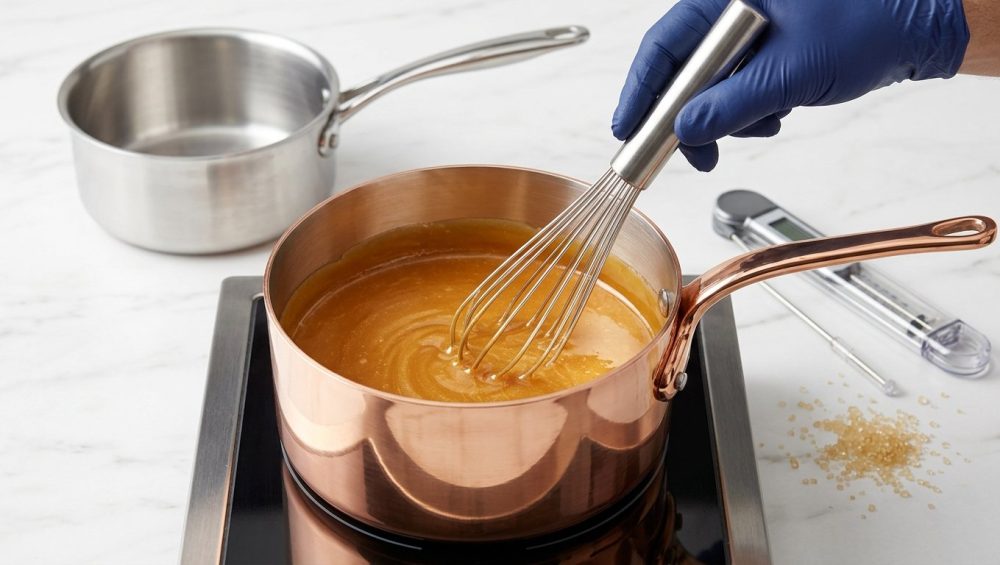
Put your sugar and a splash of water into the unlined copper pan, turn on the heat, and step away. Do not whisk it. Do not stir it with a spatula. Just let the copper do the work. The unparalleled thermal conductivity ensures that the syrup will boil evenly across the entire surface of the pan. There will be no hot spots, meaning there is no need to stir to distribute the heat.
As the water boils off and the sugar begins to change color, you can gently swirl the pan by the handle to even out the caramelization, but keep utensils out of the pot. Once the sugar reaches that perfect, deep amber hue, simply lift the pan off the heat. The temperature will plummet instantly, locking in the flavor without coasting into burnt bitterness. You can easily translate these professional techniques into modern recipes for salted caramel sauces, pralines, or candied nuts with absolute confidence.
Mastering Fruit Preserves
If you are using a wide, flared unlined copper jam pan, the geometry of the pan works in tandem with the metallurgy. The wide surface area promotes rapid evaporation of water, while the copper’s heat transfer ensures the fruit cooks incredibly fast. Rapid cooking is the secret to bright, vibrant jams; the longer you boil fruit, the more the fresh flavors degrade into a muddy, dull paste. By utilizing copper, you achieve the perfect gel set in a fraction of the time, preserving the bright, acidic pop of the fresh fruit.
Sizing Up Your Investment: Thickness and Maintenance
If you are ready to make the leap into the world of professional sugar work, you need to know how to buy the right equipment. Not all copper is created equal, and the market is flooded with cheap, decorative nonsense.
The Importance of Gauge (Thickness)
A copper pan that is 0.5mm thick is a decorative wall hanging, not a cooking vessel. To harness the true thermal mass and conductivity required to prevent hot spots, you need a pan with a thickness (gauge) of at least 1.5mm to 2.5mm. Yes, solid 2.5mm copper is heavy. Yes, it is expensive. But it is a lifetime investment. Just like the curated beginner cooking essentials you slowly upgraded over the years, a thick unlined copper sugar pan is a specialized tool that you will eventually pass down to your grandchildren.
Maintenance and Oxidation
Bare copper oxidizes when exposed to air, developing a dull, brownish tarnish over time. While some people love the rustic patina, you generally want to keep the interior of your sugar pan clean to ensure the copper ions can properly interact with your food.
Do not waste your money on expensive, toxic chemical metal polishes. You can restore bare copper to a brilliant, mirror-like shine in seconds using basic pantry staples. Simply make a paste of coarse kosher salt and an acid (like lemon juice or white vinegar). Rub the paste over the oxidized copper with a soft sponge, and watch the tarnish instantly vanish. Rinse it thoroughly with warm water, dry it immediately with a microfiber cloth to prevent water spots, and it is ready for your next batch of fudge.
Conclusion: Embrace the Science and Elevate Your Weekends
Cooking is often romanticized as an intuitive art form, a dance of tasting and adjusting. And while that is absolutely true for a Tuesday night stew, pastry and confectionery are a different beast entirely. Sugar work is an exact science, governed by the rigid laws of thermodynamics, specific heat capacity, and thermal diffusivity.
When you equip yourself with an unlined copper pan, you are no longer fighting against the sluggish, insulating properties of cheap cookware. You are harnessing a material that conducts heat twenty-five times faster than stainless steel, drops temperature the microsecond you remove it from the flame, and chemically alters sucrose to prevent crystallization.
You do not need to be a Michelin-starred pastry chef to make flawless spun sugar, vibrant fruit preserves, or complex, nutty caramels. You just need to respect the physics, ditch the toxic non-stick garbage, and invest in the right metallurgical tools for the job. Stop ordering takeout desserts from overpriced bakeries, roll up your sleeves, and let the science of unlined copper transform your weekend culinary projects into absolute masterpieces.