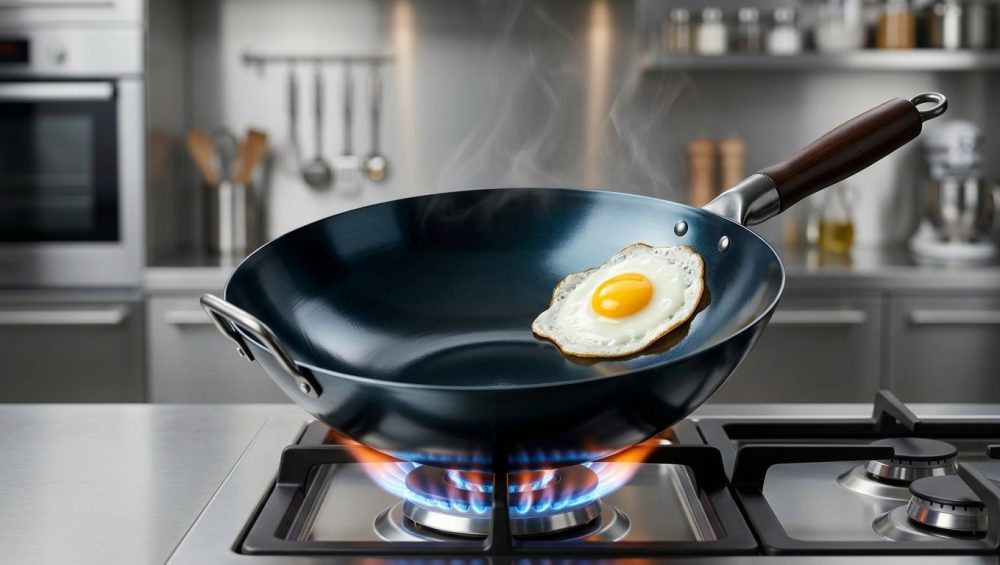
Listen, I love you, but if you are still cooking your morning eggs in a scratched-up, peeling synthetic non-stick pan, we need to have a serious intervention. There is absolutely nothing appetizing about a side of forever chemicals with your stir-fry. I have zero patience for pretentious chef-speak, but I have even less patience for cheap, toxic cookware that actively poisons you while doing a mediocre job at searing a chicken breast. The first step in banishing toxic kitchen gear from your life is realizing that professional-level results are completely achievable in a standard home kitchen, provided you are willing to learn how your tools actually work.
Today, we are diving headfirst into a definitive masterclass on the literal science of carbon steel wok seasoning. No myths, no old wives’ tales, and definitely no rubbing your pan with a potato unless you are actively making hash browns. We are going to talk about exact temperature thresholds, lipid breakdown, and structural bonding mechanisms. We are going to turn you into a kitchen metallurgist. If you are tired of your food sticking, your pans rusting, and your weeknight stir-fries turning into a soggy, frustrating mess, grab a cup of coffee and pay attention.
The Anatomy of Carbon Steel: Why It Is the Ultimate Culinary Canvas
Before we can talk about seasoning, we have to talk about the canvas itself. There is a reason that nearly every professional restaurant kitchen on the planet relies on carbon steel, particularly when it comes to wok cooking.
Carbon steel is an alloy composed of roughly 98% to 99% pure iron, combined with 0.6% to 1.0% carbon. This might sound incredibly similar to cast iron, but that microscopic difference in carbon content changes everything. Cast iron typically contains 2% to 4% carbon and up to 3% silicon, which makes the metal highly porous, heavy, and structurally brittle. If you drop a cast iron skillet on a tile floor, it might crack in half. If you drop a carbon steel wok, you will simply dent the floor.
Because of its specific metallurgical makeup, carbon steel can be forged, spun, and pressed into incredibly thin sheets. A standard high-quality wok has a gauge of just 1.2 to 2.0 millimeters. This thinness is the secret to its magic. It gives the wok an exceptionally low thermal mass combined with rapid thermal conductivity. When you turn up the flame on your stove, the wok gets blisteringly hot almost instantly. When you turn the flame down, the temperature drops immediately. This unparalleled responsiveness is what allows cooks to achieve wok hei—the legendary “breath of the wok”—where food is flash-seared at temperatures between 450°F and 600°F without overcooking the delicate interior.
Now, let us compare this to the cheap, synthetic non-stick pans you buy at the big box store. Pans coated in polytetrafluoroethylene (PTFE), commonly known as Teflon, are a chemical band-aid for poor cooking technique. More importantly, they are a massive safety hazard. Scientific research consistently shows that PTFE coatings begin to rapidly degrade and break down at temperatures over 260°C (500°F). When you are stir-frying properly, you will easily exceed that threshold. Overheating a synthetic non-stick pan releases toxic, invisible fumes that can literally kill pet birds and cause flu-like symptoms in humans. Why on earth would you subject your food to that when carbon steel offers a natural, non-toxic alternative that actually improves with every single use?
To truly harness this power, you must understand the thermodynamics of carbon steel pans and how they interact with high heat. Carbon steel does not come out of the box non-stick. It comes out of the box as raw, reactive iron. It is entirely up to you to build the protective armor that will make it slicker than a politician during election year.
The Science of Polymerization: Turning Liquid Oil into Solid Armor
When amateur cooks talk about “seasoning” a pan, they usually picture a thin layer of wet grease sitting on top of the metal. This is fundamentally incorrect. Seasoning is not a coating of oil; it is the result of a violent, beautiful chemical transformation known as polymerization.
Let us break down the organic chemistry. Cooking oils are made of triglycerides—essentially a glycerol backbone attached to three long fatty acid chains. These chains are made of carbon atoms bonded to each other and surrounded by hydrogen atoms. In “unsaturated” fats, some of these carbon atoms are missing their hydrogen partners, forcing them to form double bonds with adjacent carbon atoms. These double bonds are the key to everything. They are chemical weak points, highly reactive and eager to break open.
When you apply a microscopic layer of unsaturated oil to your carbon steel wok and heat it past its smoke point, a process called controlled pyrolysis begins. The extreme heat, combined with ambient oxygen and the catalytic presence of the iron in the pan, causes those reactive double bonds to break apart. This creates free radicals—unstable molecules that immediately seek out other broken bonds to grab onto.
As they link up, they undergo dehydrogenation and cyclization, forming a massive, interconnected three-dimensional web of molecules. The liquid oil fundamentally changes its state of matter, curing into a hard, plastic-like, carbon-rich polymer matrix. But it does not just sit on top of the pan. This newly formed polymer network actually forms covalent bonds with the iron oxide layer of the steel beneath it. It is molecularly anchored to the metal.
The result? Bare iron has a naturally high surface energy of roughly 72 mN/m, which means it desperately wants to grab onto whatever touches it—especially the proteins in your scrambled eggs. The polymerized oil layer dramatically reduces that surface energy down to approximately 22 mN/m. To put that in perspective, that is nearly identical to the surface energy of synthetic PTFE Teflon. You have literally manufactured your own non-toxic, highly durable non-stick surface using nothing but heat and fat.
However, achieving this perfect matrix requires precision. One of the most common rookie kitchen mistakes is assuming that any oil in your pantry will magically undergo this transformation. Spoiler alert: they will not.
Choosing Your Weapon: The Thermodynamics of Cooking Oils
If you want to build an indestructible patina, you have to choose the right building materials. The internet is full of terrible advice regarding which oil to use for seasoning, mostly because people confuse a high smoke point with a good polymerization profile. The secret metric you actually need to care about is the Iodine Value (IV).
The Iodine Value is a chemical measurement of how many unsaturated double bonds are present in a fat. The higher the IV, the more reactive the oil is, and the more readily it will cross-link and polymerize into a hard shell. Let us look at why this matters by evaluating the three main categories of fats.
First, we have highly saturated fats like butter, lard, and coconut oil. Because they are saturated, their carbon chains are completely full of hydrogen atoms. They have very few reactive double bonds. Coconut oil has an abysmal Iodine Value of roughly 7 to 10. If you try to season a wok with coconut oil, it will barely polymerize. Instead, it will just sit on the surface, turning into a sticky, gummy, rancid mess.
On the opposite end of the spectrum, we have the highly polyunsaturated drying oils, the most infamous being flaxseed oil (the food-grade equivalent of linseed oil). A few years ago, a viral blog post convinced the entire culinary world that flaxseed oil was the holy grail of cast iron and carbon steel seasoning because it has a massive Iodine Value of around 200. Yes, flaxseed oil polymerizes incredibly fast and forms a surface that looks like glass. But here is the problem: it is too hard. The resulting polymer matrix is so densely cross-linked that it becomes completely brittle. When your carbon steel wok undergoes the rapid thermal expansion and contraction of high-heat cooking, the rigid flaxseed polymer cannot flex with the metal. It shatters and flakes off into your food like cheap nail polish.
The sweet spot—the absolute Goldilocks zone for wok seasoning—lies in oils with a moderate Iodine Value between 120 and 170. You need an oil that polymerizes hard enough to protect the steel, but remains flexible enough to survive thermal shock.
Grapeseed oil is the undisputed champion here, boasting an Iodine Value of 160 to 170. It creates a beautifully flexible, highly adherent polymer film. Sunflower oil (IV 125–135) is another phenomenal choice. If you prefer an oil that doubles as a high-heat cooking fat, refined avocado oil is a stellar option. While its IV is slightly lower (80–90), its high concentration of monounsaturated fats compensates beautifully, and its massive smoke point of 500°F to 520°F makes it incredibly versatile. Having the right oil on hand makes whipping up simple weeknight dinners infinitely less frustrating, as you won’t be fighting a sticky pan.
The Step-by-Step Masterclass: Seasoning Like a Metallurgist
Now that we have established the chemistry, it is time to put it into practice. Seasoning a wok is not a casual chore; it is an initiation ritual. Clear your schedule, open your kitchen windows, and turn on your exhaust fan, because we are about to generate some smoke.
Step 1: Stripping the Factory Grease (The Blank Slate)
When you buy a high-quality carbon steel wok, it will arrive coated in a thick layer of industrial machine oil or beeswax. Manufacturers do this to prevent the raw iron from rusting while it sits on a cargo ship crossing the ocean. This layer is entirely inedible and will block your seasoning oil from bonding to the steel.
You must strip the wok down to the bare, naked metal. Take the wok to your sink, run the hottest water you can tolerate, and apply a generous amount of aggressive dish soap. A sturdy stainless steel scrubber is one of those beginner kitchen tools you will use constantly during pan restorations. Scrub the absolute life out of the wok. You want to scour the inside and the outside until the water runs completely clear and the steel feels squeaky clean to the touch. Dry it immediately with a paper towel.
Step 2: Blueing the Steel (Creating Magnetite)
This step is unique to carbon steel woks and is arguably the most visually stunning part of the process. We are going to intentionally oxidize the pan, but we are going to dictate exactly how it oxidizes.
If raw iron is exposed to ambient oxygen and moisture, it undergoes an electrochemical reaction to form Fe2O3, commonly known as red rust. Red rust is structurally larger than the iron beneath it, which causes it to expand, blister, and flake away, exposing fresh iron to the air and creating a vicious cycle of decay. We do not want red rust.
Instead, we are going to subject the dry wok to extreme, dry heat to force the formation of Fe3O4, also known as magnetite or black iron oxide. Place your raw wok directly over your highest gas burner. At first, nothing will happen. Then, as the steel approaches 400°F, it will begin to turn a light straw yellow. Keep the heat blasting. As the temperature climbs past 500°F and approaches 550°F, the yellow will deepen into a rich brown, then a vibrant purple, and finally, a brilliant, iridescent blue-grey.
This color change is the visual evidence of an electrochemical conversion coating. The magnetite layer is dense, hard, and chemically stable. It passivates the metal, acting as an impenetrable shield against future red rust, and provides a highly textured micro-surface for your oil polymer to grip onto. Slowly tilt and rotate the wok over the flame until the entire bowl, from the base to the rim, has turned this magnificent blue.
Step 3: The Micro-Layer Application (Less is More)
Once the wok is fully blued, let it cool down just enough so that you do not instantly incinerate your hand, but while it is still quite warm (around 200°F to 250°F). It is time to apply the lipid layer.
Pour exactly one-half teaspoon of your chosen high-IV oil (like grapeseed) into the center of the wok. Take a folded paper towel and aggressively rub the oil over every square inch of the interior and exterior.
Now comes the most critical instruction in this entire article: take a clean, dry paper towel and wipe all the oil off. Wipe it off like you made a terrible mistake and you are desperately trying to hide the evidence. You want the wok to look completely dry, with only the faintest, microscopic sheen remaining.
Why? Because carbon steel is incredibly dense. Unlike cast iron, which acts like a porous sponge, carbon steel only allows the seasoning layer to form on the topmost 2 to 5 microns of the surface. If your oil layer is too thick, the heat will not be able to penetrate evenly. The top of the oil will polymerize, sealing the liquid oil underneath, resulting in a sticky, gummy, half-baked mess that will immediately peel off into your food. These precise application techniques will transform your daily meals by ensuring your food actually releases from the pan beautifully.
Step 4: The Thermal Bake (Hitting the Threshold)
Place the micro-oiled wok back over the burner (or upside down in an oven if your wok has all-metal handles). We need to hit the exact thermal threshold where polymerization peaks.
If you are using the stovetop method, turn the burner to medium-high. You will see the microscopic layer of oil begin to smoke. This is the pyrolysis in action—the oil is cracking into volatile aldehydes and free carbon. You must maintain this heat. Research utilizing FTIR spectroscopy confirms that for oils like grapeseed, polymerization peaks around 375°F to 400°F.
Keep moving the wok over the flame so the heat distributes evenly. The smoke will eventually thin out and stop, and the surface will transform from a glossy wet look to a hard, matte black or deep bronze finish. This indicates that the fatty acid chains have successfully cross-linked into a solid plastic-like film.
Once the smoking stops, turn off the heat. Let the wok cool down naturally and slowly. Do not run it under cold water! Rapid air-cooling or thermal shock creates massive stress gradients in the metal (exceeding 120 MPa) which will instantly cause microscopic hairline fractures in your brand new polymer layer. Once I understood this thermal threshold, I stopped burning dinner every night and started searing proteins like a professional.
Repeat Steps 3 and 4 two more times. By the third round, your wok will possess a slick, obsidian-dark patina that is ready for battle.
Diagnosing Wok Woes: Why Your Seasoning is Flaking or Sticking
Even with a masterclass under your belt, the reality of everyday cooking means you will occasionally damage your patina. Carbon steel is a living, breathing tool, and the seasoning is dynamic—it wears down and builds back up. Here is how to diagnose and fix the three most common wok tragedies.
The Sticky Pan Syndrome: If your wok feels tacky to the touch, like the back of a cheap sticker, you committed the cardinal sin of applying too much oil during the seasoning phase, or you failed to heat the pan high enough to initiate cross-linking. The triglycerides are trapped in a half-polymerized purgatory. To fix this, place the wok in a 400°F oven for an hour to force the remaining oil to cure, or scrub the gummy layer off with coarse salt and start over.
The Acid Wash: You spent hours building a beautiful black patina, and then you decided to simmer a tomato sauce or deglaze with a heavy splash of black vinegar. Acid is the mortal enemy of polymerized oil and the Fe3O4 magnetite layer. It will literally eat the seasoning right off the iron, leaving you with bare, grey metal. Never simmer highly acidic liquids in a newly seasoned wok. If you strip your pan, don’t panic. Just wash it, dry it, and do a quick stovetop maintenance seasoning. Knowing how to troubleshoot a stripped patina is the best way to rescue a ruined dinner at the last minute.
The Flaking Pan: If your seasoning is chipping off in hard, black flakes, you either fell for the flaxseed oil trap (resulting in a brittle matrix), or you allowed a thick layer of carbonized food debris to build up over time. Seasoning is polymerized oil, not burnt food. If you have crusty black carbon buildup, you must aggressively scrub it away, even if it means taking some of the seasoning with it.
Maintenance: Keeping the Patina Alive
You have successfully seasoned your wok. Now, you have to maintain it. The rules of carbon steel maintenance are not difficult, but they are entirely non-negotiable.
First, we need to dispel the most pervasive myth in the culinary world: the idea that you cannot use soap on seasoned iron. You absolutely can, and you should. Decades ago, dish soap was made with lye (sodium hydroxide), a highly caustic base that will rapidly dissolve polymerized fats. Modern dish liquids like Dawn do not contain lye; they are mild synthetic surfactants. They are strong enough to wash away loose cooking grease, but they are completely incapable of breaking the covalent bonds of a cured polymer matrix. Wash your wok with soap and a sponge. You are cooking food in it, for crying out loud.
However, you must obey the 90-Second Rule. Carbon steel’s Achilles’ heel is time-dependent hydration. The moment your wok gets wet, electrochemical corrosion begins. Within 90 seconds at room temperature, invisible orange micro-rust starts forming at the grain boundaries of the steel. You cannot leave a carbon steel wok soaking in the sink, and you cannot let it air dry on a rack.
The workflow is simple: Wash the wok immediately after cooking while it is still warm. Rinse it thoroughly. Immediately place it back on the stove over medium heat. Let the burner evaporate every single molecule of water until the pan is bone dry. Adopting this strict cleaning ritual will help you eliminate kitchen chaos for good and ensure your cookware lasts a lifetime.
Once the wok is dry and still hot, apply one single drop of your seasoning oil. Wipe it around the interior with a paper towel, then wipe it completely dry. This micro-layer of oil protects the steel from ambient humidity while it sits in your cabinet, ensuring it is perfectly rust-free and ready for your next meal.
Mastering the science of carbon steel is not just about having a non-stick pan; it is about taking control of your tools and refusing to settle for disposable, toxic garbage. It requires a little bit of chemistry, a touch of thermodynamics, and a healthy dose of heat. Your wok is a living record of your culinary journey, darkening and improving with every meal you cook. Embracing this process is the ultimate key to mastering the art of the home kitchen. Now get off the internet, go strip that factory grease, and start building your armor.