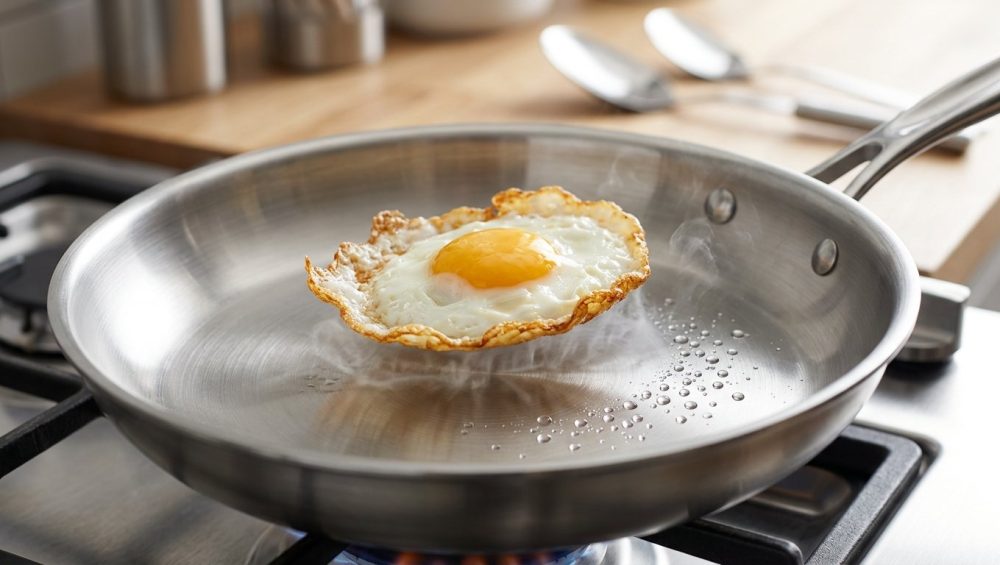
Listen up, weekend culinary warriors. We need to have a serious, unfiltered conversation about the most misunderstood, unfairly maligned piece of equipment in your culinary arsenal: the uncoated stainless steel skillet. If you are like most home cooks, you probably have a gorgeous, heavy-bottomed stainless steel pan sitting in the dark recesses of your cabinet, gathering dust. You are terrified of it. You probably tried to cook a beautiful, expensive twenty-five-dollar salmon fillet in it once, only to watch in absolute horror as the delicate fish chemically welded itself to the metal, tearing into a mangled, shredded disaster when you desperately tried to flip it with a spatula. I get it. We have all been there, staring at a ruined dinner while the smoke detector screams in the background.
But here is the brutal, scientific truth: the pan is not the problem. A high-quality stainless steel pan is a flawless instrument of culinary perfection. The problem is a fundamental misunderstanding of basic kitchen thermodynamics. You do not need a culinary degree to master the art of the home kitchen, but you absolutely must respect the laws of physics. Today, we are going to completely demystify the science of cooking on uncoated metal. We are going to break down the exact molecular interactions that cause your food to stick, and more importantly, we are going to teach you how to manipulate temperature to create an invisible, frictionless barrier between your food and the pan. Grab a cup of coffee—or a glass of wine, I do not judge—because school is officially in session.
The Toxic Elephant in the Room: Why We Are Ditching Synthetic Non-Stick
Before we dive into the thermodynamic wizardry of stainless steel, we have to address why we are having this conversation in the first place. For decades, the cookware industry sold us a highly toxic lie of convenience. They convinced us that the only way to fry an egg or sear a piece of chicken without spending an hour scrubbing pans was to rely on synthetic, chemically-laden non-stick coatings. I have zero patience for cheap, peeling non-stick pans, and when it comes to banishing toxic kitchen gear from your home, the data is entirely on our side.
Traditional non-stick coatings, most notably PTFE (polytetrafluoroethylene), belong to a massive class of synthetic chemicals known as PFAS (per- and polyfluoroalkyl substances). These are widely referred to by environmental scientists as “forever chemicals” because they simply do not break down in the environment—or in the human body. When these cheap pans are scratched, overheated, or simply worn down by daily use, they can leach these highly questionable compounds directly into your food.
The regulatory landscape is finally catching up to the science, and the era of the synthetic non-stick pan is rapidly coming to an end. As of January 1, 2025, Minnesota became the first state in the United States to completely ban the sale of non-stick cookware coated with intentionally added PFAS. The international community is moving even faster; France implemented a sweeping ban on PFAS in various consumer goods starting January 1, 2026, and the broader European Union is currently tracking toward a universal PFAS restriction by 2027. The public is waking up, too. A 2025 Consumer Reports survey revealed that a staggering 65% of U.S. adults are now actively concerned about the presence of PFAS in their daily cookware.
Now, you might be thinking, “What about ceramic non-stick pans? Those are marketed as green and healthy!” Let me stop you right there. While ceramic coatings (which are essentially sol-gel silicon derivatives) are indeed free of PFAS, they suffer from a fatal, unavoidable flaw: they lack durability. A ceramic pan will give you a beautifully slick surface for about six to twelve months. After a year of regular weekday cooking, the microscopic ceramic matrix degrades, the non-stick properties vanish entirely, and you are left with a useless piece of metal that ends up in a landfill. Time is money, and replacing your cookware every single year is a terrible investment.
This is why professional chefs and serious weekend culinary hobbyists rely on 18/10 multi-clad stainless steel. It is virtually indestructible, entirely non-toxic, handles blistering high heat without degrading, and will literally outlive you. You just have to learn how to drive it.
The Anatomy of a Sticky Situation: The Physics of Your Frying Pan
To understand how to prevent protein sticking, we first have to zoom in and look at the microscopic reality of your cookware. When we talk about high-quality stainless steel, we are almost always talking about “18/10” steel, which is technically classified in the metallurgical world as Grade 304. The numbers are not just marketing fluff; they represent the exact chemical alloy of the metal. The “18” stands for 18% chromium, which creates a passive, invisible layer of chromium oxide on the surface of the pan, rendering it highly resistant to rust and corrosion. The “10” stands for 10% nickel, which provides the pan with its lustrous, mirror-like shine, enhances its structural toughness, and prevents it from reacting with highly acidic ingredients like tomatoes, vinegar, or wine.
To the naked human eye, the polished surface of an 18/10 stainless steel skillet looks as smooth as a sheet of glass. However, if you were to look at that exact same surface under a powerful electron microscope, you would see a terrifying, jagged terrain. The surface of the metal is actually a chaotic landscape of microscopic hills, deep valleys, jagged crevices, and gaping pores.
When you take a piece of raw, protein-rich food—like a chicken breast, a cracked egg, or a steak—and drop it into a cold or improperly heated stainless steel pan, a violent chemical reaction occurs. The heat of the pan causes the proteins in the food to rapidly denature. As these complex, three-dimensional protein structures heat up, they unfold and unravel, exposing highly reactive side chains, specifically polyester and carboxylate groups.
These newly exposed protein groups are chemically desperate to bond with something, and they find a highly willing partner in the free metal atoms—particularly the iron—sitting on the jagged surface of your pan. The denatured proteins seep deep into the microscopic valleys of the steel and form incredibly stubborn covalent bonds and van der Waals forces with the metal. At this point, your food is no longer just sitting on the pan; it has chemically welded itself to the steel at a molecular level. If you try to force a spatula under it, you will simply tear the food in half.
Enter the Leidenfrost Effect: Thermodynamics for the Home Cook
So, how do we defeat these chemical bonds without relying on toxic synthetic coatings? We use physics. Specifically, we harness a thermodynamic phenomenon known as the Leidenfrost effect. Named after Johann Gottlob Leidenfrost, an 18th-century German doctor and theologian who first documented the principle in 1756, this effect is the holy grail of stainless steel cooking.
The science behind the Leidenfrost effect is brilliantly simple yet incredibly powerful. When a liquid (or a moisture-rich piece of food) comes into direct contact with a surface that is significantly hotter than the liquid’s boiling point, the bottom-most layer of that liquid vaporizes instantaneously upon impact. This rapid, violent vaporization creates a microscopic, highly pressurized cushion of pure steam.
This steam cushion acts as an invisible, physical vapor barrier. It literally lifts and suspends the liquid—and the food—a fraction of a millimeter above the jagged, microscopic mountain range of the steel. Because the food is floating on this pressurized layer of steam, the denatured proteins never actually make physical contact with the reactive iron atoms in the pan. No physical contact means no chemical bonds. No chemical bonds means zero sticking.
However, achieving and maintaining this vapor barrier requires absolute precision. One of the most common beginner cooking mistakes is assuming that simply turning the stove dial to “High” will magically make the pan non-stick. It will not. Through rigorous culinary testing and thermodynamic analysis, we know that the absolute sweet spot for creating and sustaining the Leidenfrost vapor barrier in an 18/10 stainless steel skillet lies precisely between 320°F and 380°F (160°C to 193°C).
You must respect this specific temperature window. Here is exactly why those boundaries exist:
- Below 320°F (The Sticky Zone): If your pan has not reached 320°F, the metal is simply not hot enough to cause instantaneous vaporization. The moisture in your food will slowly boil and evaporate rather than flashing into a pressurized steam cushion. The microscopic pores of the metal remain fully open, the vapor barrier fails to form, and your proteins will immediately sink into the valleys of the steel and chemically bond to the iron.
- Above 380°F (The Danger Zone): If you blindly blast your pan with high heat and push the surface temperature past 380°F, you enter a culinary nightmare. While the Leidenfrost effect will technically still occur at these extreme temperatures, the environment becomes entirely too hostile for cooking fat. Any cooking oil or butter you introduce to a 400°F+ pan will instantly exceed its smoke point. The fat will rapidly polymerize, breaking down into a sticky, acrid, carbonized lacquer that will ruin the flavor of your food, set off your smoke alarms, and create an impenetrable burnt mess that will require an hour of scrubbing to remove.
The Water Drop Test: Your Built-In Kitchen Thermometer
Now that we know the exact thermodynamic window we need to hit (320°F to 380°F), how do we actually measure it? You might be tempted to jump on the internet and buy a fancy infrared laser thermometer. Save your money. A high-quality, heavy-bottomed skillet is one of the essential tools every beginner needs, but an infrared gun is practically useless here. Infrared thermometers are notoriously inaccurate when attempting to read highly reflective, shiny surfaces like polished 18/10 stainless steel due to the metal’s low thermal emissivity. The laser will bounce off the shiny surface and give you a wildly inaccurate reading, often telling you the pan is 220°F when it is actually pushing 400°F.
Instead, we use the most reliable, foolproof temperature gauge in the world: the Water Drop Test (also known in professional kitchens as the Mercury Ball Test).
Here is the exact, step-by-step methodology for executing the Water Drop Test flawlessly:
- Place your clean, completely dry 18/10 stainless steel pan on your stove over medium heat. Never use high heat to preheat your pan; rapid, aggressive heating can cause the internal aluminum or copper core of the pan to warp, permanently ruining its ability to sit flat on your burner.
- Allow the pan to heat gently and evenly for roughly two to three minutes.
- Take exactly 1/4 teaspoon of room-temperature water and drop it directly into the center of the dry pan.
Depending on the exact surface temperature of the metal, you will observe one of three distinct visual cues:
Stage 1: The Fizzle (Too Cold)
If the water droplet hits the pan and immediately flattens out, aggressively bubbling, sizzling, and evaporating into thin air within a few seconds, your pan is hovering somewhere between 212°F and 300°F. It is entirely too cold. The thermal energy is high enough to boil the water, but not high enough to trigger the instantaneous vaporization required for the Leidenfrost effect. Wipe the pan dry and wait another 60 seconds before testing again.
Stage 2: The Split (Too Hot)
If you drop the water in and it immediately shatters into dozens of tiny, skittering micro-droplets that violently dart around the edges of the pan, you have overshot the mark. Your pan is likely pushing past 400°F. The vapor barrier is forming, but the thermal energy is so aggressive that it fractures the surface tension of the water. If you add oil now, it will instantly smoke and burn. Remove the pan from the heat for 45 seconds to let it cool down.
Stage 3: The Mercury Ball (Absolute Perfection)
When the pan perfectly enters that thermodynamic sweet spot of 320°F to 380°F, magic happens. The 1/4 teaspoon of water will hit the pan and instantly bead up into a single, cohesive, perfect sphere. It will not sizzle. It will not evaporate. It will simply glide frictionlessly across the surface of the metal, looking exactly like a bead of liquid mercury rolling across a sheet of glass. Congratulations. You have achieved the Leidenfrost effect. Your pan is now functionally non-stick.
The Fat Protocol: Why “Hot Pan, Cold Oil” is the Golden Rule
Once you have confirmed the presence of the mercury ball, you must act with purpose. Take a dry paper towel, quickly wipe the water bead out of the pan, and immediately introduce your cooking fat. This sequence—heating the dry metal first, verifying the temperature, and then adding the fat—is the undisputed golden rule of stainless steel cooking. This is exactly how I stopped burning dinner every single night.
If you put cold oil into a cold pan and heat them together, you are setting yourself up for failure. As the 18/10 stainless steel heats up to our target 320-380°F range, the metal undergoes a process of thermal expansion. This physical expansion of the metal actually causes those microscopic, jagged valleys and pores on the surface to contract, tighten, and smooth out. You want the metal to expand and close its pores before the oil and food are introduced.
When you pour room-temperature oil into a perfectly preheated 350°F pan, a massive shift in viscosity occurs. The cold oil hits the hot metal and its viscosity drops to near zero; it becomes incredibly thin, fluid, and shimmering. This super-heated, highly fluid oil races across the surface of the pan, instantly seeping into and filling any remaining microscopic crevices that the thermal expansion did not fully close.
Furthermore, the high heat causes the oil to undergo a very mild, temporary polymerization. The fat reacts with the metal atoms to form a slick, protective patina—a microscopic layer of polymerized oil that acts as a secondary barrier between your food and the iron. Unlike the permanent seasoning on a cast iron skillet, this temporary patina will easily wash away with dish soap later, leaving your stainless steel pristine for its next use.
However, because we are operating in the 320-380°F window, you must be incredibly strategic about your choice of fat. You must use an oil with a smoke point that comfortably exceeds 400°F. Refined avocado oil, grapeseed oil, canola oil, or clarified butter (ghee) are your absolute best options here. Do not, under any circumstances, drop a knob of whole, unclarified butter or a glug of extra virgin olive oil into a pan operating in the Leidenfrost zone. The milk solids in the butter and the unrefined particulate matter in the olive oil will instantly burn, smoke, and turn violently bitter upon contact with the 350°F steel.
The Protein Playbook: Searing Meat and Cooking Eggs Without Tears
You have preheated the pan. You have verified the 320-380°F Leidenfrost window with the water drop test. You have added a high-smoke-point oil, and it is shimmering beautifully. Now, it is time to cook. But even with the thermodynamics perfectly aligned, you can still ruin the meal if you mishandle the protein.
Step 1: Temperature Tempering
Never, ever take a piece of meat straight from the 38°F refrigerator and throw it directly into your skillet. If you take a massive, freezing cold chicken breast and drop it into a 350°F pan, you are going to destroy the thermodynamic equilibrium you just worked so hard to achieve. The massive influx of cold, dense mass will instantly crash the surface temperature of the pan, plummeting it well below the critical 320°F threshold. The vapor barrier will immediately collapse, the microscopic pores of the metal will reopen, and the cold meat will chemically fuse to the steel. You must let your proteins rest on the counter for 15 to 20 minutes to take the chill off before they hit the heat.
Step 2: The Dry Pat
Moisture is the mortal enemy of a proper sear. If the surface of your steak or fish is dripping wet with water or marinade, the pan has to expend a massive amount of thermal energy just to boil off that surface liquid. This rapid boiling drops the temperature of the pan and causes the food to steam rather than sear. Take a paper towel and aggressively pat the surface of your protein completely dry before it goes into the pan.
Step 3: The Drop and the Release
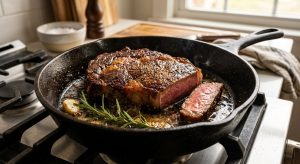
Once the dry, tempered protein hits the shimmering oil, you must exercise absolute restraint. Step away from the stove. Do not prod it with a fork. Do not poke it. Do not violently shake the pan, and absolutely do not attempt to forcefully flip it. The absolute key to mastering the Maillard reaction lies in patience.
As the amino acids and reducing sugars on the surface of the food are exposed to the sustained 320-380°F heat, they undergo the Maillard reaction—a complex chemical process that creates hundreds of new flavor compounds and turns the exterior of the food a beautiful, crispy golden-brown. As the proteins brown and dehydrate, their chemical structure changes, and they naturally sever their physical bonds with the metal. The food will literally tell you when it is ready to be flipped. If you gently nudge the edge of the chicken breast with your tongs and it resists, it is not ready. Leave it alone. When the sear is perfect, the pan will willingly release the food, allowing you to flip it with zero resistance.
Deglazing and the Aftermath: Cleanup Without the Elbow Grease
Once your protein is perfectly cooked and resting on a cutting board, you will likely look into your stainless steel pan and see a smattering of dark, caramelized, browned bits permanently affixed to the bottom. Do not panic, and do not throw the pan into the sink. Those browned bits are called the fond, and they are absolute culinary gold.
This is where stainless steel truly outshines any non-stick pan on the market. Because we want those bits to stick temporarily, we can use them to build an incredible pan sauce. While the pan is still hot, pour in a splash of dry white wine, unsalted chicken stock, or even just water. The liquid will instantly boil and violently deglaze the pan, lifting all of that concentrated, roasted flavor off the metal and into your liquid. Whisk in a cold knob of butter off the heat, and you have a restaurant-quality sauce in under three minutes.
When it is finally time to clean the pan, you must heed one final, critical warning regarding thermodynamics. Never, under any circumstances, take a 350°F stainless steel pan off the stove and plunge it directly into a sink full of cold, soapy water. The most critical step in mitigating thermal shock is allowing the metal to cool down gradually at room temperature. Plunging hot metal into cold water causes a violent, uneven contraction of the steel and the internal aluminum core, which will permanently warp the pan, turning the flat bottom into a wobbly, useless spinner.
Once the pan is cool, a simple pass with a non-abrasive sponge and some warm soapy water will usually do the trick. If you managed to polymerize some oil on the sidewalls, a quick sprinkle of Bar Keepers Friend (an oxalic acid-based cleanser) will melt the polymerized grease away in seconds, restoring the 18/10 stainless steel to its original, mirror-like factory shine.
The Final Word
If you want to survive the kitchen without setting off the smoke detector or resorting to toxic, disposable cookware, you simply have to play by the rules of physics. Mastering the Leidenfrost effect is not some pretentious, gate-kept chef secret; it is just a basic understanding of how metal, water, and fat interact at 350°F.
Yes, it requires an extra two minutes of preheating. Yes, it requires you to actually pay attention to the temperature of your stove rather than blindly turning dials. But this method is essential for breaking your takeout habit and taking control of your culinary environment. Leave the peeling Teflon in the trash where it belongs, heat your stainless steel properly, wait for the mercury ball, and watch as your food glides across the pan like magic. You’ve got this.