Listen up, my fellow kitchen warriors. If you are reading this, you probably fall into one of two camps: you are either a busy professional surviving on takeout and sheer willpower, or you are a weekend culinary hobbyist who occasionally sets off the smoke detector while trying to recreate a dish you saw on social media. Either way, welcome to the club. I am here to tell you a fundamental truth that the restaurant industry likes to keep quiet: you do not need a culinary degree to make mind-blowing food. You just need to understand a few basic scientific principles and stop making things harder than they need to be.
Let us skip the obligatory ten-page story about my grandmother’s rustic farmhouse and get straight to the facts. Weekday cooking is about ruthless efficiency, because time is money. Weekend cooking is where we can afford to be perfectionists. But regardless of what day it is, you need to know how to decode pretentious recipe jargon and just cook. What follows is an exhaustively researched, definitively snarky masterclass on the ten foolproof cooking secrets that will instantly transform your daily meals with zero extra effort. Grab your chef’s knife, pour yourself a glass of wine, and let us get to work.
Secret 1: The Maillard Reaction (Why Brown Means Flavor)
If you take nothing else away from this masterclass, let it be this: color equals flavor. Gray, boiled-looking meat is a culinary tragedy, and it is entirely preventable if you understand the chemistry of browning.
The Science of Searing
Back in 1912, a French chemist named Louis Camille Maillard discovered something magical while attempting to reproduce biological protein synthesis. He documented a chemical reaction between amino acids and reducing sugars that occurs when food is subjected to high heat. This is not caramelization, which is the browning of sugars alone; the Maillard reaction is a complex non-enzymatic browning process that creates hundreds of brand-new, distinct flavor compounds. These compounds then break down to form even more complex flavor molecules, which is why a properly seared steak tastes incredibly savory, nutty, and rich compared to a boiled one.
Moisture is the Ultimate Enemy of Crust
Here is where most home cooks fail: the Maillard reaction typically requires temperatures between 280°F and 330°F (140°C to 165°C) to proceed rapidly. Do you know what temperature water boils at? 212°F (100°C). If you toss a damp chicken breast into a hot pan, the surface water will clamp the temperature of the pan at exactly 212°F until every last drop of that moisture evaporates. You are effectively steaming your food, which is one of the most tragic rookie kitchen mistakes you can make. Always relentlessly pat your proteins dry with a paper towel before they ever touch the heat. Dry surface, high heat, incredible crust. It really is that simple.
Secret 2: The Magic of Carryover Cooking (Step Away From the Steak)
I cannot tell you how many times I have watched someone meticulously cook a beautiful, expensive cut of meat on the stove, only to slice into it immediately and watch all the juices bleed out onto the cutting board, leaving them with a dry, gray, overcooked disaster.
The Physics of Meat Resting
Carryover cooking is not a myth; it is basic thermodynamics. When you cook a piece of meat, the heat source transfers energy to the outer layers, which then pass that heat inward toward the center. Because the exterior of the meat is significantly hotter than the interior, that thermal energy does not just magically vanish the second you take the pan off the stove. The heat continues to migrate toward the cooler center, raising the internal temperature until the entire piece of meat reaches a state of equilibrium.
Factoring in the Temperature Spike
Depending on the size of the protein and the intensity of the heat, carryover cooking can increase the internal temperature of your food by anywhere from 5 to 15 degrees Fahrenheit (3 to 8 degrees Celsius). For dense, large roasts cooked quickly at high heat, that hidden temperature spike can reach up to 22 degrees Fahrenheit (12 degrees Celsius). If you wait until your steak reads 135°F on a thermometer to take it off the grill, it will easily hit 145°F while it rests, completely ruining your medium-rare ambitions. Pull your meat off the heat at least 5 to 10 degrees before your target temperature. Let it rest for 5 to 10 minutes so the muscle fibers can relax and reabsorb their liquids. As a bonus, this hands-off resting period gives you time to pour drinks and mingle, which is the real art of effortless hosting anyway.
Secret 3: Acid is the Missing Link in Your Kitchen
If you have ever tasted a soup, stew, or sauce that you spent hours simmering, only to feel like it tastes “flat” or “heavy” despite adding plenty of salt, you are experiencing an acid deficiency.
Brightening the Palate
Salt enhances existing flavors, but acid brightens and balances them. Think of a heavy, rich dish like a slow-cooked beef stew or a creamy macaroni and cheese. Without a counterbalancing element, the fat coats your tongue and deadens your palate. Acid cuts directly through that richness, stimulating your salivary glands and making the next bite taste just as vibrant as the first. Professional chefs know that acid is the secret weapon for making food taste alive.
Vinegar and Citrus as Flavor Enhancers
You do not need to make your food taste sour to reap the benefits of acid. A tiny splash of apple cider vinegar in a rich chili, a squeeze of fresh lemon juice over roasted broccoli, or a few drops of white wine vinegar in a pan sauce will elevate the dish from mundane to restaurant-quality. The trick is to add the acid at the very end of the cooking process. Heat destroys the volatile, bright compounds in citrus juice and mellows out vinegar, so always hit your food with acid right before serving.
Secret 4: Salting Early, Aggressively, and Correctly
Most people treat salt like an afterthought, sprinkling a tiny pinch of fine table salt over their food right before they eat it. This is a fundamental misunderstanding of what salt does. Salt is not just a topping; it is a chemical tool that fundamentally alters the structure of your food.
The Magic of Dry Brining and Osmosis
When you salt a piece of meat 24 hours in advance and leave it uncovered in the fridge—a process known as dry brining—science takes over. Through the process of osmosis, the salt draws moisture out of the meat and onto the surface. The salt then dissolves in this liquid, creating a concentrated brine. Over the next few hours, the meat reabsorbs this salty liquid deep into its muscle fibers. This seasons the meat all the way through, rather than just on the surface. Furthermore, the salt denatures the proteins, unwinding their tight coils so they retain more moisture during the cooking process.
Kosher Salt vs. Table Salt
Throw away your iodized table salt. It is laced with anti-caking agents and iodine, which impart a bitter, metallic chemical taste to your food. Furthermore, its tiny, dense cubic crystals make it incredibly easy to accidentally over-salt your dishes. Switch to a high-quality Kosher salt immediately. Kosher salt has large, coarse, flaky crystals that are easy to pinch between your fingers, giving you immense tactile control over your seasoning.
Secret 5: Ditching the Toxic Non-Stick Pans (My Ultimate Dealbreaker)
I am going to get very serious for a moment because I have absolutely zero patience for this. If you are cooking your family’s dinner on a cheap, scratched, peeling non-stick pan you bought at a discount store five years ago, you need to throw it in the garbage right now. This is my absolute non-negotiable rule. When curating your beginner kitchen tools, you must prioritize your health and safety over the convenience of easy cleanup.
The Ugly Truth About PFAS and Polymer Fume Fever
Traditional non-stick coatings, like Teflon, are manufactured using a class of synthetic “forever chemicals” known as PFAS (per- and polyfluoroalkyl substances). These chemicals are infamous for their inability to break down in the environment or in the human body. Studies have linked PFAS exposure to a terrifying array of health issues, including kidney and testicular cancer, liver damage, reproductive harm, immune suppression, and endocrine disruption. In fact, PFOA (a widely studied PFAS) is officially classified as “carcinogenic to humans” by the International Agency for Research on Cancer.
Under normal, low-heat conditions, these pans are theoretically stable. But the moment you heat a standard PTFE-coated pan above 500°F (260°C)—which is alarmingly easy to do if you leave an empty pan on a hot burner—the coating begins to break down and release invisible, toxic fumes. Breathing in these emissions leads to a condition medically known as “polymer fume fever,” commonly referred to as the “Teflon flu,” which causes severe flu-like symptoms. The danger is so well-documented that several states are finally taking legislative action. Minnesota has already banned the sale of PFAS-coated cookware, and states like California, Vermont, and Colorado are rolling out strict bans and regulations between 2024 and 2028.
Investing in Lifetime Cookware
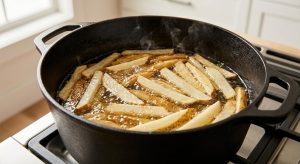
Stop wasting your money on toxic pans that end up in a landfill every two years. Invest in heavy-bottomed stainless steel, enameled cast iron, or carbon steel. Yes, there is a slight learning curve. You need to preheat a stainless steel pan properly so that the moisture in the food instantly vaporizes, creating a microscopic layer of steam that prevents sticking (a phenomenon known as the Leidenfrost effect). But once you learn this simple technique, you will have safe, high-performance cookware that will literally outlive you.
Secret 6: Unleashing Safe, Savory Umami Bombs
Umami is the fifth basic taste, alongside sweet, sour, bitter, and salty. It translates from Japanese as a “pleasant savory taste,” and it is the deep, meaty, mouth-filling richness that makes food deeply satisfying.
The Unfair Demonization of MSG
For decades, Monosodium Glutamate (MSG) has been unfairly vilified due to a fabricated 1960s phenomenon known as “Chinese Restaurant Syndrome” (CRS), which was fueled heavily by xenophobia rather than actual science. Let us set the record straight with exhaustive research: MSG is completely safe. The United States Food and Drug Administration (FDA) classifies MSG as “Generally Recognized as Safe” (GRAS). In the 1990s, the FDA commissioned an independent scientific group, the Federation of American Societies for Experimental Biology (FASEB), to thoroughly investigate MSG. The FASEB report conclusively determined that MSG is safe for consumption.
The glutamate in MSG is a naturally occurring amino acid that is chemically indistinguishable from the glutamate found abundantly in tomatoes, aged cheeses, mushrooms, and human breast milk. Your body metabolizes the glutamate from a sprinkle of MSG exactly the same way it metabolizes the glutamate from a slice of parmesan cheese. Keeping a small shaker of MSG in your pantry and adding a tiny pinch to your soups, stews, and marinades is a brilliant, scientifically backed way to drastically elevate the savory depth of your meals.
Anchovies, Tomato Paste, and Soy Sauce
If you are still hesitant about the powder, you can achieve massive umami boosts using natural ingredient hacks. Keep a tube of anchovy paste in your fridge; melting a teaspoon into your onions and garlic as they sauté will not make your food taste like fish, but it will make it taste incredibly rich. Tomato paste, when caramelized in the pan before adding liquids, provides a massive hit of concentrated glutamates. A dash of high-quality soy sauce in a beef stew or a Bolognese sauce will completely transform the dish.
Secret 7: Pan Crowding and the Tragedy of Steamed Meat
We have all been there. You are tired, you are hungry, and you just want dinner to be finished. So, you take two pounds of diced chicken and dump it all into a single 10-inch skillet. Congratulations, you just ruined dinner.
Heat Zoning and Spatial Awareness
When you add cold or room-temperature food to a hot pan, the temperature of the pan drops immediately. If you leave enough empty space between the pieces of food, the pan retains enough thermal mass to quickly recover its heat and initiate the browning process. But if you cram the food together shoulder-to-shoulder, the pan’s temperature plummets and stays low. The moisture released from the food has nowhere to escape, so it pools in the bottom of the skillet. Instead of a hard, flavorful sear, your food stews in its own lukewarm juices. Even when making something as simple as pan-seared salmon and asparagus, you need to give your ingredients room to breathe.
Cooking in Batches
I know that cooking in batches sounds like it takes more time, but it is actually the ultimate time-saving hack. When you crowd the pan, the food takes three times as long to cook because water conducts heat far less efficiently than hot metal or oil. By cooking in two smaller, well-spaced batches, your food sears rapidly, develops an incredible crust, and finishes faster overall. Do not let impatience sabotage your meal.
Secret 8: Using the Fond (The Free Pan Sauce)
After you properly sear a piece of meat in a high-quality stainless steel pan, you will notice a layer of browned, stuck-on bits at the bottom. Do not you dare put that pan in the sink to soak. That crust is called “fond,” and it is concentrated culinary gold.
Deglazing Like a Professional
Fond is the foundation of every great pan sauce. To harvest it, you use a technique called deglazing. While the pan is still hot, pour in a splash of liquid—white wine, chicken broth, or even just water. The liquid will immediately boil and steam. Take a wooden spoon and scrape the bottom of the pan; the browned bits will lift off effortlessly and dissolve into the liquid, creating a deeply flavored reduction.
Mounting with Butter for Emulsion
To turn that reduction into a luxurious, glossy restaurant-quality sauce, you need to perform a classic French technique called “monter au beurre” (mounting with butter). Take the pan off the heat entirely, and aggressively whisk in a few cubes of fridge-cold butter. The residual heat will melt the butter slowly, while the vigorous whisking forces the fat droplets to suspend evenly within the liquid. This creates a stable emulsion that is thick, velvety, and intensely flavorful. Pour this over your rested meat, and you will look like an absolute genius.
Secret 9: The Lazy Weekday “Mise en Place”
“Mise en place” is a French culinary phrase meaning “putting in place.” In professional kitchens, it means having every single ingredient perfectly diced, measured, and stored in neat little glass bowls before the stove is even turned on. In a home kitchen on a Tuesday night, doing that just creates a mountain of unnecessary dishes.
Pragmatic Prep for Busy Humans
We are going to do the lazy, highly efficient weekday version. The best way to eliminate kitchen chaos is to read the recipe all the way through before you start, and group your prep by cooking stages. If the onions, carrots, and celery all go into the pot at the same time, they do not need separate bowls; they can all sit in the same pile on the corner of your cutting board. Maintaining a permanently organized kitchen means setting up your cutting board right next to your stove, and creating zones for your raw ingredients, your prepped ingredients, and your waste.
There are countless uses for a bench scraper, but its primary job is to efficiently scoop up those piles of prepped vegetables and transfer them directly into the hot pan without dropping half of them on the floor.
Cleaning as You Go
The other half of a pragmatic mise en place is cleaning as you go. Time is money, and you do not want to spend an hour scrubbing pots after dinner. While the onions are sautéing for five minutes, wash the cutting board. While the sauce is simmering, load the dishwasher. When you finally sit down to eat, the kitchen should already be clean. It is a psychological game-changer that makes cooking feel like a joy rather than a stressful chore.
Secret 10: The Finishing Touch (Fat and Fresh Herbs Off the Heat)
The final secret to transforming your daily meals is understanding the difference between cooking ingredients and finishing ingredients. Heat destroys delicate flavors, so you must protect your most expensive and vibrant ingredients by adding them at the absolute last second.
The Raw Olive Oil Drizzle
If you are cooking your onions in a $40 bottle of extra-virgin olive oil, you are literally burning your money. High heat destroys the grassy, peppery, complex polyphenols that make good olive oil special. Cook with a neutral, high-smoke-point oil or a cheap, everyday olive oil. Save the expensive, high-quality extra-virgin olive oil to use purely as a finishing fat. A raw drizzle of great olive oil over a bowl of soup, a piece of grilled fish, or a plate of pasta right before it hits the table adds a luxurious, velvety mouthfeel and a punch of fresh flavor that cannot be replicated on the stove.
A Final Hit of Green
The same rule applies to soft, leafy herbs like parsley, basil, cilantro, and chives. If you simmer them in a sauce for twenty minutes, they will turn gray and taste like lawn clippings. Chop them fresh and scatter them over the dish just before serving. The residual heat of the food will warm the herbs, releasing their essential oils into the air and hitting your nose right as you take your first bite. It adds a pop of vibrant color and a clean, fresh contrast to heavy, savory dishes.
Cooking does not have to be an intimidating, chaotic mess. By understanding the simple science behind browning, resting, acidity, and temperature control—and by aggressively rejecting toxic, cheap kitchenware—you can elevate your everyday meals into something spectacular. You do not need a Michelin star; you just need a little bit of knowledge, a good stainless steel pan, and the confidence to trust your own palate. Now get out of here and go make something delicious.