Listen, if you are still sawing through a perfectly good heirloom tomato with a dull, heavy, mystery-metal knife that you bought in a blister pack ten years ago, we need to have a serious intervention. I have zero patience for kitchen equipment that actively sabotages your efforts, and nothing ruins a meal prep session faster than a blade that crushes your ingredients instead of slicing them. As someone who spends their weekdays frantically optimizing prep time and their weekends obsessing over culinary perfection, I can tell you unequivocally: your knife is the most important tool you own. Period.
Yet, so many home cooks are terrified of high-carbon Japanese steel. They hear words like “patina” or “chipping” and immediately run back to the safety of their soft, uninspired stainless steel blocks. But here is the brutal truth: if you want to elevate your cooking, you have to stop relying on cheap, mass-produced junk. When you are focused on upgrading your cooking skills, the very first step is understanding the profound difference between a knife that just “cuts” and a knife that glides through proteins and produce on a microscopic level. Today, we are taking an unapologetically deep, nerdy dive into the undisputed king of high-carbon Japanese cutlery: Aogami Super Steel. We are going to break down the exact metallurgy, the physics of edge retention, and why this specific alloy justifies its premium price tag. Grab a coffee—or a glass of wine—and let’s talk material science.
Ditching the Mystery Metal: Why Steel Choice Matters
Before we can properly worship at the altar of Aogami Super, we need to understand exactly what we are upgrading from. Most Western kitchens are equipped with knives forged from X50CrMoV15 or similar standard stainless steel alloys. These are often marketed as “heavy-duty workhorses,” but in the metallurgical world, “heavy-duty” is usually just polite marketing speak for “soft and thick.”
Western stainless steels typically contain around 0.50% to 0.55% carbon. In the realm of knife making, carbon is the primary engine of hardness. Because of this relatively low carbon content, these Western blades usually max out at a Rockwell Hardness (HRC) of 56 to 58. Now, a softer steel isn’t inherently evil—it means the blade is tough. If you accidentally slam it into a chicken bone or drop it in the sink, the edge will roll or fold rather than chip. But this softness comes with a massive penalty: terrible edge retention. A rolled edge feels dull, requiring constant honing on a steel rod just to realign the metal. You end up spending more time fighting your equipment than actually cooking. When you are focused on conquering the kitchen on a busy Tuesday night, a knife that requires constant babysitting is a massive bottleneck.
Furthermore, to compensate for the soft steel, Western knives are usually ground to a wider, more obtuse angle—typically 20 degrees per side. This wedge-like geometry requires more physical force to push through food. You aren’t slicing; you are cleaving. This is where the myth that a “heavy knife does the work for you” comes from. It has to be heavy, because the steel can’t hold an edge thin enough to cut efficiently on its own.
What Exactly is Aogami Super Steel?
The Blue Paper Origin Story
In Japan, the philosophy of knife making is entirely different. The focus is on extreme sharpness, incredibly thin edge geometry (often 10 to 15 degrees per side), and edge retention that lasts through hundreds of prep sessions. To achieve this, Japanese blacksmiths rely on high-carbon steels.
The most legendary producer of these traditional steels is Proterial, Ltd. (formerly known as Hitachi Metals), operating out of their Yasugi Specialty Steel plant in the Shimane Prefecture. This region is historically famous for its iron sand (satetsu), the same exceptionally pure raw material used to forge traditional katana swords. Proterial produces several grades of high-carbon steel, famously naming them after the color of the paper used to wrap the raw steel billets before shipping them to blacksmiths. There is White Paper Steel (Shirogami) and Blue Paper Steel (Aogami).
Let me be perfectly clear: the steel itself is not blue. The name “Aogami” literally translates to “blue paper”. But within this blue paper hierarchy, there is a distinct pecking order. You have Aogami #2, Aogami #1, and sitting atop the throne in all its over-engineered glory is Aogami Super (often abbreviated as AS). Aogami Super is essentially the mad scientist’s version of carbon steel, where metallurgists pushed the elemental composition to the absolute limit to create a blade that holds a razor-sharp edge longer than almost anything else on the market.
The Chemical Anatomy of Aogami Super
To truly understand why Aogami Super commands such respect among professional chefs and obsessive home cooks, we have to look at its exact chemical recipe. Steel is an alloy of iron and carbon, but it’s the trace elements—the “seasoning,” if you will—that dictate the final properties of the blade. Aogami Super is a masterclass in alloying.
Carbon (1.40% – 1.50%): The Engine of Hardness
Carbon is the single most critical element in any knife steel. It dictates the maximum potential hardness the steel can achieve during the heat treatment process. While standard Western knives hover around 0.50% carbon, and premium Japanese stainless steels like VG-10 sit around 1.00%, Aogami Super boasts a staggering 1.40% to 1.50% carbon content. This massive carbon load is what allows the steel to be hardened to an extreme degree, forming rigid iron carbides (cementite) within the steel matrix. This is the foundation of a blade that can effortlessly transform your daily meals by slicing cleanly through delicate herbs without bruising them.
Tungsten (2.00% – 2.50%): The Microscopic Armor
If carbon is the engine, tungsten is the armor. Aogami Super contains a very high concentration of tungsten, between 2.00% and 2.50%. When steel is heated and quenched, tungsten binds with the available carbon to form tungsten carbides. These microscopic particles are phenomenally hard and wear-resistant. Imagine the steel matrix as a concrete sidewalk, and the tungsten carbides as the hard gravel embedded within it. As the softer iron matrix slowly wears away from friction against your cutting board, these ultra-hard tungsten “pebbles” remain exposed at the microscopic edge, acting like tiny, indestructible saw teeth. This is the primary reason Aogami Super has such legendary edge retention.
Vanadium (0.30% – 0.50%): The Grain Refiner
Vanadium is the secret weapon that elevates Aogami Super above standard Blue #1 or Blue #2 steels. At 0.30% to 0.50%, vanadium serves two critical purposes. First, it forms vanadium carbides, which are actually even harder than tungsten carbides. Second, and perhaps more importantly, vanadium acts as a grain refiner. During the extreme heat of the forging process, steel crystals can grow large and blocky, which makes the final blade brittle and prone to catastrophic chipping. Vanadium restricts this grain growth, keeping the crystalline structure of the steel incredibly tight and fine. A fine grain structure is what allows a blacksmith to grind the knife edge down to a terrifyingly thin, laser-like geometry without it crumbling like dry crackers.
Chromium (0.30% – 0.50%) & Molybdenum (0.30% – 0.52%)
Now, you might see chromium and think “stainless,” but do not be fooled. A steel generally requires at least 13% chromium to be considered truly stainless. Aogami Super contains a mere 0.30% to 0.50% chromium. This tiny amount is not there to prevent rust; it is added alongside molybdenum (0.30% to 0.52%) to improve the steel’s hardenability. These elements help the steel cool uniformly during the quenching process, ensuring that the blade hardens evenly from the spine all the way down to the microscopic cutting edge. It provides a tiny buffer of toughness to balance out the extreme hardness of the carbon and tungsten.
The Pursuit of Purity: Low Phosphorus and Sulfur
Just as important as what is in the steel is what is removed from it. Phosphorus and sulfur are impurities found in raw iron ore. If left in the steel, they congregate at the grain boundaries, creating weak points that lead to cracking and brittleness. Proterial goes to great lengths to refine Aogami Super, reducing phosphorus to below 0.03% and sulfur to an astonishing 0.004%. This extreme purity is a hallmark of authentic Japanese high-carbon steel and is a major factor in why these knives, despite being incredibly hard, maintain enough structural integrity for daily culinary use.
The Crucible of Fire: Heat Treatment and Quenching
You can hand a blacksmith the finest Aogami Super billet in the world, but if their heat treatment is flawed, the resulting knife will be worthless. The chemical composition is merely potential; heat treatment is what actualizes that potential.
The Quench: Water vs. Oil
Aogami Super is typically subjected to an incredibly rigorous heat treatment cycle. The steel is heated in a forge to its critical temperature, a state where the carbon atoms dissolve completely into the iron matrix, forming a structure known as austenite. The blade is then rapidly cooled, or “quenched.”
Traditional Japanese blacksmiths often prefer water quenching for pure carbon steels like Shirogami, as water cools the steel violently and rapidly, achieving maximum hardness. However, because Aogami Super is packed with tungsten, vanadium, and molybdenum, water quenching can be too aggressive, causing the blade to crack or warp under the immense thermal shock. Therefore, many smiths opt for a specialized oil quench. The oil cools the blade slightly slower than water, but fast enough to trap the carbon atoms within the crystalline structure, transforming the austenite into martensite—the ultra-hard, needle-like microstructure that gives the knife its cutting power.
Tempering: Walking the Tightrope of Brittleness
Immediately after quenching, the steel is at its absolute maximum hardness, but it is also as brittle as glass. If you dropped it on the floor, it would shatter. To make the knife usable in a kitchen environment, it must be tempered. The blade is reheated to a much lower temperature for a specific duration. This relieves the internal stresses created during the violent quenching process, sacrificing a tiny fraction of hardness to gain a crucial amount of toughness. The exact tempering temperature and time are closely guarded secrets of master blacksmiths. It is this delicate dance of extreme heating, rapid cooling, and precise reheating that locks Aogami Super into its optimal state, ensuring the microscopic carbides are perfectly suspended in the martensitic matrix.
Rockwell Hardness (HRC) and Edge Retention Mechanics
When you are researching premium kitchen knives, you will inevitably run into the Rockwell Hardness scale (HRC). This is a standardized metallurgical test that measures a material’s resistance to indentation. It is the universal benchmark for knife hardness.
The 64-65 HRC Sweet Spot
As we established, your typical Western stainless chef’s knife sits around 56 to 58 HRC. Premium Japanese stainless steels like VG-10 or SG2 powder metallurgy steel typically hit 60 to 63 HRC. Aogami Super, when properly heat-treated by a master blacksmith, consistently hits a blistering 64 to 65 HRC.
This number is not just a flex; it translates directly to kitchen performance. Harder steel resists deformation. When you push a 65 HRC edge through a stubborn carrot or a dense butternut squash, the microscopic apex of the blade does not roll or bend. It stays perfectly aligned. This extreme rigidity is what gives Aogami Super its legendary “bite”—that feeling of the knife aggressively catching and slicing into a tomato skin with zero downward pressure. If you are serious about mastering the art of the home kitchen, experiencing this level of frictionless cutting is an absolute revelation.
The Physics of the Edge Matrix and Geometry
Hardness is only half of the cutting equation; the other half is geometry. You could harden a crowbar to 65 HRC, but it still won’t slice a tomato. Japanese knives forged from Aogami Super are renowned for being incredibly thin “behind the edge.” This refers to the thickness of the blade just a millimeter or two above the actual cutting apex. Because Aogami Super has such a tight, refined grain structure, blacksmiths can grind the primary bevel to an astonishingly thin profile without the steel crumbling.
When a blade is exceptionally thin behind the edge, it experiences virtually zero wedging resistance as it passes through dense ingredients like sweet potatoes or massive onions. You are not splitting the food apart via brute force; you are cleanly severing the cellular bonds. This is why a properly ground Aogami Super Gyuto feels like a lightsaber.
However, physics demands a trade-off. Hardness and toughness exist on opposite ends of a seesaw. Because Aogami Super is so hard and so thin, it is inherently less tough than a softer Western blade. It will not tolerate lateral twisting, bone-hacking, or being slammed against a frozen block of meat. If you treat an Aogami Super knife like a crowbar, it will not bend—it will chip. This is a precision instrument, not a blunt force tool. You must use a straight, fluid cutting motion and pair it with a forgiving cutting board surface, such as end-grain walnut, cherry, or a high-quality Japanese synthetic rubber board like Hasegawa. Never, under any circumstances, use glass, marble, or bamboo cutting boards. Bamboo is loaded with natural silica (essentially sand) that will instantly destroy a 65 HRC edge.
Aogami Super vs. Powder Metallurgy (PM) Steels
In recent years, the culinary world has been flooded with high-tech Powder Metallurgy (PM) steels, such as SG2 (R2), ZDP-189, and HAP40. These steels are created by atomizing molten metal into a fine powder and then fusing it together under immense heat and pressure. This process allows for massive amounts of alloying elements—ZDP-189, for instance, contains a ridiculous 3.00% carbon and 20.00% chromium. So, how does traditional ingot-forged Aogami Super stack up against these modern lab-created super-steels?
The Feel of the Cut
PM steels like SG2 are phenomenal; they offer incredible edge retention and are generally fully stainless. However, many veteran chefs and knife enthusiasts still prefer Aogami Super for a very specific, almost intangible reason: the “feel” of the edge. Because Aogami Super is a traditional ingot steel with a relatively simple composition compared to the complex alloy soup of PM steels, it takes a much keener, toothier edge on a whetstone. The edge of an Aogami Super blade feels aggressive, eagerly biting into the slick skins of bell peppers and tomatoes. PM steels, while holding their edge for a remarkably long time, often feel slightly “slicker” or more glassy on the cutting board.
Sharpenability: The Deciding Factor
Furthermore, Aogami Super is significantly easier to sharpen than ultra-hard PM steels like ZDP-189 (which can reach an absurd 67 HRC). Trying to reprofile a dull ZDP-189 blade on standard water stones is an exercise in pure, unadulterated frustration—you will spend hours grinding away with minimal results. Aogami Super, despite its high hardness and wear-resistant carbides, still responds beautifully to ceramic whetstones. It provides tactile feedback, letting you feel exactly where the apex is contacting the stone, allowing you to raise a burr and polish the edge with relative ease. For the home cook who actually wants to maintain their own tools, this sharpenability is a massive advantage.
Aogami Super vs. The Rest of the Blue Steel Family
To fully appreciate Aogami Super, you need to understand how it compares to its siblings in the Hitachi steel lineup. A common question among culinary hobbyists is whether they should invest in White Steel (Shirogami), Blue #2, Blue #1, or make the leap straight to Super.
White Steel (Shirogami) vs. Blue Steel (Aogami)
White Steel is the purist’s choice. It is virtually nothing but iron and carbon, with almost zero alloying elements. Because it lacks the hard tungsten and vanadium carbides found in Blue Steel, White Steel is incredibly easy to sharpen. A skilled sharpener can take a Shirogami blade to a mind-bending, screaming-sharp edge in minutes. The downside? It loses that edge relatively quickly because it lacks wear resistance.
Blue Steel (Aogami) was created specifically to solve this problem. By taking the pure White Steel base and adding tungsten and chromium, Hitachi created a steel that holds its edge significantly longer, making it the preferred choice for high-volume professional kitchens where chefs do not have time to touch up their blades mid-service.
Aogami #2 and Aogami #1
Within the Blue Steel family, Aogami #2 is the widely accepted standard. It has a carbon content of 1.05% to 1.15% and strikes a beautiful balance between edge retention, ease of sharpening, and durability. It is highly recommended when you are looking for beginner kitchen tools in the carbon steel world, as it is slightly more forgiving than its harder siblings.
Aogami #1 bumps the carbon up to 1.25% to 1.35%, increasing the hardness and edge retention, but making the blade slightly more brittle. It is favored by sushi chefs who need extreme sharpness for slicing raw fish but don’t want to sacrifice all their toughness.
Why “Super” Earns Its Name
Then we arrive at Aogami Super. It takes the carbon content even higher, maximizes the tungsten, and throws in vanadium and molybdenum for good measure. The result is a steel that outlasts both Blue #1 and Blue #2 in edge retention by a significant margin. Yes, it is slightly more difficult to sharpen than White Steel due to those stubborn vanadium carbides, but once you establish the edge, it stays sharp for an eternity. For a home cook preparing simple weeknight dinners, an Aogami Super blade might only need a proper session on the whetstones two or three times a year.
Oxidation, Patina, and the Reality of Carbon Steel Care
Let’s address the elephant in the room: Aogami Super is not stainless. It is a highly reactive carbon steel. If you leave it wet on the counter, or if you slice a lemon and walk away to check your email, the blade will oxidize. For cooks who are used to tossing their knives into the dishwasher (which you should never do, regardless of the steel), this requires a fundamental shift in habits. Establishing a peaceful daily habit of immediately wiping your blade clean and dry after use is absolutely mandatory.
The Beauty of a Controlled Patina
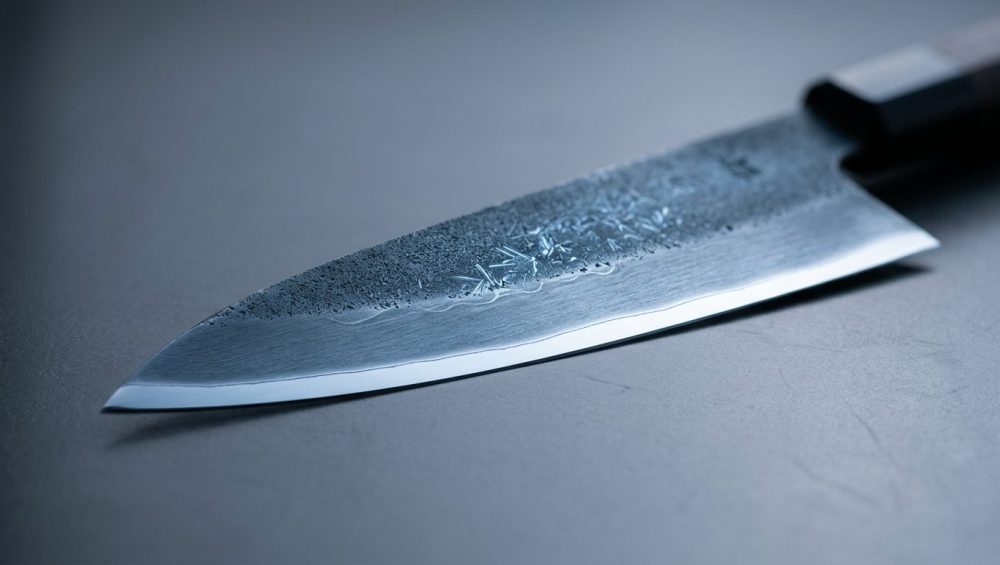
However, oxidation is not inherently bad. There are two types of oxidation: red rust and patina. When carbon steel reacts with the acids in food (like onions, tomatoes, or hot proteins), it forms a layer of black, grey, or even iridescent blue oxidation known as a patina (magnetite, or Fe3O4). This patina is actually a good thing! It acts as a protective, passivated barrier that shields the raw steel underneath from further, more destructive oxidation. Many chefs cherish the developing patina on their Aogami Super knives, viewing it as a living record of the meals they have prepared.
Red Rust: The Enemy of the Blade
What you must avoid at all costs is red rust (hematite, or Fe2O3). This occurs when the steel is exposed to moisture and oxygen for prolonged periods without the protective acidic reaction. Red rust is corrosive; it will literally eat away at the steel, causing pitting and destroying that microscopic 65 HRC edge we just spent so much time praising.
Daily Maintenance for the Home Cook
Caring for an Aogami Super knife is not difficult; it just requires mindfulness. Keep a damp towel and a dry towel on your cutting board station. Wipe the blade with the damp towel between tasks, and immediately dry it when you are finished. If you live in a humid climate or plan to store the knife for an extended period, apply a very light coat of food-safe camellia oil (tsubaki oil) or mineral oil to the blade to lock out ambient moisture. Many modern Aogami Super knives are also forged with a stainless steel “clad” (San-Mai construction), where the reactive carbon core is sandwiched between two layers of stainless steel. This means only the very edge of the blade will patina, giving you the extreme performance of carbon steel with 90% of the easy maintenance of a stainless knife.
Sharpening Aogami Super: A Whetstone Masterclass
You cannot buy a Ferrari and take it to a drive-through car wash. Similarly, you cannot buy an Aogami Super knife and drag it through a cheap, V-notch carbide pull-through sharpener. Those aggressive gadgets rip chunks of metal out of the blade, completely destroying the delicate, acute edge geometry that makes Japanese knives so special. If you want to maintain the structural integrity of this steel, you must learn to use Japanese water stones (whetstones).
The Whetstone Progression
Because of the hard vanadium and tungsten carbides in Aogami Super, you need high-quality abrasive stones, preferably ceramic-based stones like Shapton or Naniwa, which cut fast and resist dishing.
For a standard maintenance routine, a 1000-grit stone is your workhorse. It is abrasive enough to establish a fresh apex but fine enough to leave a clean edge. Because Aogami Super holds its edge so well, you will rarely need to drop down to a coarse 400-grit stone unless you are repairing a chip.
After the 1000-grit, refine the edge on a 3000 or 4000-grit finishing stone. This polishes the microscopic teeth of the edge, giving you that buttery, frictionless slicing capability that is essential when you are practicing the art of food plating with delicate sashimi or finely shaved garnishes. You can take it even further to a 6000 or 8000-grit stone, but be warned: highly polished edges can lose their “bite” on slippery vegetable skins like tomatoes or bell peppers. A 3000 to 4000-grit finish is generally the optimal balance of polish and toothiness for Aogami Super in a culinary environment. Finally, finish by stropping the blade on a leather block loaded with diamond compound to remove any lingering microscopic burr.
Is Aogami Super the Right Investment for Your Kitchen?
We have covered the intense metallurgical data, the strict maintenance requirements, and the physics of high-hardness edge retention. So, the ultimate question remains: is an Aogami Super knife right for you?
If you view cooking as an unfortunate chore to be rushed through, and your idea of knife maintenance is throwing it in a drawer with loose spatulas, then absolutely not. You will chip it, you will rust it, and you will be miserable. Stick to a soft, forgiving Western stainless blade.
Choosing Your Profile: Gyuto, Santoku, or Nakiri?
If you have decided to take the plunge into the world of Aogami Super, you must choose the right blade profile to match your cooking style.
The Gyuto is the Japanese equivalent of the Western chef’s knife. It ranges from 210mm to 240mm in length and features a slight curve (belly) that allows for a gentle rocking motion, though it excels at push-cutting. If you only buy one high-end knife, make it an Aogami Super Gyuto. It is the undisputed master of versatility.
The Santoku is shorter (usually 165mm to 180mm) with a flatter profile and a “sheep’s foot” tip. It is designed for slicing, dicing, and mincing. Its compact size makes it highly maneuverable, perfect for smaller kitchen spaces or cooks who find a 240mm Gyuto intimidating.
The Nakiri is a double-bevel vegetable cleaver. It has a completely flat edge designed for pure up-and-down chopping. When forged from Aogami Super, a Nakiri becomes an absolute vegetable-destroying machine. Because the edge is perfectly flat, it makes full contact with the cutting board, ensuring you never end up with accordion-style connected vegetables. The extreme edge retention of the AS steel means you can power through mountains of prep work without the blade losing its aggressive bite.
The Weekday Efficiency vs. Weekend Perfectionist Debate
But if you are the type of cook who respects their tools, who views culinary prep as a craft rather than a burden, Aogami Super is a revelation. Yes, it demands a disciplined wiping routine, but the return on that minor investment of time is astronomical. When you are assembling the components to build a beautifully organized dream kitchen, a knife that requires sharpening only a fraction as often as standard steel is the ultimate efficiency hack. It buys you the time and mental bandwidth to focus on flavor, technique, and presentation.
Final Verdict on the Ultimate Culinary Tool
Aogami Super is the pinnacle of traditional Japanese steel manufacturing colliding with modern metallurgical science. It takes the ancient, pure-carbon soul of the samurai sword and injects it with industrial-grade tungsten and vanadium to create a cutting tool of uncompromising performance. It forces you to be a better, more mindful cook. It teaches you proper cutting mechanics, because poor technique is punished with a chipped edge, while proper technique is rewarded with effortless, gravity-defying slices.
When you are ready to stop making the same beginner cooking mistakes born of dull, heavy, uninspired equipment, stepping up to an Aogami Super blade is the most transformative upgrade you can make. It is not just a knife; it is a meticulously engineered piece of material science that will serve you flawlessly for a lifetime—provided you show it the respect it demands. Now, dry your blade, put away the glass cutting board, and go prep something extraordinary.