Listen up, weekend warriors and weeknight survivalists. We need to have a serious talk about the state of your pasta dinners. I’ve seen the photos you post. I’ve witnessed the culinary crimes committed in the name of a “quick spaghetti night.” You boil a massive pot of water, dump in your noodles, drain them bone-dry in a colander, and then—brace yourselves—you dump a jar of watery, separated tomato sauce on top of a naked pile of pasta. The result? A sad, slip-and-slide mountain of noodles sitting in a puddle of red water and separated oil at the bottom of the bowl. It’s a tragedy. It’s a crime against carbohydrates. And frankly, you deserve better.
But here is the good news: you don’t need a culinary degree to fix this. You don’t need expensive ingredients, and you certainly don’t need to spend three hours standing over a hot stove. You just need to understand one fundamental, zero-cost restaurant technique that will elevate your basic pasta dinners from a watery mess to a glossy, restaurant-quality masterpiece. We are talking about the magic of starchy pasta water—affectionately known in professional kitchens as “liquid gold.”
I am going to walk you through the exact science of why your sauce won’t cling, how to harness the chemical power of starch, and how to execute this technique so flawlessly that your family will think you secretly hired a private chef. We are going to dive deep into the thermodynamics of boiling water, the molecular structure of wheat, and the absolute necessity of ditching your cheap, toxic cookware in the process. Grab a glass of wine, pull up a stool, and let’s get to work.
The Anatomy of a Kitchen Disaster: Why Your Sauce is Currently a Puddle
Before we can fix the problem, we have to understand the crime scene. Why does your sauce slide right off your penne? The answer lies in basic chemistry: the age-old dilemma of oil and water.
Most pasta sauces are essentially a combination of fats (olive oil, butter, rendered pork fat from guanciale or pancetta) and liquids (crushed tomatoes, wine, stock, or just the natural moisture from vegetables). As you probably learned in middle school science class, fat and water hate each other. They repel one another. When you heat them up in a pan, the fat separates and floats to the top, while the watery liquid sinks to the bottom. If you just dump this unstable, separated mixture over a pile of dry noodles, the water runs down to the bottom of your bowl, the oil coats the noodles in a slick, greasy sheen, and the actual flavor—the tomatoes, the garlic, the herbs—slides right off.
And it gets worse. Let’s talk about the cardinal sin of pasta preparation: rinsing your noodles. I don’t know who started this vicious rumor that you need to rinse cooked pasta under cold tap water to “stop the cooking process” or “wash off the excess starch,” but they need to be permanently banned from the kitchen. When you rinse your pasta, you are literally washing away the very glue that binds your entire meal together. You are taking a beautiful, textured, starch-coated noodle and turning it into a slippery, sterile tube of sadness. Rinsing pasta is one of those fixing rookie kitchen mistakes that you need to correct immediately if you ever want to cook like a pro.
The other crime? The olive oil in the boiling water myth. Somewhere along the line, home cooks were told that adding a glug of olive oil to the pasta boiling water would prevent the noodles from sticking together. All this actually does is coat your pasta in a slick layer of fat as you pull it out of the water, creating a waterproof barrier that guarantees your sauce will never, ever cling to it. If you want to prevent sticking, you just need to stir the pot during the first two minutes of cooking. Save your expensive extra virgin olive oil for finishing the dish, not for dumping down the drain.
The Science of Emulsion: How Starchy Water Plays Peacemaker
So, how do we force oil and water to hold hands and play nicely? We need a mediator. In the culinary world, this is called an emulsifier, and the process of binding these two enemies together is called an emulsion.
An emulsion is a mixture of two or more liquids that are normally immiscible (unmixable). Mayonnaise is an emulsion of oil and lemon juice, bound together by the lecithin in egg yolks. Vinaigrette is an emulsion of oil and vinegar, often bound by a dab of mustard. In the context of a hot pan sauce, our emulsifier is the starch released from the pasta itself.
Let’s get a little nerdy for a second, because understanding the chemistry is what separates the clueless cooks from the kitchen artists. Dried pasta is primarily made from durum wheat semolina, a hard wheat with a high protein and starch content. The starch in this wheat is composed of two main complex carbohydrates: amylose and amylopectin [1].
When you drop dried pasta into hot water, a magical thermodynamic process begins. At around 60°C (140°F), the starch granules on the surface of the pasta begin to absorb water and swell [1]. As the temperature climbs toward 95°C (203°F) and eventually reaches a rolling boil, these swollen starch granules literally burst open, releasing their amylose and amylopectin molecules into the surrounding water [1]. This process is known as starch gelatinization [1].
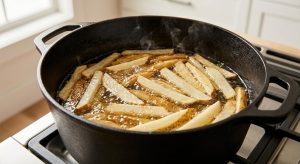
This is why your pasta water turns cloudy. It is no longer just tap water; it is a concentrated, starchy solution. When you ladle a splash of this cloudy “liquid gold” into your simmering pan of separated sauce, the starch molecules act as microscopic traffic cops. They physically get in the way of the fat droplets, coating them and preventing them from coalescing back together into a greasy layer [1]. The fat stays suspended in the liquid, bound by the starch matrix, resulting in a stable, creamy, glossy texture that miraculously hugs every single curve, ridge, and crevice of your pasta [1].
This is the secret behind every mind-blowing bowl of cacio e pepe, carbonara, and aglio e olio you have ever eaten in a high-end Roman trattoria. They aren’t using heavy cream to make those sauces thick and luscious. They are using the mechanical agitation of tossing the pasta with fat, cheese, and highly concentrated starchy water to forge a perfect emulsion.
The Mythbusting Lightning Round: Stop Believing These Pasta Lies
Before we get to the step-by-step execution, I need to completely deprogram you from the terrible advice you’ve been fed by outdated cookbooks and pretentious TV chefs. Let’s bust some myths so you can start cooking with actual science.
Myth 1: You Must Use a Massive Cauldron of Water
For decades, the golden rule of Italian cooking was that pasta needs to “swim” in a massive pot of rapidly boiling water—usually four to six quarts per pound of pasta. The theory was that a large volume of water would return to a boil faster after the pasta was added, preventing the noodles from getting gummy.
Science has proven this is utter nonsense. Culinary researchers, including the brilliant Kenji López-Alt, have exhaustively tested this and found that you can cook perfectly al dente pasta in a fraction of the water [2]. In fact, a 2018 study from the University of Tuscia in Italy found that cooking pasta in just 2 liters of water per kilogram (an 80% reduction from traditional methods) yielded identical texture, hardness, and resilience, while cutting energy consumption drastically [3].
But here is the absolute best part for us home cooks: using less water means a higher concentration of starch [2]. When you boil a pound of spaghetti in two quarts of water instead of six, the starch released by the noodles isn’t diluted [2]. It becomes a thick, murky, hyper-concentrated elixir that makes emulsifying your sauces infinitely easier [2]. Plus, a smaller pot boils faster, which is exactly what we need when prioritizing time and efficiency for a perfect 30-minute meal on a chaotic Tuesday night.
Myth 2: Salting the Water Makes It Boil Faster
I see this repeated constantly. People throw a pinch of salt into their cold water, thinking it will speed up the boiling time. Let’s look at the thermodynamics. Adding a dissolved solid (like salt) to a liquid actually raises the boiling point of that liquid through a phenomenon called boiling point elevation. However, the amount of salt we use in cooking is so minuscule that it raises the boiling point by maybe one-tenth of a degree. It has absolutely zero practical effect on the time it takes to boil.
We salt pasta water for one reason and one reason only: flavor. Pasta is dense and bland. As it hydrates and swells in the boiling water, it absorbs the liquid. If that liquid is aggressively salted (think: the salinity of a well-seasoned soup, not the dead sea), the pasta is seasoned from the inside out.
Myth 3: Pasta Must Be Cooked All the Way in the Water
If you are boiling your pasta until it is perfectly tender and ready to eat, you have already overcooked it. By the time you drain it, mix it with hot sauce, and get it to the table, it will be a mushy, flabby disaster. Pasta must be pulled from the boiling water before it is fully cooked, while it still has a stark, chalky, hard bite in the center. The final cooking happens in the sauce pan. This is non-negotiable.
The Gear Check: Ditch the Toxic Pans Ruining Your Emulsion
Alright, I am going to take a brief detour here because I cannot in good conscience teach you how to make a beautiful, restaurant-quality pan sauce if you are doing it in a scratched, peeling, toxic nightmare of a non-stick pan.
I have zero patience for cheap kitchen gear that poisons your food and falls apart in six months. The era of the traditional Teflon non-stick pan needs to end. Most conventional non-stick coatings are made from PTFE (polytetrafluoroethylene), which belongs to a class of synthetic “forever chemicals” known as PFAS (per- and polyfluoroalkyl substances) [4]. These chemicals do not break down in the environment, and they certainly don’t break down in your body [4]. According to recent 2026 data and EPA filings, PFAS accumulation has been linked to severe health issues, including kidney cancer, testicular cancer, and thyroid disease [5]. In fact, the International Agency for Research on Cancer classifies PFOA (a legacy chemical used in manufacturing these pans) as a Group 1 human carcinogen [5].
Even if a pan claims to be “PFOA-free,” it is often just using a substitute chemical within the exact same toxic PFAS family [5]. In 2026, we saw massive federal class-action settlements—like the $2.5 million payout involving a major hybrid pan brand—proving that companies have been falsely advertising their PTFE pans as “non-toxic” [5]. When you heat these cheap pans over high heat, or when you aggressively toss and scrape them with metal utensils, that coating degrades, flakes off, and leaches directly into the beautiful, glossy sauce you just worked so hard to emulsify [5].
If you want to master the art of the hard toss (which is required for this technique), you need serious, durable, safe cookware. You need a pan that can take a beating, handle high heat, and allow you to aggressively scrape up the fond (the caramelized brown bits) from the bottom.
You need raw, tri-ply stainless steel, carbon steel, or enameled cast iron [6]. Yes, I know stainless steel intimidates beginners because “everything sticks to it.” But learning how to properly preheat the metal and utilizing the Leidenfrost effect will make your stainless steel pan actually non-stick without any of the toxic chemical coatings. Throw away the scratched gray pans. Investing in safe, lifetime-quality tools is the first step toward banishing toxic kitchen gear and cooking like an adult.
The Master Technique: Step-by-Step Guide to Liquid Gold
Now that we understand the science, busted the myths, and thrown our toxic pans in the trash, it is time to execute. This technique is known in Italy as mantecatura—the process of vigorously tossing pasta with fat and starchy water off the heat to create a creamy emulsion. Here is your foolproof, step-by-step masterclass.
Step 1: The Low-Water Boil
Grab a wide pot or a deep sauté pan. Yes, you can boil pasta in a sauté pan. Add just enough water to comfortably submerge the pasta (about 2 to 3 quarts for a pound of pasta). Bring it to a boil. Once boiling, add a generous handful of kosher salt. The water should taste pleasantly salty, like a good broth. Drop in your dried pasta. Stir it continuously for the first two minutes. This is crucial because as the starch gelatinization begins, the surface of the noodles becomes intensely sticky [1]. Stirring physically prevents them from fusing together.
Step 2: The Sauce Foundation
While the pasta is boiling, build your sauce in a large, heavy-bottomed stainless steel skillet. Whether you are sautéing garlic and red pepper flakes in olive oil for an aglio e olio, rendering the fat from guanciale, or simmering down some crushed San Marzano tomatoes, get your flavor base ready. If your recipe calls for spices, remember to toast them in the fat early on; treating your aromatics correctly and blooming them in oil unlocks a depth of flavor that raw spices can never achieve.
Step 3: The Early Harvest
Keep a close eye on the pasta. You want to pull it out of the water about 2 to 3 minutes before the package directions say it is al dente. It should still be quite firm and chalky in the very center.
Before you drain the pasta, you must harvest the liquid gold. Take a heat-proof measuring cup or a ladle and scoop out at least one to two cups of that cloudy, starchy pasta water. Set it aside. Never, ever dump the pot into a colander without saving the water first. (Pro tip: If you are notoriously forgetful, place your colander in the sink with a glass measuring cup sitting directly inside it. You literally cannot drain the pasta without moving the cup, forcing you to remember to save the water).
Step 4: The Marriage (Mantecatura)
Transfer the undercooked pasta directly from the boiling water into your skillet with the sauce base. Do not rinse it. Turn the heat under the skillet to medium-high.
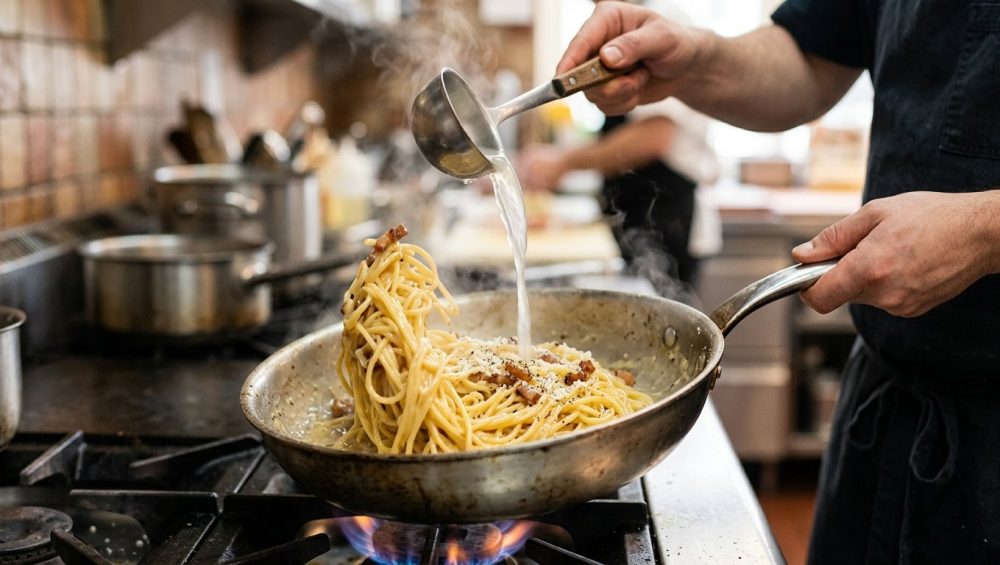
Now, pour in about half a cup of your reserved starchy pasta water. The pasta is going to finish its cooking process right here in the skillet, absorbing the seasoned sauce and the starchy water directly into its core. As the liquid simmers and reduces, the starch is working its magic, thickening the liquid and binding with the fats in the pan [1].
Step 5: The Agitation
This is where you earn your chef stripes. Emulsions require mechanical force to come together. You cannot just let the pan sit there and bubble. You need to agitate it.
Grab the handle of your skillet and start vigorously tossing the pasta, flipping it over itself. If you don’t have the wrist strength for the chef-toss, use a pair of tongs to rapidly and aggressively stir the noodles in a circular motion. This violent agitation forces the fat droplets to break apart and disperse into the starchy liquid [1].
Watch the pan closely. If the sauce looks too watery, keep tossing and let it reduce. If the pan looks dry or the pasta is sticking, add another splash of the starchy water. You are looking for a moment of transformation. Suddenly, the separated oil and water will merge into a single, cohesive, glossy, opaque sauce that coats the back of a spoon and clings desperately to every single noodle.
Once you achieve that glossy perfection, remove the pan from the heat immediately. If you are adding grated cheese (like Parmigiano-Reggiano or Pecorino Romano) or cold butter, do it now, off the heat, tossing rapidly. The residual heat will melt the fat, and the starch will catch it, thickening the emulsion even further.
Serve it immediately. Emulsions are time-sensitive. If you let it sit on the stove for ten minutes, the sauce will cool, the starches will set, and it will turn into a gummy brick.
Advanced Starch Tactics: Troubleshooting Your Broken Sauces
Even the best weekend warriors mess up an emulsion from time to time. If you find yourself staring at a pan of separated oil or a sticky, gluey mess, don’t panic. You can save it. Here is how to troubleshoot the most common pasta pitfalls.
The Sauce is Too Thin and Watery
If you added the pasta water, tossed it, and it still looks like soup, you likely added too much water at once, or your water wasn’t starchy enough.
The Fix: Keep the heat on medium-high and keep tossing. You need to evaporate the excess water (reduction) while the mechanical agitation forces the emulsion. Just be careful not to overcook the pasta in the process. Next time, use less water in your boiling pot to ensure a higher starch concentration [2].
The Sauce Separated into an Oily Slick
You had a nice sauce going, but suddenly it “broke.” The oil pooled at the edges, and the sauce looks greasy. This usually happens when the pan gets too hot, causing the emulsion to shatter, or when there isn’t enough starch to hold the volume of fat you introduced.
The Fix: Take the pan completely off the heat. Add a fresh splash of your reserved (and still hot) starchy pasta water. Vigorously stir or toss. The drop in temperature combined with the influx of fresh starch and mechanical agitation will almost always bring a broken emulsion back together.
The Cheese Turned into a Stringy, Clumpy Nightmare
You were trying to make Cacio e Pepe, but instead of a silky cheese sauce, you have a giant, stringy wad of melted cheese stuck to your tongs, surrounded by watery noodles. This happens when the pan is too hot, causing the proteins in the cheese to curdle and tighten, squeezing out their fat. It is the exact same chemical failure that happens when a cheese sauce gets grainy on the stovetop.
The Fix: Prevention is the only cure here. You must take the pan off the heat before adding finely grated cheese. The cheese should melt gently from the ambient heat of the pasta and the warm starchy water, not from the direct flame of the stove.
The Sauce Tastes Flat
You achieved the perfect glossy texture, but the flavor is just… boring. It feels heavy and lacks a punch.
The Fix: You forgot to balance your flavors. Fats and starches are heavy on the palate. They need to be cut with something bright. A squeeze of fresh lemon juice, a splash of white wine vinegar, or even a dash of hot sauce will wake the dish up instantly. Learning to realize when your dinner actually needs acid is a masterstroke that will elevate your cooking immediately. Also, check your gear; if you cooked a highly acidic tomato sauce in an unlined cast iron or cheap aluminum pan, a chemical reaction can occur, which is exactly why your tomato sauce tastes metallic. Stick to stainless steel or enameled cast iron for acidic sauces.
The Weeknight Warrior’s Guide to Efficiency
I know what some of you are thinking. “This sounds great for a leisurely Saturday night, but I have exactly 25 minutes to feed my family on a Tuesday before soccer practice. I don’t have time to harvest liquid gold and perform a vigorous chef-toss.”
Listen to me: time is money, and this technique actually saves you time.
By utilizing the low-water boiling method, your pot of water comes to a boil in half the time [2]. By finishing the pasta in the sauce pan, you are consolidating your cleanup and building flavor simultaneously. You aren’t dirtying a colander (just use tongs or a spider skimmer to pull the pasta straight from the water into the skillet).
If you really want to optimize your weeknights, you can even embrace the “one-pan pasta” method. This involves throwing your dry pasta, aromatics, fats, and a precisely measured amount of cold water into a single wide skillet and boiling it all together. As the water evaporates, the starch is concentrated directly in the pan, naturally creating a rich, emulsified sauce with zero draining required. It requires a bit of practice to get the liquid ratios right, but once you master it, it is the ultimate shortcut.
Integrating these smart, science-backed techniques is exactly how you stop viewing weeknight dinners as a stressful chore. It is the key to mastering a peaceful daily habit in the kitchen. You stop fighting the ingredients and start letting the chemistry work for you.
Conclusion: Your New Culinary Reality
You are now armed with the knowledge of starch gelatinization, the thermodynamics of low-volume boiling, the mechanics of a proper emulsion, and the terrifying truth about your cheap non-stick pans.
The days of watery, pooled sauces and slick, flavorless noodles are officially over. By simply saving a cup of that cloudy, starchy cooking water and vigorously tossing it into your sauce off the heat, you are bridging the gap between amateur home cooking and professional culinary artistry. It costs absolutely nothing. It requires no specialized equipment beyond a safe, heavy-bottomed pan. It is simply a matter of understanding the science of your food and respecting the ingredients.
Cooking isn’t magic, and it certainly isn’t reserved for people in white chef coats. It is just applied physics, chemistry, and a little bit of attitude. So, the next time you decide to boil up a box of rigatoni, put down the jarred sauce, step away from the colander, and treat that starchy water with the respect it deserves. Master these simple steps to culinary artistry, and you will never eat a mediocre bowl of pasta again. Now get back in the kitchen and start tossing.