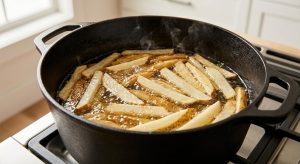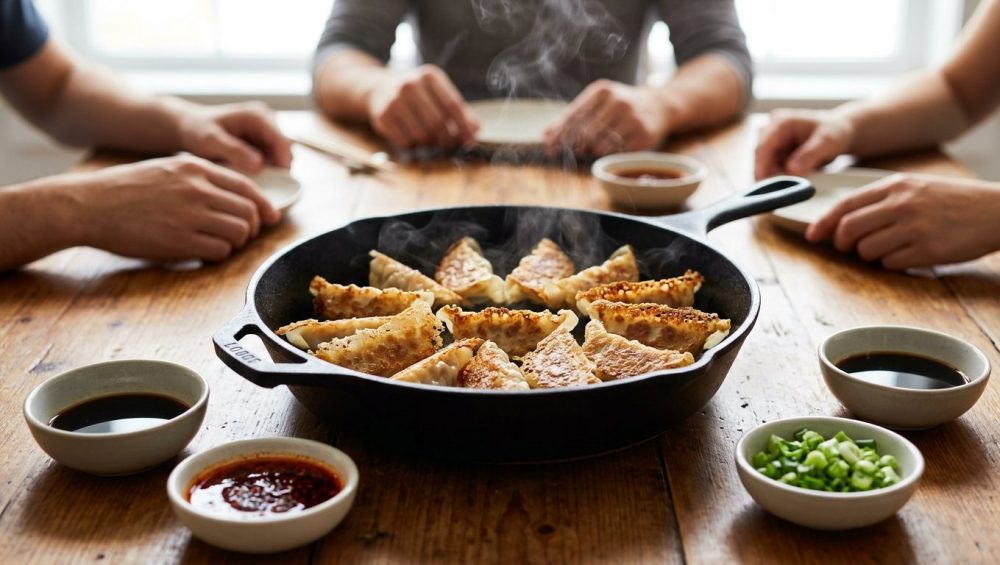
You have spent the last hour meticulously folding, pinching, and crimping. Your dumplings look like little works of art, sitting proudly on your cutting board. You heat your pan, add a generous glug of oil, and carefully arrange them in a perfect concentric circle. You add the water, cover the pan, and listen to the satisfying hiss of steam. So far, so good. When the water evaporates, you grab your trusty spatula, slide it under that glorious, golden-brown crust, and give it a confident lift.
And then, tragedy strikes.
The bottom of the dumpling stays cemented to the pan. The delicate wrapper rips wide open, spilling a sad, soggy puddle of pork and chive filling directly onto the hot metal. We have all been there, staring into the abyss of a ruined dinner, wondering why your dumpling wrappers tear the exact second you try to plate them. It is infuriating. It is enough to make you want to throw the pan out the window and order delivery.
But here is the brutal, honest truth: it is not the dumpling’s fault, and it is certainly not because you didn’t use enough oil. It is because you are fighting against the fundamental laws of kitchen physics.
As a home cook who survives the chaotic weekdays with ruthless efficiency but transforms into an absolute perfectionist for weekend culinary projects, I have zero patience for pretentious chef-speak. I do, however, have immense respect for food science. I firmly believe that anyone can cook like an expert without a culinary degree, provided they understand the “why” behind the “how.” Today, we are going to completely dismantle the mechanics of the perfect pan-fried dumpling. We are going to explore the thermodynamics of your skillet, the chemistry of your dough, and the exact techniques required to achieve a shatteringly crisp, unbroken bottom. More importantly, we are going to turn this notoriously frustrating chore into a relaxed, communal potsticker bar that you can proudly host for your friends without having a mid-dinner meltdown.
The Kitchen Science of Why Dumplings Stick
Let’s get nerdy for a second, because understanding the science is the only way to win this battle. When you drop a raw dumpling into a hot pan, you are not just cooking food; you are initiating a highly complex sequence of chemical and physical reactions. If you don’t manage these reactions, the pan will always win.
Starch Gelatinization Explained
At their core, dumpling wrappers are incredibly simple: just wheat flour and water. However, when you introduce heat and moisture to this combination, you trigger a fascinating process called starch gelatinization. The starch granules in the wheat flour absorb the surrounding water, swell up to several times their original size, and eventually burst open. When they burst, they release a highly viscous, sticky gel into the surrounding environment.
In layman’s terms? You are literally manufacturing homemade glue right there in your skillet.
This is exactly why boiling or steaming dumplings makes their exteriors incredibly tacky. If that sticky, gelatinized dough comes into direct contact with a hot metal surface before a proper, dehydrated crust has formed, it will fuse to the microscopic pores of the pan. It is one of the most common rookie kitchen mistakes to assume that blindly pouring more oil into the skillet will magically solve a fundamental temperature problem. If the heat isn’t calibrated correctly, that starch-glue will bond to the metal with the strength of industrial adhesive, and no amount of aggressive scraping will save your dinner.
Thermocapillary Convection and the Marangoni Effect
“But I used oil!” I hear you screaming at your screen. Yes, I know you did. But oil is a liquid, and liquids behave in incredibly bizarre ways under high heat.
In 2026, physicists published fascinating research on exactly why food sticks to pans, highlighting a fluid dynamics phenomenon called thermocapillary convection, also known as the Marangoni effect. When you heat a pan from below, a severe temperature gradient forms within the thin film of cooking oil. As the temperature rises, the surface tension of the oil actually decreases in the hottest part of the pan (usually the direct center). This drop in surface tension causes the oil molecules to aggressively pull away from the heat source and migrate toward the cooler outer edges of the skillet.
What does this microscopic migration leave behind? Dry, completely unlubricated patches of scorching hot metal right where you placed your beautiful dumplings. This is the exact reason why everything sticks to your stainless steel pans when you fail to manage your heat gradients properly. The raw proteins and sticky starches in the dumpling hit that dry, expanding metal, conform to its microscopic imperfections, and lock into place like Velcro.
Banish the Toxic Pans: Choosing the Right Weapon
Now that we know the enemy is starch-glue and fleeing oil, you might be tempted to reach for that scratched-up, peeling non-stick pan you bought for ten dollars at a big-box store five years ago. Don’t you dare.
The Danger of Cheap Non-Stick
I am a massive, uncompromising advocate for banishing toxic kitchen gear from your home, especially when it comes to the high-heat searing required for potstickers. For decades, pans coated with PTFE (polytetrafluoroethylene) and other PFAS “forever chemicals” have been the ultimate crutch of the lazy home cook. But the era of blindly trusting these mystery metals is officially over.
The cookware industry is currently facing a massive reckoning regarding these synthetic coatings. In 2026, a federal court approved a staggering $2.5 million settlement against a major, highly popular cookware brand for misleadingly marketing their PTFE-coated hybrid pans as “non-toxic” and “PFAS-free”. Furthermore, aggressive environmental bans in countries like France have exposed how heavily the industry relies on these toxic compounds, with corporate lobbyists fighting tooth and nail to keep cookware exempt from chemical regulations.
These forever chemicals bioaccumulate in the human body and the environment, linked to severe health issues including kidney and testicular cancers. When a cheap non-stick pan is heated past a certain threshold—which happens incredibly fast during a hard sear—or scratched with a metal spatula, it can release toxic fumes and microscopic plastic flakes directly into your food. I absolutely refuse to serve my friends a side of forever chemicals at a dinner party. If your pan is flaking, peeling, or hiding behind shady “PFOA-free” marketing while still using PTFE, throw it in the trash. You do not need toxic crutches to make perfect potstickers; you just need better technique and safer materials.
Carbon Steel and Cast Iron: The Heroes We Deserve
If you want professional-level, restaurant-quality results, you need to use what the professionals use. A well-seasoned carbon steel wok or a heavy-gauge cast iron skillet is the ultimate weapon for pan-fried dumplings.
If you understand the basic science of seasoning cast iron, you can build a slick, naturally non-stick surface that rivals any synthetic chemical coating on the market. When you bake ultra-thin layers of unsaturated fat onto cast iron or carbon steel at high temperatures, the oil undergoes a chemical process called polymerization. It transforms from a liquid fat into a hard, slick, plastic-like matrix that bonds directly to the metal, naturally repelling sticky starches.
The exact same principles apply to carbon steel wok seasoning, creating a perfectly smooth, dark patina that will effortlessly release the most stubborn dumpling wrappers. Beyond their non-stick capabilities, these heavy pans possess immense thermal mass. This means that when you drop a dozen cold, dense dumplings into the pan, the metal won’t rapidly drop in temperature, ensuring your sear remains aggressive and consistent.
The Stainless Steel Debate
Can you cook potstickers in a bare stainless steel pan without them tearing to shreds? Yes, absolutely. But you have to respect the physics of the metal.
You can make your pan actually non-stick by utilizing a phenomenon known as the Leidenfrost effect. If you preheat a heavy-bottomed stainless steel pan until it is hot enough that a drop of water beads up and dances across the surface like a ball of mercury without instantly evaporating, you have successfully created a vapor barrier. Add your oil at this exact moment, let it heat for just a second until it shimmers, and then immediately add your dumplings. The intense, immediate heat will instantly sear the starches on contact, preventing them from sinking into the microscopic pores of the metal and fusing in place.
The Master Technique for Crispy, Unbroken Bottoms
The Chinese term for these pan-fried beauties is guotie, which literally translates to “pot stick”. The name itself is a historical warning! To achieve the holy grail of dumplings—a shatteringly crisp, golden-brown bottom, a tender, chewy top, and a fully cooked, juicy filling—you must master the traditional “Fry-Steam-Fry” method.
The “Fry-Steam-Fry” Method Decoded
This is not some viral, fluffy internet hack; it is a time-tested, evidence-based thermal management strategy designed to manipulate moisture and heat. Here is the exact, foolproof blueprint for flawless execution:
Phase 1: Conductive Sealing (The First Fry)
Heat your seasoned skillet over medium-high heat. Add a generous tablespoon of neutral, high-smoke-point oil (like canola, grapeseed, or peanut oil). Do not skimp on the oil; it is the vital medium of heat transfer. Place your dumplings in the pan, flat side down. Do not touch them. Do not nudge them. Do not shake the pan. Let them fry undisturbed for 1 to 2 minutes. The scientific goal here is to initiate the Maillard reaction (the browning of proteins) and rapidly retrograde the starches on the bottom of the wrapper, creating a hardened, impermeable crust that acts as a barrier.
Phase 2: The Steam Phase
Once the bottoms have achieved a pale golden color (they should not be fully browned yet), it is time to cook the raw filling and gelatinize the upper portion of the wrapper. Pour about 1/3 to 1/2 cup of water directly into the hot pan and immediately clamp a tight-fitting lid on top. The water will violently boil, instantly converting into trapped steam. This high-pressure steam circulates around the dumplings, penetrating the dough to cook the raw pork or vegetable filling through to a safe temperature (pathogen lethality is crucial here) while simultaneously hydrating the top of the wrapper, giving it that signature chewy, translucent texture. Let this steam for about 5 to 6 minutes, or slightly longer if you are cooking straight from frozen.
Phase 3: The Crisp-Out (The Second Fry)
This is where you must use your senses. Listen closely to your pan. The sound will distinctly change from a deep, rolling, bubbling rumble to a sharp, aggressive, high-pitched crackle. This auditory cue means the water has completely evaporated, and only the original cooking oil remains. Remove the lid immediately. The dumplings are now frying again. This is where the magic happens. The hot oil is actively re-crisping the bottom crust that inevitably became slightly soggy during the steam phase, driving off any residual surface condensation.
Temperature Management and Patience
Here is the most critical, non-negotiable rule of the Fry-Steam-Fry method: the dumpling will release itself when it is ready.
If you try to pry the dumpling off the pan with your spatula and feel any resistance whatsoever, stop pulling immediately. The proteins and starches are still desperately clinging to the metal. Give it another 30 to 60 seconds of frying in the residual oil. As the crust fully dehydrates, browns, and hardens, it will naturally detach from the pan’s surface. A gentle nudge with a thin, flexible metal fish spatula is all it should take to slide them out, revealing a breathtakingly perfect, golden-brown crust.
Anatomy of the Perfect Dumpling Wrapper
You can have the best, most expensive carbon steel pan and the most precise heat control in the world, but if your wrapper is fundamentally flawed, you are setting yourself up for failure. If you’ve ever wondered why your dumplings fall apart in the pan before they even finish cooking, it almost always comes down to the structural integrity and hydration ratio of your dough.
Store-Bought vs. Homemade
Let me be perfectly clear, because my philosophy on weekday cooking is strict: time is money. On a chaotic Wednesday night when you just got off a ten-hour shift and you are trying to get dinner on the table before you collapse, there is absolutely no shame in using store-bought wrappers. Look for wrappers specifically labeled for “potstickers” or “gyoza,” as they are rolled slightly thicker and are much more resilient than the delicate, paper-thin wrappers meant for boiling wontons.
However, if you are hosting a weekend dinner party and want to truly blow your guests’ minds, you must make the wrappers from scratch. The texture of a homemade wrapper—simultaneously elastic, tender, and capable of stretching to hold a massive amount of filling—simply cannot be replicated by a commercial machine.
Hydration Ratios and Gluten Development
The secret to the ultimate pan-fried dumpling dough is boiling water. This technique is universally known as a “hot water dough.”
When you pour rapidly boiling water directly into all-purpose wheat flour, the extreme heat immediately denatures the gluten proteins, physically preventing them from forming a highly elastic, springy, tough network. It also instantly triggers starch gelatinization right there in the mixing bowl, allowing the dough to absorb significantly more water than a standard cold-water dough.
The result of this localized chemistry? A dough that is incredibly supple, easy to roll out into thin circles without aggressively shrinking back on your cutting board, and unbelievably tender to the bite. It strikes the perfect structural balance: soft enough to melt in your mouth, but structurally sound enough to survive the violent, high-heat fry-steam-fry process without rupturing and spilling precious meat juices all over your pristine skillet.
Hosting a Mindful Potsticker Bar Without Losing Your Mind
Dinner parties should be fun, engaging, and memorable. They should not be a grueling test of your sanity. The true art of effortless hosting means you aren’t trapped at the stove, sweating over a ruined, stuck batch of food while your guests are in the other room having all the fun without you. A DIY potsticker bar is the ultimate interactive, low-stress gathering, provided you stage the evening correctly.
Prep and Staging (Time is Money)
Do not attempt to make complex fillings or knead hot water dough while your guests are standing in your kitchen watching you. Make your hot water dough the morning of the party, wrap it tightly in plastic wrap to prevent a skin from forming, and let it rest at room temperature.
Mix your fillings—whether it is a classic fatty pork and Napa cabbage blend, or a modern, umami-rich shiitake mushroom and tofu mixture—the day before. Letting the filling sit in the fridge overnight is actually a massive culinary advantage; it allows the complex flavors to meld and the proteins to bind together, making the mixture significantly firmer and much easier to scoop into the wrappers without making a mess.
Set up a massive dipping sauce station in advance. Provide small bowls of black Chinkiang vinegar, high-quality soy sauce, toasted sesame oil, fiery chili crisp, thinly sliced scallions, toasted sesame seeds, and julienned ginger. Let your guests play mad scientist and mix their own custom dipping sauces.
The Communal Folding Station
When your guests arrive, put them to work! Cooking is an inherently communal act, and folding dumplings together around a table is one of the most mindful, relaxing, and engaging ways to break the ice at a party.
Clear off your kitchen island or dining table. Provide everyone with a small bowl of water (for moistening and sealing the edges of the wrappers), a stack of fresh wrappers, and a spoon for the filling. Teach them the basic half-moon pleat—pinching the center first, then folding pleats toward the middle—but do not obsess over perfection. Some dumplings will look like beautiful, intricate, restaurant-quality masterpieces; others will look like sad, lumpy little footballs. It absolutely does not matter. They will all taste incredible once they hit the pan. The goal here is connection, laughter, and getting your hands dirty together.
The Cooking Station Setup
As the host, your primary job during the party is managing the thermodynamics of the stove. Keep two large skillets going simultaneously. Because you understand the science of the pan and the fry-steam-fry method, you can easily establish a staggered batch-cooking rhythm. While one skillet is covered and in the steaming phase, you can be actively searing the bottoms of the next batch in the second skillet.
You won’t be frantically scraping burnt dough off the metal or apologizing for torn food. You will be calmly sliding perfectly crisped, golden-brown potstickers onto a massive serving platter, looking like an absolute culinary deity.
Troubleshooting the Dumpling Disasters
Even with the best preparation and the finest carbon steel skillet, the kitchen is a wild, unpredictable place. Here is exactly how to handle the most common potsticker pitfalls without breaking a sweat.
The Gummy Wrapper
If your dumplings come out of the pan looking pale and tasting like a mouthful of raw, chewy paste, you have committed a critical timing error. A gummy wrapper is the direct result of insufficient steaming time or using a pan that wasn’t hot enough to properly gelatinize the starches when the water was added. To fix this in the future, ensure your pan is screaming hot when you pour in the steaming water, and whatever you do, don’t peek under the lid too early. The steam needs a full 5 to 6 minutes of continuous, high-pressure, trapped heat to fully cook the thick dough.
The Exploding Filling
Did your beautiful dumpling burst open in the pan, leaking a tragic puddle of pork juice that instantly burned onto the skillet? This usually happens for one of two reasons. First, you or your guests overstuffed the wrapper. Greed is the absolute enemy of a good dumpling; stick to one modest teaspoon of filling per wrapper so you have enough dough to create a secure, wide seal.
Second, you may have boiled the water too violently during the steam phase. If the heat is cranked to an absolute maximum, the rolling, aggressive boil can physically agitate the dumplings, knocking them against each other and tearing the delicate, softened skins. Keep the heat at a steady, controlled medium during the steam phase—vigorous enough to generate continuous steam, but gentle enough to keep the dumplings stationary.
The Soggy Bottom
If you execute the fry-steam-fry method perfectly but your dumplings turn soggy the minute they hit the plate, you are dealing with a condensation issue. When you transfer screaming hot dumplings to a cold, flat plate, the residual steam escaping from the hot filling hits the cool ceramic, turns back into water, and pools under your perfectly crisped crust, ruining it instantly. To prevent this, serve your dumplings on a wire cooling rack set over a baking sheet, or on a pre-warmed plate lined with a paper towel to absorb ambient moisture.
The Cemented Batch
If you are folding dumplings with friends and placing them on a plate to wait for the pan, you might find that they have fused together or stuck to the plate before you even start cooking. Raw dough is sticky. Always dust your holding trays or plates with a generous layer of cornstarch or potato starch (not regular flour, which will just hydrate and get sticky). Space the raw dumplings out so they are not touching, or they will merge into one giant, uncookable mega-dumpling.
Conclusion
Cooking beautiful, complex, highly technical food at home does not require a culinary degree, a thousand-dollar set of toxic, chemical-laden pans, or a stressful, chaotic kitchen environment. It simply requires a basic, working understanding of how heat, moisture, and raw ingredients interact on a molecular level.
By mastering the fry-steam-fry method, respecting the physics of your cookware, and turning the preparation into a shared, joyful experience, you can completely transform your weekend entertaining. You are entirely capable of ditching takeout and producing restaurant-quality food in your own home, on your own terms. So pour yourself a large glass of wine, preheat that carbon steel skillet, and show those dumplings exactly who is boss. You’ve got this.