Let’s get one thing straight right out of the gate: I love garlic. You love garlic. We all love garlic. But there is a massive, undeniable difference between the sweet, complex, savory depth of properly handled garlic and the aggressive, palate-destroying burn of raw garlic that has been carelessly hacked to pieces and thrown into a salad dressing.
If you have ever made a beautiful, fresh vinaigrette, a vibrant pico de gallo, or a creamy batch of homemade hummus, only to find that it tastes like absolute fire and leaves you with dragon breath for the next forty-eight hours, you are not alone. You didn’t necessarily use too much garlic. You just didn’t understand the food science of how to handle it.
I have zero patience for pretentious chef-speak, but I firmly believe that everyday home cooks deserve to understand the basic kitchen chemistry that separates a mediocre weeknight dinner from a restaurant-quality masterpiece. You don’t need a culinary degree to cook like an expert; you just need to know how your ingredients behave. Today, we are going to master the acid soak. This is the definitive, science-backed technique to tame raw garlic’s bite so it stops overpowering your homemade meals. By the end of this masterclass, you will know exactly how to disarm the garlic bomb.
The Anatomy of a Stink: What Makes Raw Garlic So Aggressive?
To understand how to fix pungent garlic, you first have to understand why it’s trying to attack your tastebuds in the first place. Garlic doesn’t actually want to be eaten. The harshness we associate with raw garlic is an evolutionary defense mechanism designed to punish any foraging animal foolish enough to take a bite out of the bulb.
The Botanical Defense Mechanism of the Allium Family
Garlic is a member of the allium family, alongside onions, leeks, shallots, and chives. In the wild, these bulbs sit dormant in the soil, storing vital nutrients. To protect themselves from pests, insects, and hungry herbivores, they developed a brilliant, booby-trapped chemical defense system.
When a clove of garlic is completely intact, it has virtually no smell. You can hold a peeled, unbroken clove right up to your nose, and you will barely detect a hint of that signature garlic aroma. The intense smell and sharp flavor only materialize when the cellular structure of the clove is damaged. Whether it is crushed by a chef’s knife, pulverized in a blender, or chewed by a wild rabbit, the destruction of the cell walls is what arms the bomb.
Meet Alliin and Alliinase: The Chemical Culprits
Inside the cells of a pristine garlic clove, two distinct components exist in total isolation from one another. The first is an amino acid derivative called alliin (pronounced al-ee-in). The second is an enzyme called alliinase.
As long as the clove remains whole, these two compounds sit in their separate cellular compartments, living in peaceful, odorless harmony. But the second you slice, smash, or mince that clove, you tear down the walls separating them. The alliin and the alliinase flood together, mixing in the presence of oxygen.
When the alliinase enzyme gets its hands on the alliin, it acts as a chemical catalyst, rapidly converting the alliin into a brand-new, highly volatile sulfur compound.
The Allicin Explosion: The Magic and the Madness
That newly formed compound is called allicin. Allicin is the magic and the madness of garlic. It is the sole chemical responsible for that sharp, pungent, spicy bite that burns your tongue and lingers in your sinuses.
Interestingly, allicin is also the primary reason garlic is considered a superfood. Recent market statistics from 2024 and 2025 show a massive surge in global garlic consumption—projected to push the garlic market to nearly $30 billion by 2031—driven largely by consumers chasing its cardiovascular, antimicrobial, and immune-boosting benefits. Allicin is a powerhouse antioxidant.
However, allicin is incredibly unstable. The finer you chop your garlic, the more cell walls you rupture, and the more allicin you create. If you throw a whole clove into a soup, it stays mild. If you pulverize that same clove into a microscopic paste and toss it into a raw salsa, it will produce a nuclear explosion of allicin that will completely overwhelm the dish.
The Science of the Acid Soak: How to Disarm the Garlic Bomb
So, how do we stop the allicin train from running off the tracks when we want the flavor of raw garlic without the aggressive burn? We use basic chemistry. We change the environment so the enzyme can no longer function.
pH Levels and Enzyme Deactivation
Enzymes are the divas of the microscopic world. They are incredibly picky about their working conditions. The alliinase enzyme requires a relatively neutral pH environment to successfully convert alliin into allicin.
If you drastically alter the pH of the environment by introducing a strong acid—like lemon juice, lime juice, or vinegar—the alliinase enzyme undergoes a process called denaturation. The acidic environment literally forces the enzyme to change its physical shape. Once its shape is warped, it can no longer bind to the alliin. The chemical reaction stops dead in its tracks.
By soaking your minced garlic in an acid with a pH below 3.5, you effectively deactivate the enzyme, preventing any further allicin from forming. The result is a brilliantly mellow, sweet, and savory raw garlic flavor that enhances your food rather than dominating it.
The Timeline: Why Speed is Your Greatest Ally
Here is the most critical part of the masterclass, and it is where 90% of home cooks mess up: the timeline.
Allicin formation is exceptionally fast. Scientific studies on garlic biochemistry reveal that the conversion of alliin to allicin is nearly complete within 10 to 60 seconds of crushing the clove.
If you mince your garlic, leave it sitting on your cutting board for ten minutes while you chop your tomatoes, and then scrape it into a bowl of lemon juice, the acid soak will do absolutely nothing. The bomb has already gone off. The allicin has already been created, and the acid cannot reverse the reaction.
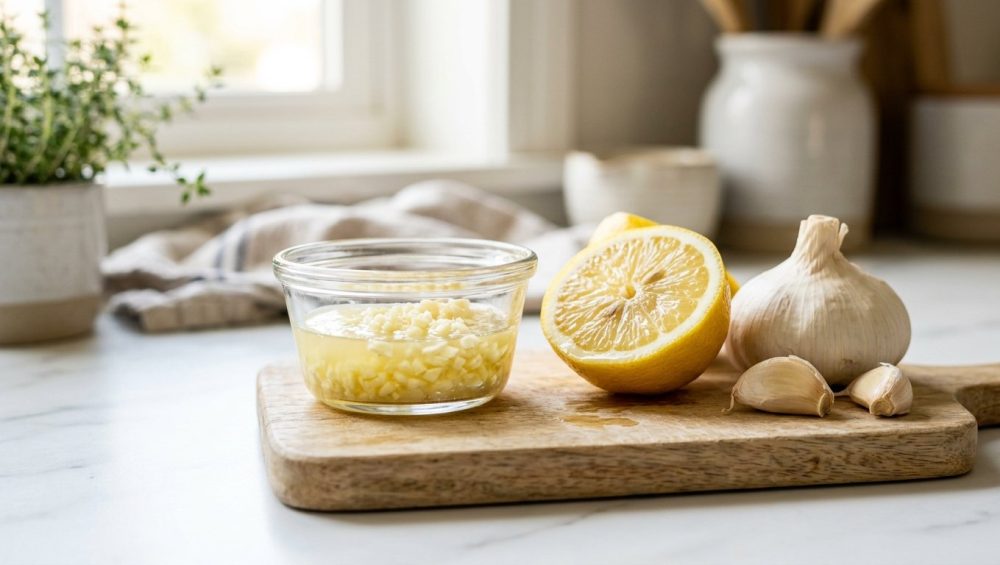
To successfully execute the acid soak, you must submerge the garlic in the acid immediately after its cell walls are ruptured. I’m talking within seconds. Mince the garlic, instantly scrape it into a small bowl, pour your vinegar or citrus juice over it, and let it sit for 10 to 15 minutes. This immediate submersion stops the enzyme before it has the chance to flood your dish with pungent sulfur compounds.
Lemon Juice vs. Vinegar vs. Citrus Alternatives
You have plenty of options for your acid soak, and you should choose based on the final flavor profile of your dish.
Lemon juice (pH of roughly 2.0 to 2.5) is the gold standard for Mediterranean dishes, hummus, and bright vinaigrettes. Lime juice is the undisputed king for salsas, guacamole, and Latin American marinades.
Vinegars are equally effective. Apple cider vinegar brings a fruity sweetness that works beautifully in autumn salads. Red wine vinegar provides a robust, sharp backbone for Italian dressings. White wine vinegar and champagne vinegar are delicate enough for shallot and garlic mignonettes. As long as the liquid is highly acidic, the science will work.
The Great Garlic Prep Debate: Mincing, Smashing, and the Tools We Trust
Now that we understand the chemistry, we need to talk about the mechanics of how you are breaking down your garlic. The tools you use dictate how much cellular damage you inflict, which directly correlates to how much allicin you produce before the acid even touches it.
Why Your Cheap Garlic Press is Ruining Your Food
It is time for a brutally honest intervention. I have a strict, zero-tolerance policy for cheap, toxic kitchenware. If you are using a lightweight, mystery-metal garlic press that you bought for three dollars in a bargain bin, you are actively sabotaging your meals.
First, let’s talk about the mechanics. A poorly manufactured garlic press makes food bitter because it doesn’t cleanly slice the cell walls; it violently crushes, tears, and pulverizes them. This maximizes the allicin production instantaneously.
More importantly, cheap cast-aluminum or zinc-alloy presses are notorious for leaching reactive metals into your food, especially when they come into contact with acidic ingredients like the lemon juice we use for the soak. Over time, the cheap chrome plating flakes off, leaving you with pitted, oxidized metal that taints the flavor of your food. It is time to banish toxic kitchen gear from your drawers forever. If you insist on using a press for weeknight efficiency, invest in a solid, heavy-duty, 100% stainless steel model that won’t react with acids or shed toxic flakes into your dinner.
The Microplane vs. The Chef’s Knife
For the absolute best results, rely on a sharp chef’s knife. A clean, sharp blade slices through the garlic cells rather than crushing them, giving you much more control over the allicin release. If you constantly wonder why your knives go dull so fast, take a hard look at your cutting board. Hard glass, marble, or cheap bamboo boards will destroy your blade’s edge in days.
Using dull knives is the fastest way to ruin your prep, because a dull blade forces you to bear down and crush the garlic, resulting in a bitter, uneven paste. Keep your knife honed, mince the garlic finely, and immediately transfer it to your acid.
If a recipe calls for a completely smooth garlic paste, a stainless steel microplane grater is a fantastic tool. Just remember that grating inflicts maximum cellular damage. You must grate the garlic directly into the bowl of acid to instantly halt the enzymatic reaction.
Practical Weeknight Applications: Where You Absolutely Must Use the Acid Soak
Understanding the science is great, but applying it efficiently on a chaotic Tuesday night is what actually matters. Time is money, and we need to prioritize shortcuts that deliver maximum flavor with minimal stress. Here are the everyday scenarios where the acid soak is non-negotiable.
Vinaigrettes and Salad Dressings That Don’t Bite Back
There is nothing quite as elegant as a simple, homemade vinaigrette tossed with fresh greens. But there is nothing quite as offensive as a vinaigrette that tastes like a sulfur factory.
When prepping your salad, always make the dressing first. Mince your garlic and drop it straight into the vinegar at the bottom of your salad bowl. Let it sit for 10 minutes while you wash your lettuce, chop your cucumbers, and shred your carrots. By the time you are ready to whisk in the olive oil, the garlic will be perfectly mellowed.
As a quick troubleshooting tip, if your homemade vinaigrette always separates, you are likely missing a binding agent. Once the garlic has finished its acid soak, whisk in a teaspoon of Dijon mustard or honey before slowly drizzling in your oil. The emulsifiers in the mustard will lock the oil and acid together into a creamy, stable dressing.
Salsas, Pico de Gallo, and Guacamole
Mexican-inspired dips are heavily reliant on the sharp, fresh flavors of raw aromatics like onions and garlic. However, the delicate, buttery flavor of a ripe Hass avocado or the sweet acidity of a summer tomato can easily be overpowered by a harsh garlic bite.
The secret to restaurant-quality guacamole is macerating your minced garlic and finely diced onions in fresh lime juice before you do anything else. The lime juice denatures the alliinase in the garlic and softens the bite of the raw onions. After 10 minutes, fold in your mashed avocados, cilantro, and salt.
Not only does the acid soak fix the flavor, but the heavy dose of lime juice mixed throughout the dip acts as an antioxidant barrier. Nobody wants to serve a dip where the guacamole turns brown before the guests even arrive. The acid helps keep everything vibrant and green.
Tzatziki, Hummus, and Yogurt-Based Dips
Mediterranean and Middle Eastern cuisines are unapologetically garlic-forward. A good hummus or tzatziki should have a distinct garlic presence, but it should taste savory and earthy, not spicy and metallic.
The beauty of these recipes is that they almost always call for lemon juice anyway. All you have to do is change your order of operations. Instead of throwing the garlic, chickpeas, tahini, and lemon juice into the food processor all at once, start by processing just the garlic and the lemon juice. Let that mixture sit in the bowl of the food processor for 10 minutes.
This brief waiting period allows the acid to neutralize the harshness. Once the time is up, add your tahini, ice water, and chickpeas, and blend until impossibly smooth. You will be left with a hummus that has a deep, rich garlic flavor without the aggressive afterburn.
Pesto and Raw Herb Sauces
Traditional Genovese pesto relies on raw garlic, fresh basil, pine nuts, parmesan, and olive oil. Because it is a raw, unheated sauce, the garlic can quickly become the loudest voice in the room, completely masking the delicate, sweet anise notes of the fresh basil.
While classic pesto doesn’t typically call for a heavy dose of acid, adding just a tiny squeeze of lemon juice to the garlic in your mortar and pestle (or food processor) before adding the herbs can work wonders. It tames the allicin just enough to let the basil shine, and the subtle hit of citrus brightness elevates the entire sauce.
Beyond Acid: Other Clever Ways to Tame the Garlic Beast
While the acid soak is the most effective method for raw applications, there are a few other scientific tricks you can keep up your sleeve to control garlic’s pungency, depending on the dish you are making.
The Microwave Trick for Emergency Weeknights
Sometimes, you are rushing to get dinner on the table, and you don’t have 10 minutes to spare for an acid soak. If you need mild garlic in a hurry, turn to your microwave.
Heat, just like acid, denatures the alliinase enzyme. Place a few unpeeled cloves of garlic in a small microwave-safe bowl and heat them on high for 10 to 15 seconds. The gentle, rapid heat slightly cooks the cloves from the inside out, deactivating the enzyme without fully roasting the garlic. Let them cool for a few seconds, peel them, and mince them as usual. The flavor will be significantly milder, and you can toss them straight into your dish.
The Salt Mash Method
If you don’t want to introduce any acid or heat to your recipe, you can use the osmotic power of salt. Mince your garlic on the cutting board, sprinkle a generous pinch of coarse kosher salt over it, and use the flat side of your chef’s knife to scrape and mash the garlic into a fine paste.
The coarse salt acts as an abrasive to break down the cells, while simultaneously drawing out the moisture and some of the harsh sulfur compounds via osmosis. While it won’t completely stop the allicin production like an acid soak does, it significantly mellows the bite and creates a smooth paste that dissolves effortlessly into dressings and marinades.
Blanching and Roasting for Weekend Perfectionists
When you have the luxury of time on a lazy Sunday afternoon, heat is your best tool for completely transforming garlic.
Blanching peeled garlic cloves in boiling water for two minutes before using them in a recipe will completely kill the alliinase enzyme, leaving you with a very mild, almost potato-like garlic flavor.
Taking it a step further, roasting whole, intact heads of garlic wrapped in foil (or placed in a covered baking dish) at 400°F (200°C) for 45 minutes causes the complex carbohydrates in the garlic to break down into simple sugars. Because the cloves are roasted whole, the alliin and alliinase never mix, meaning zero allicin is formed. The result is a deeply caramelized, sweet, spreadable garlic jam that you can slather on crusty bread or whisk into gravies.
The Sassy Sous-Chef’s Blueprint for Restaurant-Quality Flavor Balancing
Cooking is not just about following a list of ingredients; it is about understanding how those ingredients interact with time, temperature, and each other.
Efficiency in the Kitchen: Prep Smart, Not Hard
Weeknight cooking is a battle of efficiency. You do not need a kitchen overflowing with single-use gadgets to win this battle. Investing in a curated collection of high-quality beginner kitchen tools is the best way to speed up your prep and reduce your frustration. A sturdy cutting board, a razor-sharp 8-inch chef’s knife, and a set of glass prep bowls are all you need to execute techniques like the acid soak flawlessly.
When you walk into the kitchen to make dinner, read your recipe and identify your “passive time” tasks. Mincing the garlic and getting it into the acid soak takes 60 seconds of active work. Do that first. While the chemistry is happening in the bowl, you can move on to chopping vegetables, preheating pans, and boiling water. By the time you need the garlic, it will be perfectly mellowed and ready to go.
Flavor Pacing Like a Pro
Understanding the timeline of flavor development is what separates amateur cooks from the pros. Just as you must time your acid soak perfectly, you must time your heat applications.
If you are cooking a hot dish, you already know to stop adding garlic first to a hot skillet. Minced garlic contains very little water and high amounts of sugar; if you throw it into hot oil before your onions or proteins, it will scorch and turn acrid in a matter of seconds. Add it during the last 60 seconds of sautéing to release its aromatic oils without burning it.
Similarly, if you are making a cold sauce, sequence matters. If your salad dressing separates before it hits the table, it is because you rushed the emulsification process. Let the garlic soak in the vinegar, whisk in your mustard to create a stable base, and then slowly drizzle in your oil while whisking vigorously. The order of operations is the secret to a perfect emulsion.
A Crucial Warning on Garlic Storage and Food Safety
Before I send you off to conquer your weeknight meals, we need to have a very serious conversation about food safety.
Because the acid soak is so effective, you might be tempted to mince up a massive batch of garlic, soak it in liquid, and leave it sitting in a jar on your counter for the week. Do not do this.
Garlic is grown in the dirt, which means it can carry spores of Clostridium botulinum, the bacteria responsible for botulism. These spores thrive in anaerobic (oxygen-free), low-acid environments at room temperature. While the acid in lemon juice or vinegar lowers the pH and helps inhibit bacterial growth, storing raw garlic in oil or any liquid at room temperature is a massive food safety risk.
If you want to meal-prep your acid-soaked garlic, you must store it in the refrigerator, and you should consume it within three to four days. Furthermore, always store your highly aromatic, acidic prep ingredients in non-reactive glass jars. If you use cheap plasticware, the acid will degrade the plastic, and you will quickly notice that your containers stain orange and hold onto that pungent garlic smell until the end of time.
Elevate Your Everyday Cooking
You don’t need to be a Michelin-starred chef to make mind-blowing food in a standard home kitchen. You just need to respect your ingredients and understand the basic science of how they behave.
Raw garlic is a magnificent, healthy, and deeply flavorful ingredient, provided you don’t let it bully the rest of your dish. By utilizing the 10-minute acid soak, you take away its weapon. You denature the alliinase, halt the allicin production, and unlock a sweet, savory depth that will completely transform your homemade dressings, dips, and salsas.
So the next time a recipe calls for raw garlic, don’t panic, and definitely don’t reach for that jar of pre-minced, preservative-laden garbage from the supermarket. Grab your chef’s knife, grab a lemon, and let science do the heavy lifting. Your tastebuds—and anyone you happen to speak to after dinner—will thank you.